
Operations and Workflow Management
- Add to list Added to list Added
-
Get link
Get link icon closeLink to this page directly with a permalink:https://sk.sagepub.com/skills/business/om/operations-and-workflow-management
-
Cite
Cite icon close
Nemer, C., & Mehta, S., (2024). Operations Management: Operations and Workflow Management. In SAGE Skills: Business. SAGE Publications, Inc., [https://
copy to clipboarddoi. org/10.4135/9781071957745] or -
Share
Share icon close
- Embed
- Download PDFopens in new window
Overview
In this Skill, you will follow the company EaziBikes, a fictional bicycle manufacturer based in China that exports its products to the United States. The company manufacturers a range of products for both adults and children, and if you want to learn more about EaziBikes’ story and how it applies to different concepts in operations management, check out the rest of the Skills in the module. However, in this Skill we illustrate operations and management workflow through the example of EaziBikes.
Operations means coordinating resources to get a job done. Operations involves planning priorities and capacities as well as executing them. Priorities specify what employees work on first, second, third, and so on. Capacities refers to having the necessary resources when they are needed to ensure that plans are achievable.
Figure 1 shows how work flows throughout the planning and execution process. Quadrant 1 is where an organization plans its priorities and thinks about what it wants to do. In quadrant 2, the planning of the capacities needed to execute the priorities in quadrant 1 takes place. Quadrant 3 houses the activities involved in executing the priorities decided on in quadrant 1. Quadrant 4 is where the company executes the capacity activities needed to support the performance of activities planned in quadrant 1.
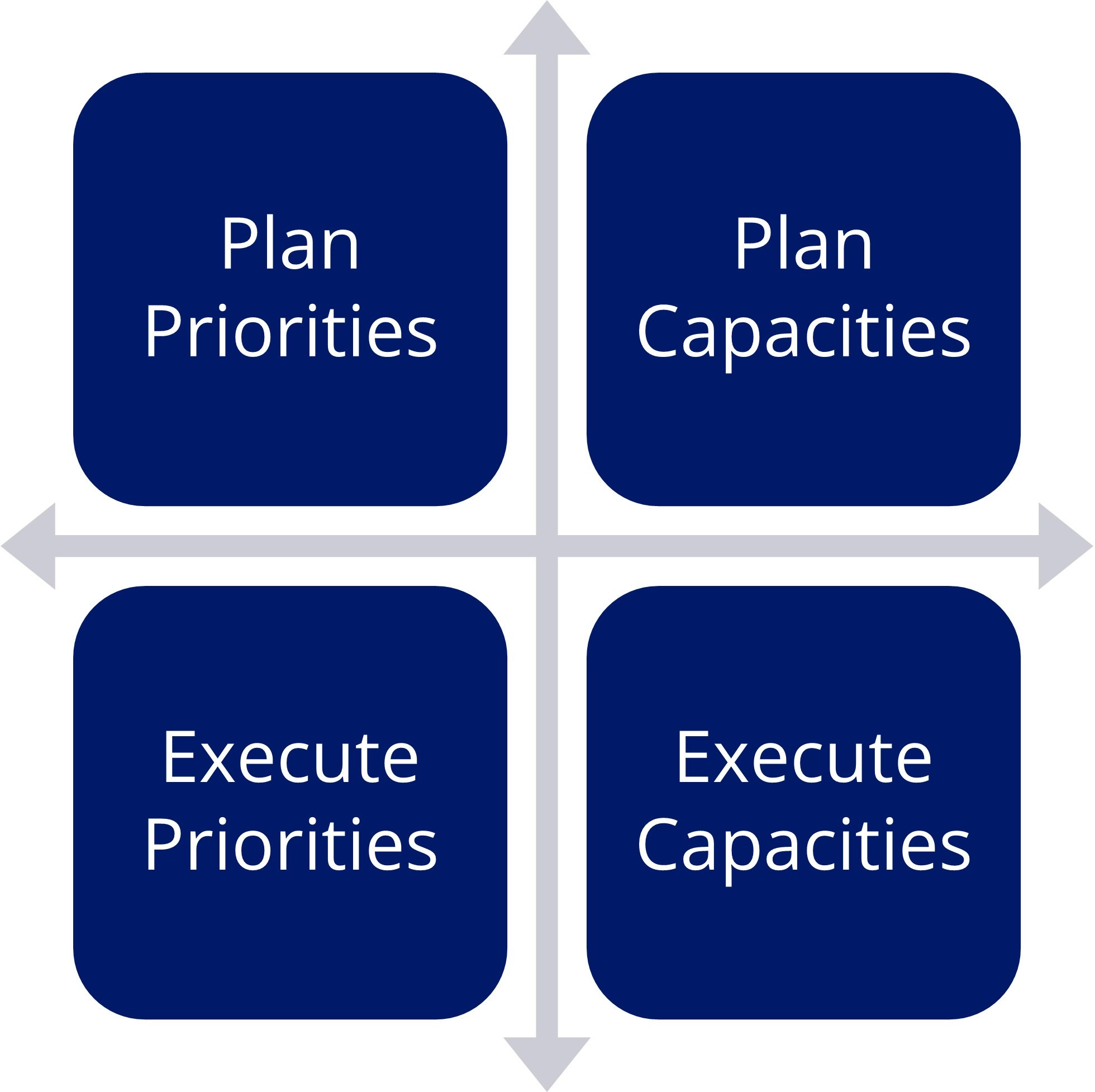
In the first section we discuss how companies set their priorities through sales and operations planning. This is where EaziBikes will assess company demand and how many units it needs to manufacture and compare this with its sales plan. If you want to learn more about how companies set sales goal and how to calculate how many units a company needs to sell to make a profit, check out the Skill Profit Planning. Once a company has set its priorities, it must decide how to meet those priorities through resource planning, master scheduling, rough-cut capacity planning, and materials requirements planning.
Once planning is complete, organizations must turn to execution. In the strategy section, you will learn how to manage supply chains and use demand management to ensure that sufficient quantities of raw materials are delivered to meet production demands and ensure that customers are satisfied with prompt delivery of their goods. In the case of EaziBikes, the company has expanded all around the globe in a short space of time and now must use a variety of strategies to ensure that it deliver finished bikes to customers and sources high-quality materials for its manufacturing.
Finally, in Workflow Management, you will learn more about how companies execute on their priorities. EaziBikes has a production activity control that implements the master production schedule and the material requirements plan. The managers at EaziBikes also must prevent bottlenecks on the factory floor by managing inputs and outputs and calculating what will happen when inputs or outputs go up or down in value.
Not sure where to start?Assess your skills level for operations and workflow management
|  |

Have you created a personal profile? Login or create a profile so that you can save clips, playlists and searches
Read next

More like this
Sage Recommends
We found other relevant content for you on other Sage platforms.