
Summary
Contents
Subject index
 Conjecturing
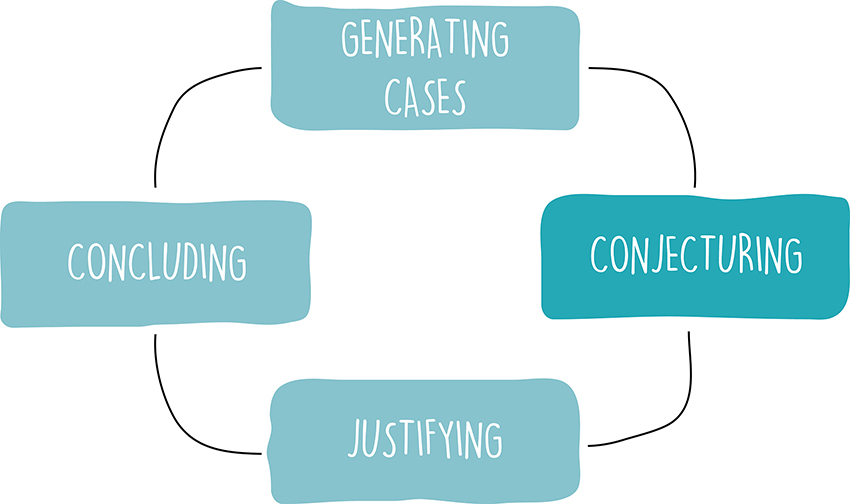 Conjecturing
In this chapter, you will learn
- What conjecturing means in the mathematics classroom
- Through a vignette, how students create conjectures
- Moves for explaining, clarifying, and helping students extend each other’s conjectures
- Moves for supporting conjecturing in the “if … then …” form
- Norms for conjecturing along with games to help establish them
- How to plan for conjecturing in your lessons
- Tasks for encouraging conjecturing that can be adapted for different grade levels
- In working with your grade-level team or department, how different types of conjectures can engage your students in argumentation
What Does It Mean to Conjecture?
A conjecture is a mathematical statement that you think might be true.
As Ms. Cooper tells her students in the following vignette, a conjecture is a mathematical statement that you think might be true, based on what you know so far. Conjecturing is the process of making these statements without yet deciding if they are true. In this chapter, you’ll learn how to guide students through that process.
Conjectures can be general or specific. General conjectures often follow from generating cases and noticing patterns—when students state what those patterns are, they are on their way to making conjectures that generalize from a few cases to what is true for all cases. For some activities, conjectures will be more specific. For example, students might conjecture a solution to one example equation before they develop general methods for solving similar equations. We discuss both kinds of conjectures in this chapter.
A good conjecture should contain precise language with the purpose of making the conjecture clear to everyone—but it’s unlikely that students’ first attempts will come out this way. That’s why clarifying conjectures is important. We explain more about clarifying conjectures in this chapter.
As important as the process of conjecturing is, there are times when you will want to start out with a premade conjecture. We discuss that approach and when to take it.
Vignette: Conjecturing Together
The following vignette is based on the conjecturing task from the Rectangle Coordinates activity.
Make conjectures about the relationships between the coordinates of the vertices of any rectangle whose sides are parallel to the x- and y-axes.
Before reading the vignette, take some time to make conjectures about what you think is always true about coordinates of vertices of all rectangles with sides parallel to the axes or what might be true just for the category of special cases you made. Consider also false conjectures that students might make.
Ms. Cooper structured a whole-class discussion leading to a broad variety of conjectures based on the patterns students had found. Through this process, she addressed important content: Students were exploring the properties of lines that are parallel to the axes through making conjectures about the vertices of sides of rectangles. She was preparing students to use algebra to describe coordinates in subsequent lessons by making general conjectures in words.
...
 Generating Cases
 Justifying
- Loading...
Get a 30 day FREE TRIAL
-
 Watch videos from a variety of sources bringing classroom topics to life
 -
Read modern, diverse business cases
-
Explore hundreds of books and reference titles

Read next

More like this
Sage Recommends
We found other relevant content for you on other Sage platforms.
Have you created a personal profile? Login or create a profile so that you can save clips, playlists and searches