
Summary
Contents
Subject index
The Handbook of 21st Century Management provides authoritative insight into the key issues for students in college or corporate courses with a particular emphasis on the current structure of the topic in the literature, key threads of discussion and research on the topic, and emerging trends. This resource is useful in structuring exciting and meaningful papers and presentations and assists readers in deciding on management areas to take elective coursework in or to orient themselves towards for a career. Indeed, familiarity with many of the topics in this Handbook would be very useful in job interviews for positions in business.
Facilitating Mobile and Virtual Work
Facilitating Mobile and Virtual Work
The distribution and mobilization of activities in the corporate value chain has increased dramatically over the last decade and will continue to do so as these organizations seek to reduce costs, get closer to their customers, ally themselves with other companies, and engage the best talent, wherever it may be.
Working in Multiple Places
Two Examples: Global Sales Force and Local Maintenance Workers
A Global Sales Force
A sales force is marketing tailored product and system packages in developing countries. The manager has seven local workers and five others in China, Russia, Singapore, India, and the United States. The U.S. representative is responsible for activities in Africa. In addition, every 2 to 3 months an extended steering group, also including product managers, has its meeting. The meetings are supposed to be face-to-face, but often, customer appointments make this impossible, and virtual meetings and call conferences are used instead for communication and decision making.
Employees consider the distribution of their working locations, asynchronous ways of working, and the diversity of the people they meet to be the main complexity factors in their work (see Figure 84.1). They fly to their working destinations, passing through several time zones. Locally, they also use cars and trains. For example, one of the employees described his trips as follows:
I have around 80 travel days yearly. I often go to Latin America. Usually I go there twice a month, each trip lasting around one week. In addition I go to China, Indonesia, Russia, Thailand, and Vietnam.
We typically have trade shows where I meet local clients. Usually during a week I try to focus my work so that for example I visit four countries and cities during the same trip: Mexico, Brazil, Argentina, and Chile. A one-day visit to each to meet the local account team in the morning and to visit customers in the afternoon.
When traveling, they work in the company's local office, at customers' premises, in conference venues, and in hotels. The purpose of moving is twofold: first, to meet and cowork with their own local teams, and second, working with customers to promote product sales. Diverse actors such as media people, local politicians, researchers, and company people are met. This brings with it various cultural, religious, and individual influences on the ways and contents of communication. Working times are a challenge. For example, an employee may start to work at 3:00 a.m. local time in order to be able to have a joint call conference with colleagues in Europe. And while working at home, he may participate in a virtual meeting at 9:00 p.m. in order to have a joint meeting with American colleagues. The sales force is mainly occupied with temporary projects; when a task is fulfilled, a project ends and a new one starts. Employees consider face-to-face meetings important, especially for convincing customers. When traveling, sales force employees use electronic connections sparingly.
Figure 84.1 Global Sales Force's Complexity Factors
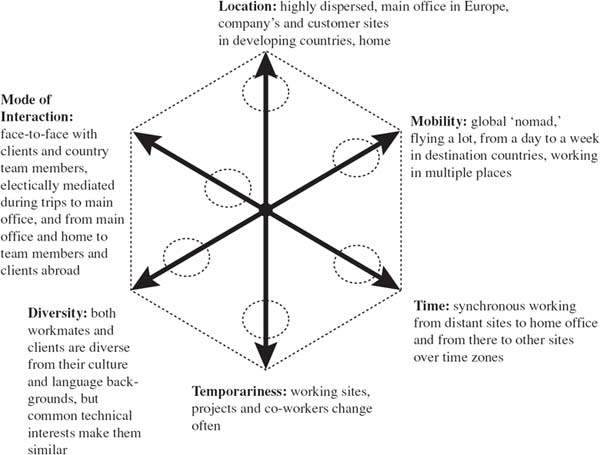
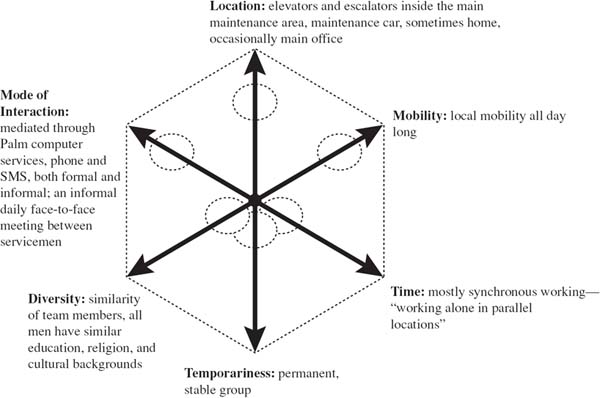
Figure 84.2 Mobile Maintenance Workers' Complexity Factors
Mobile Maintenance Employees in a City
A large-scale engineering and facility management enterprise employs people globally, but its teams work locally. Workers are organized into groups of maintenance workers under one supervisor. In each city, there are several service districts, each with its own responsible supervisor. The service districts are further divided into maintenance areas, each with one maintenance employee. Maintenance work consists of the service tasks defined in the maintenance contract, alarm situations demanding immediate response, and possible on-call and specified tasks (Figure 84.2).
...
- Loading...
Get a 30 day FREE TRIAL
-
 Watch videos from a variety of sources bringing classroom topics to life
 -
Read modern, diverse business cases
-
Explore hundreds of books and reference titles

Read next

More like this
Sage Recommends
We found other relevant content for you on other Sage platforms.
Have you created a personal profile? Login or create a profile so that you can save clips, playlists and searches