
Summary
Contents
Subject index
This vital new handbook marks the development of sports studies as a major new discipline within the social sciences. Edited by the leading sociologist of sport, Eric Dunning, and author of the best selling textbook on sport in the USA, Jay Coakley, it both reflects and richly endorses this new found status. Key aspects of the Handbook include: an inventory of the principal achievements in the field; a guide to the chief conflicts and difficulties in the theory and research process; a rallying point for researchers who are established or new to the field, which sets the agenda for future developments; a resource book for teachers who wish to establish new curricula and develop courses and programmes in the area of sports s
General Introduction
At the beginning of the twenty-first century, the study of sport and society in various forms and from various perspectives has become a rapidly expanding field of scholarly endeavour across the world. Our aim in editing this Handbook of Sports Studies is to mark and celebrate that fact. We have done so at this historical moment, the dawning of the third Christian millennium, because we think that the challenge of living in a new time frame creates an apposite moment for taking stock.
There is, we think, also a need at this moment for a comprehensive, up-to-date and authoritative reference book for scholars working in the broad field of ‘sport and society’ studies. We include under this rubric all those who study sports as social phenomena, namely anthropologists, economists, geographers, historians, philosophers, psychologists, political scientists as well as sociologists. However, because the sociology of sport is the largest and best established of the subdisciplines in this area and because it is the field that we as sociologists know best, the majority of our contributors are sociologists or have written from one or more of the sociological perspectives that are currently on offer. To have attempted at the present juncture to secure greater equality in the representation of the different subdisciplines of sport and society studies would, we feel, have resulted in a distorted representation of the current state of the literature.
As a stocktaking exercise, it is our hope that this handbook will:
- Mark any advances of knowledge that have been made in the field during the second half of the twentieth century.
- Provide a guide to the principal conflicts and difficulties that have arisen in this connection.
- Alert readers to some of the mistakes that have been made and some of the strategies that have been advocated for avoiding them.
- Recruit new scholars to the field by providing an accessible and comprehensive text that can be used readily as a teaching and research resource.
- Serve as a guide for teachers who wish to establish new curricula and develop courses and programmes in the area of sport and society studies.
A brief overview of the history and development of the field will help us to assess the advances that have been made in our understanding of sport and society.
Among the subdisciplines concerned with the study of sport as a social phenomenon, the sociology of sport was the first to emerge in an institutionalized form. For example, it was the first to be named as such, to have a named professional body (The International Committee for Sport Sociology ICSS) and its own ‘house’ journal (The International Review of Sport SociologyIRSS), and to be researched and taught in universities and other centres of higher education in specifically named and dedicated courses. The ICSS, recently renamed the International Sociology of Sport Association (ISSA), was and remains dedicated to organizing conferences and promoting the field. At the same time, the IRSS has continuously published research and a range of conceptual and theoretical discussions.
This process of institutionalization began in the mid-1960s, largely in conjunction with five main interrelated and interacting developments. The first was a dawning recognition among university teachers of physical education that sport and physical education are social practices and that they are culturally and historically relative. This, in turn, led them to see traditional teacher training curricula emphasizing sports, athletics and gymnastics practice, together with biomechanics and exercise physiology as unnecessarily restrictive and lacking the benefits associated with locating and looking at a subject sociologically.
The second development was that a few university teachers of sociology (including Theodor Adorno, Norbert Elias, Max Horkheimer, Charles H. Page and Gregory P. Stone) realized that sport was an increasingly visible and important social practice, and that a sociology in which this was not clearly recognized would represent and foster an impoverished, perhaps distorted, view of the social world.
The third development was the general process of university expansion that took place in the 1960s. This expansion was accompanied by increased competition both within and between disciplines, and it both intensified the pressure on university teachers to publish and expanded the need for publication outlets. The International Review of Sport Sociology was one of the new journals that met this need. At the same time, it encouraged the formulation of research and theory related to sport and society.
The fourth development associated with the institutionalization of the sociology of sport was the advent of what might be called the ‘permissive revolution’. This has been described by Norbert Elias (1996) and others (Wouters, 1986) as a process of ‘informalization’, the origins of which were grounded in significant equalizing shifts in the balance of class, racial/ethnic, gender and inter-generational power largely in favour of hitherto subordinate groups. Permissiveness/informalization was conducive to the expansion of sociology and the spread of sociological ways of thinking, especially left-orientated, ‘radical’ forms of thinking, into areas such as the study of science, religion, law, the arts, medicine, education and sport. In its turn, the expansion of left-orientated, ‘radical’ forms of sociology reciprocally fuelled the process of informalization and the associated ‘permissive’ ways of behaving which gathered momentum through the 1960s and early 1970s.
The fifth development was the EastWest struggle or ‘Cold War’ which started in the 1940s and lasted through the 1980s. This global polarization and nuclear stand-off between the ‘first’ or ‘capitalist’ and the ‘second’ or ‘communist’ worlds created a context in which there was a perceived need to increase understanding of global power relations and the prominent and complex part that came to be played by sport in those relations.
However, the institutionalization of the sociology of sport during the 1960s is perhaps best understood as one of the key moments in a long-term ongoing process, the roots of which can be traced back as far as the eighteenth and nineteenth centuries and the initial emergence of modern sport. In Britain, for example, works such as Peter Beckford's Thoughts on Hare and Foxhunting (1796), Pierce Egan's Boxiana (1812) and Montague Shearman's (1887, 1889) studies of the history and development of soccer, rugby and athletics although they were not produced in academic institutions or intended for the instruction of students marked the inception of the serious study of sport in that nation. Later, these works became rich research resources for twentieth-century scholars. Then, at the end of the nineteenth century, Thorstein Veblen wrote about American college sports in his Theory of the Leisure Class (1899). Shortly thereafter, Max Weber, widely identified as one of the ‘founders’ of sociology (see Giddens, 1971), discussed the opposition of the English Puritans to sport in his famous book The Protestant Ethic and the Spirit of Capitalism (Weber, 1958). His analyses were published in two parts in 1904 and 1905 respectively, and made available in English translation in 1930.1 In 1906 William Graham Sumner devoted part of a chapter to ‘popular sports’ in his Folkways, and somewhat later, Willard Waller wrote about the integrating functions of sport in US high schools in The Sociology of Teaching (1932). However, despite their historical significance in sociology, none of these texts was devoted to the sociological study of sport per se. Rather, sport was discussed in them in the context of a sociological analysis of some wider issue. Accordingly, they can be regarded as containing, at best, proto-sociological studies of sport.
To our knowledge, the sociology of sport first emerged as a named endeavour and the subject of a book-length study in 1921, when Heinz Risse, a student of Theodor Adorno, published his Soziologie des Sports. Along with Max Horkheimer, Adorno founded the Frankfurter Institut für Sozialforschung (the Frankfurt Institute of Social Research) which was the location of the earliest productions in ‘critical theory’ of the so-called ‘Frankfurt School’.2 However, after 1921 Risse seems to have disappeared from the academic scene and the sociological study of sport did not become firmly established in that context. This is not surprising given what happened in Germany between the 1920s and the 1940s when a majority of sociologists were forced into silence, conformity with Nazi dogma, or exile. In fact, Adorno, Elias and Horkheimer were among those forced into exile. At any rate, it was not until 1969, at the height of the worldwide student protest movement, that the second piece of ‘critical theory’ dealing with sport, Bero Rigauer's Sport und Arbeit (Sport and Work), was published. By that time, the sociology of sport was well on the way towards becoming a recognized and institutionalized, if not a high status, area of academic endeavour.
We have already noted how the early institutionalization of the sociology of sport as a university subject took place as part of the expansion of higher education that occurred in most Western countries during the 1950s and 1960s. Sociology was one of the subjects that expanded most rapidly in that context, and public awareness of its existence spread although this awareness did not always take the form of accurate knowledge of the ways in which specialists defined and understood sociology. It was during this time that the insightful and original essay ‘American Sports: Play and Display’ was published by the University of Chicago-educated, symbolic interactionist Gregory P. Stone (1955). If we are right, this was the first sustained and unambiguously sociological piece of work on sport to appear after Risse's text was published in 1921. Then, in Britain in 1961, Anthony Giddens at the London School of Economics, and Eric Dunning at the University of Leicester, successfully defended sociological Masters theses on sport-related topics (Dunning, 1961; Giddens, 1961). Their theses drew on the ‘proto-sociological’ work on sport done by physical education scholars such as Peter McIntosh, A.D. Munro, Bill Slater and Barbara Knapp of Birmingham University.3 Perhaps not surprisingly, one of the central concerns of these physical education scholars during that period was to combat what they saw as the deleterious effects of the professionalization and commercialization of sports. In some ways, the work they did anticipated the later Marxist critiques of the commercialization and commodification of sports but they did so in a context of research which was empiricist and lacking in the rigour and penetration characteristic of Marxist studies at their best.
It was not until 1965, however, when the ICSS was formed and the IRSS was first published, that the sociology of sport ‘came of age’. Centrally involved in this formalization and institutionalization of the subject were German (later substantially American-based) scholar Günther Lüschen, the First General Secretary of the ICSS, and Andrzej Wohl from Poland, the first ICSS President and first Editor of the IRSS, together with Peter McIntosh and Gregory P. Stone. It was Günther Lüschen who, in 1966, organized the first ICSS Symposium. Its theme was small groups in sport and it was convened in Cologne.4 Subsequent ICSS Symposia were held in ChampaignUrbana (1967), Leicester (1968), and Magglingen/Macolin (1969).5 In addition to the ICSS officials listed above, other participants in these early meetings included Rolf Albonico (Switzerland); Michel Bouet (France); Norbert Elias, Eric Dunning and Barbara Knapp (UK); Kalevi Heinila (Finland); Gerald S. Kenyon (Canada); John W. Loy, John C. Phillips and Walter Schafer (USA); and Brian Sutton-Smith (New Zealand/USA). It was characteristic both of the early development of the field and of sport per se that, at that stage, all but one of the participants were male and, with the exception of a few Japanese scholars such as Takaaki Niwa of Nara Women's University, all were white.
A further mark of the early institutionalization of the sociology of sport as a subject researched and taught in universities was the appearance in the 1960s and early 1970s of the first textbooks. With the exception of George Magnane's Sociologie du sport, published in 1964 (little known in the English-speaking world),6 edited collections or ‘readers’ were the first to appear. Loy and Kenyon's Sport, Culture and Society (1969) was the first major collection to be published, followed by Dunning's The Sociology of Sport: a Selection of Readings (1971). German ‘readers’, Texte zur Soziologie des Sports edited by Kurt Hammerich and Klaus Heinemann and Die Soziologie des Sports edited by Günther Lüschen and Kurt Weis, followed in 1975 and 1976 respectively.
Other signs that the field was beginning to mature appeared around the same time. For example, in the United States Harry Edwards's text, The Sociology of Sport, was published in 1973, and three additional texts were published in 1978 Sport in Society: Issues and Controversies by Jay Coakley; Sociology of American Sport by D. Stanley Eitzen and George Sage; and Social Aspects of Sport by Eldon Snyder and Elmer Spreitzer. Since that time, confining the discussion for present purposes to the English-speaking world, many introductory-type ‘readers’ and textbooks have been published in Australia, Canada and the United Kingdom as well as the USA.7
Beginning in the 1970s and 1980s publication outlets continued to expand with the publication of new journals devoted to social analyses of sports. These journals represented many disciplines in addition to sociology (see Table I). Furthermore, many mainstream journals in both sociology and physical education began to accept and publish research using sociological perspectives to study sports. Further growth in the field was fuelled as national and regional professional associations in both sociology and physical education in many countries began to sponsor regular sessions in the sociology of sport at annual conferences. Such conferences have also been sponsored regularly by national and regional sociology of sport associations around the world, including those in Japan, Korea and Brazil, as well as the countries of North America and Europe. Attendance at most of these conferences has been consistent, and the quality of conference programmes generally has been impressive.
| Table I Some major English-language sport and society journals | ||
|---|---|---|
| Subject | Journal title | First published |
| Anthropology | Play and Culture | 1988 |
| Economics | Journal of Sports Economics | 2000 |
| Geography | Sport and Place | 1987 |
| History | British Journal of Sport History | 1984 |
| Canadian Journal of the History of Sport | 19801 | |
| Journal of Sport History | 1974 | |
| International Journal of Sport History | 1984 | |
| Soccer and Society | 1999 | |
| Sporting Traditions | 1985 | |
| The European Sports History Review | 1999 | |
| The Sports Historian | 1981 | |
| Philosophy | Journal of the Philosophy of Sport | 1974 |
| Political science | no journal | |
| Psychology | International Journal of Sport Psychology | 1970 |
| Journal of Applied Sport Psychology | 1989 | |
| Journal of Sport and Exercise Psychology | 1979 | |
| The Sport Psychologist | 1988 | |
| Sociology | International Review for the Sociology of Sport | 1966 |
| Journal of Sport and Social Issues | 1976 | |
| Leisure Studies | 1982 | |
| Society and Leisure | 1968 | |
| Sport, Culture, Society | 1998 | |
| Sociology of Sport Journal | 1986 | |
| Interdisciplinary | Journal of Sport Behavior | 1978 |
| 1Founded in 1970 as The Canadian Journal of the History of Sport and Physical Education. | ||
An indication of the growing public awareness of the value of research on sport and society is provided by the fact that scholars who use sociology and other related disciplinary perspectives to study sports have become recognized widely as ‘public intellectuals’ by journalists and reporters associated with the media. Quotes from and references to the research of these scholars appear increasingly in the popular print and electronic media. Another indicator of widespread interest in sports as social phenomena is the fact that ‘http://Amazon.com’, the major Internet bookseller in the world, listed over 490 books in its ‘Sociology of Sport’ reference category as of June 2000. Additionally, according to an organization that tracks the number of students taking various courses in the United States, there were nearly 30,000 students around the world expected to take ‘sport in society’ courses during the 19989 academic year (CMG College Mailing List). This organization also reported that in the United States alone there were about 580 instructors in all disciplines who taught such courses.
The existence of organizational endorsement and support along with the continued growth in the pervasiveness, visibility and significance of sports in society supports our thesis that the study of sport and society is a growing field. But at the same time, even in countries where scholars have been using sociology to research sports, mainstream sociology has been slow at the institutional level to acknowledge the growing social and cultural significance of sports and sports participation. The tendency among most sociologists to give priority to studies of work and other ‘serious’ subjects (politics, for example) over studies of play, sports, or leisure has accounted for much of this inertia in the parent discipline. Many sociologists around the world have seen sports as trivial, non-productive dimensions of society and culture that do not merit scholarly attention relative to more ‘serious’ issues and concerns. Furthermore, they have not identified sports as sites for the existence of the issues and problems deemed by many as important in the field. Consequently, the sociology of sport has continued to exist on the fringe of sociology as a whole, and studying sports has not contributed generally to scholars' career enhancement in many sociology departments. For example, data from the American Sociological Association (ASA) indicate that during 1999 only 149 (1.3 per cent) of 11,247 members declared ‘Leisure/Sport/Recreation’ as one of their three major areas of interest, and over half of those scholars focused primarily on leisure rather than sports. Only 37 ASA members, 0.3 per cent of the Association's total membership, identified ‘Leisure/Sports/Recreation’ as their primary research and/or teaching topic, and according to the 1999 Guide to Graduate Departments of Sociology, only two Canadian and two US sociology departments offered a graduate emphasis in the sociology of sport. Furthermore, at the 1998 annual ASA meeting there were approximately 3,800 presenters and co-presenters, and just 20 dealt with sport-related topics in their presentations; two of the 525 sessions were devoted to the sociology of sport. Patterns in the late 1990s were similar in Canada, Britain and Australia (Rowe et al., 1997). The number of scholars doing research and teaching in the sociology of sport in each of these countries has increased. However, they do not constitute a critical mass large enough to present themselves as formal subsections in the major professional sociology associations in their countries.
Patterns have been slightly different in physical education where professional associations have incorporated the sociology of sport in a formal manner and often designated an organizational subsection to represent those doing research and teaching related to sport and society. This is not to say that these subsections assume prominent positions within the organizations, but they do exist and they do provide institutional support for the field in ways that have not been characteristic in professional sociology associations. In large part this is because those who have figured prominently in the institutionalization of the field have backgrounds in departments of physical education or departments that have grown out of the field of physical education. The development of the field and the backgrounds of those who claim a professional attachment to the sociology of sport reflect this history.
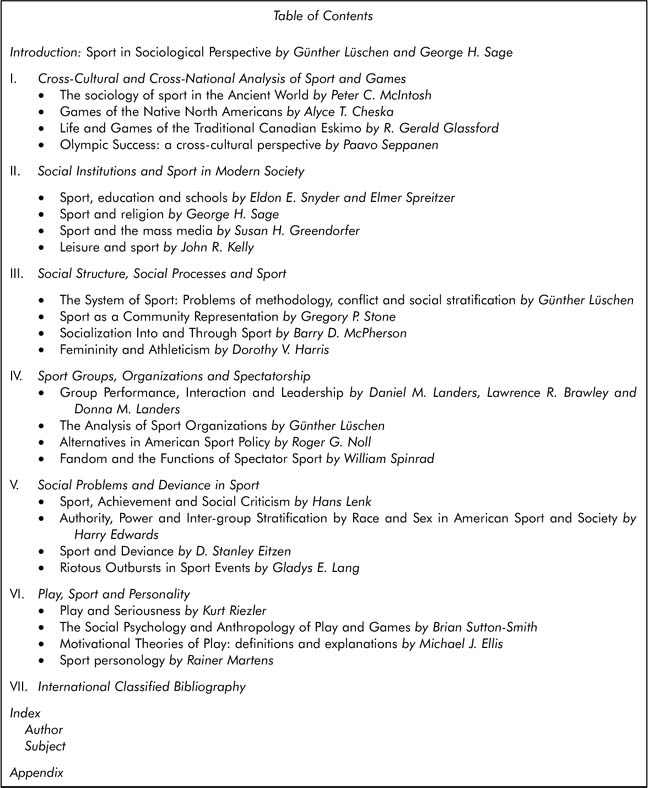
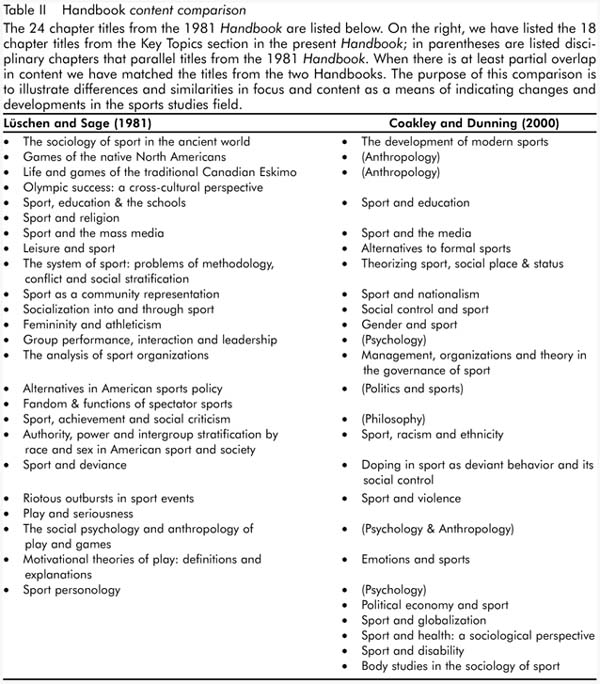
In addition to an expansion of the field during the last half of the twentieth century, there have also been significant changes in the study of sport and society. There are many ways to highlight this but we will identify some of these changes by comparing the contents of the present volume with the contents of the 1981Handbook of Social Science of Sport edited by Günther Lüschen and George Sage.8 The most obvious contrasts between the two can be inferred through an analysis of the respective tables of contents (see Figure I for the Table of Contents of the 1981 volume, and Table II for a comparison of chapter titles in the 1981 volume with titles of Chapters in the Key Topics Section of this volume). With the exception of two chapters dedicated to anthropological and social psychological analyses, the contents of the 1981 Handbook focused almost exclusively on the sociology of sport a fact implied by their title. The table of contents in the present volume is considerably broader in scope because, as editors, we have been able to draw on expanding contributions from scholars in the disciplines of economics, geography, history, philosophy and political science as well as sociology. The expansion of the study of sport and society is also seen in the fact that the 1981 Handbook contained 24 chapters, while the present volume contains 44. Of course, it is important to note that the 1981 volume devoted over 200 pages, nearly 30 per cent of its content, to an international bibliography and cross-listed index of sport and society publications.
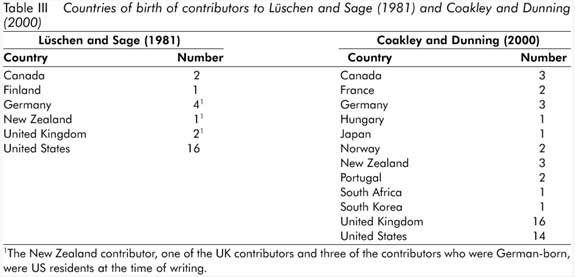
Contributors to the 1981 volume represented five countries, while contributors for this volume represent 13. Table III shows that 16 of 26 contributors to the 1981 Handbook were born in the United States and an additional five lived in the USA for some time. Only two of the contributors, one from England and one from Germany, lived entirely outside the United States. The fact that the majority of contributors to the present volume come from the United Kingdom and that contributors represent 13 countries in total provides a measure of the increasingly international scope of the sociology of sport and the global reach of research on sport and society. This trend is further documented by the membership of the International Sociology of Sport Association (the former ICSS) which, in the year 2000, included 170 paid-up members representing 34 countries.
In saying this, we do not wish to exaggerate the degree to which sport and society studies, and particularly the sociology of sport, have spread internationally. The continuing predominance in this volume of contributions from scholars living in the UK and the USA inevitably reflects our own national backgrounds and professional networks as editors. However, it also reflects, we think, the tradition that the field is more clearly identified and developed through research and academic curricula in the English-speaking countries than it is elsewhere, at least in terms of the number of scholars and students. The exceptions to this would be Germany and France, where Bero Rigauer, Klaus Heinemann, Pierre Bourdieu and their colleagues have made important contributions to the field. And we should add that notable developments and contributions from various regions and countries around the globe are summarized in the 12 short chapters that make up Part Four of this volume. Part of our intent in including this section is to stimulate further research in the countries represented by the chapters and in other countries and regions where the study of sport and society is just now being initiated. The ultimate goal is to promote greater global representation in this regard.
Figure I Contents and contributors to the Handbook of Social Science of Sport, editors G. Lüschen and G. H. Sage, Stipes Publishing Co., 1981
The proportions of male and female contributors in each of the volumes highlights one of the most significant changes in the field in the two decades separating the two publications. Men constituted 21 of 26 contributors to the earlier volume, a malefemale ratio of roughly 4:1. Men constitute 37 of 51 contributors to the present volume, a malefemale ratio of around 2.5:1. We believe that the 1981 ratio was a reflection primarily of patriarchal structures and values in the world at large and in the social sciences at that time. That these structures and values persist both in the sociology of sport and the wider social world is indicated by the continuing, although lesser, predominance of male contributors in this present volume. However, it is important to stress that the greater number of female contributors to this handbook also represents a clear increase in the number of women scholars who have made contributions to sport and society studies. It also reflects the impact of feminism on the field and the associated and at least embryonic transformations in taken-for-granted patriarchal assumptions that have traditionally influenced research as well as relationships between colleagues.
Sociological contributions predominate in this volume as they also did in the 1981 Handbook. However, apart from Gregory Stone's symbolic interactionist discussion of ‘Sport as a Community Representation’, a majority of contributions in the earlier volume were implicitly and in some cases explicitly grounded in empiricist (that is, data-based analyses that lacked an explicit theoretical focus) and structural-functionalist assumptions. This emphasis did not represent the Marxist, critical and figurational theoretical perspectives which were emerging at the time. But it did highlight the extent to which early work on sport and society was grounded in and influenced by the notion that societies are most accurately conceptualized as ‘social systems’ possessing ‘needs’ and ‘goals’ and delimited by clear-cut, impermeable and easily determinable boundaries. Of course, these assumptions have been criticized to the point that structural functionalism has been used less and less often to guide research and analysis in sport and society studies since the early 1970s. However, that structural-functionalist assumptions continue to be implicit even in the work of its critics is demonstrated by Loy and Booth in their chapter (Chapter 1).
At the beginning of the twenty-first century scholars in the field are more likely to take the following positions:
- Societies are fluid and interpenetrating products of human interaction and interdependence which change and develop over time.
- Sports and societies are most accurately conceptualized as the unplanned products of the interaction over time of pluralities of conscious, interdependent, differentially powerful, emotional as well as rational ‘embodied’ human beings who make choices.
- Social life is more open-ended and less determined than previously assumed by structural functionalists and some kinds of Marxists (although to say this is not to claim that it is chaotic, contingent and entirely undetermined).
- Social processes are best understood in connection with various forms of power relations that are inter-societal as well as intra-societal.
- The balance and tension that exists between continuity and change in social life has been shifting in favour of change at an accelerating rate at least since the seventeenth and eighteenth centuries.
Overall, it has been widely recognized that there are serious difficulties associated with attempts to understand social life within a framework of essentially static, process-reducing assumptions such as those underlying the Parsonian version of structural functionalism.
Despite the priority given to structural functionalism in the 1981 Handbook, there was, beginning in the 1960s, considerable conflict over theoretical paradigms.9 This conflict heated up during the late 1970s and early 1980s when Marxist/neo-Marxist, feminist and Marxistfeminist scholars became increasingly vocal and powerful, if not hegemonic, figures in the sociology of sport. As they grew more influential there was an associated change in the dominant professional self-image among sociologists of sport. Rather than seeing themselves as technocratic servants of sport-forms which they uncritically accepted as ‘good’, many began to see themselves as critics whose principal goal was to use research and action to ‘purify’ the ‘pathological’ sport-forms produced under capitalism. The ultimate goal was to secure more egalitarian articulations of sports into more egalitarian social frameworks. Sociologists of sport today continue to have variants of both these self-images but, if we are right, the ‘critics’ have come to outnumber the ‘technocrats’.
We suggest that the paradigm conflicts that intensified during the 1960s and 1970s in sociology remain today. These conflicts raise complex issues that are perhaps best addressed in this context by means of an historical detour. The first thing worthy of note is that sociology was named as a subject in a conflict-situation, more particularly when Auguste Comte reacted critically to a book published in 1835 by Belgian statistician Adolphe Quetelet. The subtitle of Quetelet's book was An Essay on Social Physics and, although Comte himself had used the term ‘social physics’ up until that time, he ceased from then on to use it. He did so for two main reasons: first, he objected to Quetelet's vision of ‘social physics’ as a primarily statistical subject; and secondly, he objected to what he regarded as Quetelet's scientifically unwarranted egalitarianism. Comte's alternative term was ‘sociology’ (Coser, 1971).
Another term coined by Comte was ‘positivism’, and the chief positive method that he recommended for use in sociology was the method of historical comparison. In a word, even though the meaning of ‘positivism’ has been changed so that it now refers to the inappropriate advocacy and use of natural science methods in studies of the social field, a struggle between sociologists who advocate comparative-historical methods and those who advocate statistics has been built into our subject since its early days. In the 1960s, this struggle surfaced in the sociology of sport in the different paradigms advocated by Kenyon (1969), Loy (1968), and Lüschen (1967) on the one hand, and by Elias (Elias and Dunning, 1986) and Dunning (1971) on the other. Paraphrasing Ralf Dahrendorf's description (1959) of the new middle class in capitalist societies, sociology and the sociology of sport can be said, like the new middle class, to have been ‘born decomposed’, that is, with differences, conflicts and tensions built into their very core.10
Other early conflicts in sociology were also noteworthy as we try to put current conflicts in perspective. In late nineteenth-early twentieth-century France there were heated differences between ‘realist’, Emile Durkheim and ‘nominalist’, Gabriel Tarde. Around the same time in Germany there took place what they called the Methodenstreit, the not dissimilar ‘fight over method’, between the ‘posi-tivists’ (in Comte's sense, they were wrongly named)11 and the ‘historicists’. Max Weber sought to resolve this conflict through the suggestion that sociologists should seek explanations that are both ‘causally adequate’ and ‘adequate at the level of meaning’. Interestingly, Weber advocated the establishment of causal relations, not by means of statistical analyses, but by means of counterfactual reasoning.
These early sociological conflicts were fiercely fought. However, the conflicts between proponents of opposing paradigms that began in the 1960s and continue through today are more intense than past conflicts. For 20 or so years following the end of the Second World War, advocates of functionalist and non-Comtean (that is, ahistorical and even anti-historical) ‘positivist’ sociology, most of them from the United States, reigned supreme. Then, for various sociological and extra-sociological reasons, the functionalist-empiricist hegemony collapsed and the subject, which had been ‘born decomposed’, became multiply fractured. The sociological reasons for this process of decomposition included, among other things, the difficulties encountered by Parsonian functionalism in dealing with issues such as conflict, power and change.12 The extra-sociological reasons included the effects on a younger generation of sociologists whose subject-identities and identifications were being forged in a context that was influenced by powerful events and forces which included: (a) the Vietnam war and the protest against it, (b) the civil rights struggle, (c) the rise of second-wave feminism, (d) the campus rebellions which broke out in North America and many countries in Western Europe, (e) the growth of ‘permissiveness’/ ‘informalization’ and (f) the power shift towards the younger generation. The latter centrally underlay and was reciprocally fuelled by many of these other changes.
If we are right, the fact that Canadian scholars and others who had not been born in the United States were centrally involved in the left-radicalization of the sociology of sport which took place during the 1970s and 1980s correlatively with these powerful events and forces was no accident. Processes of radicalization are more likely to occur in dependencies than in centres of imperial power such as the USA. But more to the point for present purposes, it seems that sociologists of sport who received their sociological training in the 1960s and early 1970s differed from their predecessors. The former worried less about the dangers of the ‘Cold War’ and focused more on struggling against capitalism which, for most Marxists or near-Marxists, was seen as the principal cause of inequities and global conflict. Perhaps because fewer of them had directly experienced the Second World War, they were more inclined to take peace for granted? Be that as it may, what is certain is the fact that it was precisely when the conflict over paradigms was especially intense that the sociology of sport began to come of age. Like the parent discipline, having been ‘born decomposed’ it, too, became multiply fractured.13
Since the 1960s, there have been on offer in sociology and the sociology of sport a variety of named paradigms. They include various forms of functionalism (for example, ‘soft’ and ‘hard’), Marxism (for example, ‘humanist’ and ‘structuralist’) and feminism (for example, ‘liberal’, ‘socialist’, ‘Marxist’ and ‘cultural’), together with conflict theory, Weberian theory, rational choice theory, action theory, symbolic interactionism, exchange theory, ethnometh-odology, structuralism, post-structuralism, postmodernism, structuration theory and figu-rational sociology. Among other things, these paradigms differ regarding the positions taken by their advocates in relation to epistemologi-cal/methodological issues and ontological/factual issues. Among the epistemological/methodological issues are the following:
- Where they see sociology located on the continuum between the humanities and the sciences.
- If they see sociology as a science, whether they see it as a science in a ‘soft’, for example, comparative-historical or participant observational orientated, sense or in a ‘hard’, that is, non-Comtean ‘positivist’ sense based on statistics and equivalents to experimentation.
- Whether they see the purpose of sociological knowledge as an ‘end in itself’ (that is, as something that is interesting and valuable for its own sake), as a tool for improving human performance (in our case in the field of sport), or as a means to identify and achieve political goals.
Among the ontological/factual issues are where their advocates stand in relation to such dualisms as ‘materialism’ versus ‘idealism’, ‘agency’ versus ‘structure’, ‘social statics’ versus ‘social dynamics’, and ‘synchronic’ studies versus ‘diachronic’ studies (that is, whether they see sociology as concerned solely with the present day or whether they see it as an historical subject).
Approached in these terms, the abundance of paradigms listed above can be categorized into five basic types: functionalist paradigms, conflict paradigms, action paradigms, feminist paradigms and attempted syntheses, such as structuration theory and figurational sociology. Mention of these last two suggests another source of basic differences: the way that advocates of each sociological paradigm deal with the sociologyphilosophy relationship. Thus while Anthony Giddens, the primary architect of structuration theory, advocates a heavy dependency of sociology on philosophy, Elias, the principal originator of figurational sociology, urged sociologists to maximize their autonomy in this and other regards. In a word, while Giddens recommends the continuing relevance for sociology of philosophy, a subject based on metaphysical, armchair speculation and reading other people's books, Elias advocated the constant cross-fertilization of theory and research as the only secure means of advancing knowledge.14 Of course, he stressed comparative-historical research on balance in this connection, rather than research of a statistical kind. Most of the paradigms discussed above are now well represented in the sociology of sport and, up to a point, the conflict and competition between their proponents could be said to provide empirical confirmation of Marx's dictum ‘without conflict, no progress’. That is, the conflict and competition have contributed to the advancement of knowledge in the field. For example, much of the work of ‘male feminists’ owes its insights and acceptance to the sustained and highly effective feminist critique of the hitherto hegemonic status of patriarchal assumptions in the sociology of sport (Klein, 1993; Messner, 1992; Messner and Sabo, 1990, 1994). Seen solely from a present-centred perspective, these advances may not appear particularly great, but seen from the standpoint of those who knew what the sociology of sport was like in the 1960s and 1970s, they are substantial. As another example, there has been a definitive shift from a ‘sociology of women’ to a ‘sociology of gender relations’ perspective as represented in a wide range of ‘female feminist’ work (Birrell and Cole, 1994; Hall, 1996; Hargreaves, 1994; see Chapters 4 and 20 by Birrell and Theberge respectively in this volume). The clash over interpretations of the globalization of sport has also given rise to fruitful and creative analyses. Interpretations informed by Marxism have consistently emphasized that strong elements of ‘Americanization’ have been involved in the worldwide spread of sports (Donnelly, 1996; Kidd, 1991), while interpretations guided by figurational theory have shown, equally persuasively, that globalization is best understood as a trend or social process that is both homogenizing and heterogenizing (Maguire, 1994, 1999).
In fact, we would suggest that, with the possible exception of the sociology of education which is in certain respects structurally similar, the sociology of sport has been one of the liveliest and most fruitful of the parent subject's subdisciplines since the late 1970s. We realize that such a judgement may reflect our greater familiarity with our own subdiscipline and our relative ignorance of others. Nevertheless, it seems to us and we hasten to add that this has not yet been established empirically that recent output in the sociology of sport has outstripped output in the sociology of law, the sociology of medicine, the sociology of science and probably the sociology of religion. This is almost certainly the case in terms of quantity and probably in terms of quality as well.
Assuming the validity of this judgement, we hypothesize that the putative fruitfulness of our field relative to others can, in part, be explained structurally. That is, the power and status gap between sociologists and physical educators, like the gap between sociologists and school teachers, is considerably more narrow than it is in the relations between sociologists and lawyers, sociologists and doctors, sociologists and natural scientists, and even sociologists and the clergy. This relative equality has been centrally involved in constituting sociologists of sport as a figuration and the sociology of sport as a social field both of which are characterized by a tension-balance between the polarities of consensus and dissensus, cooperation and rivalry. This tension-balance has fostered creativity in the subdiscipline and this creativity has defused the centrifugal potential that is inherent in the paradigmatic fragmentation of post-1960s sociology. That is to say, in highly differentiated and individualized societies such as the ‘advanced’ or ‘complex’ societies of today, tension in the relations between people who pursue different specializations within a common field is less likely to produce hostility and a spirit of perversity when relationships are relatively equal than when the power and status gap is wide. Relative equality is also more likely to foster greater mutual recognition of what such groups can offer each other. That is to say, lawyers, doctors, and natural scientists are more likely than physical educators to ignore or deny the possibility that sociological investigation can be valuable and add to understanding in their fields of endeavour.
In a related sense, the relative fruitfulness and high creativity of the sociology of sport may also be fostered by the relative equality between the people in the field employed in sociology departments and physical education departments. This equality within the context of universities has enabled an open dialogue to be maintained between scholars whose principal aim in their work is the advancement of knowledge and scholars whose principal aim is securing socio-political or ‘practical’ sport-related goals. An effective balance has been struck, in other words, between socio-political and ‘practical’ detachment and socio-political and ‘practical’ involvement. On no side have people allowed the search for ‘pure’ knowledge, for ‘practical interventions’ or for idealized political goals to become paramount and exclusive. As a result, the search for knowledge has been aimed at the real world of sports and games, and at increasing our ability to make practical interventions in that world. Finally, the bonds between different specialists in the sociology of sport are further consolidated through a widely shared fondness for sports and a common belief in the value of sociology as a means of enhancing our understanding of sports and society and as a means of informing our involvement in related practical and political issues.
This discussion of fruitfulness and creativity in the sociology of sport is not meant to imply that we think there are no challenges or problems facing the field as we begin the new millennium. In fact, we are facing a series of serious interrelated challenges that seem to us to revolve around the following.
1. Dealing with the Consequences of Paradigmatic Fragmentation in Sociology as a Whole This fragmentation has negatively affected our subdiscipline in at least two ways. First, it has on more than one occasion been accompanied by potentially dangerous caricatures of the work of others. When these caricatures become deeply embedded in segments of disciplinary discourse, they are not only difficult to dislodge, but they become subversive of the mutual respect that is required for relationships in the field that are simultaneously critical and supportive. Secondly, fragmentation has weakened sociologists relative to specialists in other subjects, thus making it difficult collectively to resist the intrusion into the field of the representatives of higher status subjects such as philosophy. The prestige that has been or is recurrently heaped on abstract theorizers such as Parsons and Giddens, who are nominally sociologists but really types of philosophers, is one example. Another example is the overly positive reaction of some scholars in our field to ‘postmodernist’ philosophers, primarily those from France, who advocate approaches to the social world parts of which verge on solipsism. Although it is crucial for us to interrogate what is know-able about the social world, the existence of that world, although it may be complex, is a precondition for sociology itself. The challenge for sociology and the sociology of sport is to utilize that which is of value in what the postmodernists have said and continue to say and to abandon the rest. The high status of philosophy should not allow what philosophers argue to go unchallenged.
2. Maintaining a Balance between Understanding and Action in the Sociology of Sport When scholars in our field place the need for action above the need for understanding, there is a possibility that ‘truth claims’ will come to rest primarily on normative commitments rather than theory-guided empirical research. Although it is important for scholars in any of the social sciences or humanities to discuss what ought to be in a critically reflective and morally reasoned manner, it should not supplant systematic and replicable attempts to understand what is and how it has come to be. This means that while we recognize that sociologists are not morally or culturally neutral analysts who stand apart from the societies in which we participate and, indeed that our socio-political involvements are a source of motivation and knowledge, the viability of our field depends on our ability to develop collective agreement about rules for making ‘truth claims’ or, perhaps better, claims about the ‘reality-congruence’ of our propositions and findings. In the absence of such an agreement, we cannot share and criticize each other's ideas and research in a manner that produces general understanding as well as a foundation of knowledge that can be used to inform intervention and transformational efforts.
We would argue that there are indeed circumstances when the need to take assertive action must take precedence over the need for understanding, but we would also argue that the identification of such circumstances requires a thorough and thoughtful assessment. We remember Karl Marx's observation that ‘philosophers have interpreted the world in various ways; the point, however, is to change it’. But we also remember that he devoted his life to laying the foundations for a ‘scientific socialism’ through a detailed, empirically based understanding of social relationships and social dynamics. In fact, if he were alive today, he might even look back at history and say that ‘Marxists have tried to change the world in various ways, the point, however, is to understand it’. At any rate, it is important to balance understanding and action.
3 Engaging in Critical Self-reflection as a Field This challenge should be self-evident in any academic discipline or subdiscipline. However, it is important for scholars to engage in constructively critical self-reflection while avoiding forms of self-deconstruction and deconstruction of the work of others that can jeopardize the political and intellectual foundations of the field. For example, while it is extremely important for the sociology of sport to serve as a site for integrating a range of dissenting voices concerned with sport and society, without a basis for identifying a unity of focus and for making ‘truth claims’ that will be respected and seen as legitimate by others it is possible that the field will lack the status required to elicit and maintain funding within the institutional structure of contemporary universities.
It is also important for scholars in sociology and the sociology of sport to interrogate the assumptions of cultural neutrality that have traditionally informed theory and research, the organization of the field including professional networks and relationships, the evaluation of colleagues, and the identity development of scholars themselves. Although sociologists in the past have dealt with this challenge from a distance through the sociologies of knowledge and sociology, the growth of various forms of feminist theory, especially cultural feminism (Tong, 1998), has presented this challenge to us in a close-up, face-to-face manner. This has caused considerable discomfort among some men in the field, a few of whom have made considerable contributions to sociology and/or the sociology of sport. During their professional socialization these men learned and accepted at least to some degree that being a good sociologist called for and valorized objectivity in research, and for competition and individualism in their professional relationships. Then certain feminist theorists made a convincing case that this way of being a sociologist was part of a gendered system through which the values and experiences of men were used as the basis for making ‘truth claims’, assessing the quality of research, evaluating colleagues and defining oneself as a scientist. Joining the feminist theories were racial theories and queer theories that critically interrogated ‘whiteness’ and heterosexuality in the same way that feminists had interrogated masculinity in connection with the field. As a result, some white, male, heterosexual sociologists with records of achievement and participation in the parent discipline and our subdiscipline were faced with the accusation that all their ‘truth claims’ were contentious, and that their theories and research were tainted by various combinations of sexism and patriarchy, racism and colonial privilege, and/or heterosexism and homophobia. In the same context there was and continues to be a tendency among some younger scholars to reject previously identified classical scholars and theories as a matter of course. Thus, we are faced with a two-sided challenge. One side involves acknowledging and dealing with the pervasive consequences of longstanding systems of privilege within sociology in general and the sociology of sport in particular. The other side involves coming to terms with the value of past theory and research in the field as a form of data and with the value of those who have done this work as colleagues (Loy and Booth, in press). An inability to face and deal with this dual challenge could leave the field hopelessly decomposed (see Risman and Tomaskovic-Devey, 1999). It is our suspicion as sociologists who no longer consider themselves to be young that forms of ‘ageism’ on the part of both older and younger generations of scholars a mutual inability or unwillingness to recognize common problems of humanity, for example, the old forgetting they were once young and the young being unwilling to entertain the fact that they will age may be among the contributories to this problem.
4 Maintaining Professional Commitment in the Clash over ‘Modernism’ and ‘Postmodernism’ One of the central struggles in sociology and related disciplines today is over what one might call the validity and value of the promise of ‘modernism’ and whether we have entered or are currently entering a ‘postmodern’ era. Centrally at issue in this connection is the belief that the success of sociology rests in the promise of its theories and methods in delivering the tools necessary for contributing to the creation of a future that will be better than the past and present. In short, what is at issue is whether sociology can make a contribution to human ‘progress’. The seeds of such a belief can be traced, for example, to Condorcet and Turgot in the eighteenth century. However, it first began to be given an explicitly sociological form by thinkers such as August Comte and Herbert Spencer in the nineteenth century. Although he considered himself to be a ‘political economist’, it has come to be customary to include Karl Marx among the earliest contributors to this sociological way of thinking. Despite the often considerable political and scientific differences between them, all these thinkers were united in their belief that history and social development equal ‘progress’, and that social scientific research and theory can be of help in bringing this ‘better future’ into being.15
Turn-of-the-century sociologists such as Durkheim and Weber were among the first to be involved in the institutionalization of sociology as a university subject and they were also among the first to entertain doubts about the ‘inevitability of progress’. Durkheim, for example, claimed to have demonstrated that nineteenth-century social developments in Europe were leading to increasing rates of suicide, social disintegration and anomie, while Weber hypothesized that the processes of rationalization, which he showed were occurring correlatively with the development of capitalism, were likely in the future to lead to growing ‘disenchantment’ with and of the world (Entzaüberung) and an increase in irrational behaviour.16 There was an attack on ‘progress theories’ in anthropology, too, for example, by Franz Boas and his students,17 and, whilst at the end of his career he became involved in a revival of ‘evolutionary’ sociology, Talcott Parsons began his elaboration of what he called ‘the theory of social action’ with an attack on the ‘evolutionary individualism’ of Herbert Spencer (see Parsons, 1937). Nevertheless, whether he was writing in his earlier ahistorical and static mode or in his latter mode which was diachronic and evolutionary, Talcott Parsons can be said to have played a central role after the Second World War in spreading and consolidating the idea that the promise of ‘modernism’ and ‘modernity’ has to be grounded in an understanding of the properties of social systems (see Parsons, 1951). Such an idea grew during the 1960s and 1970s as a number of more ‘radical’ sociologies, including most importantly varieties of Marxism, were fuelled by the belief that the promise of ‘modernism’ could only be fulfilled through various revolutionary movements and transformations. However, a majority of the proponents of these more radical sociologies continued alongside their more ‘liberal’ (for example, Parsonian) colleagues to stress that more adequate sociological knowledge is a necessary prerequisite for effective social revolution and reform.
What might be called ‘mainstream sociology’ as we enter the third Christian millennium continues to be organized by and large around the pursuit of social possibilities grounded in the ‘modernist’ notion that it is possible to discover a body of sociological theory which will enable us ‘scientifically’ to establish a ‘normative centre’ or ‘consensus’, that is, a set of normative propositions or principles around which work for a better future might be organized. At least since the writings of the German philosophers, Nietzsche and Heidegger and more recently of French philosophers such as Foucault and Baudrillard who were more or less heavily influenced by their reading of their German predecessors,18 there has been a growing number of social observers and analysts, many with a literary rather than social scientific background, who have concluded in various and what are widely regarded as ‘compelling’ ways that the social world is comprised of unstructured and unstructurable differences (Lemert, 1995: 20911). The goal of their social and cultural analyses has been and continues to be that of understanding that world in as many of its particular and differential details as possible (Rail, 1998). Apparently forgetting or being unaware of earlier sociologists who attacked ‘grand theories’ (such as C. Wright Mills, Norbert Elias, Robert K. Merton, Barney Glaser and Anselm Strauss19), such ‘postmodernist’ writers also proclaim the ‘impossibility’ of ‘grand narratives’ or ‘universal theories’ (itself a kind of ‘grand narrative’ or universal lawlike statement, it seems to us!). However, be that as it may, their work has served to disrupt the mainstream search for ‘the normal’. These individuals are describing what they regard as a variety of social worlds in ways that give rise to what they think of as critical analyses of the dynamics of power, denial, marginalization and exclusion that have been at the core of the self-same economic, political, academic and scientific structures in and through which the ‘promise of modernism’ was first formulated and through which it has subsequently been sustained (cf. Lemert, 1995).
As one might expect, heated debates occur when mainstream sociologists encounter these analysts and their analyses that are not premised on the modernist quest for a normatively ‘centred’ social world. We have seen this in the sociology of sport as well as in sociology as a whole. The futures of the organized discipline of sociology and subdisciplines such as the sociology of sport, rest in the extent to which these debates foster a culture of critical self-reflection and mutual tolerance and respect among dissenting sociological voices and a recognition that the vitality of sociology should not be measured simply by the standards of modern progress. The purpose of these debates should not be to dismiss what ‘classical’ and ‘mainstream’ sociology have to offer in our attempts to understand the social world and the many varieties of lived experiences that constitute that world. Nor should the purpose be to arrive at a single, general explanation of the world and how we might use that explanation to make the world unified through a particular normative consensus. Instead, the purpose, if we wish to continue coming together in formal gatherings to share our experiences and understandings, should be to give voice to a range of experience-based descriptions and explanations of the world. If these descriptions and explanations contain the necessary particular details, we should be able to use them to acknowledge and come to terms with our own differences and then deal with the dilemmas associated with social factors and forces that constrain people's lives, including our own. If we can manage this, sociology can become a means for a critically informed body of knowledge that can serve as a basis for engaging an ever-changing collection of social relationships and the unanticipated problems and issues often associated with them.
Concluding Comment
Our sense is that in practical terms the sociology of sport consists of a collection of scholars most of whom claim to do ‘science’, agree on the rules we use to make ‘truth claims’, and then share our claims and how we have arrived at them through publications and discussions. If our ‘truth claims’ are based on empirical data, if there is general agreement on what constitutes data, and if we are committed to a rigorous pursuit of understanding, the diversity and dynamism of the field will enrich our awareness of sport and society and enhance our potential to transform both. The chapters in this handbook represent a version of the ‘state of our understanding’ of sport and society at this point in time along with where we have been and where we might go in the immediate future.
As we anticipate that future from our perspective as editors of this volume, we wonder about the connection between this present Handbook of Sports Studies and the next similar volume that might be published (probably electronically) in 2020. If the editors of the 2020 volume are a Latin American woman and a black man from postcolonial Africa, how might they select authors and chapter topics? Might they look back at this volume and wonder about our naivety as editors and ask why we did not select other authors or foresee issues related to sport and the law, sport and the environment, sport and postcolonial development, and other topics that should have been discussed at the turn of the millennium? We expect so. And for the sake of the vitality of our field, we hope so.
Notes
1 As Loy and Kenyon (1969) note, Weber also discussed the knightly games of feudal Europe.
2 The Frankfurt Institut für Sozialforschung was founded in 1923 at the University of Frankfurt by Felix Weil, the son of a rich businessman. Its first Director was Max Horkheimer and among its prominent early members were Theodor Adorno, Walter Benjamin and Erich Fromm. More recently, its members have included Herbert Marcuse and Jürgen Habermas. The Frankfurt School (or ‘critical theorists’ as they are also called) are Marxists but it is characteristic of their approach that they concentrate in their work on elements of ‘the superstructure’, that is, on aspects of ‘culture’.
3 Together with their colleagues M. Baument, M.A. Madders and Beryl Sanders, these four scholars were the authors of an influential pamphlet, Britain in the World of Sport: An Examination of the Factors Involved in Participation in Competitive International Sport (University of Birmingham, 1956). Perhaps the best-known member of the Birmingham group, and certainly the one most influential in the sociology of sport, was Peter McIntosh. See, above all, his Sport in Society (1960).
4 The proceedings were published by Günther Lüschen (1966).
5 See Lüschen (1970) for the proceedings of the ChampaignUrbana Conference, and Albonico and Pfister-Binz (1972) for the proceedings of the Magglingen Conference (the French-Swiss name for Magglingen is Macolin).
6 Rather surprisingly, M. Magnane never took part in the affairs of the ICSS.
7 A sample of these includes the following: Bryant and McElroy, 1997; Cashmore, 1996; Coakley, 1998; Coakley and Donnelly, 1999; Donnelly, 1997; Eitzen, 1996; Eitzen and Sage, 1997; Figler and Whitaker, 1991; Hall et al., 1991; Hart and Birrell, 1981; Harvey and Cantelon, 1988; Horne et al., 1987; Horne et al., 1999; Lawrence and Rowe, 1986; Leonard, 1998; McPherson et al., 1989; Nixon and Frey, 1996; Phillips, 1993; Sage, 1980; Vogler and Schwartz, 1993; Yiannakis et al., 1993.
8 It is difficult to compare the 1981 Handbook with the present volume because each was edited under different circumstances. The 1981 volume was originally conceived as part of a larger project that was to take the form of an Encyclopaedia of Physical Education. The Lüschen and Sage contribution was to be one volume in the series that would make up the encyclopaedia. This is partly why over 200 pages of the 1981 volume consisted of a detailed bibliography and cross-listed index of sources that could be considered a foundation for the field at that time. Also, contributors to the volume were chosen in part because of their connection with physical education as it had developed primarily in the United States. In fact, the series editor was an exercise physiologist who had reservations about the critical nature of some of the work done in the sociology of sport during the 1970s.
9 Related to this observation on our part, it should be noted that a handbook, or any similar volume, is often a more or less conservative representation of a field or body of literature. Authors are selected on the basis of their past work and the extent to which it has been accepted by established publication outlets and incorporated into the mainstream literature of the discipline or subdiscipline. Although we, too, may be guilty of this charge, we have tried in this volume, within the limits of our own professional experiences, to stretch the understanding of what the sociology of sport comprises by including new ideas and perspectives along with those that are widely recognized and discussed.
10 Dahrendorf's (1959) point was that the new middle class of the twentieth century had consisted of white-collar workers and bureaucrats, differentiated groups with few, if any, common interests.
11 Towards the end of the nineteenth century, German academics became sharply divided over the status of the ‘human’ or ‘social sciences’. The ‘positivists’ in this debate (for example, the psychologist Wundt) argued that the social sciences can use the same methods as the natural sciences, whilst the ‘historicists’ (for example, the philosophers Dilthey, Rickert and Windelband) argued that the human ‘mind’ or Geist (spirit) constitutes an autonomous sphere of reality which is not subject to law-like regularities similar to those which are studied by the natural sciences. It is reasonable to hypothesize that, like Weber, Comte would not have identified with either side in this dispute but would have sought a higher level resolution. What is certain, though, is that the main ‘positive’ method recommended for sociology by Comte was the method of historical comparison (see Andreski, 1974: 192ff).
12 It is clear that Mertonian functionalism did not encounter these difficulties to the same extent, except perhaps in relation to power.
13 This fact is not apparent in the volume edited by Lüschen and Sage.
14 According to Anthony Giddens, ‘the social sciences are lost if they are not directly related to philosophical problems by those who practise them’ (1984: xvii). For Elias, by contrast, Western philosophy has been locked at least since Descartes and Kant in what he (Elias) called homo clausus modes of thinking which are not conducive to the advancement of knowledge about human beings and human societies. For a discussion of this complex issue, see Elias (1978).
15 The Reverend Thomas Malthus's Essay on Population (1798), in which he pessimistically argued that population growth will always outstrip food supply, constituted an exception in this context.
16 See Durkheim (1952) for his arguments, and see Gerth and Mills (1946, especially p. 139ff) for a discussion of Weber's theory of ‘disenchantment’. Weber took this term from poet and playwright Friedrich Schiller.
17 German-born Franz Boas (18581942) was Professor of Anthropology at Columbia University, New York, from 1899 to 1936. Probably the most famous of his students were Margaret Mead and Ruth Benedict. Whilst accepting the reality of biological evolution, Boas and his followers denied the reality of its socio-cultural equivalents, that is, social or cultural ‘evolution’ or ‘development’.
18 For a clear and insightful sociological diagnosis of the relationships between sociology and philosophy, see Kilminster (1998).
19 Already in the 1950s, C. Wright Mills (1959) developed a sharp critique of what he called ‘grand theory’. Around the same time, R.K. Merton (1957) argued for ‘theories of the middle range’. Somewhat later, Barney Glaser and Anselm Strauss in lectures and private discussions suggested that sociology needed ‘grounded theories’. Norbert Elias's favoured term in this connection was ‘central theory’ of which he considered his own theory of civilizing processes to be an exemplar.
References
- Loading...
Get a 30 day FREE TRIAL
-
 Watch videos from a variety of sources bringing classroom topics to life
 -
Read modern, diverse business cases
-
Explore hundreds of books and reference titles
Read next

More like this
Sage Recommends
We found other relevant content for you on other Sage platforms.
Have you created a personal profile? Login or create a profile so that you can save clips, playlists and searches