
Summary
Contents
Subject index
The Handbook of Marketing presents a major retrospective and prospective overview of the field of marketing, and provides a landmark reference at a time when many of the traditional boundaries and domains within the marketing discipline have been subject to change. The Handbook frames, assesses and synthesizes the work in the field and helps to define and shape its current and future development. It includes contributions from leading scholars in the field, and the input of an international and extremely distinguished advisory board of marketing academics. The Handbook of Marketing will be invaluable to advanced undergraduates, graduate students and academics in marketing.
Competitive Response and Market Evolution
Competitive Response and Market Evolution
Introduction
Our objective is to review the major areas of research that relate to the dimensions of ‘competitive response’ and ‘market evolution.’ We develop a conceptual framework that considers the interactions between these two key constructs of ‘competitive response’ and ‘market evolution.’ We, therefore, first identify what the key dimensions of competitive response and market evolution are. Then, we review the literature that addresses the impact that competitive responses (to a variety of market initiatives) can have on the evolution of a market. We then examine the research that considers how the evolution of a market can constrain and influence the responses of firms within an industry. Our framework also considers the impact that environmental (or exogenous) factors can have on both dimensions of ‘competitive response’ and ‘market evolution.’ Such factors may assist to distinguish between the cause and effects of some of the interactions between competitive response and market evolution. In each section, we identify several areas where we believe that further research is both necessary and can yield fruitful advances.
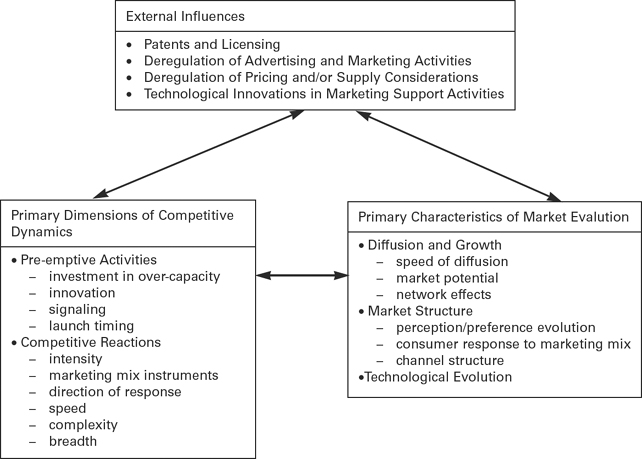
More specifically, we can represent the area of investigation using the framework shown in Figure 6.1. This framework can be useful for organizing and structuring our review of this literature. The focus of this chapter is about the links between the competitive dynamics dimensions (bottom left box in Figure 6.1) and the dimensions of market evolution (bottom right box in Figure 6.1).
In the second section of this paper, we characterize the dimensions along which competitive responses can be described, and we then define the characteristics of market evolution. Within each box in Figure 6.1, the list of dimensions that are discussed in this chapter is shown for both competitive dynamics and market evolution. In the third section, we review the literature and propose new directions for research concerning how competitive responses affect market evolution and vice versa (how market evolution impacts competitive responses). While each aspect has received individual attention in past research, the interaction between the two remains under-researched. Lambkin and Day (1989) made this observation over a decade ago, yet their call for research in that direction has remained for the most part unanswered. We propose a stream of research that goes beyond the population ecology concepts that they suggest. In this section, we include an analysis of the role of external forces in explaining changes in these dimensions.
Dimensions of Competitive Responses and Characterization of Market Evolution
The Primary Dimensions of Competitive Dynamics
Two streams of research concerned with competitive dynamics have received considerable attention in the marketing literature. The first of these streams concerns the entry and exit of competitors. This is the focus of population ecology, which provides a source of explanations for the evolution of markets from a supply-side point of view. Lambkin and Day (1989) clearly establish the importance of that perspective and explain the role of key population ecology concepts (e.g., structural inertia, r-strategists versus k-strategists, specialists versus generalists). The essence of the theory consists in the impact of strategic choices concerning the firm (e.g., technological or organizational) at the time of entry as a function of the stage of the product life cycle. Beyond the questions of whether multiple types of organizations can coexist at the same stage, and of the ability to develop a valid harmony of firms, Carroll's (1985) argument of resource partitioning combines the dynamics between generalists and specialists. Aldrich (1999) summarizes this approach and especially the notion that generalists can stratify the market, which stimulates the entry of specialists. However, the theory remains at the level of competition between these firm types and does not consider the specific action or strategies used by the firms to compete, and does not develop implications on evolution of demand. We devote our discussion to actions of the firms that may occur at any time when entry is likely or when entry has already happened. Consequently, even though we do recognize the existence of structural inertia (Hannan & Freeman, 1977), we focus our analysis on pre-emptive activities of incumbents, i.e., the decisions firms make that stifle or encourage competition, with emphasis on the impact of firm entries and exits over time.
Figure 6.1 A Framework for Understanding Interactions Between Market Evolution and Competition Dynamics
...
- Loading...
Get a 30 day FREE TRIAL
-
 Watch videos from a variety of sources bringing classroom topics to life
 -
Read modern, diverse business cases
-
Explore hundreds of books and reference titles

Read next

More like this
Sage Recommends
We found other relevant content for you on other Sage platforms.
Have you created a personal profile? Login or create a profile so that you can save clips, playlists and searches