
Summary
Contents
Subject index
Available in print and electronic formats to provide students with convenient, easy access.
Environmental Disasters
Environmental Disasters
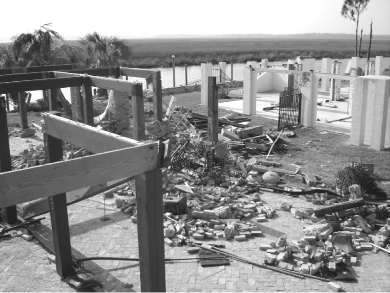
Mildly put, Earth in the 21st century is a dangerous place. In December 2004, an earthquake-induced tsunami leveled homes and businesses from Indonesia to India to Sri Lanka. The waves even reached the east coast of Africa. It is estimated that 230,000 people lost their lives. Climatic extremes hit North America in 2005; so many hurricanes formed that the Tropical Storms Prediction Center—responsible for naming storms—ran out of names on its list. The more than 1,800 fatalities and monetary losses near $150 billion made Hurricane Katrina a hard name to forget (Figure 47.1). Earthquakes in Pakistan (2005) and China (2008) claimed 80,000 and 70,000 people, respectively. In Chile (2010), an 8.8 magnitude earthquake toppled buildings and felled bridges. The death toll topped 700. The 7.0 magnitude earthquake a month earlier in Haiti killed 230,000 and left 1 million homeless. Economic losses in Haiti are estimated at $8 billion, and Chile faces losses up to $30 billion.
What should be obvious from this brief overview of catastrophic events are the widely differing outcomes. These varying results are not lost on geographers, who recognize spatial and qualitative differences in building stock, emergency services, disaster mitigation programs, governmental policies before and after, geologic structure, and economic wealth, among other measures, that influenced the severity of each event.
Figure 47.1 Hurricane Katrina Damage, Diamondhead, Mississippi, 2005
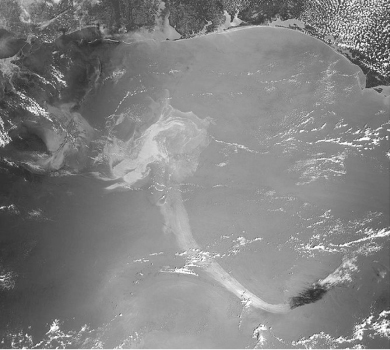
Although firsthand reports by people and news media coverage may explain natural events as the result of an angry or unhappy Earth (Oliver-Smith & Hoffman, 1999), there are numerous catastrophic events that have much less or little to do with the natural world. The sources of those events were suggested in a poster from Earth Day in 1970, famously stating that “we have met the enemy and he is us.” The “enemy” here is catastrophic events of human making. Our history is peppered with these events, many remembered with just the mention of a place name: Donora, Love Canal, Three Mile Island, Bhopal, Chernobyl. Recent events include the chlorine spill in Graniteville, South Carolina (2005, nine deaths); the sugar refinery explosion in Savannah, Georgia (2008, 13 deaths); and the ash-sludge spill in Kingston, Tennessee (2008) when over 1 billion gallons of waste were released. The 2010 massive oil spill in the Gulf of Mexico, the result of a failed wellhead valve, affected the livelihoods of tourism operators, shrimpers, and other fishers in addition to marine life and waterfowl who call the Gulf and its environs home (Figure 47.2).
Figure 47.2 Satellite Image of Deepwater Horizon Oil Spill, Gulf of Mexico, United States, 2010
This chapter addresses these environmental catastrophes beginning with a discussion of how we define and characterize them; then it discusses the importance of geography to the research and the study of the topic. Important issues such as scale, the spatial nature of these threats, parallels with natural events, social vulnerability, and important developments in geospatial technologies are emphasized through a series of vignettes. Offered at the end are reflections on how geographers may play a role through their spatial methodologies and techniques to limit or mitigate the impacts of both natural and human events that result in catastrophe.
...
- Loading...
Get a 30 day FREE TRIAL
-
 Watch videos from a variety of sources bringing classroom topics to life
 -
Read modern, diverse business cases
-
Explore hundreds of books and reference titles

Read next

More like this
Sage Recommends
We found other relevant content for you on other Sage platforms.
Have you created a personal profile? Login or create a profile so that you can save clips, playlists and searches