
Summary
Contents
Subject index
"The editors of this genuinely brilliant book seem to dare the reader to argue with them from the first page... I would encourage everyone interested in cultural geography, or in the cultural turn within a whole set of human geogrphies, to do likewise." --ANNALS OF THE ASSOCIATION OF AMERICAN GEOGRAPHERS "A richly plural and impassioned re-presentation of cultural geography that eschews everything in the way of boundary drawing and fixity. A re-visioning of the field as "a set of engagements with the world," it contains a vibrant atlas of ever shifting possibilities. Throbbing with commitment, and un-disciplined in the most positive sense of that term, it is exactly what a handbook ought to be."--Professor Allan PredDepartment of Geography, University of California at Berkeley Ten sections, with a detailed editorial introduction, the Handbook of Cultural Geography presents a comprehensive statement of the relation between the cultural imagination and the geographical imagination. Emphasising the intellectual diversity of the discipline, the Handbook is a textured overview that presents a state-of-the-art assessment of the key questions informing cultural geography, while also looking at resonances between cultural geography and other disciplines.
Spaces of Knowledge
Introduction: Reading Geography Through Binary Oppositions
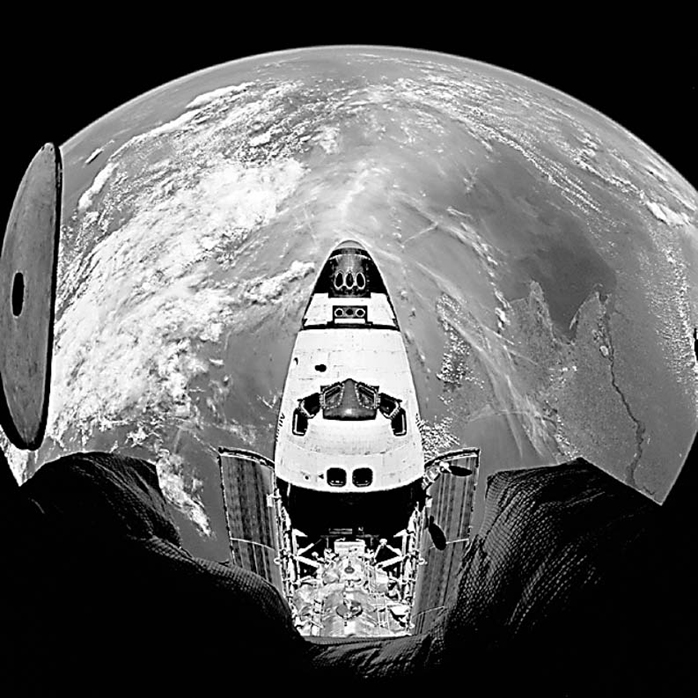
Fish-eye view of the Space Shuttle Atlantis as seen from the Russian Mir space station (Source: NASA)
In this section of the Handbook four chapters take up the question of knowledge in cultural geography. Ulf Strohmayer explores the imbrication of knowledge and culture in the western tradition, examining key themes from the Renaissance to contemporary poststructuralist thought. Francis Harvey surveys different critical perspectives on technology, each of which stands in opposition to the naive empiricist view that technology is little more than a tool, one that is exogenous to social relations. Audrey Kobayashi offers a historical analysis of the concept of race in geography. She argues that our disciplinary knowledge is racialized, and she suggests ways to subvert the dominant whiteness that infuses Anglo-American geographic thought and practice. The section ends with a chapter by Richard Howitt and Sandra Suchet-Pearson. They criticize disciplinary knowledge from the perspective of postcolonial theory, showing how cultural geography's understanding of key concepts such as nature and landscape are limited by the western bias of much geographic research.
In this introduction to the section, I offer a general context for these essays by exploring the evolution of Anglo-American geographic thought as seen through the lenses of its most prominent binary oppositions. These infuse both what and how we know, the study of which is, respectively, ontology and epistemology. My survey is grounded in the various ‘paradigmatic’ shifts enveloping geography over the past century or so. I conclude the introduction with a brief review of the chapters in this section.
What is Knowledge?
Defining knowledge is a slippery endeavor, for the concept skates back and forth between ontology and epistemology. The latter term refers to theories concerned with how we understand or know the world. It encompasses the theoretical study of science and interpretation, as well as many aspects of the metatheoretical perspectives associated with these endeavors. Of those that have been historically influential in geography, we can point to empiricism, positivism, critical realism, humanism, structuralism, and poststructuralism. In the west, our understanding of epistemology is founded upon - one might even say congealed around - a number of key binary oppositions. These include: objectivity and subjectivity; determination and uncertainty; rigor and play; explanation and description; and generality and particularity. Each of these aspects of knowing the world structures different theoretical approaches: scientific understandings typically assign positive valences to the former terms in the above binaries, while interpretive approaches typically privilege the latter terms. Different thinkers have different stances with respect to these terms, including not only their utility in helping us conduct research, but also what they mean and, even, their very possibility. Furthermore, how we know the world at the everyday, non-reflective, level is in part determined (with more or less certainty) by how we negotiate these oppositions through our experiences, language and, of course, culture (see Strohmayer, Chapter 28 in this section).
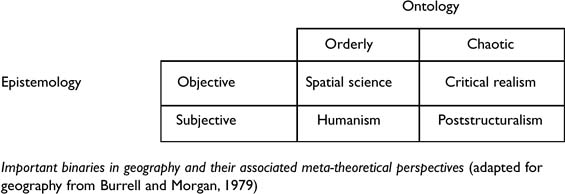
Ontology refers to the theoretical study of what the world is like. It is similarly structured, in the western imagination, along a number of key binaries. Studies of the ontological character of the world within geography have tended to focus on the distinctions between: nature and culture; individual and society; order and chaos; space and time; space and society; and the world of ideas and discourses versus the world of material objects and concrete social processes. Even our disciplinary distinctions - between say, geography and sociology (that is, space and society) - are structured along ontological assumptions.
...
- Loading...
Get a 30 day FREE TRIAL
-
 Watch videos from a variety of sources bringing classroom topics to life
 -
Read modern, diverse business cases
-
Explore hundreds of books and reference titles

Read next

More like this
Sage Recommends
We found other relevant content for you on other Sage platforms.
Have you created a personal profile? Login or create a profile so that you can save clips, playlists and searches