
Summary
Contents
Subject index
The Handbook of Community Practice is the first volume in this field, encompassing community development, organizing, planning, and social change, and the first community practice text that provides in-depth treatment of globalization—including its impact on communities in the United States and in international development work. The Handbook is grounded in participatory and empowerment practice including social change, social and economic development, feminist practice, community-collaboratives, and engagement in diverse communities. It utilizes the social development perspective and employs analyses of persistent poverty, policy practice, and community research approaches as well as providing strategies for advocacy and social and legislative action.
Preface
Community practice has been an integral part of social work since its inception in the Settlement House Movement and Charity Organization Societies in the Global North in response to pressures caused by the Industrial Revolution. In the Global South, community practice as a formal process typically began in reaction to the pressures of colonization and efforts to rebuild communities and societies in its wake. Across both hemispheres, community practice—in its grassroots organizing, interagency planning, and social justice aspects—engages citizens in problem-solving work to improve quality of life for vulnerable groups and communities and enacts the profession's social justice mission through a variety of practice models, from community development to political action. While practice emphases varied in many nations over the course of the 20th century—sometimes with greater focus on organizing services, grassroots organizing, planning, or social action—the essential purposes of strengthening communities and services and pressing for access, equality, empowerment, and social justice have not wavered.
Indeed, community practice is expanding globally in the 21st century. At the same time, major new contexts are developing that will impact community practice work everywhere: the increasing interaction of multiple cultures within and among nations; the continuing struggle to make human rights for everyone—including women and children—a reality throughout the world; and the far-reaching impact of globalization on the poor and working classes in both the Global South and North. Many practice strategies are likely to prove tried and true, others will need modifications for diverse settings or changing populations, and doubtless new strategies will be developed in the future as needed.
All communities are and will continue to be affected by the global economy and by the social, economic, and political shifts that will continue interactively. Community practitioners will need to be cognizant, proactive, and seriously engaged to bring forth close global connections that support human and sustainable development, rather than witnessing the increase of already-evident risks and damage to local economies, social structures, and the environment. Community practice approaches, from grassroots organizing to policy and social action, must take into account new complexities, challenges, and opportunities in this period of unparalleled global change. Indeed, community practice is the critical component of the profession that can help citizens, groups, communities, and organizations enlarge civil society, increase grassroots political clout, advocate for human rights, and work for positive social change to support those most disadvantaged by macro changes.
This second edition of The Handbook of Community Practice has been reorganized and reworked, and many new chapters have been added to present a strong global perspective supported by knowledge, theory, and practice examples from the Global South and North. This book is intended to assist current and future community practice, social work, and community development students, faculty, and practitioners in many parts of the world as they confront the challenges posed in the coming decades. It is also intended to help students in industrialized nations understand and recognize how much they have to learn from practice, theory, and knowledge developed in industrializing nations. Likewise, it is intended to provide current knowledge and theory from industrialized and post-industrial nations, marked by concerns and practices that stress inclusion, social justice, and human rights concerns that recognize the critical importance of local knowledge and contexts, free of the academic imperialism that has presumed other nations should follow Western-developed approaches to practice (Dominelli, 2007; Hall & Midgley, 2004; Midgley, 1997). There is much to be gained through mutual and egalitarian transnational learning, and while much more sharing, knowledge building, and research are needed, this handbook seeks to establish and encourage this transnational and mutual approach to learning and testing practice approaches.
The first edition of this text was encouraged by Jim Nageotte (then SAGE's human services editor) and Professor Charles Garvin of the University of Michigan. I greatly appreciate the work of the authors for the first edition and particularly the writing and excellent initial editing of selected chapters by associate editors Michael Reisch, Dorothy N. Gamble, Lorraine Gutiérrez, Elizabeth A. Mulroy, and Ram A. Cnaan. The positive response to the book owes much to the quality of their work. Happily, SAGE has made the original edition of the handbook available online through libraries so that readers can continue to refer to it and faculty can access chapters for their classes.
Given the very positive reception of the first edition of this text and the need for such a community practice volume to provide greater focus on global issues and broader ranges of theory, practice, and knowledge, I was delighted when Kassie Graves, senior acquisitions editor for SAGE, proposed a second edition. Kassie has been unfailing in her encouragement and support of this work. One could not hope to work with a more knowledgeable and skilled editorial team than Kassie, Megan Granger, and Libby Larson.
Most especially, I am immensely appreciative of the creative chapter development and astute editing of Michael Reisch of the University of Maryland at Baltimore and Mary L. Ohmer of Georgia State University, who graciously consented to serve as associate editors for the second edition. Their intellect, extensive knowledge, commitment, and editorial skill made them outstanding partners in the development of this text. They assisted in author selection, offered support in chapter planning, and reviewed and edited multiple drafts of numerous chapters for this edition, providing support for authors and excellent editorial skills. I extend heartfelt thanks to Mary and Michael for their work and to the contributors to the second edition, who expanded the concept of the book and deepened the knowledge, theory, and practice examples for students.
Chapter Authors
A total of 66 distinguished authors contributed to this second edition, with some involved in more than one chapter. With regard to multinational experience, 8 authors were born or now live in nations other than the United States. These authors all have experience working in multiple nations. A number of authors from the United States have considerable experience in multinational practice, teaching, and research; at least 20 have been involved in international work, and 1 works full-time for an international nongovernmental organization.
While a number of the authors are university faculty, these are not ivory tower people. Almost all are involved in work with communities, groups, and organizations, or advocacy and policy practice. Some are guiding comprehensive neighborhood initiatives. Several have developed research and study centers that tie them to communities in multiple nations. One has developed a women's community organizing center that supports organizers in communication and collaborative work. Several have been called on to conduct research on asset development in multiple nations; a number have led study-abroad programs; several have taught in countries other than their own; some have been involved in multinational research for international organizations; and many have been involved in volunteer consultation for organizations in multiple countries. They bring extensive knowledge and practice experience to their writing.
To heighten the focus on the realities of practice, this second edition has added more practitioner authors who bring current, on-the-ground experience to vital areas of community practice. Sixteen second-edition authors are experienced practitioners/leaders: Six of these are CEOs or directors of nonprofit organizations they founded and built, and others lead nonprofit development programs. Still others work as community organizers, advocates, and program and organizational consultants, and one is assistant to the president of a national U.S. labor union. At least 14 contributing authors are now or have previously been heads of university research, policy, or practice-research centers, and another 10 have led complex university/community partnership development and research programs.
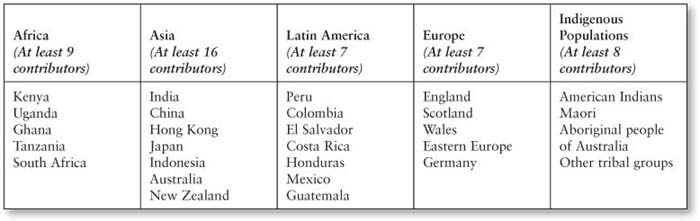
In addition to international representation, some of the diversity of the U.S. population is represented, including American Indians, Latino/as, African Americans, and Indian Americans, as well as others from the myriad ethnicity and nationality groups that make up the U.S. population. While a full survey has not been taken, the table below reflects some of the nations in which contributors to the book have worked or volunteered.
This second edition has provided these contributors the opportunity to compose a comprehensive summary of their favorite subjects and practice areas. In combination, the handbook builds strongly on the earlier literature on community practice and on theory and perspectives from multiple nations. Michael Reisch, Mary L. Ohmer, and I have worked to ensure that the second edition builds on the current literature and presents both the breadth and depth of community practice.
As a result, this volume provides unprecedented opportunities (1) to examine the range of practice methods employed currently in community interventions; (2) to consider the political, economic, social, and global shifts affecting and changing the context of practice across the world; (3) to explore theory and practice theorizing; and (4) to analyze ways in which knowledge, methodology, and research can provide direction and inform leaders, facilitators, community members, and practitioners about ways to strengthen communities and service systems as well as to organize, plan, and act for needed change. Authors have critically examined knowledge, theory, practice, and methods, and have worked to define and interpret emerging issues that future students, practitioners, scholars, and researchers will need to confront in coming years.
Organization of the Book
The handbook is organized into six sections. Part I provides analysis of the contexts of community practice and presents central issues that impact the practitioner's work. Four new chapters introduce this edition. Chapter 1 examines global contexts and a range of issues facing community practitioners across the world. Chapter 2 provides an overview of the complex history of community development, organizing, and planning in the United States. Chapter 3 analyzes challenges in the global economy for both the Global South and North, and Chapter 4 probes central issues and principles of social justice, human rights, and values that can assist community practitioners in determining courses of action. Two new theory chapters conclude this section: Chapter 5 analyzes theories of community and provides essential knowledge, and Chapter 6 explores types of theories that relate to and support practice, as well as central practice theories of development, organizing, planning, and social change. Beginning with relevant explanatory theory, the process of theorizing, and the importance of applying critical perspectives, this chapter moves to examination of theory focused on scales of intervention—from interpersonal to inter-organizational—through which practitioners engage members of communities and organizations. The chapter concludes with central practice theory for major methods of community practice and the process of moving theories into action.
Part II begins with the evolution of practice models in Chapter 7 and specifically examines eight current models used in many parts of the world and adapted for local context and issues. These models relate to organizing; community, social, economic, and sustainable development; program and service development; social planning, coalition building, political and social action, and policy practice; and movements for progressive change. Analysis of each model is provided, along with discussion of outcomes, change strategies, constituencies, and scope of concern as well as identification of major roles needed for effective practice in each model. Chapter 8 presents a vital history of development theory and development work infused with knowledge and critical perspective from the Global South. It provides historical analysis of the outcomes of application of particular theories and carefully analyzes whose interests were met by dominant theories, some of which emerged in conjunction with colonial exploitation or followed colonialist ideologies. Chapter 9 presents central issues of practice for sustainable development to promote progressive social and economic change and environmental protection of the earth for future generations. Chapters 10 and 11 examine contemporary community organizing practice—one compares and contrasts conflict and consensus approaches, and the other provides examples and issues related to organizing in communities of color. Chapters 12 and 13 examine social planning, the first presenting theory and case examples of planning with communities and the second illustrating principles and examples of larger-scale planning in communities and cities, as well as particular issues related to planning for service development. Both these chapters take a global perspective, providing examples from both the Global North and South.
The next five chapters (Chapters 14–18) examine practice to promote progressive social change. Chapter 14 addresses essential participatory methods that are adaptable to many practice settings and ground practice with those who have been marginalized. Chapter 15 focuses on strategies for social, political, and legislative action. Chapter 16 skillfully differentiates radical community organizing from other types and illustrates the need for practitioners to employ strategies and tactics that address root causes of major social problems. The increasing importance and methods of practice in coalitions, collaborations, and partnerships are analyzed in Chapter 17, along with illustrations of these central interorganizational practice approaches. Chapter 18 analyzes eight models for engaging in policy practice—a central means of initiating and solidifying needed social change.
Part III engages readers in diverse issues, areas, and fields of community practice. The first two chapters in this section examine issues of diversity and multicultural communication in different ways: Chapter 19 explores what needs to happen for organizations to develop cultural competence for effective work with diverse groups and communities of color, while Chapter 20 analyzes issues related to multicultural communication and collaboration and documents the principles, skills, and practice strategies needed for effective cross-cultural communication. The fields of practice discussed present issues and challenges in rural community practice (Chapter 21), in reviving social work's commitment to workplace justice (Chapter 22), and in the skills needed now for effective community economic development (Chapter 23). Chapter 24 examines social problems in major U.S. cities, exacerbated as funding for comprehensive community initiatives has been scaled back, and what approaches are needed to rekindle this type of broad-ranging, collaborative initiative and rebuild supportive communities in low-income areas. Chapter 25 demonstrates the development of a model children's service system and what is required to promote needed services in major urban areas. Chapters 26 and 27 concentrate on community practice focused on youth. Chapter 26 examines the promise of youth-led organizing and the mutual benefits to communities of “growing their own leaders,” while Chapter 27 focuses on the needs for and positive outcomes of adopting methods of restorative justice for youth and their communities.
Part IV delves deeper into global issues and practice approaches, examining in Chapter 28 the power of social development indicators in identifying and understanding problems and impediments to positive and healthy human development. Chapter 29 confronts pivotal issues for humankind's survival—the scourge of global poverty, the need for effective welfare regimes, the consequences of absolute poverty, and promising strategies to create assets and promote sustainable livelihoods. Chapter 30 provides discussion of the major areas of international community practice and leads us through consideration of serious issues, illustrating the interconnections of problems and populations across the world and the need to act to protect the most vulnerable. The section concludes with presentations of women's leadership in community development, planning, organizing, and social change. Chapter 31 treats major issues related to the current lack of equal rights for women and girls in many areas of the world and demonstrates that even in the face of familial and communal discrimination, women rise as powerful leaders who invest in the holistic development of their communities and families. This chapter examines women's leadership and empowerment work on four continents and is written by a woman originally from Colombia, a woman from Mumbai, a woman originally from Zambia, and two women from the United States—all invested in opportunities and advancement for women as a major step in the advancement of humanity and more egalitarian societies.
Part V examines issues related to community building and connections among community-based organizations, and addresses major challenges in service coordination, resource development, and the design of effective programs. Chapter 32 explores the role human service nonprofits can play in community-building efforts. From a global perspective, Chapter 33 demonstrates effective approaches to building local capacity for rural development in nations across the world. World Neighbors, an international nongovernmental organization, is committed to sustainability; when the organization agrees to work with a community or a cluster of villages, it commits to stay and work directly with community members for 10 years to ensure that the population can maintain positive changes—improved crops and livelihoods, better health, and gender equity. The next two chapters examine serious service issues and the need for family- and client-driven service systems. Chapter 34 investigates the growth of and the distance to go in constructing culturally competent youth- and family-driven services and well-coordinated systems of care, and Chapter 35examines the history and current challenges of creating a holistic and healing system of care for adults with mental health and other social problems. As has been echoed over decades, the way a nation treats its most vulnerable teaches us volumes about the ethic of care and our level of humanity. Chapter 36 views these issues from a planning perspective, illustrating differing ways to design programs that effectively address community needs and involve community members in that planning. Chapter 37 provides innovative ways of approaching resource development to fund programs and organizations, and seeks to establish a broader framework focused on a stakeholder model.
Part VI addresses the criticality of research and evaluation, along with the promise of newer technologies to strengthen the capacities of organizations and community associations to build new knowledge and assist productive practice. Chapter 38 provides a strong analysis of community-based research, with special attention to community practice. Chapter 39 guides readers through considerations of optimal use and application of technology in the digital age, and Chapter 40 demonstrates how mapping using geographic information systems can be used to support positive, community-led change. In combination, these 40 chapters seek to ground readers in community practice, to promote understanding of our increasing global connectedness—even in the face of major social and economic problems—and to provide perspective on the essential needs for equal human rights, multicultural understanding, and social justice.
References
Acknowledgments
Initially, I extend great appreciation and respect to my colleagues Michael Reisch and Mary L. Ohmer, who have been associate editors extraordinaire. Their knowledge of the field and intellectual acumen helped make the chapters both engaging and challenging. Special thanks to Dee Gamble, Clinical Professor Emerita of the University of North Carolina, for our long writing and research partnership, for our friendship, and for what I have learned from her about principles and values for community practice, which she embodies. Again, many thanks to our remarkable editor, Kassie Graves. I offer great appreciation and deep thanks to all the authors who contributed to making this edition even stronger than the first. Together, we have provided a much expanded global perspective for the volume and incorporated cutting-edge theory, research, and practice knowledge that is ready to be tested in many practice environments.
My deep thanks to the wonderful women who have worked with me as research assistants during their MSW studies: Emily MacGuire, who again skillfully reviewed and edited chapters; Colleen Jeske, who has assisted with logistics and background research and contributed the Kibera case study; Alison Doernberg, who took on editing from Montana, insightfully critiqued and edited chapters, and coauthored one chapter; Cassandra Chugh, who has provided back-up and research for the case study of Rainier Beach in Seattle; and Hannah Popish, who helped initiate the project, connecting with authors and setting up logistics and procedures that provided a smooth working process. Special appreciation goes to Robert Pleasants and Susan White for clear-eyed initial copyediting, and to Jong-Gyu Paik and Andrea Meier who have provided technical, research, and moral support. Finally, I express great appreciation to my partner, Charles Weil, who has cheerfully endured this long process and remained stalwart, supportive, and loving.
- Loading...
Get a 30 day FREE TRIAL
-
 Watch videos from a variety of sources bringing classroom topics to life
 -
Read modern, diverse business cases
-
Explore hundreds of books and reference titles
Read next

More like this
Sage Recommends
We found other relevant content for you on other Sage platforms.
Have you created a personal profile? Login or create a profile so that you can save clips, playlists and searches