
Entry
Reader's guide
Entries A-Z
Subject index
Aquinas, Thomas (c. 1225–74)
THOMAS AQUINAS was an Italian Dominican theologian and the foremost medieval Scholasticist, usually credited for the integration of the recently discovered philosophy of Aristotle into Christian thought. As a Dominican friar, St. Thomas was part of the mendicant orders, which required their members to live in extreme poverty and beg alms. By choosing the newly established Dominican order, Aquinas renounced his feudal background and the traditional spirituality that his parents hoped he would follow.
Born at Roccasecca in the Kingdom of Naples, Aquinas's family owned a feudal domain in a territory torn by constant battles between the emperor and the pope. Young Thomas was first sent to study at the Benedictine abbey of Monte Cassino, but later transferred to the University of Naples when the abbey became a disputed site in the medieval struggles between empire and papacy.
In Naples, Aquinas came into contact with the Dominican order and dashed his family's hopes for his future as a Benedictine abbot. Aquinas appreciated the more active attitude toward life of the new order, where preaching and teaching were more relevant than contemplative prayers and manual labor. When he was sent to Paris to pursue his studies, Aquinas was kidnapped by his family and was kept prisoner for more than a year. Yet his obstinate resistance convinced his parents to allow Aquinas to continue his life and career as a Dominican.
In 1245, Thomas arrived in Paris where he studied under the renowned scholar Albertus Magnus. After four years spent in Cologne with Albertus, he returned to Paris, where he first obtained his degree and then the license to teach. In 1259, he was appointed theological advisor and lecturer to the Roman Curia, a prestigious and influential position that put Thomas at the center of humanism.
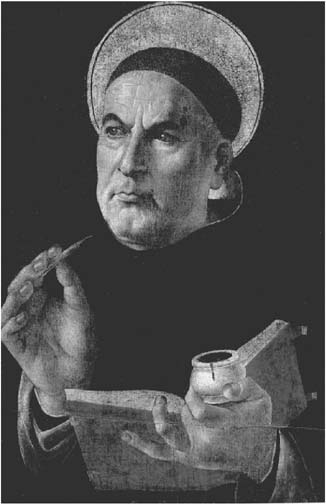
In Thomas Aquinas's thought and writings, poverty is not an end in itself but a means to reach God.
In his later years, Thomas was sent to Naples where he was given the task to establish a Dominican house of studies at the local university. He died in 1274 at the monastery of Fossanova while en route to the Council of Lyons where the pope had summoned him in an attempt to prevent the schism of the Roman and Byzantine church.
Although Thomas's work was shaped by the encounter with academic life in Paris and the discovery of Aristotle, St. Francis of Assisi and the centrality of personal and corporate poverty in the Dominican order were also important influences in his thought. Aquinas's intellectual accomplishment was to stimulate a renewal at both a personal and a larger, institutional level of Catholic life. At a time when the discovery of Aristotelian philosophy and its emphasis upon reason was putting Catholic faith in danger, Aquinas was able to reconcile both reason and revelation in his major work, Summa Theologica, on which he worked until his death. Both in the Summa and in the earlier Contra impugnantes Dei cultum et religionem, Saint Thomas defined poverty as a means to perfection, an “instrumentum perfectionis.”
He was involved in the controversy over mendicant orders against William of Saint-Amour who, in the 1250s, had argued that the ministry of the religious who pretended to dedicate themselves to study and teaching, but who lived not from their work but from mendicancy, was not legitimate. While Aquinas conceded that religious orders could belong to professional bodies, he also forcefully asserted that mendicant orders were forbidden manual labor and thus advocated for them the right to absolute poverty.
...
- Antipoverty Organizations
- African Development Foundation
- American Friends Service Committee
- Anti-Defamation League
- Better Safer World
- Big Brothers Big Sisters
- Campus Compact
- CARE
- Center for Democratic Renewal
- Center for the Study of Urban Poverty
- Center on Budget and Policies Priorities
- Center on Hunger and Poverty
- Charity Organization Society
- Comic Relief
- Cuernavaca Center
- Development Gateway
- Employment Policies Institute
- Engineers Without Borders
- Feinstein Foundation
- Food First
- Food for the Hungry
- Food Research and Action Center
- Foods Resource Bank
- Habitat for Humanity
- Haig Fund
- Hull House
- Institute for Research on Poverty
- Institute for the Study of Homelessness and Poverty
- Institute on Race and Poverty
- International Food Policy Research Institute
- International Labor Organization
- International Monetary Fund
- International Nongovernmental Organizations
- Lawyers Without Borders
- Médecins Sans Frontières
- National Alliance to End Homelessness
- National Association for the Advancement of Colored People
- National Coalition for the Homeless
- National Coalition of Barrios Unidos
- National Coalition on Health Care
- National Conference for Community and Justice
- National Low-Income Housing Coalition
- National Poverty Center
- New Partnership for Africa's Development
- Nongovernmental Organizations
- Salvation Army
- Second Harvest
- Students Against Sweatshops
- UNICEF
- United For a Fair Economy
- World Bank
- World Health Organization
- World Trade Organization
- Children and Poverty
- CDF Black Community Crusade for Children
- Child Malnutrition
- Child Mortality
- Child Welfare League of America
- ChildLine
- Children and Poverty
- Children's Aid Society
- Children's Defense Fund
- Children's Hunger Relief
- Church of England
- Education
- National Association for the Education of Young Children
- National Education Association
- National Fatherhood Initiative
- Nutrition
- Street Children
- Causes of Poverty
- Countries: Africa
- Algeria
- Angola
- Benin
- Botswana
- Brunei Darussalam
- Burkina Faso
- Burundi
- Côte d'Ivoire
- Cameroon
- Cape Verde
- Central African Republic
- Chad
- Comoros
- Congo
- Congo, Democratic Republic
- Djibouti
- Egypt
- Equatorial Guinea
- Eritrea
- Ethiopia
- Gabon
- Gambia
- Ghana
- Guinea
- Guinea-Bissau
- Kenya
- Lesotho
- Liberia
- Libya
- Madagascar
- Malawi
- Mali
- Mauritania
- Mauritius
- Morocco
- Mozambique
- Namibia
- Niger
- Nigeria
- Rwanda
- São Tomé and Principe
- Senegal
- Sierra Leone
- Somalia
- South Africa
- Sudan
- Swaziland
- Tanzania
- Togo
- Tunisia
- Uganda
- Zambia
- Zimbabwe
- Countries: Americas
- Antigua and Barbuda
- Argentina
- Bahamas
- Barbados
- Belize
- Bolivia
- Brazil
- Canada
- Chile
- Colombia
- Costa Rica
- Cuba
- Dominica
- Dominican Republic
- Ecuador
- El Salvador
- Grenada
- Guatemala
- Guyana
- Haiti
- Honduras
- Jamaica
- Mexico
- Nicaragua
- Panama
- Paraguay
- Peru
- Saint Kitts and Nevis
- Saint Lucia
- Saint Vincent and the Grenadines
- Suriname
- Trinidad and Tobago
- United States
- Uruguay
- Venezuela
- Countries: Asia
- Afghanistan
- Azerbaijan
- Bahrain
- Bangladesh
- Bhutan
- Cambodia
- China
- East Timor
- Georgia
- India
- Indonesia
- Iran
- Iraq
- Israel
- Japan
- Jordan
- Kazakhstan
- Korea, North
- Korea, South
- Kuwait
- Kyrgyzstan
- Laos
- Lebanon
- Malaysia
- Maldives
- Moldova
- Mongolia
- Myanmar
- Nepal
- Oman
- Pakistan
- Palestine
- Philippines
- Qatar
- Russia
- Saudi Arabia
- Seychelles
- Singapore
- Sri Lanka
- Syria
- Tajikistan
- Thailand
- Turkey
- Turkmenistan
- Ukraine
- United Arab Emirates
- Uzbekistan
- Vietnam
- Yemen
- Countries: Europe
- Albania
- Andorra
- Armenia
- Austria
- Belarus
- Belgium
- Bosnia and Herzegovina
- Bulgaria
- Croatia
- Cyprus
- Czech Republic
- Denmark
- Estonia
- Finland
- France
- Germany
- Greece
- Hungary
- Iceland
- Ireland
- Italy
- Latvia
- Liechtenstein
- Lithuania
- Luxembourg
- Macedonia (FYROM)
- Malta
- Monaco
- Netherlands
- Norway
- Poland
- Portugal
- Romania
- San Marino
- Serbia and Montenegro
- Slovakia
- Slovenia
- Spain
- Sweden
- Switzerland
- United Kingdom
- Countries: Pacific
- Economics of Poverty
- Agriculture
- Agriculture-Nutrition Advantage
- Area Deprivation
- Bankruptcy
- Basic Income
- Basic Needs
- Basic Security
- Capitalism
- Civil Society
- Class Analysis of Poverty
- Class Structure
- Communism
- Cost of Living
- Credit
- Debt
- Debt Relief
- Debt Swap
- Dependency School
- Deprivation
- Destitution
- Disability Insurance
- Distribution
- Drought
- Economic Distance
- Economic Growth
- Employment
- Employment Theory
- Environmental Degradation
- Equity and Efficiency Trade-Off
- Equivalence Scales
- Family Budgets
- Famine
- Financial Markets
- Fiscal Policy
- Food Shortages
- Foreign Direct Investment
- Free Trade Agreement of Americas
- Fuel Poverty
- Globalization
- Household Consumption
- Household Employment
- Household Income
- Human Capital
- Human Development
- Income
- Income Distribution Theories
- Income Inequality
- Income Poverty
- Inflation
- International Trade
- Intrahousehold Transfers
- Labor Market
- Laissez-Faire
- Lumpenproletariat
- Macroeconomic Policies
- Macroeconomics
- Market Efficiency
- Microeconomics
- Monetary Policy
- Myrdal's Theory of Cumulative Causation
- Needs
- Neoclassical Thought
- Nonincome Poverty
- North American Free Trade Agreement
- OECD Countries
- Outsourcing/Offshoring
- Pension Programs
- Physiocrats
- Planning
- Poverty Trap
- Primary Poverty
- Privatization
- Public Goods
- Public Policy
- Recession
- Redistribution
- Relative Deprivation
- Rural Deprivation
- Scarcity
- Social Democracy
- Socialism
- Stabilization
- Structural Dependency
- Structuralist School
- Supply-Side Economics
- Wage Slavery
- Wages
- War and Poverty
- Water
- Welfare State
- Effects of Poverty
- Crime
- Deprivation
- Destitution
- Disease
- Economic Distance
- Economic Insecurity
- Environmental Degradation
- Exclusion
- Exploitation
- Family Desertion
- HIV/AIDS
- Homelessness
- Malnutrition
- Nonworking Poor
- Rural Deprivation
- Social Disqualification
- Social Exclusion
- Social Inequality
- Social Insecurity
- Starvation
- Stigmatization
- Structural Dependency
- Underclass
- Vulnerability
- Welfare Dependence
- History of Poverty
- Adams, John (Administration)
- Adams, John Quincy (Administration)
- Almshouses
- Ancient Thought
- Apartheid
- Arthur, Chester (Administration)
- Buchanan, James (Administration)
- Bush, George H.W. (Administration)
- Bush, George W. (Administration)
- Carter, James (Administration)
- Cleveland, Grover (Administration)
- Clinton, William (Administration)
- Cold War
- Colonialism
- Coolidge, Calvin (Administration)
- Depression, Great
- Eisenhower, Dwight (Administration)
- Fabian Society
- Feudalism
- Fillmore, Millard (Administration)
- Ford, Gerald (Administration)
- French Revolution
- Garfield, James (Administration)
- Grant, Ulysses (Administration)
- Harding, Warren (Administration)
- Harrison, Benjamin (Administration)
- Harrison, William (Administration)
- Hayes, Rutherford (Administration)
- Hoover, Herbert (Administration)
- Imperialism
- Industrial Revolution
- Industrialization
- Irish Famine
- Jackson, Andrew (Administration)
- Jefferson, Thomas (Administration)
- Johnson, Andrew (Administration)
- Johnson, Lyndon (Administration)
- Kennedy, John F. (Administration)
- Les Misérables
- Lincoln, Abraham (Administration)
- Madison, James (Administration)
- McKinley, William (Administration)
- Medieval Thought
- Mercantilism
- Monroe, James (Administration)
- Nixon, Richard (Administration)
- Pierce, Franklin (Administration)
- Polk, James (Administration)
- Poor Laws
- Reagan, Ronald (Administration)
- Roosevelt, Franklin (Administration)
- Roosevelt, Theodore (Administration)
- Taft, William Howard (Administration)
- Taylor, Zachary (Administration)
- Truman, Harry (Administration)
- Tyler, John (Administration)
- Utopian Socialists
- Van Buren, Martin (Administration)
- War on Poverty
- Washington, George (Administration)
- Wilson, Woodrow (Administration)
- World War I
- World War II
- Measurements and Definitions of Poverty
- Absolute-Income-Based Measures of Poverty
- Arab Definition of Poverty
- Australian Definition of Poverty
- Axiom of Monotonicity and Axiom of Transfers
- Beveridge Scheme
- Brazilian Definition of Poverty
- Bureau of Labor Statistics
- Capability Measure of Poverty
- Chinese Definition of Poverty
- Comparative Research Program on Poverty
- Consumption-Based Measures of Poverty
- Contextual Poverty
- Cost-of-Living-Based Measures of Poverty
- Cyclical Poverty
- Decomposable Poverty Measures
- Definitions of Poverty
- Demographics
- Dependency Ratio
- Deprivation Index
- Direct and Indirect Measures of Poverty
- Duration of Poverty
- Economic Definitions of Poverty
- Economic Insufficiency
- Endemic Poverty
- Engel Coefficient
- European Relative-Income Standard of Poverty
- European Union Definition of Poverty
- Extended Poverty Minimum
- Extreme Poverty
- Food-Ratio Poverty Line
- Foster, Greer, and Thorbecke Index
- Gini Coefficient
- Headcount Index
- Human Poverty Index
- Indicators of Poverty
- Joint Center for Poverty Research
- Living-Standards Measurement Study
- Luxembourg Employment Study
- Luxembourg Income Study
- Mapping Poverty
- Means-Testing
- National Research Council
- Normative Standards
- Overall Poverty
- Peripheral Poverty
- Permanent (Collective) Poverty
- Poverty Assessment
- Poverty Clock
- Poverty Gap
- Poverty Gap Index
- Poverty Rate
- Poverty Research
- Poverty Threshold
- Relative Welfare Index
- Relative-Income-Based Measures of Poverty
- Rural Poverty Research Center
- Scientific Definitions of Poverty
- Secondary Poverty
- Sen Index
- Sen-Shorrocks-Thon Index
- Speenhamland System
- Squared Poverty Gap Index
- Standard Food Basket
- Standard Food Basket Variant
- Standard of Living
- Subjective Measures of Poverty
- TIP Curves
- Totally Fuzzy and Relative (TFR) Poverty Measures
- Traumatic Poverty
- UBN-PL Method
- Ultimate Poverty
- University of Kentucky Center for Poverty Research
- USDA Poverty Line
- Voluntary Poverty
- Working Poor
- World Bank Poverty Lines
- People
- Aquinas, Thomas
- Bellamy, Edward
- Black, Hugo L.
- Brandeis, Louis D.
- Bryan, William Jennings
- Calvin, John
- Carnegie, Andrew
- Coughlin, Charles
- de Soto, Hernando
- Donnelly, Ignatius
- Engels, Friedrich
- Evans, George Henry
- Foucault, Michel
- Francis of Assisi
- Frank, Andre Gunder
- Franklin, Benjamin
- Friedman, Milton
- Galbraith, John Kenneth
- Gandhi, Mahatma
- George, Henry
- Giddens, Anthony
- Gilder, George
- Greeley, Horace
- Harrington, Michael
- Heilbronner, Robert
- Hobbes, Thomas
- Hobson, John
- Lewis, Arthur
- Locke, John
- Luxemburg, Rosa
- Malthus, Thomas
- Marshall, Alfred
- Marx, Karl
- Mill, John Stuart
- Mother Teresa
- Owen, Robert
- Polanyi, Karl
- Prebisch, Raul
- Rawls, John
- Ricardo, David
- Sen, Amartya
- Smith, Adam
- Thompson, T. Phillips
- Wallerstein, Immanuel
- Weber, Max
- Politics and Poverty
- Poverty Relief Initiatives
- Access-to-Enterprise Zones
- Adjustment Programs
- Aid to Families with Dependent Children
- Asset-Based Antipoverty Programs
- Congressional Hunger Center
- Earned-Income Tax Credit
- Economic Growth and Poverty Reduction Strategy
- Federal Targeted Training
- Food Stamps
- G-8 Africa Action Plan
- Great Society Programs
- Guaranteed Assistance
- Head Start
- Heifer Project
- Help the Aged
- Housing Assistance
- Inter-American Development Bank
- International Development Cooperation Forum
- Libyan Arab Jamahiriya
- Living Wage Campaign
- Low-Income Cut-Offs
- Means-Tested Government Antipoverty Programs
- Medicaid
- Medicare
- Microcredit
- Millennium Development Goals
- Minimum Wage
- Pro-Poor Growth
- Rationing
- Regulation
- Rural Antipoverty Programs
- Social Assistance
- Supplemental Security Income
- Temporary Assistance for Needy Families
- UNDP Regional Project for Overcoming Poverty
- Unemployment Insurance
- United Nations Development Program
- Urban Antipoverty Programs
- Wealth Tax
- Work-Welfare Programs
- Workers' Compensation
- Workfare
- Religious and Secular Charities
- Africa Faith and Justice Network
- Brotherhood of St. Laurence
- Catholic Campaign for Human Development
- Christian Antipoverty Campaigns
- Christian Community Health Fellowship
- Christmas Seals
- Church World Services
- Community-Based Antipoverty Programs
- Damascus Road
- Easter Seals
- Evangelicals for Social Action
- Faith-Based Antipoverty Programs
- Franciscan Order
- Goodwill Industries
- International Red Cross and Red Crescent Societies
- Jesuits
- Jubilee 2000
- Judaism and Poverty
- Living Waters for the World
- March of Dimes
- Mendicant Orders
- Milwaukee New Hope Program
- Missionaries
- National Interfaith Committee for Worker Justice
- OXFAM
- Partnership to Cut Hunger in Africa
- Polish Humanitarian Organization
- Presbyterian Hunger Project
- Protestant Churches
- Rebuilding Together
- Roy Wilkins Center
- Samaritans
- Save the Children
- Share Our Strength
- Society of St. Vincent de Paul
- United Methodist Church Initiatives
- United Methodist Committee on Relief
- United Way
- World Concern
- World Food Program
- YMCA and YWCA
- Women and Poverty
- Loading...
Get a 30 day FREE TRIAL
-
 Watch videos from a variety of sources bringing classroom topics to life
 -
Read modern, diverse business cases
-
Explore hundreds of books and reference titles

Read next

More like this
Sage Recommends
We found other relevant content for you on other Sage platforms.
Have you created a personal profile? Login or create a profile so that you can save clips, playlists and searches