
Entry
Reader's guide
Entries A-Z
Subject index
Influenza Pandemic of 1918–19
The influenza that spread throughout the world from 1918 to 1919 was one of the deadliest pandemics in human history. It sickened at least one-quarter of the world's population, 2 to 4 percent of whom died, usually from complications of pneumonia. Influenza killed more people in one year than World War I had killed in four: the flu killed 40 to 50 million compared with 9 to 12 million war dead. The pandemic came in three deadly waves: the first in the spring of 1918, the second and most deadly wave in the late summer and fall of that year, and a third, weaker but still lethal, wave in early 1919. In the United States, an estimated 25 million people became ill and 675,000 died. The influenza pandemic followed wartime transportation routes across oceans and continents, heaping misery on a world already struggling with the mass death and destruction of modern industrial warfare.
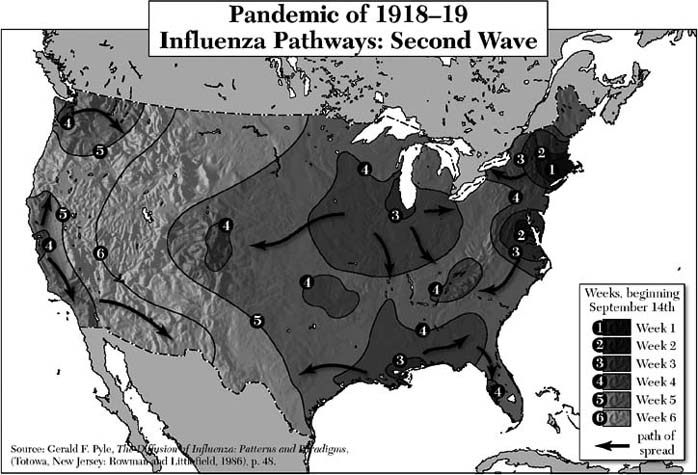
This map shows the sequence and path the influenza pandemic of 1918–19 took across the country.
Like the common flu, the 1918 influenza had a short incubation period, a high sickness rate, and was highly contagious, spreading from person to person most often in airborne droplets. This virus, however, had unusually severe symptoms. A quick onset of illness, high fever, severe headaches, torpor, nosebleeds, a blood-producing cough, and cyanosis—a blue cast to the skin caused by lack of oxygen in the blood—often enabled public health officials to pinpoint to the day the flu's arrival in a community. The 1918 flu was also unusually lethal, especially for young adults. Whereas influenza usually kills only the very weak in a population—the youngest and very oldest—and creates a “U-shaped” mortality curve, the 1918 virus was also deadly to people ages 20 to 40. It killed both the weakest and the strongest in society, producing a “terrible W” curve of high mortality for the young and old at the extremes of the demographic spectrum, with an unusual peak at its center.
Medical professionals did their best to save flu patients, but in an era before virology and antibiotics, they lacked effective tools. Treatment included bed rest, a light diet, aspirin for fever and pain, and keeping the patient warm in hopes of preventing pneumonia. Recovery usually occurred after a few days unless pneumonia, which was often lethal, developed.
The origin of the influenza of 1918 has long been a mystery and the virus responsible was not identified until 1997. Influenza apparently first appeared in March 1918 in the American Midwest and from there spread to soldiers in several U.S. Army training camps. The virus then traveled to Europe, probably aboard troopships, to the Western Front where in May and June it sickened thousands of soldiers but killed few in this first wave. In the wretched conditions of trench warfare, however, the virus flourished, mutating into an especially virulent strain that exploded worldwide in August 1918. This deadly second wave of flu appeared simultaneously in the Atlantic ports of Boston, Brest (France), and Freetown (Sierra Leone), once again following troops and the increased trade generated by the war. From these points (and probably others), it spread throughout the globe within weeks.
...
- Art, Culture, and Memory
- “Star-Spangled Banner, The”
- Apocalypse Now
- Beetle Bailey
- Born on the Fourth of July
- Combat!
- Deer Hunter, The
- Farewell to Arms, A
- From Here to Eternity
- Hiroshima
- M*A*S*H
- Naked and the Dead, The
- Platoon
- Red Badge of Courage
- Twelve O’ Clock High
- WarGames
- Ali, Muhammad
- Atrocity and Captivity Narratives
- Baby Boom
- Best Years of Our Lives, The
- Bierce, Ambrose
- Bridges at Toko-Ri, The
- Caine Mutiny
- Captain Marvel Comic Books
- Dr. Strangelove
- Enola Gay Controversy
- Film and War
- Gun Ownership
- Hunt for Red October, The
- Language and War
- Literature and War
- Mauldin, Bill
- Media and War
- Memorial Day
- Memorials and Monuments
- Memory and War
- Military Reenactments
- Murphy, Audie
- Music and War
- Musical Theater and War
- Newsreels
- Niles, John Jacob
- Radio in World War II
- Rambo
- Sad Sack, The
- Saving Private Ryan
- Seven Days in May
- Sport and War
- Television and War
- Theater and War
- Victory Gardens
- Visual Arts and War
- War Brides
- Wargaming
- Wayne, John
- Economics and Labor
- Aerospace Industry
- Arms Trade
- Baby Boom
- Civilian Conservation Corps
- Conscription and Volunteerism
- Economy and War
- Filibustering
- Greenbacks
- Gunboat Diplomacy
- Impressment
- Labor Strikes
- Marshall Plan
- Military–Industrial Complex
- Munitions Industry
- National System of Interstate and Defense Highways
- New York City Anti-Draft Riots
- Rationing in Wartime
- Revolutionary War Food Riots
- War Industries Board
- War Labor Board
- War Profiteering
- Women in the Workforce: World War I and World War II
- Education
- Environment, Health, and Medicine
- Gender
- Barton, Clara
- Camp Followers
- Commission on Training Camp Activities
- Families, Military
- Gays and Lesbians in the Military
- Mahan, Dennis Hart
- Nurses, Military
- Pinups
- Rosie the Riveter
- Sampson, Deborah
- Sexual Abuse and Harassment
- Stratton, Dorothy C.
- Tailhook Convention
- Victory Gardens
- War Brides
- Women in the Military
- Women in the Workforce in World War I and World War II
- Women's International League for Peace and Freedom
- Media and Journalism
- Enola Gay Controversy
- Brady, Mathew B.
- Censorship and the Military
- CNN
- Combat-Zone Photography
- Committee on Public Information
- Frontline Reporting
- Greeley, Horace
- Mauldin, Bill
- Media and War
- Militant Liberty
- My Lai Massacre
- Newsreels
- Office of Censorship
- Office of War Information
- Pentagon Papers
- Political Cartoons
- Propaganda and Psychological Operations
- Pyle, Ernie
- Radio Free Europe
- Radio in World War II
- Recruiting Advertisements
- Television and War
- Voice of America
- Law and Justice
- United States v. Seeger and Welsh v. United States
- American Civil Liberties Union
- Andersonville
- Articles of War
- Court of Military Appeals
- Customs of War
- Desertion
- Doolittle Board
- Draft Evasion and Resistance
- Espionage and Sedition Acts
- Executive Order 8802
- Fort Pillow Massacre
- General Orders, No. 100
- Geneva and Hague Conventions
- Genocide
- Impressment
- Just War Theory
- My Lai Massacre
- Posse Comitatus Act
- Prisoners of War
- Quantrill's Raiders
- Tiger Force Recon Scandal
- Uniform Code of Military Justice
- People-Military Leaders and Figures
- Arnold, Henry Harley
- Brant, Joseph and Margaret “Molly” Brant
- Butler, Smedley Darlington
- Chief Joseph
- Crazy Horse
- Custer, George Armstrong
- Davis, Jefferson
- Eisenhower, Dwight D.
- Forrest, Nathan Bedford
- Geronimo
- Grant, Ulysses S.
- Halsey, William F., Jr.
- Hitchcock, Ethan Allen
- Jones, John Paul
- Lee, Robert E.
- LeMay, Curtis Emerson
- Lynch, Jessica
- MacArthur, Douglas
- Mahan, Alfred Thayer
- Marshall, George Catlett
- Mitchell, William “Billy”
- Murphy, Audie
- Nimitz, Chester William
- Osceola
- Patton, George
- Pershing, John Joseph
- Pontiac
- Powell, Colin
- Rickover, Hyman
- Ridgway, Matthew Bunker
- Roosevelt, Theodore
- Sampson, Deborah
- Schwarzkopf, H. Norman
- Scott, Winfield
- Sheridan, Philip H.
- Sherman, William Tecumseh
- Spaatz, Carl
- Stratton, Dorothy C.
- Tecumseh
- York, Alvin Cullum
- Planning, Strategy, and Command and Control
- Aerial Bombardment
- All Volunteer Force
- Berlin Crises
- Civil Defense
- Civil–Military Relations
- Coastal Patrolling
- Colonial Militia Systems
- Continental Army
- Cuban Missile Crisis
- Desertion
- European Military Culture, Influence of
- Goldwater–Nichols Act
- Homeland Security
- Impressment
- Intelligence Gathering in War
- Joint Chiefs of Staff
- Marine Corps
- McNamara, Robert S.
- Merchant Marine
- Militarization and Militarism
- Military Bases
- Militia Groups
- National Guard
- National Security Council Memorandum-68
- National War College
- Nitze, Paul Henry
- Nuclear Strategy
- Prisoners of War
- Private Military Contractors
- Public Opinion and Policy in Wartime
- Rangers
- Reconstruction
- Replacement Depots
- Rumsfeld, Donald
- Selective Service System
- Strategic Air Command
- Systems Analysis
- Think Tanks
- War Powers Resolution
- Washington, George
- Weinberger–Powell Doctrine
- Politics
- Enola Gay Controversy
- Ali, Muhammad
- American Civil Liberties Union
- Antiwar Movements
- Civil–Military Relations
- Draft Evasion and Resistance
- Eisenhower, Dwight D.
- Filibustering
- Geneva and Hague Conventions
- Genocide
- Goldwater–Nichols Act
- Holocaust, U.S. Response to
- Impressment
- Isolationism
- Jackson, Andrew
- Lincoln, Abraham
- McKinley, William
- McNamara, Robert S.
- My Lai Massacre
- Nitze, Paul Henry
- Pacifism
- Polk, James K.
- Posse Comitatus Act
- Powell, Colin
- Prisoners of War
- Public Opinion and Policy in Wartime
- Roosevelt, Franklin Delano
- Roosevelt, Theodore
- Rumsfeld, Donald
- Truman, Harry S.
- Veteran Status and Electability
- War Powers Resolution
- Washington, George
- Wilson, Woodrow
- Women's International League for Peace and Freedom
- Race and Ethnicity
- 442nd Regimental Combat Team of Nisei
- 54th Regiment of Massachusetts Volunteer Infantry
- African Americans in the Military
- Ali, Muhammad
- Atrocity and Captivity Narratives
- Brownsville Riot
- Buffalo Soldiers
- Continental Army, Foreign Officers in
- Davis, Benjamin O. Sr.
- Du Bois, W. E. B.
- Executive Order 9981
- Fighting 69th
- Foreign Officers in the Continental Army
- German and Italian Americans, Internment of
- Great Migration
- Harlem Hellfighters
- Hastie, William Henry
- Indian Army Scouts
- Japanese Americans, Internment of
- Latinos in the Military
- Native Americans in Colonial Wars and the Revolutionary War
- Native Americans in the Military
- Port Chicago Mutiny
- Powell, Colin
- Race Riots
- Racial Integration of the Armed Forces
- Randolph, A. Philip
- Schuyler, George
- Shaw, Robert Gould
- Young, Charles
- Zoot Suit Riot
- Religion
- Science and Technology
- Aerospace Industry
- Armored Vehicles
- Arms Trade
- Computer Technology and Warfare
- Defense Advanced Research Projects Agency
- Manhattan Project
- Munitions Industry
- National Space Program
- National System of Interstate and Defense Highways
- Oppenheimer, J. Robert
- Satellite Technology
- Technology and Revolutionary Changes in Military Affairs
- Ultra and Enigma
- Soldiering and Veterans’ Affairs
- American Legion
- American Veterans Committee
- AMVETS
- Bonus March
- Combat, Effects of
- Disabled American Veterans
- GI Bills
- Grand Army of the Republic
- Memory and War
- Psychiatric Disorders, Combat Related
- Revolutionary War Pensions
- Society of the Cincinnati
- Tomb of the Unknown Soldier
- Veterans Administration
- Veterans Day
- Veterans of Foreign Wars
- Vietnam Veterans against the War
- Vietnam Veterans of America
- Wars
- Boxer Rebellion
- Central America and the Caribbean, Interventions in
- Civil War
- Cold War
- Colonial Wars
- Indian Wars: Eastern Wars
- Indian Wars: Seminole Wars
- Indian Wars: Western Wars
- Iraq War
- Korean War
- Mexican War
- Mormons, Campaign against the
- Peacekeeping Operations
- Persian Gulf War
- Philippine War
- Revolutionary War
- Russia U.S. Intervention in
- Spanish–American War
- Vietnam War
- War of 1812
- War on Terrorism
- World War I
- World War II
- Loading...
Get a 30 day FREE TRIAL
-
 Watch videos from a variety of sources bringing classroom topics to life
 -
Read modern, diverse business cases
-
Explore hundreds of books and reference titles

Read next

More like this
Sage Recommends
We found other relevant content for you on other Sage platforms.
Have you created a personal profile? Login or create a profile so that you can save clips, playlists and searches