
Entry
Reader's guide
Entries A-Z
Subject index
Documents
1609 Rev. William Symonds's Sermon Criticizing the Virginia Company's Violence against Natives
1611 John Winthrop on the Evils of Gun Ownership
1613 Defense by William Strachey of the Virginia Company's Violence against Natives
1622 Virginia Co. Sec. Edward Waterhouse Defends Company's Conduct during 1622 War
1637 Excerpt from Captain John Underhill's Account of a Raid on a Pequot Village
1654 Letter of Roger Williams
1712 John Barnwell's Expedition against the Tuscaroras of North Carolina
1737 Massachusetts's Rev. William Williams on Just Wars
1747 Massachusetts Lt. Gov. Thomas Hutchinson's Observations on the Boston Press Gang Riot of 1747 in His History of the Colony
1759 Petition from Army Wife Martha May for Freedom to Carry Water to Troops
1760 Lt. Col. James Grant and Gen. Jeffrey Amherst Discuss How to Subdue the Cherokees
1766 Comments from British Pamphlet on Colonies’ Refusal to Pay Taxes
1768 a A Letter from Samuel Adams to the Boston Gazette
1768 b Excerpts from Tryon's Journal of the Expedition into the Backcountry
1772 Excerpt from “The Dangers of Standing Armies” by Joseph Warren
1774 North Carolina Militia Act of 1774
1775 Peter Oliver's Interview with POW William Scott
1776 a Distribution of Enlisted Men and Officers over Wealthholding Thirds of Total Ratable State Population
1776 b Gen. Washington's Letter to Continental Congress on Reenlistment Difficulties
1776 c Account of Walter Bates, Connecticut Loyalist
1777 a Petition of Samuel Townsend to New York State Convention
1777 b Account Concerning Connecticut Men's Refusal to Serve in the Revolutionary War
1777 c The Rifleman's Song at Bennington
1785 Tory Veteran's Testimony Concerning Treatment by Patriots
1797 Gov. Samuel Adam's Farewell Address
1800 Excerpt from Mason Weems's A History of the Life and Death, Virtues & Exploits of General George Washington
1814 Treaty of Ghent
1824 Lyrics to a Popular Song Celebrating Jackson's Victory over the British
1830 Sec. of War John Eaton on Inability to Fill Army Ranks
1833 Revolutionary War Pension Application
1835 A Crisis of Conscience and Ethan Allen Hitchcock
1838 Lyrics to “Benny Havens, Oh!”
1846 a Letter from Pres. James Polk to House of Representatives on Secrecy in Executive Branch Dealings
1846 b Excerpts from The Biglow Papers
1849 Lyrics to “I’m Off For Nicaragua”
1850 Excerpt from A. A. Livermore's War with Mexico
1861 a Officers Staying in the U.S. Army or Joining the Confederacy, by Region of Birth
1861 b Mark Twain's Account of His Brief Confederate Career
1861 c An Englishman's Memory of Enlisting in an Arkansas Regiment
1861 d Examples of Confederate Soldiers’ Experiences on Battlefield
1861 e Excerpt from Anglo-African Editorial
1861 f Comments of African American Spy Allan Pinkerton
1862 a Excerpt from Official Army Records on Impressment of Black Workers
1862 b Exchange between Horace Greeley and Abraham Lincoln
1863 a Enlistment Speech to African Americans
1863 b Frederick Douglass's Comments on the Recruitment of His Sons
1863 c Letter of Lewis Douglass to Future Wife
1863 d Letter of Captain M. M. Miller to His Aunt
1863 e Account of Col. Thomas J. Morgan Concerning His African American Brigade
1863 f Account of Black Physician on Escape from Anti-Draft/Anti-Black Riots
1863 g Letter from Grant to Lincoln on Recruitment of African Americans
1863 h Excerpts from General Orders, No. 100
1863 i Lyrics to “Just Before the Battle, Mother”
1864 a Comments of Black Sailor George Reed
1864 b Excerpt from Sherman's Memoirs on His March from Atlanta to the Sea
1864 c Excerpts from the Writings of Oliver Wendell Holmes, Jr.
1865 a New York Tribune's Comments on the 54th Regiment of Massachusetts
1865 b Lyrics to “I’m A Good Old Rebel”
1866 John Faller, Andersonville POW, on His Captivity
1899 Two Songs Popular among Naval Officers Dating from the Philippine War
1900 Black Soldier's Letter to a Wisconsin Editor on American Treatment of Filipinos
1908 Leonard Wood on Preparedness and Civil Obligation of the Army
1910 Excerpts from William James's Essay, “The Moral Equivalent of War”
1915 a Excerpts from The Poet in the Desert by Charles Erskine Scott Wood
1915 b Lyrics to “I Didn’t Raise My Boy to Be a Soldier”
1917 a Mother's Poem: “I Didn’t Raise My Boy” by Abbie Farwell Brown
1917 b Lyrics to “Over There,” or “Johnnie Get Your Gun”
1917 c John Simpson's Letter to Senator
1917 d “Uncle Sam's Little War in the Arkansas Ozarks,” a Report of Draft Resistance in the Literary Digest
1917 e Alpha IQ Tests Administered to Recruits
1917 f Beta IQ Tests Administered to Recruits
1918 a The Man's Poem and The Woman's Response
1918 b Verse of the American Expeditionary Force, 1918–1919
1918 c Selected Songs from the Compilations of John Jacob Niles
1918 d President Woodrow Wilson's Fourteen Points
1919 a Florence Woolston Reflects on the Effect of World War I on Her Nephew Billy
1919 b DuBois Writes of Returning Soldiers
1919 c African American Reaction to D.C. Race Riots
1919 d Facts and Questions Concerning the NREF
1919 e Lyrics to “How ’ya Gonna Keep ’em Down on the Farm (After They’ve Seen Paree?)”
1919 f Excerpts from the Diary of Sgt. Will Judy
1929 Lyrics to “Marines’ Hymn”
1930 Excerpt from Nineteen Nineteen by John Dos Passos
1932 “The Bonuseers Ban Jim Crow” by Roy Wilkins
1933 Excerpts from Company K by William March
1938 A Massachusetts Veteran Reflects on Memorial Day Ceremonies
1940 War Activity, November 1943, and Civilian Population Change, 1940 to November 1, 1943
1941 Executive Order 8802: Prohibition of Discrimination in the Defense Industry
1942 a Letters from Black Soldiers in World War II
1942 b Black Serviceman Lester Simons's Account of Training Experience
1942 c Marine's Letter to Father Concerning His Experience in Guadalcanal #1
1942 d Marine's Letter to Father Concerning His Experience in Guadalcanal #2
1942 e Monica Itoi Sone's Account of Her Transfer to a Japanese Internment Camp
1942 f Interviews with Japanese-Americans Regarding Mistreatment during World War II
1943 Excerpt from Bill Mauldin's Up Front
1944 a Excerpt from Ernie Pyle's Brave Men
1944 b Excerpts from Pacific War Diary 1942–1945 by James J. Fahey
1944 c Black Soldier's Encounter with Racism and its Psychological Effects
1945 a Black Serviceman's Account of Confrontation with Battalion Commander
1945 b Black Soldiers’ Recollections of Their Experiences in World War II
1945 c Soldiers’ Poems on the Horrors of War
1945 d John Ciardi's “A Box Comes Home”
1945 e Excerpt from Bill Mauldin's Brass Ring
1945 f Excerpts from Company Commander by Charles B. MacDonald
1946 a Remarks of Navajo Veteran on Serving in the Military
1946 b Excerpts from Hiroshima by John Hersey
1947 Excerpts from Bill Mauldin's Back Home
1948 a Psychiatric Case History of World War II Tailgunner
1948 b Executive Order 9981: Desegregation of the Armed Forces
1949 Attitude of Veterans and Nonveteran Fathers during World War II Toward Personality Characteristics of First-Born
1950 a World War II Veteran's Account of Experience in Service
1950 b Lyrics to the R.O.T.C. Song
1950 c Random House's Bennett Cerf Praising Military after Attending JCOC
1950 d Excerpt from Harry J. Maihafer's From the Hudson to the Yalu: West Point in the Korean War
1951 Recall of Gen. Douglas MacArthur
1953 Case History of World War II Psychiatric Casualty
1957 Excerpt from Born on the Fourth of July by Ron Kovic
1961 Pres. Dwight D. Eisenhower's Farewell Address
1964 Veteran Harold Bond's Reflections on Returning to Monte Cassino
1965 a Seymour Melman on America's Aging Metal-Working Machinery
1965 b Selective Service System's Channeling Manpower Memo
1965 c Case Report on Psychiatric Illness of Submariner's Wife
1965 d Letter Home from Serviceman on Combat Experience
1965 f Excerpts from A Rumor of War by Philip Caputo
1966 a Letters from Vietnam GIs on Killing Enemies in Combat
1966 b Letter from Vietnam GI Objecting to Antiwar Protesters
1966 c Air Force Officer Dale Noyd's Letter of Resignation
1966 d Excerpts from Soldados: Chicanos in Viet Nam
1967 a Postings to Tiger Force Website in Response to Toledo Blade Revelations
1967 b Environmental Effects of War in Vietnam
1968 a Accounts of Servicemen's Combat-Related Psychiatric Disorder
1968 b Defense and NASA Spending in Various States
1969 Survey of Veteran's Opinions on Effects of Service
1970 a Open Letter of Chicana GI Widow
1970 b Widow of Air Force Pilot's Account of Her Experience and Attitude Toward the War
1970 c Excerpts from “Pentagon Papers” Supreme Court Briefs
1971 a Letters to Editors of SGT Fury and His Howling Commandos
1971 b Interview with U.S. Army Col. David H. Hackworth
1971 c Drug Use in the Army
1971 d Did Vietnam Turn GIs into Addicts?
1972 Remarks of Black Veteran on His Return to Pennsylvania
1973 War Powers Resolution
1975 Lt. Keffer's Reflections on Attending a Reunion of Buchenwald Survivors
1976 a Excerpts from Book Two (Intelligence Activities and the Rights of Americans) of the Church Committee Report
1976 b Remarks of Deserter on Eve of His Surrender to Authorities
1977 Remarks of Mother on the Death of Her Son and the Pardon of Draft Resisters
1988 Editorial on Loss of Military Service as a Rite of Passage by Gerald A. Patterson
2000 “Principles of Ethical Conduct…The Ultimate Bait and Switch” by Peter L. Duffy
2001 “The Harvest Matrix 2001”
2004 a Yale Law School Faculty Suit against Department of Defense Regarding On-campus Recruitment
2004 b Statement by Christian Leaders Condemning a “Theology of War”
2004 c Interview with Yale Graduate Tyson Belanger who Served in the Iraq War
1609
REV. WILLIAM SYMONDS'S SERMON CRITICIZING THE VIRGINIA COMPANY'S VIOLENCE AGAINST NATIVES
Some of the early English and Scots colonists in their North American “plantations” treated indigenous peoples with unwarranted violence. This led some of their countrymen to remind them of Christian Just War concepts. Example: word came to the spiritual leader of the Plymouth Pilgrims, Pastor John Robinson, in 1623 that the Plantation's employed military leader, Capt. Miles Standish, had led a sortie against Massachusetts Native Americans who had threatened the lives of fur trader Thomas Weston and his men, claiming that Weston had cheated them. Standish had killed several. “Oh, how happy a thing had it been,” Robinson wrote, “if you had converted some before you had killed any! … [Y]ou being no magistrates over them were to consider [only] what by necessity you were constrained to inflict. Necessity of this … I see not … [I]ndeed I am afraid lest, by these occasions, others should be drawn to affect a kind of ruffling course in the world.” Similarly, in the passage that follows, Rev. William Symonds, troubled by news of the killing of a number of Tidewaters in Virginia, delivered these admonitions during a London religious service for those about to join the first wave of colonists in 1609:
O but, in entering of other countries, there must needs be much lamentable effusion of blood. Certainly our objector was hatched of some popish egg; & it may be in a JESUITS vault, where they feed themselves fat, with tormenting innocents. Why is there no remedy, but as soon as we come on land, like Wolves, and Lions, and Tigers, long famished, we must tear in pieces, murder, and torment the natural inhabitants, with cruelties never read, nor heard of before? must we needs burn millions of them, and cast millions into the sea? must we bait them with dogs, that shall eat up the mothers with their children? let such be the practices of the devil, of Abaddon the son of perdition, of Antichrist and his frie, that is of purple Rome. As for the professors of the Gospel, they know with Jacob and his posterity, to say to Pharaoh, To Sojourn in the land are we come; for thy servants have no pasture, &c. They can with Sampson live peaceably with the Philistines, till they be constrained by injustice, to stand upon their defence. They can instruct the barbarous princes, as Joseph did Pharaoh and his Senators; and as Daniel did Nabuchad-nezer, &c. And if these objectors had any brains in their head, but those which are sick, they could easily find a difference between a bloody invasion, and the planting of a peaceable Colony, in a waste country, where the people do live but like Deer in herds, and (no not in this stooping age, of the gray headed world, full of years and experience) have not as yet attained unto the first modesty that was in Adam, that knew he was naked, where they know no God but the devil, nor sacrifice, but to offer their men and children unto Moloch. Can it be a sin in Philip, to join himself to an Ethiopian charet? Is only now the ancient planting of Colonies, so highly praised among the Romans, and all other nations, so vile and odious among us, that what is, and hath been a virtue in all others, must be sin in us?
NOTE: The language and typography in this excerpt have been updated to modern English.
SOURCE: William Symonds, A Sermon Preached at White-Chappel (London: Eleazar Edgar, 1609).
RELATED ENTRIES: Colonial Wars; Just War Theory; Religion and War
1611
JOHN WINTHROP ON THE EVILS OF GUN OWNERSHIP
By the time that the English were beginning to colonize North America, the British Parliament had begun to limit the owning and use of firearms largely to men of property, in part to curb the poaching of game on their estates. Nevertheless, some men without property acquired firearms. In 1611 young John Winthrop (soon to become the chief magistrate of the English court at Norwich, East Anglia, and, in time, the first governor of the Puritan's Massachusetts Bay Colony) offered these entertaining thoughts in his diary on his use of his musket.
Finding by much examination that ordinary shooting in a gun, etc: could not stand with a good conscience in my self, as first, for that it is simply prohibited by the law of the land, upon this ground amongst others, that it spoils more of the creatures than it gets: 2 it procures offence unto many: 3 it wastes great store of time: 4 it toils a man's body overmuch: 5 it endangers a man's life, etc: 6 it brings no profit all things considered: 7 it hazards more of a man's estate by the penalty of it, than a man would willingly part with: 8 it brings a man of worth and godliness into some contempt: —lastly for mine own part I have ever been crossed in using it, for when I have gone about it not without some wounds of conscience, and have taken much pains and hazarded my health, I have gotten sometimes a very little but most commonly nothing at all towards my cost and labor:
Therefore I have solved and covenanted with the Lord to give over altogether shooting at the creek; —and for killing of birds, etc: either to leave that altogether or else to use it, both very seldom and very secretly. God (if he please) can give me fowl by some other means, but if he will not, yet, in that it is [his] will who loves me, it is sufficient to uphold my resolution.
NOTE: The language and typography in this excerpt have been updated to modern English.
SOURCE: Winthrop Papers, vol. 1, 1498–1628 (Boston: Massachusetts Historical Society, 1929).
RELATED ENTRIES: Colonial Militia Systems; European Military Culture, Influence of; Gun Ownership; Militia Groups
1613
DEFENSE BY WILLIAM STRACHEY OF THE VIRGINIA COMPANY'S VIOLENCE AGAINST NATIVES
Criticism of the treatment by Virginia colonists of some of their Rapahanock and Powhatan Confederacy neighbors continued to be expressed in English circles, prompting that colony's secretary, William Strachey, to include these passages in the company's defense within his report of the colony's first five years of operation.
… What open and actual injury shall we do to the poor and innocent inhabitants to intrude upon them? I must ask them again, In which shall we offer them injury? for proffering them trade, or the knowledge of Christ? From one of these two or both the injury must proceed. Why? What injury can it be to people of any nation for Christians to come unto their ports, havens, or territories, when the law of nations (which is the law of God and man[)] doth privilege all men to do so, which admits it lawful to trade with any manner of people, in so much as no man is to take upon him (that knoweth any thing) the defence of the savages in this point, since the savages themselves may not impugn or forbid the same, in respect of common fellowship and community betwixt man and man; albeit I will not deny but that the savages may (without peradventure) be ignorant of as much, and (alas) of more graces beside, and particularities of humanity, the reason whereof being, because (poor souls) they know not the good which they stand in need of; but we that are Christians do know how this law (enriching all kingdoms) gives privileges to ambassadors, keeps the seas common and safe, lays open ports and havens, and allows free scales and liberal access for whosoever that will import unto them such commodities as their countries have, and they want; or export from them some of their plenty (duties and customs provincial observed). If this be so for the first, concerning the other it may fully be answered with this demand, shall it not follow, if traffic be thus justifiable (which intended nothing but transitory profit and increase of temporal and worldly goods) shall not planting the Christian faith be much more? Yes by how much the divine good (not subject to change, and under no alteration), excels, takes an account, and surveys, and surpasseth all things, and all our actions are to bend their intentions thitherward; and what way soever we make, yet miserable and wretched he whose every line he draws, every act and thought do not close and meet in the center of that….
But yet it is injurious to the natural inhabitants, still say ours. Wherefore? It is because it is, now indeed, a most doughty and material reason, a great piece of injury to bring them (to invert our English proverb) out of the warm sun, into God's blessing; to bring them from bodily wants, confusion, misery, and these outward anguishes, to the knowledge of a better practice, and improving of these benefits (to a more and ever during advantage, and to a civiler use) which God hath given unto them, but involved and hid in the bowels and womb of their land (to them barren and unprofitable, because unknown); nay, to exalt, as I may say, mere privation to the highest degree of perfection, by bringing their wretched souls (like Cerberus, from hell) from the chains of Satan, to the arms and bosom of their Saviour: here is a most impious piece of injury. Let me remember what Mr. Simondes, preacher of St. Saviour's, saith in this behalf: It is as much, saith he, as if a father should be said to offer violence to his child, when he beats him to bring him to goodness. Had not this violence and this injury been offered to us by the Romans (as the warlike Scots did the same, likewise, in Caledonia, unto the Picts), even by Julius Caesar himself, then by the emperor Claudius, who was therefore called Britannicus, and his captains, Aulus Plautius and Vespatian (who took in the Isle of Wight); and lastly, by the first lieutenant sent hither, Ostorius Scapula (as writes Tacitus in the life of Agricola), who reduced the conquered parts of our barbarous island into provinces, and established in them colonies of old soldiers; building castles and towns, and in every corner teaching us even to know the powerful discourse of divine reason (which makes us only men, and distinguisheth us from beasts, amongst whom we lived as naked and as beastly as they). We might yet have lived overgrown satyrs, rude and untutored, wandering in the woods, dwelling in caves, and hunting for our dinners, as the wild beasts in the forests for their prey, prostituting our daughters to strangers, sacrificing our children to idols, nay, eating our own children, as did the Scots in those days, as reciteth Tho. Cogan, bachelor of physic, in his book De Sanitate, cha. 137, printed 1189, …
All the injury that we purpose unto them, is but the amendment of these horrible heathenisms, and the reduction of them to the aforesaid manly duties, and to the knowledge (which the Romans could not give us) of that God who must save both them and us, and who bought us alike with a dear sufferance and precious measure of mercy.
For the apter enabling of our selves unto which so heavenly an enterprise, who will think it an unlawful act to fortify and strengthen our selves (as nature requires) with the best helps, and by sitting down with guards and forces about us in the waste and vast unhabited grounds of theirs, amongst a world of which not one foot of a thousand do they either use, or know how to turn to any benefit; and therefore lies so great a circuit vain and idle before them? Nor is this any injury unto them, from whom we will not forcibly take of their provision and labours, nor make rape of what they cleanse and manure; but prepare and break up new grounds, and thereby open unto them likewise a new way of thrift or husbandry; for as a righteous man (according to Solomon) ought to regard the life of his beast, so surely Christian men should not show themselves like wolves to devour, who cannot forget that every soul which God hath sealed for himself he hath done it with the print of charity and compassion; and therefore even every foot of land which we shall take unto our use, we will bargain and buy of them, for copper, hatchets, and such like commodities, for which they will even sell themselves, and with which they can purchase double that quantity from their neighbours; and thus we will commune and entreat with them, truck, and barter, our commodities for theirs, and theirs for ours (of which they seem more fain) in all love and friendship, until, for our good purposes towards them, we shall find them practice violence [no more].
NOTE: The language and typography in this excerpt have been updated to modern English.
SOURCE: William Strachey, The Historie of Travaile into Virginia Britannia (London: Hackluyt Society, 1849).
RELATED ENTRIES: Colonial Wars; Just War Theory
1622
VIRGINIA COMPANY SEC. EDWARD WATERHOUSE DEFENDS COMPANY'S CONDUCT DURING 1622 WAR
A defense similar to the one above (see document, 1613), but one more frank in its tone, was offered nine years later by Strachey's successor, Edward Waterhouse, after the Powhatan had attacked the colony in 1622, killing 25 percent of its population, in an attempt to regain lands and sovereignty.
THUS have you seen the particulars of this massacre, out of Letters from thence written, wherein treachery and cruelty have done their worst to us, or rather to themselves; for whose understanding is so shallow, as not to perceive that this must needs be for the good of the Plantation after, and the loss of this blood to make the body more healthful, as by these reasons may be manifest.
First, Because betraying of innocency never rests unpunished: And therefore Agesilaus, when his enemies (upon whose oath of being faithful he rested) had deceived him, he sent them thanks, for that by their perjury, they had made God his friend, and their enemy.
Secondly, Because our hands which before were tied with gentleness and fair usage, are now set at liberty by the treacherous violence of the Savages not untying the Knot, but cutting it: So that we, who hitherto have had possession of no more ground than their waste, and our purchase at a valuable consideration to their own contentment, gained; may now by right of War, and law of Nations, invade the Country, and destroy them who fought to destroy us: whereby we shall enjoy their cultivated places, turning the laborious Mattock into the victorious Sword (wherein there is more both ease, benefit, and glory) and possessing the fruits of others labours. Now their cleared grounds in all their villages (which are situate in the fruitfullest places of the land) shall be inhabited by us, whereas heretofore the grubbing of woods was the greatest labour.
Thirdly, Because those commodities which the Indians enjoyed as much or rather more than we, shall now also be entirely possessed by us. The Deer and other beasts will be in safety, and infinitely increase, which heretofore not only in the general huntings of the King (whereat four or five hundred Deer were usually slain) but by each particular Indian were destroyed at all times of the year, without any difference of Male, Dame, or Young. The like may be said of our own Swine and Goats, whereof they have used to kill eight in ten more than the English have done. There will be also a great increase of wild Turkeys, and other weighty Fowl, for the Indians never put difference of destroying the Hen, but kill them whether in season or not, whether in breeding time, or sitting on their eggs, or having new hatched, it is all one to them: whereby, as also by the orderly using of their fishing Wares, no other known Country in the world will so plentifully abound in victual.
Fourthly, Because the way of conquering them is much more easy than of civilizing them by fair means, for they are a rude, barbarous, and naked people, scattered in small companies, which are helps to Victory, but hinderances to Civility: Besides that, a conquest may be of many, and at once; but civility is in particular, and flow, the effect of long time, and great industry. Moreover, victory of them may be gained many ways; by force, by surprise, by famine in burning their Corn, by destroying and burning their Boats, Canoes, and Houses, by breaking their fishing Wares, by assailing them in their huntings, whereby they get the greatest part of their sustenance in Winter, by pursuing and chasing them with our horses, and blood-Hounds to draw after them, and Mastiffs to tear them, which take this naked, tanned, deformed Savages, for no other than wild beasts, and are so fierce and fell upon them, that they fear them worse than their own Devil which they worship, supposing them to be a new and worse kind of Devils than their own. By these and sundry other ways, as by driving them (when they flee) upon their enemies, who are round about them, and by animating and abetting their enemies against them, may their ruin or subjection be soon effected….
Fiftly, Because the Indians, who before were used as friends, may now most justly be compelled to servitude and drudgery, and supply the [?] of men that labour, whereby even the meanest of the Plantation may employ themselves more entirely in their Arts and Occupations, which are more generous, whilst Savages perform their inferiour works of digging in mines, and the like, of whom also some may be sent for the service of the Sommer Ilands.
Sixtly, This will for ever hereafter make us more cautious and circumspect, as never to be deceived more by any other treacheries, but will serve for a great instruction to all posterity there, to teach them that Trust is the mother of Deceit, and to learn them that of the Italian, Chi non fida, non s’ingamuu, He that trusts is not deceived; and make them know that kindnesses are misspent upon rude natures, so long as they continue rude; as also, that Savages and Pagans are above all other for matter of Justice ever to be suspected. Thus upon this Anvil shall we now beat out to our selves an armour of proof, which shall for ever after defend us from barbarous Incursions, and from greater dangers that otherwise might happen. And so we may truly say according to the French Proverb, Aquelq, chose malheur est bon, Ill luck is good for something.
Lastly, We have this benefit more to our comfort, because all good men do now take much more care of us than before, since the fault is on their sides, not on ours, who have used so-fair a carriage, even to our own destruction. Especially his Majesties most gracious, tender and paternal care is manifest herein, who by his Royal bounty and goodness, hath continued his many favors unto us, with a new, large, & Princely supply of Munition and Arms, out of his Majesties own store in the Tower, being graciously bestowed for the safety and advancement of the Plantation. As also his Royal favor is amply extended in a large supply of men and other necessaries throughout the whole Kingdom, which are very shortly to be sent to VIRGINIA.
NOTE: The language and typography in this excerpt have been updated to modern English.
SOURCE: Edward Waterhouse, A Declaration of the State of the Colony and the Affaires in Virginia (London, 1622).
RELATED ENTRIES: Colonial Wars; Just War Theory; Religion and War
1637
EXCERPT FROM CAPTAIN JOHN UNDERHILL's ACCOUNT OF A RAID ON A PEQUOT VILLAGE
Several thousand Puritans from England and the Massachusetts Bay Colony migrated in the mid-1630s to what is now Connecticut. In the eastern half of that region they came to loggerheads with the powerful Pequot nation whose people brooked no trespass on their domains. Violent encounters between Pequot and newcomers led to a Puritan punitive expedition in 1637. Capt. John Underhill, a Puritan settler who had gained military experience in the service of Philip William, prince of Orange, while selfexiled with his fellow Puritans in Holland, commanded the Massachusetts Bay contingent of this expedition. His account of the ensuing war includes these passages. Note the evidence of a cultural difference between the ways that Europeans their Narragansett and Mohegan allies conceived of the limits to war.
… Having our swords in our right hand, our Carbines or Muskets in our left hand; we approached the Fort. Master Hedge being shot threw both arms, and more wounded; though it be not commendable for a man to make mention of any thing that might tend to his own honour; yet because I would have the providence of God observed, and his Name magnified, as well as for my self as others, I dare not omit, but let the world know, that deliverance was given to us that command, as well as to private soldiers. Captaine Mason and my self entering into the Wigwams, he was shot, and received many Arrows against his head-piece, God preserved him from any wounds; my self received a shot in the left hip, through a sufficient Buffcoat that if I had not been supplied with such a garment the Arrow would have pierced through me; another I received between neck and shoulders, hanging in the linen of my Head-piece, others of our soldiers were shot some through the shoulders, some in the face, some in the head, some in the legs; Captaine Mason and my self losing each of us a man, and had near twenty wounded: most courageously these Pequots behaved themselves; but seeing the Fort was too hot for us, we devised a way how we might save our selves and prejudice them; Captaine Mason entering into a Wigwam, brought out a fire-brand, after he had wounded many in the house, then he set fire on the West-side where he entered, my self set fire on the South end with a train of Powder, the fires of both meeting in the center of the Fort blazed most terribly, and burnt all in the space of half an hour; many courageous fellows were unwilling to come out, and fought most desperately through the Palisadoes, so as they were scorched and burnt with the very flame, and were deprived of their arms, in regard the fire burnt their very bowstrings, and so perished valiantly: mercy they did deserve for their valour, could we have had opportunity to have bestowed it; many were burnt in the Fort, both men, women, and children, others forced out, and came in troops to the Indians, twenty, and thirty at a time, which our soldiers received and entertained with the point of the sword; down fell men, women, and children, those that escaped us, fell into the hands of the Indians, that were in the rear of us; it is reported by themselves, that there were about four hundred souls in this Fort, and not above five of them escaped out of our hands. Great and doleful was the bloody sight to the view of young soldiers that never had been in War, to see so many souls lie gasping on the ground so thick in some places, that you could hardly pass along. It may be demanded, Why should you be so furious (as some have said) should not Christians have more mercy and compassion? But I would refer you to David's war, when a people is grown to such a height of blood, and sin against God and man, and all confederates in the action, there he hath no respect to persons, but harrows them, and saws them, and puts them to the sword, and the most terriblest death that may be; sometimes the Scripture declareth women and children must perish with their parents; sometime the case alters: but we will not dispute it now. We had sufficient light from the word of God for our proceedings….
… Our Indians came to us, [sic]-eyed at our victories, and greatly admired the manner of English men's fight; but cried mach it, mach it; that is, it is naught, it is naught, because it is too furious, and slays too many men. Having received their desires, they freely promised, and gave up themselves to march along with us, wherever we would go.
NOTE: The language and typography in this excerpt have been updated to modern English.
SOURCE: John Underhill, Newes from America; or, a New and Experimentall Discoverie of New England (London: Peter Cole, 1638).
RELATED ENTRIES: Colonial Wars; European Military Culture, Influence of; Just War Theory; Militarization and Militarism
1654
LETTER OF ROGER WILLIAMS
The founder of the Rhode Island colony, Roger Williams, maintained a lively correspondence with the government of his northern colonial neighbor, Massachusetts Bay. This included some protests against what he felt were that colony's failure to maintain some basic Just War principles in its dealings with Rhode Island's closest Native American neighbors, the Narragansett. Here he reminds the government in Boston that “all men of conscience or prudence ply to windward, to maintain their wars to be defensive…. ”
To the General Court of the Massachusetts Bay Colony To the General Court of Massachusetts Bay.
PROVIDENCE, 5, 8, 54. (so called.)
[October 5, 1654.]
MUCH HONORED SIRS,—I truly wish you peace, and pray your gentle acceptance of a word, I hope not unreasonable.
We have in these parts a sound of your meditations of war against these natives, amongst whom we dwell. I consider that war is one of those three great, sore plagues, with which it pleaseth God to affect the sons of men. I consider, also, that I refused, lately, many offers in my native country, out of a sincere desire to seek the good and peace of this.
I remember, that upon the express advice of your ever honored Mr. Winthrop, deceased, I first adventured to begin a plantation among the thickest of these barbarians.
That in the Pequot wars, it pleased your honored government to employ me in the hazardous and weighty service of negotiating a league between yourselves and the Narragansetts, when the Pequot messengers, who fought the Narragansetts’ league against the English, had almost ended that my work and life together.
That at the subscribing of that solemn league, which, by the mercy of the Lord, I had procured with the Narragansetts, your government was pleased to send unto me the copy of it, subscribed by all hands there, which yet I keep as a monument and a testimony of peace and faithfulness between you both.
That, since that time, it hath pleased the Lord so to order it, that I have been more or less interested and used in all your great transactions of war or peace, between the English and the natives, and have not spared purse, nor pains, nor hazards, (very many times,) that the whole land, English and natives, might sleep in peace securely.
That in my last negotiations in England, with the Parliament, Council of State, and his Highness, I have been forced to be known so much, that if I should be silent, I should not only betray mine own peace and yours, but also should be false to their honorable and princely names, whose loves and affections, as well as their supreme authority are not a little concerned in the peace or war of this country.
At my last departure for England, I was importuned by the Narragansett Sachems, and especially by Ninigret, to present their petition to the high Sachems of England, that they might not be forced from their religion, and, for not changing their religion, be invaded by war; for they said they were daily visited with threatenings by Indians that came from about the Massachusetts, that if they would not pray, they should be destroyed by war. With this their petition I acquainted, in private discourses, divers of the chief of our nation, and especially his Highness, who, in many discourses I had with him, never expressed the least tittle of displeasure, as hath been here reported, but in the midst of disputes, ever expressed a high spirit of love and gentleness, and was often pleased to please himself with very many questions, and my answers, about the Indian affairs of this country; and, after all hearing of yourself and us, it hath pleased his Highness and his Council to grant, amongst other favors to this colony, some expressly concerning the very Indians, the native inhabitants of this jurisdiction.
I, therefore, humbly offer to your prudent and impartial view, first these two considerable terms, it pleased the Lord to use to all that profess his name (Rom 12:18,) if it be possible, and all men.
I never was against the righteous use of the civil sword of men or nations, but yet since all men of conscience or prudence ply to windward, to maintain their wars to be defensive, (as did both King and Scotch, and English and Irish too, in the late wars,) I humbly pray your consideration, whether it be not only possible, but very easy, to live and die in peace with all the natives of this country.
For, secondly, are not all the English of this land, generally, a persecuted people from their native soil? and hath not the God of peace and Father of mercies made these natives more friendly in this, than our native countrymen in our own land to us? Have they not entered leagues of love, and to this day continued peaceable commerce with us? Are not our families grown up in peace amongst them? Upon which I humbly ask, how it can suit with Christian ingenuity to take hold of some seeming occasions for their destructions, which, though the heads be only aimed at, yet, all experience tells us, falls on the body and the innocent.
NOTE: The language and typography in this excerpt have been updated to modern English.
SOURCE: Roger Williams, The Complete Writings of Roger Williams, vol. 6 (New York: Russell & Russell, 1963).
RELATED ENTRIES: Colonial Wars; Just War Theory; Religion and War
1712
JOHN BARNWELL's EXPEDITION AGAINST THE TUSCARORAS OF NORTH CAROLINA
In September 1711 the Tuscarora people of eastern North Carolina launched an attack against encroaching European colonists. The Tuscarora were particularly disturbed by the founding of New Bern in 1710, but they were also responding to a long series of aggressive actions engaged in by traders and slave raiders. The Tuscarora's initial attacks devastated the white frontier, and North Carolinians, generally powerless to respond, asked for help. South Carolina dispatched an expedition of 33 whites and about 500 allied Native Americans (mostly Yamassee) under the command of Col. John Barnwell. Barnwell marched into the southern Tuscarora towns, and, in a complicated series of sieges, truces, broken truces, and more sieges, he forced the capitulation of a major Tuscarora force defending a fort near Hancock's Town (or Catechna). Barnwell and his men and allies returned to South Carolina. Possibly because of Barnwell's actions in taking slaves from among the Tuscarora, war quickly broke out again and would continue sporadically as late as 1715. The following excerpts from his journal convey a sense of Barnwell's tactics and attitudes toward Native Americans.
The 29th I marched hard all day and most of the night, that if possible I might surprise this great town, but to my great disappointment they discovered us, being continually upon their guard since the massacre [i.e. the Tuscaroras’ initial attack]. Tho’ this be called a town, it is only a plantation here and there scattered about the Country, no where 5 houses together, and then 1/4 a mile such another and so on for several miles, so it is impossible to surprize many before the alarm takes. They have lately built small forts at about a miles distance from one another where ye men sleep all night & the women & children, mostly in the woods; I have seen 9 of these Forts and none of them a month old, & some not quite finished.
[Barnwell stormed one fort at Narhontes, and]
Next morning ye Tuscaruro town of Kenta came to attack us, but at such a distance I could not come up with them so I ordered two of Capt. Jack's Company to cross a great Swamp that lay at the back of us and ly close untill they heard our firing, and then to come on the back or rear of the Enemy if possible to surround them, accordingly they did, but being two [too] eager, they did not time [it properly, and we took] but 9 scalps & 2 prisoners which I ordered immediately to be burned alive.
[Now with an army of 153 whites and 128 Indians, Barnwell besieged Hancock's Fort. Progress was slow, and required the digging of zigzag approach trenches. Finally the trenches came up the palisade wall, and]
.… we gained ye ditch & sevll times fired ye pallisades wch ye enemy like desperate villians defended at an amazing rate. This siege for variety of action, salleys, attempts to be relieved from without, can’t I believe be parallelled agst Indians. Such bold attacks as they made at our trenches flinted the edge of those Raw soldiers, that tho’ they were wholly under ground yet they would quitt their posts and with extreme difficulty be prevaled upon to resume them. The subtell Enemy finding the disadvantage they were under in sallying open to attack our works took ye same method as we did and digged under ground to meet our approaches…
[Barnwell found the effort of assault too costly in lives and especially time, so he finally offered terms under which the Tuscaroras could surrender. They agreed to a list of articles that included admitting Barnwell's force into the fort. Barnwell paraded his forces through the entrance and]
I might see by the strength of the place a good many would be killed before it could be forced. Some base people was urging to take this opportunity [to seize the Tuscaroras] but I would sooner die. In truth they were murderers, but if our Indians found that there could be no dependence on our promises, it might prove of ill consequence …
NOTE: The language and typography in this excerpt have been updated to modern English.
SOURCE: “Journal of John Barnwell,” Virginia Magazine of History and Biography 5, no. 6 (1898–99): 42–55, 391–402.
RELATED ENTRIES: Colonial Wars; European Military Culture, Influence of
1737
MASSACHUSETTS's REV. WILLIAM WILLIAMS ON JUST WARS
In the 18th century, sermons on Just War were to be heard in a number of the settled British colonies of North America. A prominent Presbyterian minister, Gilbert Tennent, offered one in Pennsylvania in the 1740s. The passages below are drawn from a sermon preached before “the Honorable [Massachusetts] Artillery Company [on] the day of their [sic] election of officers” in 1737 by the Congregationalist minister William Williams.
… a Christian State … exposed to the Incursions and Ravages of proud, ambitious or covetous Men … is needful, that they should take care for their own Security and Defence. God can indeed, make those who are disposed to be their Enemies, to be at peace with them. And it is the highest interest of any People to labour to be in good terms with the great Ruler and Governour of the world; and to put their trust in Him, as their defence. Yet since, according to the ordinary Course of Providence, his own People have seldom enjoyed lasting peace, but have been expos’d to Invasions and Incroachments of unreasonable Men, therefore it is needful and prudent for them to be upon their Guard and Defence, and be able to repel force by force. Otherwise their Civil and Sacred Liberties, their Lives and Properties, and all that is dear unto them, may be in the utmost hazard. So that by the principles, which the God who hath made us, hath implanted in us, it is plain that Christians need Armour of Defence against their Enemies, that they may not be made a Prey unto Devourers.
Self-preservation is a fundamental Law of humane Nature, and Christianity does not overthrow any such Laws but establish them.—This is intimated to us, by that of our Lord to his Disciples, Luk. 22, 35, 36.—He said unto them, when I sent you without purse and scrip and shoes, lacked ye any thing? and they said nothing. Then said He unto them, But now he that hath a purse let him take it,—and he that hath no Sword let him sell his Garment and buy one: Signifying, “that the Instruction which He gave them for the Execution of their first Commission, was but temporal, and for that time only observable, now the time requireth that you be armed to Encounter many Difficulties. Now the posture of your affairs will be much altered, you must expect Enemies and Oppositions; and the Tragedy will begin with me—. You stand concerned to make as good preparation as you can in these things, &c.” If our Lord does not design to teach Ministers to take Arms for their Defence, nor in the least intend that the Gospel should be propagated by the Sword; yet he intimates to them and to all succeeding Christians, that they must not expect or depend on Miracles for their Supply or Defence,—but that the Sword may become as necessary as our Cloathing.—Nor is this at all inconsistent with that Repremand of our Saviour unto Peter, Mat. 26. 52. Then said Jesus unto him, put up thy Sword now into its place; for all they that take the Sword shall perish with the Sword. For this is to be understood, of private Persons taking up the Sword against the lawful Magistrate, or Persons who have not a lawful Call or Warrant. And thus all Christians are to learn the same Lesson. Men must have the Sword orderly put into their hands, before they may use it. It was not the Design of our Saviour to set up a Temporal Kingdom, or civil Dominion, as he saith, in another place, “My Kingdom is not of this world, else would my Servants fight,” (Joh. 18. 36.) or they might reasonably do it.
The lawfulness of weapons of War, and the benefit of well appointed Arms, disciplined and skilful Soldiers, has been well shew’d from this Desk,—Let it suffice therefore, now to suggest,
That the LORD himself hath this Title given Him as his great Honour: particularly in that Song of Triumph after the miraculous Destruction of his People's Enemies, Exod. 15.
Jehovah is a Man of War—. And how often is he call’d, The Lord of Hosts?—The Lord strong and mighty:—the Lord mighty in Battle!—This at least, intimates that a warlike Genius, dextrous Skill and undaunted Courage, are honourable qualifications among Men.
NOTE: The language and typography in this excerpt have been updated to modern English.
SOURCE: William Williams, Martial Wisdom Recommended; A Sermon Preached [to] the Honorable Artillery Company [on] the day of their election of officers (Boston, 1737).
RELATED ENTRIES: Colonial Wars; Just War Theory; Religion and War
1747
MASSACHUSETTS LT. GOV. THOMAS HUTCHINSON's OBSERVATIONS ON THE BOSTON PRESS GANG RIOT OF 1747 IN HIS HISTORY OF THE COLONY
Britain's imperial wars of the 18th century created seasonal demands for additional naval personnel. British naval conscription measures of the day, authorized by Parliament, were simple and direct. The vessel in need sent a “press gang” of sailors under the command of an officer ashore to draft (“impress”) unwary men possessed of no skill or trade that would have exempted them from such treatment. Commodore Charles Knowles, commanding a small squadron of warships in the vicinity of Boston in 1747, sent such a party ashore to find replacements for some sailors who had deserted. When they seized a number of likely candidates, word of their presence spread quickly and a number of Knowles's officers, dining with Lt. Gov. Thomas Hutchinson, found themselves besieged and threatened by a large and angry mob. The lieutenant governor's report of the incident follows.
IN 1747 (NOV. 17TH) HAPPENED a tumult in the town of Boston equal to any which had preceded it, although far short of some that have happened since. Mr. Knowles was commodore of a number of men of war then in the harbour of Nantasket. Some of the sailors had deserted. The commodore … thought it reasonable that Boston should supply him with as many men as he had lost and, sent his boats up to town early in the morning, and surprized not only as many seamen as could be found on board any of the ships, outward bound as well as others, but swept the wharfs also, taking some ship carpenters apprentices and labouring land men. However tolerable such a surprize might have been in London it could not be borne here. The people had not been used to it and men of all orders resented it, but the lower class were beyond measure enraged and soon assembled with sticks, clubs, pitchmops, etc. They first seized an innocent lieutenant who happened to be ashore upon other business. They had then formed no scheme, and the speaker of the house passing by and assuring them that he knew that the lieutenant had no hand in the press they suffered him to be led off to a place of safety. The mob increasing and having received intelligence that several of the commanders were at the governor's house, it was agreed to go and demand satisfaction. The house was soon surrounded and the court, or yard before the house, filled, but many persons of discretion inserted themselves and prevailed so far as to prevent the mob from entering. Several of the officers had planted themselves at the head of the stair way with loaded carbines and seemed determined to preserve their liberty or lose their lives. A deputy sheriff attempting to exercise his authority, was seized by the mob and carried away in triumph and set in the stocks, which afforded them diversion and tended to abate their rage and disposed them to separate and go to dinner.
As soon as it was dusk, several thousand people assembled in king-street, below the town house where the general court was sitting. Stones and brickbatts were thrown through the glass into the council chamber. The governor, however, with several gentlemen of the council and house ventured into the balcony and, after silence was obtained, the governor in a well judged speech expressed his great disapprobation of the impress and promised his utmost endeavours to obtain the discharge of every one of the inhabitants, and at the same time gently reproved the irregular proceedings both of the forenoon and evening. Other gentlemen also attempted to persuade the people to disperse and wait to see what steps the general court would take. All was to no purpose. The seizure and restraint of the commanders and other officers who were in town was insisted upon as the only effectual method to procure the release of the inhabitants aboard the ships.
It was thought advisable for the governor to withdraw to his house, many of the officers of the militia and other gentlemen attending him. A report was raised that a barge from one of the ships was come to a wharf in the town. The mob flew to seize it, but by mistake took a boat belonging to a Scotch ship and dragged it, with as much seeming ease through the street as if it had been in the water, to the governor's house and prepared to burn it before the house, but from a consideration of the danger of setting the town on fire were diverted and the boat was burnt in a place of less hazard. The next day the governor ordered that the military officers of Boston should cause their companies to be mustered and to appear in arms, and that a military watch should be kept the succeeding night, but the drummers were interrupted and the militia refused to appear. The governor did not think it for his honour to remain in town another night and privately withdrew to the castle. A number of gentlemen who had some intimation of his design, sent a message to him by Col. Hutchinson, assuring him they would stand by him in maintaining the authority of government and restoring peace and order, but he did not think this sufficient.
The governor wrote to Mr. Knowles representing the confusions occasioned by this extravagant act of his officers, but he refused all terms of accommodation until the commanders and other officers on shore were suffered to go on board their ships, and he threatened to bring up his ships and bombard the town, and some of them coming to sail, caused different conjectures of his real intention. Capt. Erskine of the Canterbury had been seized at the house of Col. Brinley in Roxbury and given his parole not to go aboard, and divers inferior officers had been secured.
The 17th, 18th and part of the 19th, the council and house of representatives, sitting in the town, went on with their ordinary business, not willing to interpose lest they should encourage other commanders of the navy to future acts of the like nature, but towards noon of the 19th some of the principal members of the house began to think more seriously of the dangerous consequence of leaving the governor without support when there was not the least ground of exception to his conduct. Some high spirits in the town began to question whether his retiring should be deemed a desertion or abdication. It was moved to appoint a committee of the two houses to consider what was proper to be done. This would take time and was excepted to, and the speaker was desired to draw up such resolves as it was thought necessary the house should immediately agree to, and they were passed by a considerable majority and made public.
In the house of representatives, Nov. 19th, 1747.
Resolved, that there has been and still continues, a tumultuous riotous assembling of armed seamen, servants, negroes and others in the town of Boston, tending to the destruction of all government and order.
Resolved, that it is incumbent on the civil and military officers in the province to exert themselves to the utmost, to discourage and suppress all such tumultuous riotous proceedings whensoever they may happen.
Resolved, that this house will stand by and support with their lives and estates his excellency the governor and the executive part of the government in all endeavors for this purpose.
Resolved, that this house will exert themselves by all ways and means possible in redressing such grievances as his majesty's subjects are and have been under, which may have been the cause of the aforesaid tumultuous disorderly assembling together.
The council passed a vote ordering that Captain Erskine and all other officers belonging to his majesty's ships should be forthwith set at liberty and protected by the government, which was concurred by the house. As soon as these votes were known, the tumultuous spirit began to subside. The inhabitants of the town of Boston assembled in town meeting in the afternoon, having been notified to consider, in general, what was proper for them to do upon this occasion, and notwithstanding it was urged by many that all measures to suppress the present spirit in the people would tend to encourage the like oppressive acts for the future, yet the contrary party prevailed and the town, although they expressed their sense of the great insult and injury by the impress, condemned the tumultuous riotous acts of such as had insulted the governor and the other branches of the legislature and committed many other heinous offences.
The governor, not expecting so favorable a turn, had wrote to the secretary to prepare orders for the colonels of the regiments of Cambridge, Roxbury and Milton and the regiment of horse to have their officers and men ready to march at an hour's warning to such place of rendezvous as he should direct; … Commodore [Knowles] dismissed most, if not all, of the inhabitants who had been impressed, and the squadron sailed to the great joy of the rest of the town.
SOURCE: Thomas Hutchinson, The History of the Colony of Massachusetts-Bay, 2nd ed. (London, 1765–1828), 2: 489–92.
RELATED ENTRIES: Colonial Militia Systems; Colonial Wars; Impressment
1759
PETITION FROM ARMY WIFE MARTHA MAY FOR FREEDOM TO CARRY WATER TO TROOPS
European and American colonial military forces were often accompanied by women—spouses of soldiers serving in the regiment or others employed to cook, sew, and wash for the troops. When the soldier-husband of such a “camp follower” was killed, or when he ran afoul of military discipline, the man's wife could experience real distress, especially if, as in this case, she reacted in a manner that offended the power-that-was.
Carlisle
4th June 1759
Honoured Sr/
Please to hear the Petition of your Poor unfortunate Servant Martha May now confined in Carlisle Gaol Please your Honr as my husband is an Old Soldier and Seeing him taken out of the Ranks to be Confined Put me in Such a Passion that I was almost beside myself but being informed, after that I abused Yr Honour, to a High degree for which I ask Yr Honour a Thousand Pardons, and am Really Sorrow for what I have said&done; Knowing Yr Honour to be a Compationate, and Merciful Man, I beg and hope you will take it into Consideration that it was the Love I had for my Poor husband; and no—hill will to Yr Honour, which was the cause of abusing so good a Colonel as you are. Please to Sett me at Liberty this time & I never will dis-oblige yr Honour nor any other Officer belonging to the Army for the future as I have been a Wife 22 years and have Traveld with my Husband every Place or Country the Company Marcht too and have workt veryhard ever since I was in the Army I hope yr honour will be so Good as to pardon me this [onct (stricken out)] time that I may go with my Poor Husband one time more to carry him and my good officers water in ye hottest Battles as I have done before.
I am
Yr unfortunate petitioner and Humble Servant
Mara May
[Endorsed] Petition of Martha May to carry Water to the Soldiers in the heat of Battle.
[Addressed]
To the Right Honble Colonel Bouquet
SOURCE: Martha May to Henry Bouquet, June 4, 1758, in The Papers of Henry Bouquet, vol. 2, page 30.
RELATED ENTRIES: Camp Followers; Colonial Wars; Families, Military; Women in the Military
1760
LT. COL. JAMES GRANT AND GEN. JEFFREY AMHERST DISCUSS HOW TO SUBDUE THE CHEROKEES
Frontier friction between the Cherokee of the southern Appalachians and white settlers led to three expeditions against the Cherokee from 1759 to 1761. The 1760 expedition had destroyed a number of Cherokee villages, but had not ended the war. In the following excerpts, British Gen. Jeffrey Amherst and Lt. Col. James Grant, the designated commander of an expedition to begin in the spring of 1761, discuss how to defeat the Cherokee. Their discussion highlights a number of patterns in British wars against Native Americans: the intention to “chastise” rather than conquer; the reliance on devastation as a strategy; and the seemingly insoluble problem of what to do if indigenous peoples merely fled and refused to surrender or make peace.
[Amherst to Grant to December 21, 1760.]
[Y]ou will proceed to the inland frontiers, or wheresoever the enemy may be within the Province of S. Carolina; & act against them offensively by destroying their towns & cutting up their settlements as shall occur best to you for the future protection of the Colony; the lives & the properties of the subjects; the most effectual chastisement of the Cherokees; the reducing of them to the absolute necessity of suing for pardon & peace; & the putting it out of their power of renewing hostilities with any degree of imminent danger to the Province. Immediately after you have completed this service, as I observed before, you are, with the troops under your command, to return to Charlestown, & to embark with the whole on your return here [New York], …
… No people are more easily surprised than Indians, they must at all times be pushed. If they are, they will not stand, but trust to flight and are easily conquered, so no people are more dangerous enemies when given way to, as their motions are very quick, and their howlings, with the notions the soldiers are too apt to have of their barbarities, create the greatest confusion …
Grant replied to Amherst's above orders by asking a series of questions. This letter preserves both Grant's questions and Amherst's replies. One of Grant's questions asked:
Query 3rd: After cutting up the Indian settlements, and following the Cherokees as far as troops can with any degree of safety, supposing they retire only, and don’t ask for peace, what is to be done?
Answer: You are to pursue the Cherokees as far as shall be practicable; to distress them to your utmost; & not to return until you have compelled them into a peace, or that you receive orders for so doing….
SOURCE: Edith Mays, ed., Amherst Papers, 1756–1763, The Southern Sector, (Bowie, Md.: Heritage Books, 1999), 153–54, 163.
RELATED ENTRIES: Colonial Wars
1766
COMMENTS FROM BRITISH PAMPHLET ON COLONIES’ REFUSAL TO PAY TAXES
Once the Seven Years’ (French and Indian) War had ended, the Crown and Parliament, under pressure from an officer serving therein, decided to provide support for some regiments that had not been maintained in peacetime prior to that war. Several companies of men belonging to regiments that had served in the North American theater of the war were based in colonial seaport cities and taxes were levied on the colonists to pay for them. These taxes prompted widespread resistance, and a constitutional crisis emerged that led to a flurry of pamphlets supporting one side or the other. In one such pamphlet, these inflammatory passages, probably penned by a British officer and veteran of the war in America, must have infuriated colonial New Englanders who saw it.
I take your word for it … and believe you are as sober, temperate, upright, humane and virtuous, as the posterity of independents and anabaptists, presbyterians and quakers, convicts and felons, savages and negro-worshippers, can be; that you are as loyal subjects, as obedient to the laws, as zealous for the maintenance of order and good government, as your late actions evince you to be; and I affirm that you have much need of the gentlemen of the blade to polish and refine your manners, to inspire you with an honest frankness and openness of behaviour, to rub off the rust of puritanism and to make you ashamed of proposing in your assemblies, as you have lately done, to pay off no more debts due to your original native country.
SOURCE: The Justice and Necessity of Taxing the American Colonies Demonstrated (London, 1766).
RELATED ENTRIES: Economy and War; Revolutionary War
1768 a
A LETTER FROM SAMUEL ADAMS TO THE BOSTON GAZETTE
Fear of and disdain for “standing armies” came, to one degree or another, in every ship carrying successive waves of colonists from the British Isles. The earliest settlers recalled Charles I's garrisoning of his Irish regulars in English cities. Others had read of the occasional encroachments on civilian control by Rome's Praetorian Guard or the condotierri of the Italian city-states. When the Crown garrisoned British regulars at Boston, men like Samuel Adams (writing as “Vindex”) soon raised those fears in the pages of the December 12, 1768, issue of the Boston Gazette.
IT IS A VERY IMPROBABLE SUPPOSITION, that any people can long remain free, with a strong military power in the very heart of their country:—Unless that military power is under the direction of the people, and even then it is dangerous.—History, both ancient and modern, affords many instances of the overthrow of states and kingdoms by the power of soldiers, who were rais’d and maintain’d at first, under the plausible pretence of defending those very liberties which they afterwards destroyed. Even where there is a necessity of the military power, within the land, which by the way but rarely happens, a wise and prudent people will always have a watchful & jealous eye over it; for the maxims and rules of the army, are essentially different from the genius of a free people, and the laws of a free government. Soldiers are used to obey the absolute commands of their superiors: It is death for them, in the field, to dispute their authority, or the rectitude of their orders; and sometimes they may be shot upon the spot without ceremony. The necessity of things makes it highly proper that they should be under the absolute controul of the officer who commands them; who saith unto one come, and he cometh, and to another go, and he goeth. Thus being inured to that sort of government in the field and in the time of war, they are too apt to retain the same idea, when they happen to be in civil communities and in a time of peace: And even their officers, being used to a sort of sovereignty over them, may sometimes forget, that when quartered in cities, they are to consider themselves & their soldiers, in no other light than as a family in the community; numerous indeed, but like all other families and individuals, under the direction of the civil magistrate, and the controul of the common law—Like them, they are to confine their own rules and maxims within their own circle; nor can they be suppos’d to have a right or authority to oblige the rest of the community or any individuals, to submit to or pay any regard to their rules and maxims, any more than one family has to obtrude its private method of economy upon another.
It is of great importance, and I humbly conceive it ought to be the first care of the community, when soldiers are quartered among them, by all means to convince them, that they are not to give law, but to receive it: It is dangerous to civil society, when the military conceives of it self as an independent body, detach’d from the rest of the society, and subject to no controul: And the danger is greatly increased and becomes alarming, when the society itself yields to such an ill grounded supposition: If this should be the case, how easy would it be for the soldiers, if they alone should have the sword in their hands, to use it wantonly, and even to the great annoyance and terror of the citizens, if not to their destruction. What should hinder them, if once it is a given point, that the society has no law to restrain them, and they are dispos’d to do it? And how long can we imagine it would be, upon such a supposition, before the tragical scene would begin; especially if we consider further, how difficult it is to keep a power, in its nature much less formidable, and confessedly limited, within its just bounds!—That constitution which admits of a power without a check, admits of a tyranny: And that people, who are not always on their guard, to make use of the remedy of the constitution, when there is one, to restrain all kinds of power, and especially the military, from growing exorbitant, must blame themselves for the mischief that may befall them in consequence of their inattention: Or if they do not reflect on their own folly, their posterity will surely curse them, for entailing upon them chains and slavery.
I am led to these reflections from the appearance of the present times; when one wou’d be apt to think, there was like to be a speedy change of the civil, for a military government in this province. No one I believe can be at a loss to know, by whose influence, or with what intentions, the troops destin’d for the defence of the colonies, have been drawn off, so many of them, from their important stations, and posted in this town. Whether they are to be consider’d as marching troops, or a standing army, will be better determined, when the minister who has thus dispos’d of them, or G. B——d,* or the Commissioners of the customs, if he or they sent for them, shall explain the matter; as they who did send for them, assuredly will, to Britain and America. I dare challenge them, or any others to prove that there was the least necessity for them here, for the profess’d purpose of their coming, namely to prevent or subdue rebels and traitors: I will further venture to affirm, that he must be either a knave or a fool, if he has any tolerable acquaintance with the people of this town and province, nay, that he must be a traitor himself who asserts it. I know very well, that the whole continent of America is charg’d by some designing men with treason and rebellion, for vindicating their constitutional and natural rights: But I must tell these men on both sides the atlantic, that no other force but that of reason & sound argument on their part, of which we have hitherto seen but precious little, will prevail upon us, to relinquish our righteous claim:—Military power is by no means calculated to convince the understandings of men: It may in another part of the world, affright women and children, and perhaps some weak men out of their senses, but will never awe a sensible American tamely to surrender his liberty.—Among the brutal herd the strongest horns are the strongest laws; and slaves, who are always to be rank’d among the servile brutes, may cringe, under a tyrant's brow: But to a reasonable being, one I mean who acts up to his reason, there is nothing in military achievement, any more than in knight errantry, so terrifying as to induce him to part with the choicest gift that Heaven bestows on man.
But whatever may be the design of this military appearance; whatever use some persons may intend and expect to make of it: This we all know, and every child in the street is taught to know it; that while a people retain a just sense of Liberty, as blessed be God, this people yet do, the insolence of power will for ever be despised; and that in a city in the midst of civil society, especially in a time of peace, soldiers of all ranks, like all other men, are to be protected, govern’d, restrain’d, rewarded or punish’d by the Law of the Land.
*[Editor's Note: “G. B——d” refers to the Massachusetts Bay Colony's Governor, Francis Bernard; direct reference to Bernard might have invited a charge against the Boston Gazette of seditious libel.]
SOURCE: Article signed “Vindex,” Boston Gazette, December 12, 1768, as given in The Writings of Samuel Adams, ed. H. A. Cushing (Boston, 1904), 1: 264–68.
RELATED ENTRIES: Civil–Military Relations; Just War Theory; Militarization and Militarism; Revolutionary War
1768 b
EXCERPTS FROM TRYON's JOURNAL OF THE EXPEDITION INTO THE BACKCOUNTRY
During the late 1760s, a vigorous protest movement developed in the piedmont counties of North Carolina. Small farmers for the most part, they called themselves “Regulators,” referring to their desire to “regulate” the workings of local government, which they felt had become increasingly corrupt. In the summer of 1768 Royal Gov. William Tryon sought to raise a militia to protect the upcoming fall court session in Hillsborough—in the heart of Regulator country. In this excerpt, Tryon describes his efforts to convince the militia of Rowan County (also a piedmont county) to join his expedition. It is a vivid example of the ways in which elite leaders in the colonial era found themselves negotiating for the allegiance and support of the militia. Here Tryon pulled out all the stops, meeting separately with the officers, showing letters of support from a variety of ministers, and then manipulating the traditional militia muster to try to garner the support of the militiamen.
July 6, 1768-October 2, 1768
Fryday 26th August. Eleven companies of the Rowan regiment marched into Town before 12 o’clock when the Governor ordered all the Captains and Field Officers to repair to Mr Montgomery's where he communicated to them the transactions that had passed between him and the Insurgents, at the same time that he read the several correspondence between them, except the Insurgents first address to the Governor and the Papers that accompanied them, which the time would not permit him to do. However the Governor explained the full extent and purport of them. The Governor also laid before these gentlemen the great necessity of a strict union of every honest man and well wisher of his Country at a juncture when the calamities of a civil war were impending. Colonel Osborn then spoke warmly in support of Government and the Liberties and Properties of the Inhabitants, which he said was in great Danger if these Insurgents should be able to overturn Hillsborough Superior Court. He then read a letter from four dissenting ministers directed to their Brethren the Presbyterians, wherein the wicked conduct and practises of the Insurgents were sensibly touched upon, the support of Government earnestly recommended and enforced—vide letter.
The Officers then desired to have a Conference among themselves and retired to a private room. In less than an hour they waited on the Governor again, when Colonel Osborn in the name of the whole returned the Governor their hearty thanks for the trouble he had taken to preserve the Peace of this Province, and told him it was at the request of those gentlemen that he assured the Governor they would unanimously assist him in the cause in hand with their utmost efforts. The Governor then marched into the field to review the regiment; as he passed along the front of the regiment, he spoke to every Company explaining to them the danger this country was in from the rash, obstinate & violent Proceedings of the insurgents, and that if every honest man and man of property would not with fortitude stand up in support of their liberties and Properties, this Province would inevitably fall into a civil war. That he should have occasion for a body of men to preserve the Peace at the next Superiour Court of Hillsborough, which was threatened to be attempted under solemn Oath by the Insurgents –That for this service he should draft no men, but receive those only who turned out Volunteers That after the Battalion had fired and a Discharge of the Artillery The Governor should order all those who were willing to serve His Majesty King George and protect the Liberties of the Country to move out of their ranks and join His Majesty's union colours in the front of the regiment, accordingly as soon as the regiment had gone through their Fire by companies and the discharge of three pieces of artillery the Governor invited all His Majesty's Subjects, friends to the Liberties & Properties of their Country, to join the King's colours and immediately quitted his horse, took the King's colours in his hand, inviting the Volunteers to turn out to them. The first Company that joined the union Colours was Captain Dobbins’, upon which the Governor took Captain Dobbins’ Colours (each Company having a pair of Colours) and delivered the King's Colours into the hands of the ensign of that Company; congratulating Capt: Dobbins (who had been in service) on the honour he had obtained and merited. Other Companies immediately followed the first and in a few moments there was but one Company in the Field that declined turning out the Captain of which however honourably quitted his Company and joined the Kings Colours. Each Company as it joined the Colours was saluted with three huzzas and the whole with a discharge of the Swivel guns after which the men joined again in a battalion grounded their arms, went to the right about, and marched to refresh themselves with the Provisions His Excellency had provided for them. They were ordered to stand to their arms, when each man in the ranks had a drink of either Beer or Tody, to His Majesty's health and prosperity to North Carolina – It is to be observed that one Company (Captain Knoxes) did not turn out to join His Majesty's Colours as Volunteers but remained in their ranks and afterwards without partaking of the refreshments provided, marched out of the Field carrying that shame and disgrace with them, and the just contempt of the Regiment, which their conduct apparently incurred. The Battalion was then dismissed, and the Field Officers, Captains and Gentlemen waited on the Governor to dinner, where the health of His Majesty and the Royal Family, Prosperity to the Province and success to the Rowan and Mecklenburg Volunteers were drank.
SOURCE: The Regulators in North Carolina: A Documentary History, 1759–1776 (Raleigh, N.C.: State Department of Archives and History, 1971).
RELATED ENTRIES: Colonial Militia Systems; Colonial Wars; Militarization and Militarism
1772
EXCERPT FROM “THE DANGERS OF STANDING ARMIES” BY JOSEPH WARREN
The Fatal Fifth of March, 1770—also known as “The Boston Massacre”—was regarded in New England as a consequence of the stationing of British troops in colonial urban centers like Boston and New York, where off-duty soldiers competed for work with local artisans. For many years New Englanders gathered on March 5 to hear orations like this one by the man who would die commanding Massachusetts's troops at Bunker Hill three years later:
The ruinous consequences of standing armies to free communities may be seen in the histories of SYRACUSE, ROME, and many other once flourishing STATES; some of which have now scarce a name! Their baneful influence is most suddenly felt, when they are placed in populous cities; for, by a corruption of morals, the public happiness is immediately affected; and that this is one of the effects of quartering troops in a populous city, is a truth, to which many a mourning parent, many a lost, despairing child in this metropolis, must bear a very melancholy testimony. Soldiers are also taught to consider arms as the only arbiters by which every dispute is to be decided between contending states; —they are instructed implicitly to obey their commanders, without enquiring into the justice of the cause they are engaged to support: Hence it is, that they are ever to be dreaded as the ready engines of tyranny and oppression. —And it is too observable that they are prone to introduce the same mode of decision in the disputes of individuals, and from thence have often arisen great animosities between them and the inhabitants, who whilst in a naked defenceless state, are frequently insulted and abused by an armed soldiery. And this will be more especially the case, when the troops are informed, that the intention of their being stationed in any city, is to overawe the inhabitants. That, this was the avowed design of stationing an armed force in this town, is sufficiently known; and we, my fellowcitizens have seen, we have felt the tragical effects! —THE FATAL FIFTH OF MARCH 1770, can never be forgotten—the horrors of THAT DREADFUL NIGHT are but too deeply impressed on our hearts—Language is too feeble to paint the emotions of our souls, when our streets were stained with the BLOOD OF OUR BRETHREN, —when our ears were wounded by the groans of the dying, and our eyes were tormented with the sight of the mangled bodies of the dead. —When our alarmed imagination presented to our view our houses wrapt in flames, —our children subjected to the barbarous caprice of the raging soldiery—our beauteous virgins exposed to all the insolence of unbridled passion, —our virtuous wives endeared to us by every tender tie, falling a sacrifice to worse than brutal violence, and perhaps like the famed Lucretia, distracted with anguish and despair, ending their wretched lives by their own fair hands. —When we beheld the authors of our distress parading in our streets, or drawn up in regular battallia, as though a hostile city; our hearts beat to arms; we snatched our weapons, almost resolved by one decisive stroke, to avenge the death of our SLAUGHTERED BRETHREN, and to secure from future danger, all that we held most dear; But propitious heaven forbade the bloody carnage, and saved the threatened victims of our too keen resentment, not by their discipline, not by their regular army,—no, it was royal George's livery that proved their shield—it was that which turned the pointed engines of destruction from their breasts.!!! The thoughts of vengeance were soon buried in our inbred affection to Great Britain, and calm reason dictated a method of removing the troops more mild than an immediate recourse to the sword. With united efforts you urged the immediate departure of the troops from the town—you urged it, with a resolution which ensured success—you obtained your wishes, and the removal of the troops was effected, without one drop of their blood being shed by the inhabitants.
!!! I have the strongest reason to believe that I have mentioned the only circumstance which saved the troops from destruction. It was then, and now is, the opinion of those who were best acquainted with the state of affairs at that time, that had thrice that number of troops, belonging to any power at open war with us, been in this town in the same exposed condition, scarce a man would have lived to have seen the morning light.
The immediate actors in the tragedy of that night were surrendered to justice.—It is not mine to say how far they were guilty! they have been tried by the country and ACQUITTED of murder! And they are not to be again arraigned at an earthly bar: But, surely the men who have promiscuously scattered death amidst the innocent inhabitants of a populous city, ought to see well to it, that they be prepared to stand at the bar of an omniscient judge! And all who contrived or encouraged the stationing troops in this place, have reasons of eternal importance, to reflect with deep contrition on their base designs, and humbly to repent of their impious machinations….
Even in the dissolute reign of King Charles II, when the house of Commons impeached the Earl of Clarendon of high treason, the first article on which they founded their accusation was, that “he had designed a standing army to be raised, and to govern the kingdom thereby.” And the eighth article was, that “he had introduced arbitrary government into his Majesty's plantations.” —A terrifying example, to those who are now forging chains for this Country!
You have my friends and countrymen often frustrated the designs of your enemies, by your unanimity and fortitude: It was your union and determined spirit which expelled those troops, who polluted your streets with INNOCENT BLOOD. —You have appointed this anniversary as a standing memorial of the BLOODY CONSEQUENCES OF PLACING AN ARMED FORCE IN A POPULOUS CITY, and of your deliverance from the dangers which then seemed to hang over your heads; and I am confident that you never will betray the least want of spirit when called upon to guard your freedom. —None but they who set a just value upon the blessing of Liberty are worthy to enjoy her.
SOURCE: Joseph Warren, The Dangers of Standing Armies (Boston: Edes and Gill, 1772).
RELATED ENTRIES: European Military Culture, Influence of; Militarization and Militarism
1774
NORTH CAROLINA MILITIA ACT OF 1774
As colonial economies and societies developed, their laws about their militias tended to change as well. A growing number of classes of artisans and professions, deemed indispensable to the vitality of the colony, were exempted from militia duties. The original militia law for the Carolinas in 1669 required “all inhabitants and freemen … above 17 years of age and under 60” to be “bound to bear arms, and serve as soldiers when the grand council shall find it necessary.” By 1774 the law in North Carolina read as follows:
WHEREAS A MILITIA may be necessary for the defence and safety of this province.
I. Be it Enacted by the Governor, Council and Assembly and by the Authority of the same That all Freemen and Servants within this province between the Age of Sixteen and Sixty shall compose the Militia thereof and that the several Captains of the same shall Enroll the names of all such Freemen and Servants of which their several Companies consist and shall at their respective General Musters return a Copy thereof to the Colonel of their respective Regiments under the Penalty of Five Pounds Proclamation money to be levied by a Warrant of Distress from the Colonel of their Regiment directed to the Sheriff of the County to which the said Regiment belongs which Sheriff shall be paid out of the said Penalty the sum of ten Shillings: and in case any Sheriff shall neglect or refuse to serve such Warrant he shall forfeit and pay the sum of five pounds to be recovered by action of Debt in any court of Record and be applied as hereinafter directed which Copy so returned shall by every Colonel be returned to the Governor or Commander in Chief for the time being under the like Penalty and that all persons after being so Enrolled who shall at any time (Unless rendered incapable by sickness or other accident) neglect or refuse when called upon to appear at such times and places where Ordered by the Colonel or Commanding Officer, there to be mustered, Trained and exercised in Arms and be provided with a well fixed Gun shall forfeit and pay it at a private Muster five Shillings, if at a General Muster Ten Shillings and shall also be provided with a Cartouch Box, Sword, Cutlass, or Hanger, and have at least Nine Charges of powder made into Cartridges and sizeable Bullets or Swann Shot and three Spare Flints a Worm and a picker under the Penalty if at a private Muster the Sum of two Shillings and Six pence if at a General Muster Five Shillings to be levied by a Warrant of distress from the Captain of the Company directed to the Serjeant of the same who is hereby impowered to Execute the said Warrant and distrain for the said Fines and Penalties in the same manner as Sheriffs are impowered to distrain for public Taxes and shall make return thereof to the Captain which Serjeant shall deduct one Shilling and four pence out of every Fine so levied and in Case such Serjeant or Serjeants shall neglect or refuse to serve any Warrant or Warrants to him or them so directed he or they for such Neglect or refusal shall be fined Twenty Shillings to be recovered by a Warrant from the Captain directed to any other Serjeant under the same Penalty to be accounted for and applied as other fines in this Act directed….
III. Provided also, That no member of his Majesty's Council, no member of Assembly, no Minister of the Church of England, no Protestant Dissenting Minister regularly called to any Congregation in this Province, no Justice of the Superior Courts, Secretary, Practising Attorney, no man who has borne a Military Commission as high as that of a Captain or Commissioned Officer who has served in the army, no Justice of the Peace, nor any Person who hath acted under a Commission of the Peace, no Clerk of the Court of Justice, Practicing Physician, Surgeon, Schoolmaster having the Tuition of ten Scholars, Ferryman, Overseer having the care of six Taxable slaves, Inspectors, Public Millers, Coroners, Constables, Overseers and Commissioners of Public Roads, Searchers, or Branch Pilots so long as they continue in office shall be obliged to enlist themselves or appear at such musters.
IV. Provided nevertheless, That in case any such Overseer having the Care of six Taxable Slaves shall be seen in the muster Field on the days of General or Private musters they shall be liable to a Fine of forty shillings to be levied by a Warrant from the Colonel or Commanding Officer and applied as other Fines in this Act directed.
V. And be it further Enacted, by the Authority aforesaid, That if the Captain, Lieutenant, or Ensign, or any Two of them shall adjudge any Person or Persons enrolled as aforesaid, to be incapable of providing and furnishing him or themselves with the Arms, Ammunition, and Accoutrements, required by this Act, every such Person shall be exempt from the Fines and Forfeitures imposed by Virtue of this Act until such Arms, Ammunition, and Accoutrements, shall be provided for and delivered him by the Court Martial; to be paid for out of the Fines already collected, and that may hereafter be collected….
SOURCE: Walter Clark, ed., State Records of North Carolina, 26 vols. (Winston-Salem, N.C., 1895–1914), 23: 940–41.
RELATED ENTRIES: Colonial Militia Systems; Conscription and Volunteerism; European Military Culture, Influence of; National Guard; Revolutionary War
1775
PETER OLIVER's INTERVIEW WITH POW. WILLIAM SCOTT
Peter Oliver, a prominent Tory active in the service of “king and country,” asked a Revolutionary lieutenant captured at Bunker Hill how he had decided to serve. Although we cannot know with certainty whether the lieutenant, William Scott, was being truthful, or whether he was quoted correctly, we do know that he went on to serve in a Patriot uniform (violating his parole) after having been released by the British; in any event, he is quoted as having replied:
The case was this Sir! I lived in a Country Town; I was a Shoemaker, & got my Living by my Labor. When this Rebellion came on, I saw some of my Neighbors get into Commission, who were no better than myself. I was very ambitious, & did not like to see those Men above me. I was asked to enlist, as a private Soldier. My Ambition was too great for so low a Rank; I offered to enlist upon having a Lieutenants Commission; which was granted. I imagined my self now in a way of Promotion: if I was killed in Battle, there would an end of me, but if my Captain was killed, I should rise in Rank, & should still have a Chance to rise higher. These Sir! were the only Motives of my entering into the Service; for as to the Dispute between great Britain & the Colonies, I know nothing of it; neither am I capable of judging whether it is right or wrong.
SOURCE: Douglass Adair and John A. Shutz, eds., Peter Oliver's Origin and Progress of the American Revolution (San Marino, Calif.: Huntington Library, 1961), 130. For a discussion of Scott see John Shy, A People Numerous and Armed (New York: Oxford University Press, 1976), 165–79.
RELATED ENTRIES: Conscription and Volunteerism; Prisoners of War; Revolutionary War
1776 a
DISTRIBUTION OF ENLISTED MEN AND OFFICERS OVER WEALTHHOLDING THIRDS OF TOTAL RATABLE STATE POPULATION1
The states’ “Patriot” militias were, with a few exceptions, more representative of the socioeconomic structure of the states than were the regiments that each state raised for the Continental Line. Most of the latter contracted to serve for longer periods of time than did the members of the state militias. We know the socioeconomic composition of a few of these Continental Line units. This table is based on Mark Lender's analysis of 88 New Jersey officers and 710 enlisted men on the muster rolls between late 1776 and mid-1780 (the only period when the records were sufficiently detailed to enable him to conduct the analysis).
| Percentage of Enlisted Men from: | ||
|---|---|---|
| Lower Third2 | Middle Third | Upper Third3 |
| 61% | 29% | 10% |
| Percentage of Officers from: | ||
| Lower Third | Middle Third | Upper Third4 |
| 0 | 16 | 84 |
| 1 Based on data in Lender, “Enlisted Line,” chap. 4. | ||
| 2 Includes 46 percent propertyless soldiers. | ||
| 3 Includes 1 percent of the soldiers in the wealthiest tenth. | ||
| 4 Includes 31.8 percent of the officers in the wealthiest tenth. | ||
SOURCE: Mark Edward Lender, “The Social Structure of the New Jersey Brigade: The Continental Line as an American Standing Army,” in The Military in America from the Colonial Era to the Present, ed. Peter Karsten (New York: Free Press, 1980), 70.
RELATED ENTRIES: Colonial Militia Systems; Conscription and Volunteerism; Continental Army; Economy and War; Revolutionary War
1776 b
GEN. WASHINGTON's LETTER TO CONTINENTAL CONGRESS ON REENLISTMENT DIFFICULTIES
The following is an excerpt from a letter written by George Washington, serving as general of the Continental Army, to the Continental Congress. In it, Washington addresses the Congress's view on reenlistment difficulties and details his observations about the state militia forces, Army discipline, and the selection of officers:
To The President of Congress
Colonel Morris's, on the Heights of Harlem,
September 24, 1776.
It is in vain to expect, that any (or more than a trifling) part of this Army will again engage in the Service on the encouragement offered by Congress. When Men find that their Townsmen and Companions are receiving 20, 30, and more Dollars, for a few Months Service, (which is truely the case) it cannot be expected; without using compulsion; and to force them into the Service would answer no valuable purpose. When Men are irritated, and the Passions inflamed, they fly hastely and chearfully to Arms; but after the first emotions are over, to expect, among such People, as compose the bulk of an Army, that they are influenced by any other7 principles than those of Interest, is to look for what never did, and I fear never will happen; the Congress will deceive themselves therefore if they expect it.
A Soldier reasoned with upon the goodness of the cause he is engaged in, and the inestimable rights he is contending for, hears you with patience, and acknowledges the truth of your observations, but adds, that it is of no more Importance to him than others. The Officer makes you the same reply, with this further remark, that his pay will not support him, and he cannot ruin himself and Family to serve his Country, when every Member of the community is equally Interested and benefitted by his Labours. The few therefore, who act upon Principles of disinterestedness, are, comparatively speaking, no more than a drop in the Ocean. It becomes evidently clear then, that as this Contest is not likely to be the Work of a day; as the War must be carried on systematically, and to do it, you must have good Officers, there are, in my Judgment, no other possible means to obtain them but by establishing your Army upon a permanent footing; and giving your Officers good pay; this will induce Gentlemen, and Men of Character to engage; and till the bulk of your Officers are composed of such persons as are actuated by Principles of honour, and a spirit of enterprize, you have little to expect from them.—They ought to have such allowances as will enable them to live like, and support the Characters of Gentlemen; and not be driven by a scanty pittance to the low, and dirty arts which many of them practice, to filch the Public of more than the difference of pay would amount to upon an ample allowe. besides, something is due to the Man who puts his life in his hands, hazards his health, and forsakes the Sweets of domestic enjoyments. Why a Captn. in the Continental Service should receive no more than 5/. Curry [5 s. currency] per day, for performing the same duties that an officer of the same Rank in the British Service receives 10/. Sterlg. for, I never could conceive; especially when the latter is provided with every necessary he requires, upon the best terms, and the former can scarce procure them, at any Rate. There is nothing that gives a Man consequence, and renders him fit for Command, like a support that renders him Independant of every body but the State he Serves.
With respect to the Men, nothing but a good bounty can obtain them upon a permanent establishment; and for no shorter time than the continuance of the War, ought they to be engaged; as Facts incontestibly prove, that the difficulty, and cost of Inlistments, increase with time. When the Army was first raised at Cambridge, I am persuaded the Men might have been got without a bounty for the War: after this, they began to see that the Contest was not likely to end so speedily as was immagined, and to feel their consequence, by remarking, that to get the Militia In, in the course of last year, many Towns were induced to give them a bounty. Foreseeing the Evils resulting from this, and the destructive consequences which unavoidably would follow short Inlistments, I took the Liberty in a long Letter, … to recommend the Inlistments for and during the War; assigning such Reasons for it, as experience has since convinced me were well founded. At that time twenty Dollars would, I am persuaded, have engaged the Men for this term. But it will not do to look back, and if the present opportunity is slip’d, I am perswaded that twelve months more will Increase our difficulties fourfold. I shall therefore take the freedom of giving it as my opinion, that a good Bounty be immediately offered, aided by the proffer of at least 100, or 150 Acres of Land and a suit of Cloaths and Blankt, to each non-Comd. [noncommissioned] Officer and Soldier; as I have good authority for saying, that however high the Men's pay may appear, it is barely sufficient in the present scarcity and dearness of all kinds of goods, to keep them in Cloaths, much less afford support to their Families. If this encouragement then is given to the Men, and such Pay allowed the Officers as will induce Gentlemen of Character and liberal Sentiments to engage; and proper care and precaution are used in the nomination (having more regard to the Characters of Persons, than the Number of Men they can Inlist) we should in a little time have an Army able to cope with any that can be opposed to it, as there are excellent Materials to form one out of: but while the only merit an Officer possesses is his ability to raise Men; while those Men consider, and treat him as an equal; and (in the Character of an Officer) regard him no more than a broomstick, being mixed together as one common herd; no order, nor no discipline can prevail; nor will the Officer ever meet with that respect which is essentially necessary to due subordination.
To place any dependance upon Militia, is, assuredly, resting upon a broken staff. Men just dragged from the tender Scenes of domestick life; unaccustomed to the din of Arms; totally unacquainted with every kind of Military skill, which being followed by a want of confidence in themselves, when opposed to Troops regularly train’d, disciplined, and appointed, superior in knowledge, and superior in Arms, makes them timid, and ready to fly from their own shadows. Besides, the sudden change in their manner of living, (particularly in the lodging) brings on sickness in many; impatience in all, and such an unconquerable desire of returning to their respective homes that it not only produces shameful, and scandalous Desertions among themselves, but infuses the like spirit in others. Again, Men accustomed to unbounded freedom, and no controul, cannot brook the Restraint which is indispensably necessary to the good order and Government of an Army; without which, licentiousness, and every kind of disorder triumpantly reign. To bring Men to a proper degree of Subordination, is not the work of a day, a Month or even a year; and unhappily for us, and the cause we are Engaged in, the little discipline I have been labouring to establish in the Army under my immediate Command, is in a manner done away by having such a mixture of Troops as have been called together within these few Months….
Another matter highly worthy of attention, is, that other Rules and Regulation's may be adopted for the Government of the Army than those now in existence, otherwise the Army, but for the name, might as well be disbanded. For the most attrocious offences, (one or two Instances only excepted) a Man receives no more than 39 Lashes; and these perhaps (thro’ the collusion of the Officer who is to see it inflicted), are given in such a manner as to become rather a matter of sport than punishment; but when inflicted as they ought, many hardened fellows who have been the Subjects, have declared that for a bottle of Rum they would undergo a Second operation; it is evident therefore that this punishment is inadequate to many Crimes it is assigned to, as a proof of it, thirty and 40 Soldiers will desert at a time; and of late, a practice prevails, (as you will see by my Letter of the 22d) of the most alarming nature; and which will, if it cannot be checked, prove fatal both to the Country and Army; I mean the infamous practice of Plundering, for under the Idea of Tory property, or property which may fall into the hands of the Enemy, no Man is secure in his effects, and scarcely in his Person; for in order to get at them, we have several Instances of People being frightend out of their Houses under pretence of those Houses being ordered to be burnt, and this is done with a view of seizing the Goods; nay, in order that the villany may be more effectually concealed, some Houses have actually been burnt to cover the theft.
I have with some others, used my utmost endeavours to stop this horrid practice, but under the present lust after plunder, and want of Laws to punish Offenders, I might almost as well attempt to remove Mount Atlas.—I have ordered instant corporal Punishment upon every Man who passes our Lines, or is seen with Plunder, that the Offenders might be punished for disobedience of Orders; and Inclose you the proceedings of a Court Martial held upon an Officer, who with a Party of Men had robbed a House a little beyond our Lines of a Number of valuable Goods; among which (to shew that nothing escapes) were four large Pier looking Glasses, Women's Cloaths, and other Articles which one would think, could be of no Earthly use to him. He was met by a Major of Brigade who ordered him to return the Goods, as taken contrary to Genl. Orders, which he not only peremptorily refused to do, but drew up his Party and swore he would defend them at the hazard of his Life; on which I ordered him to be arrested, and tryed for Plundering, Disobedience of Orders, and Mutiny; for the Result, I refer to the Proceedings of the Court; whose judgment appeared so exceedingly extraordinary, that I ordered a Reconsideration of the matter, upon which, and with the Assistance of fresh evidence, they made Shift to Cashier him.
I adduce this Instance to give some Idea to Congress of the Currt. [current] Sentiments and general run of the Officers which compose the present Army; and to shew how exceedingly necessary it is to be careful in the choice of the New Sett, even if it should take double the time to compleat the Levies. An Army formed of good Officers moves like Clock-Work; but there is no Situation upon Earth, less enviable, nor more distressing, than that Person's who is at the head of Troops, who are regardless of Order and discipline; and who are unprovided with almost every necessary.
SOURCE: John C. Fitzpatrick, ed., The Writings of George Washington, vol. 6 (Washington, D.C.: U.S. Government Printing Office, 1932), 106–16.
RELATED ENTRIES: Colonial Militia Systems; Conscription and Volunteerism; Continental Army; Draft Evasion and Resistance; Economy and War; European Military Culture, Influence of; Revolutionary War; Washington, George
1776 c
ACCOUNT OF WALTER BATES, CONNECTICUT LOYALIST
Walter Bates, a young Loyalist from Darien, Connecticut, whose family was active in support of the British, was 16 years of age in 1776 when he was seized by rebels and tortured in the hope that he would inform on other Loyalists.
At this time I had just entered my sixteenth year. I was taken and confined in the Guard House; next day examined before a Committee and threatened with sundry deaths if I did not confess what I knew not of…. I was taken out by an armed mob, conveyed through the field gate one mile from the town to back Creek, then having been stripped my body was exposed to the mosquitoes, my hands and feet being confined to a tree near the Salt Marsh, in which situation for two hours time every drop of blood would be drawn from my body; when soon after two of the committee said that if I would tell them all I knew, they would release me, if not they would leave me to these men who, perhaps would kill me.
I told them that I knew nothing that would save my life.
They left me, and the Guard came to me and said they were ordered to give me, if I did not confess, one hundred stripes, and if that did not kill me I would be sentenced to be hanged. Twenty stripes was then executed with severity, after which they sent me again to the Guard House. No “Tory” was allowed to speak to me, but I was insulted and abused by all.
The next day the committee proposed many means to extort a confession from me, the most terrifying was that of confining me to a log on the carriage in the Saw mill and let the saw cut me in two if I did not expose “those Torys.” Finally they sentenced me to appear before Col. Davenport, in order that he should send me to head quarters, where all the Torys he sent were surely hanged. Accordingly next day I was brought before Davenport—one of the descendants of the old apostate Davenport, who fled from old England—who, after he had examined me, said with great severity of countenance, “I think you could have exposed those Tories.”
I said to him “You might rather think I would have exposed my own father sooner than suffer what I have suffered.” Upon which the old judge could not help acknowledging he never knew any one who had withstood more without exposing confederates, and he finally discharged me the third day.
SOURCE: Catherine Crary, ed., The Price of Loyalty (New York: McGraw-Hill, 1973), 81–82.
RELATED ENTRIES: Conscription and Volunteerism; Prisoners of War; Revolutionary War
1777 a
PETITION OF SAMUEL TOWNSEND TO NEW YORK STATE CONVENTION
The Patriot militia served, John Shy has observed, as a kind of thought-police, maintaining loyalty to the cause in the presence of passing enemy forces. Samuel Townsend, a farm laborer from Kingston, New York, found himself in “hot water” after he spoke critically, while “in his cups,” of a Patriot Committee of Safety's order to all communities to pursue men who had enlisted in Loyalist regiments.
Kingston Jail, April 30, 1777
To The Honorable the Representatives of the State of New York in Convention Assembled:
The petition of Samuel Townsend humbly sheweth
That ye petitioner is at present confined in the common jail of Kingston for being thought unfriendly to the American States. That ye petitioner some few days ago went from home upon some business and happened to get a little intoxicated in liquor, and upon his return home inadvertantly fell in company upon the road with a person unknown to yr petitioner and in discoursing and joking about the Tories passing through there and escaping, this person says to yr petitioner that if he had been with the Whigs, [they] should not have escaped so…. To which your petitioner, being merry in liquor, wantonly and in a bantering manner told him that in the lane through which they were then riding five and twenty Whigs would not beat five and twenty Tories and, joking together, they parted, and yr petitioner thought no more of it. Since, he has been taken up and confined and he supposes on the above joke.
Being conscious to himself of his not committing any crime or of being unfriendly to the American cause worthy of punishment…. That yr petitioner is extremely sorry for what he may have said and hopes his intoxication and looseness of tongue will be forgiven by this honorable convention as it would not have been expressed by him in his sober hours. That yr petitioner has a wife and two children and a helpless mother all which must be supported by his labor and should he be kept confined in this time his family must unavoidably suffer through want, as yr petitioner is but of indigent circumstances and fully conceives it is extremely hard to keep him confined to the great distress of his family as well as grief of yr petitioner. Yr petitioner therefore humbly prays that this honorable convention be favorably pleased to take the premises under their serious consideration so that yr petitioner may be relieved and discharged from his confinement or [granted] such relief as to the honorable house shall seem meet and ye petitioner shall ever pray.
Samuel Townsend
SOURCE: Catherine Crary, ed., The Price of Loyalty (New York: McGraw-Hill, 1973), 151–52.
RELATED ENTRIES: Colonial Militia Systems; Conscription and Volunteerism; Revolutionary War
1777 b
ACCOUNT CONCERNING CONNECTICUT MEN's REFUSAL TO SERVE IN THE REVOLUTIONARY WAR
Nathaniel Jones and 16 other Farmington men were jailed in 1777 for refusing to serve the Revolutionary cause. After a time, they recanted, were examined, and were released upon satisfying the Revolutionary government in Connecticut that “there was no such thing as remaining neuters.”
On report of the committee appointed by this Assembly to take into consideration the subject matter of the memorial of Nathl Jones, Simon Tuttle, Joel Tuttle, Nathaniel Mathews, John Mathews, Riverius Carrington, Lemuel Carrington, Zerubbabel Jerom junr, Chauncey Jerom, Ezra Dormer, Nehemiah Royce, Abel Royce, George Beckwith, Abel Frisbee, Levi Frisbey, Jared Peck, and Abraham Waters, all of Farmingon, shewing that they are imprisoned on suspicion of their being inimical to America; that they are ready and willing to join with their country and to do their utmost for its defence; and praying to be examined and set at liberty, as per said memorial on file, reporting that the said committee caused the authority &c. of Farmington to be duly notifyed, that they convened the memorialists before them at the house of Mr. David Bull on the 22d of instant May and examined them separately touching their unfriendliness to the American States, and heard the evidences produced by the parties; that they found said persons were committed for being highly inimical to the United States, and for refusing to assist in the defence of the country; that on examination it appeared they had been much under the influence of one [James] Nichols, a designing church clergyman who had instilled into them principles opposite to the good of the States; that under the influence of such principles they had pursued a course of conduct tending to the ruin of the country and highly displeasing to those who are friends to the freedom and independence of the United States; that under various pretences they had refused to go in the expedition to Danbury; that said Nathaniel Jones and Simon Tuttle have as they suppose each of them a son gone over to the enemy; that there was, however, no particular positive fact that sufficiently appeared to have been committed by them of an atrocious nature against the States, and that they were indeed grossly ignorant of the true grounds of the present war with Great Britain; that they appeared to be penitent of their former conduct, professed themselves convinced since the Danbury alarm that there was no such thing as remaining neuters; that the destruction made there by the tories was matter of conviction to them; that since their imprisonment upon serious reflexion they are convinced that the States are right in their claim, and that it is their duty to submit to their authority, and that they will to the utmost of their power defend the country against the British army; and that the said committee think it advisable that the said persons be liberated from their imprisonment on their taking an oath of fidelity to the United States: Resolved by this Assembly, that the said persons be liberated from their said imprisonment on their taking an oath of fidelity to this State and paying costs, taxed at £22 7 10; and the keeper of the gaol in Hartford is hereby directed to liberate said persons accordingly.
SOURCE: Public Records of the State of Connecticut, vol. 1, 259–60. John Shy's reference in an essay led the editors to this passage. See Shy, “The American Revolution: The Military Conflict as a Revolutionary Conflict,” in Essays on the American Revolution, ed. Stephen Kurtz and James Hutson (Chapel Hill: Published for the Institute of Early American History and Culture, Williamsburg, Va., by the University of North Carolina Press, 1973), 121–56.
RELATED ENTRIES: Antiwar Movements; Conscription and Volunteerism; Draft Evasion and Resistance; Revolutionary War
1777 c
THE RIFLEMAN's SONG AT BENNINGTON
In the summer of 1777, Gen. John Burgoyne drove south from Canada toward New York City in an attempt to link up with British forces there and cut New England off from the main Continental Army. Growing short of provisions, he sent several hundred German, Loyalist, Indian, and British troops under Lt. Col. Friedrich Baum to seize the Patriot storehouse at Bennington, Vermont, which he was led to believe was inadequately defended. It was not. Some 1,800 Patriot forces under Col. John Stark defeated both Baum and British replacements under Lt. Col. Heinrich von Breymann on August 16. The British lost 200; some 700 were captured. Burgoyne, dealt a fatal blow, surrendered at Saratoga on October 17. This “Rifleman's Song,” celebrating the Patriot victory, is similar to many others written and sung throughout the next century that treat the American volunteer soldier as superior to regulars.
Why come ye hither, Redcoats, your mind what madness fills?
In our valleys there is danger, and there's danger on our hills.
Oh, hear ye not the singing of the bugle wild and free?
And soon you’ll know the ringing of the rifle from the tree.
Chorus:
Oh, the rifle, oh, the rifle
In our hands will prove no trifle.
Ye ride a goodly steed, ye may know another master;
Ye forward came with speed, but you’ll learn to back much faster.
Then you’ll meet our Mountain Boys and their leader Johnny Stark,
Lads who make but little noise, but who always hit the mark.
Tell he who stays at home, or cross the briny waters
That thither ye must come like bullocks to the slaughter.
If we the work must do, why, the sooner ’tis begun,
If flint and trigger hold but true, the sooner ’twill be done.
SOURCE: Burl Ives, Song Book (New York: Ballantine Books, 1966), 92–93.
RELATED TOPICS: Music and War; Revolutionary War
1785
TORY VETERAN's TESTIMONY CONCERNING TREATMENT BY PATRIOTS
Maurice Nowland, a Tory veteran, told a royal commission that he had served briefly as a Revolutionary soldier “by Compulsion” and/or “from attachment to a friend.” These excerpts are from testimony before the commission:
Memorial of Maurice Nowland
26th of May 1785.
Maurice Nowlan—the Claimant—sworn:
Is a Native of Ireland & went to America in 1770 to New York. He was settled in 1774 at Cross Creek & followed a Mercantile Line & carried out 200 Gas. He took part with Govt at first & rais’d a Company in 1776 & join’d Coll Macdonald at Cross Creek. Produces a Warrant for the rank of Captn with the Pay as such. He was four Years and ten Months in Captivity. He broke Gaol at Reading in Octr 1780 & got to New York from whence he went in 1781 to Charlestown. He got a Warrant from Coll Stuart to raise a Company in North Carolina but being obliged to evacuate Wilmington suddenly he was not able to raise the Company. Warrant produced dated 30th of Octr 1781. At the Evacuation of Charlestown he came to Engd. He never sign’d any Association or took any Oath. When he was in confinement he was offer’d his whole property if he would join them. He recd the pay of Captn up to this time & now receives half pay. He has an Allowance of £50 a Yr from the Treasury which he has had from the 1st of Jany 1783 & he now continues to receive it.
Neil McArthur—sworn.
Knew Mr Nowland in 1774. He was a very loyal Subject. He was a Storekeeper. He raised a Company in 1776. He was a long time confined. He married a Daur of one Wm White he married in Ireland. Wm White was an Irishman. He is not acquainted with any of [Maurice Nowlan's] Lands. He knows he had an House at Cross Creek can’t tell what he gave for it. Does not know what it was worth but believes £500 S. Would have given £500 for it.
Further Testimony to the Memorial of Maurice Nowlan
2d of June 1785.
Maurice Nowlan—sworn.
Admits that he was one of the Party who went by the desire of the Rebel Committee to intercept a letter written by Govr Martin which they effected. Says however that he did not go by choice. Says he went by Compulsion & that he was taken out of his Bed. Says however that he should have been in no personal Danger if he had avoided going. Says there were two Companies in Arms in America at that time for the purpose of learning their Exercise. One Co was attach’d to America & the other to G. B. He was in that which was attached to America. He was an Assistt Lieutt. Being asked why he did not tell this Story when he spoke of his own Case he says he was confused & that he was not asked. Thinks notwithstanding this that a Man may be said to have been uniformly loyal. He chose his Co. from attachment to his friend. He join’d the British because he always meant to do it. Admits that he always thought that the British would succeed.
Alexander McKay—sworn.
Did not know that Mr Nowlan was one of the Party to take Captn Cunningham till this Day. Says in the Case of Vardy [another claimant] this affected his Opinion because he knew his Sentiments but it does not alter his opinion of Nowlan's Loyalty.
SOURCE: H. E. Egerton, ed., Royal Commission on the Losses and Services of American Loyalists (Oxford: Roxburghe Club, 1915), 368–69.
RELATED ENTRIES: Conscription and Volunteerism; Revolutionary War
1797
GOV. SAMUEL ADAM's FAREWELL ADDRESS
Gov. Samuel Adams delivered a farewell address to the Massachusetts legislature on January 27, 1797, that left no doubt as to where he stood on the question of whether the nation should rely in the future on the states’ militia systems or on the federal government's regular Army.
PERMIT ME TO CALL your attention to the subject of the Militia of the Commonwealth. —A well regulated militia “held in an exact subordination to the civil authority and governed by it,” is the most safe defence of a Republic. —In our Declaration of Rights, which expresses the sentiments of the people, the people have a right to keep and bear arms for the common defence. The more generally therefore they are called out to be disciplined, the stronger is our security. No man I should think, who possesses a true republican spirit, would decline to rank with his fellow-citizens, on the fancied idea of a superiority in circumstances: This might tend to introduce fatal distinctions in our country. We can all remember the time when our militia, far from being disciplined, as they are at present, kept a well appointed hostile army for a considerable time confined to the capital; and when they ventured out, indeed they took possession of the ground they aimed at, yet they ventured to their cost, and never forgot the battle of Bunker Hill. The same undisciplined militia under the command and good conduct of General Washington, continued that army confined in or near the capital, until they thought proper to change their position and retreated with haste to Halifax. —If the Militia of the Commonwealth can be made still more effective, I am confident that you will not delay a measure of so great magnitude. I beg leave to refer you to the seventeenth article in our Declaration of Rights, which respects the danger of standing armies in time of peace. I hope we shall ever have virtue enough to guard against their introduction. —But may we not hazard the safety of our Republic should we ever constitute, under the name of a select militia, a small body to be disciplined in a camp with all the pomp & splendor of a regular army? Would such an institution be likely to be much less dangerous to our free government and to the morals of our youth, than if they were actually enlisted for permanent service? And would they not as usual in standing armies feel a distinct interest from that of our fellowcitizens at large? The great principles of our present militia system are undoubtedly good, constituting one simple body, and embracing so great a proportion of the citizens as will prevent a separate interest among them, inconsistent with the welfare of the whole. —Those principles, however, I conceive should equally apply to all the active citizens, within the age prescribed by law. —All are deeply interested in the general security; and where there are no invidious exemptions, partial distinctions or privileged bands, every Man, it is presumed, would pride himself in the right of bearing arms, and affording his personal appearance in common with his fellow-citizens. If upon examination you shall find, that the duties incident to our present system bear harder on one class of citizens, than on another, you will undoubtedly endeavour, as far as possible, to equalize its burthens.
SOURCE: Harry Alonzo Cushing, ed., The Writings of Samuel Adams (New York, 1907), 4: 402–03.
RELATED ENTRIES: Conscription and Volunteerism; European Military Culture, Influence of; Militarization and Militarism; National Guard
1800
EXCERPT FROM MASON WEEMS's A HISTORY OF THE LIFE AND DEATH, VIRTUES & EXPLOITS OF GENERAL GEORGE WASHINGTON
The Rev. Mason Locke Weems (known as “Parson Weems”) published his famous Life of Washington in 1800, one year after George Washington died. It went through 59 editions before 1850. Best known for its tale of the young Washington chopping down his father's favorite cherry tree, the book contains this passage about the war in the mid-1790s with indigenous peoples of the Ohio Valley. Ask yourself whether such a passage on the loss of American military lives in a 21st century account of contemporary warfare would pass as unnoticed and unobjected to as this one did.
Some of the Indian tribes, … were obliged to be drubbed into peace, which service was done for them by General Wayne, in 1794—but not until many lives had been lost in preceding defeats; owing chiefly, it was said, to the very intemperate passions and potations of some of their officers. However, after the first shock, the loss of these poor souls was not much lamented. Tall young fellows, who could easily get their half dollar a day at the healthful and glorious labours of the plough, to go and enlist and rust among the lice and itch of a camp, for four dollars a month, were certainly not worth their country's crying about.
SOURCE: Mason Weems, A History of the Life and Death, Virtues & Exploits of General George Washington (New York: Macy-Masius, 1927).
RELATED ENTRIES: European Military Culture, Influence of; Indian Wars: Eastern Wars; Militarization and Militarism
1814
TREATY OF GHENT
Americans who called for war with Britain in 1812 often made use of the catch-phrase “Free Trade and Sailor's Rights.” The second of these two terms referred to the British practice during the Napoleonic Wars of impressing sailors found on vessels flying the flag of the United States who were suspected of being deserters from British warships. The ensuing War of 1812 was concluded with the Treaty of Ghent, which contained eleven articles. The text covers national boundaries, American conflict with Native Americans, and even slavery, but it does not mention the term impressment anywhere.
Treaty of Peace and Amity between His Britannic Majesty and the United States of America.
His Britannic Majesty and the United States of America desirous of terminating the war which has unhappily subsisted between the two Countries, and of restoring upon principles of perfect reciprocity, Peace, Friendship, and good Understanding between them, have for that purpose appointed their respective Plenipotentiaries, that is to say, His Britannic Majesty on His part has appointed the Right Honourable James Lord Gambier, late Admiral of the White now Admiral of the Red Squadron of His Majesty's Fleet; Henry Goulburn Esquire, a Member of the Imperial Parliament and Under Secretary of State; and William Adams Esquire, Doctor of Civil Laws: And the President of the United States, by and with the advice and consent of the Senate thereof, has appointed John Quincy Adams, James A. Bayard, Henry Clay, Jonathan Russell, and Albert Gallatin, Citizens of the United States; who, after a reciprocal communication of their respective Full Powers, have agreed upon the following Articles.
ARTICLE THE FIRST.
There shall be a firm and universal Peace between His Britannic Majesty and the United States, and between their respective Countries, Territories, Cities, Towns, and People of every degree without exception of places or persons. All hostilities both by sea and land shall cease as soon as this Treaty shall have been ratified by both parties as hereinafter mentioned. All territory, places, and possessions whatsoever taken by either party from the other during the war, or which may be taken after the signing of this Treaty, excepting only the Islands hereinafter mentioned, shall be restored without delay and without causing any destruction or carrying away any of the Artillery or other public property originally captured in the said forts or places, and which shall remain therein upon the Exchange of the Ratifications of this Treaty, or any Slaves or other private property; And all Archives, Records, Deeds, and Papers, either of a public nature or belonging to private persons, which in the course of the war may have fallen into the hands of the Officers of either party, shall be, as far as may be practicable, forthwith restored and delivered to the proper authorities and persons to whom they respectively belong. Such of the Islands in the Bay of Passamaquoddy as are claimed by both parties shall remain in the possession of the party in whose occupation they may be at the time of the Exchange of the Ratifications of this Treaty until the decision respecting the title to the said Islands shall have been made in conformity with the fourth Article of this Treaty. No disposition made by this Treaty as to such possession of the Islands and territories claimed by both parties shall in any manner whatever be construed to affect the right of either.
ARTICLE THE SECOND.
Immediately after the ratifications of this Treaty by both parties as hereinafter mentioned, orders shall be sent to the Armies, Squadrons, Officers, Subjects, and Citizens of the two Powers to cease from all hostilities: and to prevent all causes of complaint which might arise on account of the prizes which may be taken at sea after the said Ratifications of this Treaty, it is reciprocally agreed that all vessels and effects which may be taken after the space of twelve days from the said Ratifications upon all parts of the Coast of North America from the Latitude of twenty three degrees North to the Latitude of fifty degrees North, and as far Eastward in the Atlantic Ocean as the thirty sixth degree of West Longitude from the Meridian of Greenwich, shall be restored on each side:-that the time shall be thirty days in all other parts of the Atlantic Ocean North of the Equinoctial Line or Equator:-and the same time for the British and Irish Channels, for the Gulf of Mexico, and all parts of the West Indies:-forty days for the North Seas for the Baltic, and for all parts of the Mediterranean-sixty days for the Atlantic Ocean South of the Equator as far as the Latitude of the Cape of Good Hope.ninety days for every other part of the world South of the Equator, and one hundred and twenty days for all other parts of the world without exception.
ARTICLE THE THIRD.
All Prisoners of war taken on either side as well by land as by sea shall be restored as soon as practicable after the Ratifications of this Treaty as hereinafter mentioned on their paying the debts which they may have contracted during their captivity. The two Contracting Parties respectively engage to discharge in specie the advances which may have been made by the other for the sustenance and maintenance of such prisoners.
ARTICLE THE FOURTH.
Whereas it was stipulated by the second Article in the Treaty of Peace of one thousand seven hundred and eighty three between His Britannic Majesty and the United States of America that the boundary of the United States should comprehend "all Islands within twenty leagues of any part of the shores of the United States and lying between lines to be drawn due East from the points where the aforesaid boundaries between Nova Scotia on the one part and East Florida on the other shall respectively touch the Bay of Fundy and the Atlantic Ocean, excepting such Islands as now are or heretofore have been within the limits of Nova Scotia, and whereas the several Islands in the Bay of Passamaquoddy, which is part of the Bay of Fundy, and the Island of Grand Menan in the said Bay of Fundy, are claimed by the United States as being comprehended within their aforesaid boundaries, which said Islands are claimed as belonging to His Britannic Majesty as having been at the time of and previous to the aforesaid Treaty of one thousand seven hundred and eighty three within the limits of the Province of Nova Scotia: In order therefore finally to decide upon these claims it is agreed that they shall be referred to two Commissioners to be appointed in the following manner: viz: One Commissioner shall be appointed by His Britannic Majesty and one by the President of the United States, by and with the advice and consent of the Senate thereof, and the said two Commissioners so appointed shall be sworn impartially to examine and decide upon the said claims according to such evidence as shall be laid before them on the part of His Britannic Majesty and of the United States respectively. The said Commissioners shall meet at St Andrews in the Province of New Brunswick, and shall have power to adjourn to such other place or places as they shall think fit. The said Commissioners shall by a declaration or report under their hands and seals decide to which of the two Contracting parties the several Islands aforesaid do respectely belong in conformity with the true intent of the said Treaty of Peace of one thousand seven hundred and eighty three. And if the said Commissioners shall agree in their decision both parties shall consider such decision as final and conclusive. It is further agreed that in the event of the two Commissioners differing upon all or any of the matters so referred to them, or in the event of both or either of the said Commissioners refusing or declining or wilfully omitting to act as such, they shall make jointly or separately a report or reports as well to the Government of His Britannic Majesty as to that of the United States, stating in detail the points on which they differ, and the grounds upon which their respective opinions have been formed, or the grounds upon which they or either of them have so refused declined or omitted to act. And His Britannic Majesty and the Government of the United States hereby agree to refer the report or reports of the said Commissioners to some friendly Sovereign or State to be then named for that purpose, and who shall be requested to decide on the differences which may be stated in the said report or reports, or upon the report of one Commissioner together with the grounds upon which the other Commissioner shall have refused, declined or omitted to act as the case may be. And if the Commissioner so refusing, declining, or omitting to act, shall also wilfully omit to state the grounds upon which he has so done in such manner that the said statement may be referred to such friendly Sovereign or State together with the report of such other Commissioner, then such Sovereign or State shall decide ex parse upon the said report alone. And His Britannic Majesty and the Government of the United States engage to consider the decision of such friendly Sovereign or State to be final and conclusive on all the matters so referred.
ARTICLE THE FIFTH.
Whereas neither that point of the Highlands lying due North from the source of the River St Croix, and designated in the former Treaty of Peace between the two Powers as the North West Angle of Nova Scotia, nor the North Westernmost head of Connecticut River has yet been ascertained; and whereas that part of the boundary line between the Dominions of the two Powers which extends from the source of the River st Croix directly North to the above mentioned North West Angle of Nova Scotia, thence along the said Highlands which divide those Rivers that empty themselves into the River St Lawrence from those which fall into the Atlantic Ocean to the North Westernmost head of Connecticut River, thence down along the middle of that River to the forty fifth degree of North Latitude, thence by a line due West on said latitude until it strikes the River Iroquois or Cataraquy, has not yet been surveyed: it is agreed that for these several purposes two Commissioners shall be appointed, sworn, and authorized to act exactly in the manner directed with respect to those mentioned in the next preceding Article unless otherwise specified in the present Article. The said Commissioners shall meet at se Andrews in the Province of New Brunswick, and shall have power to adjourn to such other place or places as they shall think fit. The said Commissioners shall have power to ascertain and determine the points above mentioned in conformity with the provisions of the said Treaty of Peace of one thousand seven hundred and eighty three, and shall cause the boundary aforesaid from the source of the River St Croix to the River Iroquois or Cataraquy to be surveyed and marked according to the said provisions. The said Commissioners shall make a map of the said boundary, and annex to it a declaration under their hands and seals certifying it to be the true Map of the said boundary, and particularizing the latitude and longitude of the North West Angle of Nova Scotia, of the North Westernmost head of Connecticut River, and of such other points of the said boundary as they may deem proper. And both parties agree to consider such map and declaration as finally and conclusively fixing the said boundary. And in the event of the said two Commissioners differing, or both, or either of them refusing, declining, or wilfully omitting to act, such reports, declarations, or statements shall be made by them or either of them, and such reference to a friendly Sovereign or State shall be made in all respects as in the latter part of the fourth Article is contained, and in as full a manner as if the same was herein repeated.
ARTICLE THE SIXTH.
Whereas by the former Treaty of Peace that portion of the boundary of the United States from the point where the fortyfifth degree of North Latitude strikes the River Iroquois or Cataraquy to the Lake Superior was declared to be "along the middle of said River into Lake Ontario, through the middle of said Lake until it strikes the communication by water between that Lake and Lake Erie, thence along the middle of said communication into Lake Erie, through the middle of said Lake until it arrives at the water communication into the Lake Huron; thence through the middle of said Lake to the water communication between that Lake and Lake Superior:" and whereas doubts have arisen what was the middle of the said River, Lakes, and water communications, and whether certain Islands lying in the same were within the Dominions of His Britannic Majesty or of the United States: In order therefore finally to decide these doubts, they shall be referred to two Commissioners to be appointed, sworn, and authorized to act exactly in the manner directed with respect to those mentioned in the next preceding Article unless otherwise specified in this present Article. The said Commissioners shall meet in the first instance at Albany in the State of New York, and shall have power to adjourn to such other place or places as they shall think fit. The said Commissioners shall by a Report or Declaration under their hands and seals, designate the boundary through the said River, Lakes, and water communications, and decide to which of the two Contracting parties the several Islands lying within the said Rivers, Lakes, and water communications, do respectively belong in conformity with the true intent of the said Treaty of one thousand seven hundred and eighty three. And both parties agree to consider such designation and decision as final and conclusive. And in the event of the said two Commissioners differing or both or either of them refusing, declining, or wilfully omitting to act, such reports, declarations, or statements shall be made by them or either of them, and such reference to a friendly Sovereign or State shall be made in all respects as in the latter part of the fourth Article is contained, and in as full a manner as if the same was herein repeated.
ARTICLE THE SEVENTH.
It is further agreed that the said two last mentioned Commissioners after they shall have executed the duties assigned to them in the preceding Article, shall be, and they are hereby, authorized upon their oaths impartially to fix and determine according to the true intent of the said Treaty of Peace of one thousand seven hundred and eighty three, that part of the boundary between the dominions of the two Powers, which extends from the water communication between Lake Huron and Lake Superior to the most North Western point of the Lake of the Woods;-to decide to which of the two Parties the several Islands lying in the Lakes, water communications, and Rivers forming the said boundary do respectively belong in conformity with the true intent of the said Treaty of Peace of one thousand seven hundred and eighty three, and to cause such parts of the said boundary as require it to be surveyed and marked. The said Commissioners shall by a Report or declaration under their hands and seals, designate the boundary aforesaid, state their decision on the points thus referred to them, and particularize the Latitude and Longitude of the most North Western point of the Lake of the Woods, and of such other parts of the said boundary as they may deem proper. And both parties agree to consider such designation and decision as final and conclusive. And in the event of the said two Commissioners differing, or both or either of them refusing, declining, or wilfully omitting to act, such reports, declarations or statements shall be made by them or either of them, and such reference to a friendly Sovereign or State shall be made in all respects as in the latter part of the fourth Article is contained, and in as full a manner as if the same was herein revealed.
ARTICLE THE EIGHTH.
The several Boards of two Commissioners mentioned in the four preceding Articles shall respectively have power to appoint a Secretary, and to employ such Surveyors or other persons as they shall judge necessary. Duplicates of all their respective reports, declarations, statements, and decisions, and of their accounts, and of the Journal of their proceedings shall be delivered by them to the Agents of His Britannic Majesty and to the Agents of the United States, who may be respectively appointed and authorized to manage the business on behalf of their respective Governments. The said Commissioners shall be respectively paid in such manner as shall be agreed between the two contracting parties, such agreement being to be settled at the time of the Exchange of the Ratifications of this Treaty. And all other expenses attending the said Commissions shall be defrayed equally by the two parties. And in the case of death, sickness, resignation, or necessary absence, the place of every such Commissioner respectively shall be supplied in the same manner as such Commissioner was first appointed; and the new Commissioner shall take the same oath or affirmation and do the same duties. It is further agreed between the two contracting parties that in case any of the Islands mentioned in any of the preceding Articles, which were in the possession of one of the parties prior to the commencement of the present war between the two Countries, should by the decision of any of the Boards of Commissioners aforesaid, or of the Sovereign or State so referred to, as in the four next preceding Articles contained, fall within the dominions of the other party, all grants of land made previous to the commencement of the war by the party having had such possession, shall be as valid as if such Island or Islands had by such decision or decisions been adjudged to be within the dominions of the party having had such possession.
ARTICLE THE NINTH.
The United States of America engage to put an end immediately after the Ratification of the present Treaty to hostilities with all the Tribes or Nations of Indians with whom they may be at war at the time of such Ratification, and forthwith to restore to such Tribes or Nations respectively all the possessions, rights, and privileges which they may have enjoyed or been entitled to in one thousand eight hundred and eleven previous to such hostilities. Provided always that such Tribes or Nations shall agree to desist from all hostilities against the United States of America, their Citizens, and Subjects upon the Ratification of the present Treaty being notified to such Tribes or Nations, and shall so desist accordingly. And His Britannic Majesty engages on his part to put an end immediately after the Ratification of the present Treaty to hostilities with all the Tribes or Nations of Indians with whom He may be at war at the time of such Ratification, and forthwith to restore to such Tribes or Nations respectively all the possessions, rights, and privileges, which they may have enjoyed or been entitled to in one thousand eight hundred and eleven previous to such hostilities. Provided always that such Tribes or Nations shall agree to desist from all hostilities against His Britannic Majesty and His Subjects upon the Ratification of the present Treaty being notified to such Tribes or Nations, and shall so desist accordingly.
ARTICLE THE TENTH.
Whereas the Traffic in Slaves is irreconcilable with the principles of humanity and Justice, and whereas both His Majesty and the United States are desirous of continuing their efforts to promote its entire abolition, it is hereby agreed that both the contracting parties shall use their best endeavours to accomplish so desirable an object.
ARTICLE THE ELEVENTH.
This Treaty when the same shall have been ratified on both sides without alteration by either of the contracting parties, and the Ratifications mutually exchanged, shall be binding on both parties, and the Ratifications shall be exchanged at Washington in the space of four months from this day or sooner if practicable. In faith whereof, We the respective Plenipotentiaries have signed this Treaty, and have hereunto affixed our Seals.
Done in triplicate at Ghent the twenty fourth day of December one thousand eight hundred and fourteen.
GAMBIER. [Seal]
HENRY GOULBURN [Seal]
WILLIAM ADAMS [Seal]
JOHN QUINCY ADAMS [Seal]
J. A. BAYARD [Seal]
H. CLAY. [Seal]
JON. RUSSELL [Seal]
ALBERT GALLATIN [Seal]
SOURCE: National Archives and Records Administration. At our.documents.gov. http://www.ourdocuments.gov/doc.php?doc=20&page=transcrip (July 22, 2005).
RELATED ENTRIES: Impressment; Indian Wars: Eastern Wars; War of 1812
1824
LYRICS TO “THE HUNTERS OF KENTUCKY,” A POPULAR SONG CELEBRATING JACKSON's VICTORY OVER THE BRITISH
This song, first performed in a Richmond, Virginia, theater, is one of a number of antebellum songs celebrating the tradition of the volunteer soldier. An instant “hit,” it was often sung at political rallies supporting Andrew Jackson for president:
Ye gentlemen and ladies fair, who grace this famous city, Just listen, if you’ve time to spare, while I rehearse a ditty; And for the opportunity conceive yourselves quite lucky, For ’tis not often that you see a hunter from Kentucky.
Chorus:
Oh, Kentucky! the hunters of Kentucky.
We are a hardy free-born race, each man to fear a stranger, Whate’er the game we join in chase, despising toil and danger;
And if a daring foe annoys, whate’er his strength and forces,
We’ll show him that Kentucky boys are alligator horses.
I s’pose you’ve read it in the prints, how Packenham attempted
To make old Hickory Jackson wince, but soon his schemes repented;
For we with rifles ready cocked, thought such occasion lucky,
And soon around the general flocked the hunters of Kentucky.
You’ve heard, I s’pose, how New Orleans is famed for wealth and beauty
There's girls of every hue, it seems, from snowy white to sooty.
So Packenham he made his brags, if he in fight was lucky, He’d have their girls and cotton bags in spite of old Kentucky.
But Jackson he was wide awake, and wasn’t scared at trifles, For well he knew what aim we take with our Kentucky rifles;
So he led us down to Cyprus swamp, the ground was low and mucky,
There stood John Bull in martial pomp, and here was old Kentucky.
A bank was raised to hide our breast, not that we thought of dying, But then we always like to rest unless the game is flying; Behind it stood our little force, none wished it to be greater, For every man was half a horse and half an alligator.
They did not let our patience tire, before they showed their faces—
We did not choose to waste our fire, so snugly kept our places;
But when so near to see them wink, we thought it time to stop ’em,
And ’twould have done you good I think to see Kentuckians drop ’em.
They found at last ’twas vain to fight, where lead was all their booty,
And so they wisely took to flight, and left us all our beauty, And now if danger e’er annoys, remember what our trade is, Just send for us Kentucky boys, and we’ll protect your ladies.
SOURCE: “ The Hunters of Kentucky” (New York: Andrews, Printer).
RELATED ENTRIES: Jackson, Andrew; Music and War
1830
SEC. OF WAR JOHN EATON ON INABILITY TO FILL ARMY RANKS
The disdain men like Parson Weems had in the 1790s for U.S. Army regulars persisted well into the 19th century. In 1830, John Eaton, secretary of war under Pres. Andrew Jackson, wrestled with his department's inability to find enough able men “obtained upon principles of fair contract” to fill his enlisted quota of 6,000 men. Eaton noted that there were 12 million Americans in 1830. In other words, Congress had authorized the raising of an army of 1 enlisted man for every 2,000 persons. In 2005 the U.S. population was about 296 million, and the authorized enlisted strength of the U.S. Army was about 450,000 or about 1 enlisted man for every 660 persons. In 1830 the Army had more trouble recruiting a third as many men per capita in peacetime than it would in 2005 in wartime.
Different feelings, altered habits, higher self-respect, and honorable incentive, in some form or other, must be produced, or the evils deservedly complained of in our army, will continue. Partial remedies are mere palliatives, and cannot answer any permanent good.
The law-giver who would reach reform, must, in the adoption of his means, look for the approbation and sanction of society; and here allow me to say, that popular opinion, in the absence of war, is not with the existing law for the punishment of desertion. In time of peace, public opinion turns with abhorrence from the severity of the penalty, and renders the law a dead letter on the statute book. Milder punishments should be resorted to, carrying with them a more appropriate and certain effect.
A more important consideration, however, than the infliction of punishment as a remedy, should be looked to. If we inspirit the soldiers of our army, rather than dishonor them, and excite them through the avenues of honorable emulation, may we not expect a return more in accordance with the dignity of human nature, the character of our people, and the genius of our institutions? There is a constant proneness in man to better his condition, and every obstacle that society interposes to check this, is impolitic and unwise.
As our army is at present organized, the gallant and faithful soldier has no opportunity afforded him to rise above his enlisted condition. He may become a corporal, or sergeant, but, with that humble advance, his hopes and his ambition terminate. Knowing that impassable barriers exist, to prevent his elevation, all incentive is destroyed, and ambition is quieted. He feels that his country has placed on him the seal of abasement, and he sinks dispirited under its withering influence. But if the door to promotion be unbarred, and the law shall recognise no distinction except merit—that the highest honors may be reached by the humblest private—what a noble incentive would it create, what enthusiasm would not follow? Multitudes then would be found advancing, who now feel the stubborn interdiction which hangs upon their hopes and expectations. There is a buoyancy in hope, that sustains in adversity, and which leads on in prosperity; extend it to the soldier, and the creations of his own fancy will give a moral force and an elevated cast of character, to which, without it, he will be an alien.
The graduates of West Point Academy, from established practice, and not by authority of law, have the exclusive privilege of entering the army. All other portions of the community are excluded. The private who has served faithfully through danger and privation, and who, from experience, has learned to obey, (thereby making himself the better qualified to command) on surveying the prospects before him, finds that each year brings a stranger to command him—a junior officer from the Military Academy. This state of things must weaken the inducements to a correct and faithful course of conduct. The non-commissioned officers, knowing that no servitude, however long or faithful; no deportment, however exemplary; no valor, however distinguished; entitle them to promotion—that they but serve only as instruments for the advancement of others—feel the injustice, and sink under the despondency it produces….
Another suggestion, in connexion with this subject, deserves consideration. At present, the law allows a premium to the recruiting officer for every soldier he shall enlist: this, either in whole or in part, passes to the noncommissioned officer, who superintends the performance of this duty. Under the temptation presented, it operates as a bounty for the encouragement of frauds, as it leads to active efforts to entrap the young, the inconsiderate, and the intemperate, by improper allurements and vicious devices. This regulation ought to be abrogated, that every inducement to impropriety may be removed, that the citizen may not be imposed on, and that the Army may be composed of men who seek the service voluntarily, rather than those who have been entrapped in a moment of intoxication, and who awake from the stupor with abhorrence, anxious only to devise means how they are to escape from their dread condition. If none other present, desertion becomes the alternative; and this is sustained by the fact that more than half the desertions which take place are with the new recruits.
A country possessing twelve millions of people, ought surely to be able at all times to possess itself of an Army of six thousand men, obtained upon principles of fair contract: if this cannot be effected, then will it be better to rely on some other mode of defence, rather than resort to the expedient of obtaining a discontented and besotted soldiery. To this end orders have been given to our recruiting officers forbidding any enlistments if the persons be in the least intoxicated.
SOURCE: Senate Doc. no. 62, vol. 2, 21st Cong., 1st Sess., 1829–30.
RELATED ENTRIES: Conscription and Volunteerism; Jackson, Andrew; Militarization and Militarism
1833
REVOLUTIONARY WAR PENSION APPLICATION
In the early 19th century, Congress passed a series of laws allowing pensions for veterans of the American Revolution. To apply, veterans went to their local courthouse and swore out a statement of their service. The pension office of the War Department retained their applications on file with other supporting documentation. Depending on the state, the courthouse, and the pension law in effect, various standardized forms were also used to aid in the processing of the pension. Certain vital statistics and statements of service were required, but occasionally some veterans took the opportunity to tell longer stories. What follows is a partial transcription of South Carolina veteran James Dillard's sworn affidavit (S6797), as well as an image of a common standardized form used for his application. It is representative of an average pension application. Note that the statement was usually delivered orally and recorded by the court clerk, thus the switching of pronouns from "he" to "I" and back again. The pension records are now filed in the National Archives as the "Revolutionary War Pension and Bounty Land Warrant Application Files, 1800–1900, (M804).
The State of South Carolina
Laurens district
To Wit
On this Eleventh day of July Anno Domini 1833 personally appeared before the Honorable Henry W. Dessaussure one of the chancellors of the said state in open Court being a Court of Chancery now sitting for the district and state aforesaid, Capt. James Dillard a resident of Laurens district in the State of South Carolina aged Seventy seven or Seventy Eight years, who being first duly sworn according to Law, doth on his oath make the following declaration in order to obtain the benefit of the provisions made by the act of Congress passed June 7 1832. That he entered the service of the United States under the following named officers and served as herein after stated.
This applicant was born in Culpepper County in the State of Virginia in the year 1755 or 1756 according to the information derived from his parents, having in his possession no record of his age. That he was living at the time he entered the service in what was then called Ninety Six District in the state of S Carolina near where he now lives and where he has continued to live to this day.
I enlisted under Capt _______ Perieuhoof [?] in Col William Thompson's Regiment of State Troops at Ninety Six otherwise called Cambridg in So Carolina for six months, some time in the month of September 1775 and at the time of Col Drayton's Campaign in that part of the State. That he was marched with a detachment of State Troops under the command of Col. Thomson from Ninety Six to Dorchester in So Carolina where he was stationed for the protection of the magazine of that place untill the expiration of his term of service which was in March 1776. Immediately upon the expiration of his first term of service, he again enlisted under Capt Perieuhoof in the same company and Regiment of State Troops commanded by the same officers for the term of eighteen months. During this term of service he was taken from Dorchester to the 10 mile house near Charleston where we were stationed for some time, and during that time Capt Perieuhoof died and was succeeded by Capt Brown. While stationed at the 10 mile house an express arrived and we were marched in the night time to Charleston where we arrived about sunrise in the morning and after receiving some refreshment we were carried over to Sullivan's Island (Fort Moultrie). Genl Lee was at this time Commander in Chief at Charlestown, Col. Moultrie had the immediate command at Fort Moultrie assisted by Maj. Marion. He was in the engagement in which Sir Peter Parker was repulsed in his attack upon Fort Moultrie in June 1776. Some time after this engagement we were removed to Charleston, from there to the 10 mile house, from the 10 mile house we were marched to Nelson's Ferry on Santee River, from thence to Purysburgh on Savannah River and after lying there a short time were were marched back to Nelsons Ferry on Santee River. From that place we were marched to [….] where we remained untill he was discharged to the best of his recollection in September 1777. During the next spring this applicant volunteered his services in Capt. Josiah Greer's company of militia, in Col James William's Regt, Robert McGrary Lieut Col. and Received the appointment of Sergeant Major, and served during the expedition to Florida under the command of Genl Andrew Williamson. This expedition proceeded beoynd [sic] St. Mary's River and then returned to So Carolina after a tour of better than four months when this applicant was again discharged. After his return from Florida he again voluteered under Capt McGrary and swerved [sic] a tour of one month in pursuit of Col. Boyd who commanded a detachment of Tories. He next volunteered as a private under Capt. Thomas McGrary and served three months on the Indian frontier as a militiaman to prevent the Tories and Indians from molesting the people of the State. After the fall of Charleston he took refuge in No Carolina untill about the first of August 1780 when he joined Col. James Williams and was elected a Captain in his Regiment and received a Commission signed by Governor Rutledge, which has been lost or mislaid. With this Regiment he was marched to Kings Mountain and with the commands of Cols Campbell, Shelby, Sevier & Cleveland participated in the Victory gained over Col. Ferguson at that place where his Col. James Williams was killed. After this action Col Joseph Hays succeeded to the command of the Regiment and this applicant continued in his command as captain with the same Regiment employed in almost constant service to the close of the war. During the time Col. Hays commanded the Regiment this applicant was engaged under the command of Col. Washington of the Continental Line in a battle in which the tories were defeated at Bush River and at the taking of Williams Fort. He was also at the Battle of Cowpens under the command of Genl Morgan in which Tarleton was defeated when he received a gunshot wound. He was also at the siege of 96 under Genl Green, and was in command of the same company. In the close of the year 1781 Col. Joseph Hays was killed and was succeeded by Col. Levi Casey. Under him the Regiment proceeded under Genl Andrew Pickens to Edisto River where they defeated the tories under Col. Cunningham and this applicant was again wounded. He also received two other wounds, saber cuts, in skirmishes with the Indians. After he recovered of his wound he was sent by Col. Casey with a part of his company to join Genl Pickens in an expedition to the Cherokee Nation to compel them to deliver up Tories who had taken refuge there. This tour was about two months and during the time a treaty of peace was made with the Indians. This was the last service this applicant performed and was in the year 1783. This applicant received a discharge but it has been lost or destroyed and has no other papers relating to his services than is herewith forwarded. He hereby relingquishes [sic] every claim whatsoever to a pension or annuity except the present and he declares that his name is not on the pension Roll of any agency in any state. He refers to the Revd John B. Kennedy and Robert Lord Esquire, Golding Tinsley, James Tinsley, & Thomas Entrick [?] to testify as to his services and character. Sworn to and subscribed on day and year aforesaid.
X James Dillard [he has signed his own name, next to an X]
SOURCE: “Selected Records from Revolutionary War Pension and Bounty Land Warrant Application Files, 1800–1900.” Microfilm in the library of the National Society of the Sons of the American Revolution, (M805).
RELATED ENTRIES: Conscription and Volunteerism; Revolutionary War; Revolutionary War Pensions; Veterans Administration
1835 (to 1854)
A CRISIS OF CONSCIENCE AND ETHAN ALLEN HITCHCOCK
Several 18th-century British (and late-18th-century American) Army officers not serving in active regiments declined invitations to serve in wartime with impunity on the grounds that they did not regard a war as "just." The creation of the United States Military Academy at West Point in 1803 steadily replaced the recruiting of officers in this fashion. By the 1830s officers in the U.S. Army increasingly regarded the military as a lifetime profession. Hence an officer with a troubled conscience faced a career dilemma as well as a moral one. Ethan Allen Hitchcock left a rich record of his wrestling with such moral questions in his diary, edited by W. A. Croffut. His first dilemma was with the way a fraudulent treaty with the Seminoles in 1832 (Payne's Landing) was being enforced while he served in Florida in 1835. (Others include what he viewed as the problematic nature of the war with Mexico, the treatment of Indians in the West, and possible war aimed at wresting Cuba from Spanish control in 1854.) During 1835, the Seminole treaty was sent to Gen. Wiley Thompson, the Indian agent in Florida, with orders to announce to the Indians that, in compliance with their treaty, they must go west.
The king and his chiefs were called together at Fort King, but the moment they heard from the agent the object of the council, they loudly and earnestly denied that there was such a treaty as he alleged. The point of disagreement was upon the article in the treaty touching the deputation; and when they were informed that the six men sent to the West had signed the paper offered to them by Major Phagan, their authority to do so was utterly repudiated. It appeared to the officers of the garrison that the chiefs were entirely in the right; and it appeared also that the king had been kept in ignorance of what the deputation had done until it was disclosed by General Thompson. The Indians themselves, having been compelled to sign that paper in disobedience of the orders they had received, had maintained silence about it, never having informed the king of what they had done. At least this is the only rational solution of the matter.
Councils were then held from time to time for several weeks while a correspondence was being carried on between General Thompson and the government, in which the President insisted upon the execution of the treaty; but on each occasion when it was presented to them they stoutly denied its validity, and on one occasion, while the treaty was lying open on the council table, Miccanopy, pointing to it, exclaimed, ‘That is not the treaty: I never signed that treaty!’
‘You lie, Miccanopy,’ said the agent Thompson, ‘Interpreter, tell him he lies, for there is his signature,’—putting his finger on his mark.
But Miccanopy did not lie; for, although his mark was upon that paper, he meant only to deny that he had signed such a paper as was then interpreted to him.
By this time these councils had become quite boisterous, and a young Indian in the council name Osceola, who was called in English by the name of Powell, stood up in council, and with much gesticulation denounced the treaty and everything done about it. This General Thompson imprudently construed into a disrespect to himself, and, not regarding the freedom of debate which the Indians are even more tenacious about in council than the whites, he signified his wish to the commanding officer to have a section of the guard placed at his disposal, which soon appeared, and General Thompson ordered the guard to seize Osceola and put him into confinement, in irons. This was accordingly done, but not without some difficulty, for the young Indian became frantic with rage, and if he had had weapons about him, it would have been very dangerous to approach him; but he was overpowered and carried to prison in irons.
Upon this, General Thompson wrote desponding letters to the government, and it was uncertain for a time what was to be done or what could be done. Osceola, on his part, acted like a madman; he was perfectly furious when anybody came near him. After some days of frenzied violence he seemed to have formed his ultimate purpose and settled down into a perfect calm. He sent word to General Thompson that he wished to see him, and General Thompson, having been informed of his quiet disposition, permitted an interview. In this interview Osceola became exceedingly submissive; acknowledged himself to be entirely in the wrong; apologized for what he had done, and asked General Thompson's forgiveness; declared that he was now willing to go to the West with his people, and, as he had been made a sub-chief over a small band, he told General Thompson that if he would release him and allow him to go among his people, he would bring them all in, and deliver them to the agent.
General Thompson then addressed a letter to President Jackson direct, in which, with great exultation, he informed the President that all the difficulties were now overcome; that Osceola had gone out to bring in his people, and that the treaty would be executed. But nothing was further from Osceola's intentions than compliance with his promises. He had resorted to them only for the purpose of gaining his liberty, that he might employ it in seeking revenge upon General Thompson for the outrage put upon him by arresting him for ‘words spoken in debate.’
Osceola, being at large, armed himself, and lay in wait for an opportunity of taking the life of the man whom he regarded as the foe of his people. General Thompson had been in the habit of walking between the agency house and the fort, which were separated from each other a few hundred yards, with clumps of bushes here and there along the road, affording places of concealment. An opportunity did not offer itself for the execution of Osceola's purpose for some days, and he thought it necessary to give General Thompson some evidence of his fidelity, to throw him, or keep him, off his guard. With this object he gathered up a few of the women and children of his band, and exhibiting these he told General Thompson that his people had become so much scattered that he had not been able to find them, but that he would do so as soon as possible. General Thompson had no suspicion of his purpose, and allowed him to go out again; and, as he did not care to detain the women and children, they were allowed to go also.
A few days after this, on the 28th of December, 1835, Osceola, with some of his band, concealed by bushes near the road leading from the fort to the agency house, saw General Thompson approach, accompanied by a lieutenant, Constantine Smith, and the Indians, securing their aim, at a signal fired, killing both the agent and his companion. Osceola immediately fled and took command of the Indians in the field [sending out a runner to all chiefs directing that no white woman or child should be harmed, “for this fight is between men.”]
This tragedy happened on the very day on which the main body of the Indians under Miccanopy waylaid Major Dade, who was marching up from Tampa Bay to Fort King, with two companies of infantry and a piece of artillery. When within about thirty-five miles of Fort King this body of troops was ambushed, and the whole party destroyed except three who escaped from the massacre and got back to Tampa Bay.
The Indians had taken the alarm from the disclosures made in the councils at Fort King, and had banded together resolved to resist any attempt at a movement of troops in their country for their expulsion from it. Many of them knew the officers at Tampa Bay….
July 8, 1836…. I hardly know what it is proper to do. When I left General Gaines all was quiet on the Sabine. I was temporarily attached to his staff and had his orders to return to him from Washington, but I thought the order was for my accommodation, and believing active service in that quarter at an end, I did not hesitate to avail myself of Major Smith's offer to relieve him at New York. Now I hear that General Gaines has actually crossed the Sabine and gone with his army to Nacogdoches in Texas. I am puzzled what to do. I regard the whole of the proceedings in the Southwest as being wicked as far as the United States are concerned. Our people have provoked the war with Mexico and are prosecuting it not for ‘liberty’ but for land, and I feel averse to being an instrument for these purposes….
July 1837…. Report to the Secretary of War, …
I have crossed the purposes of a band of greedy speculators and brought upon myself the maledictions of many who will pretend an infinite degree of sympathy for the very halfbreeds whom they have cheated and almost robbed by what will be boldly put forth as a legal proceeding. Be the consequences what they may, I rejoice that I have, for a few weeks at least, suspended the execution of this business. One claim of $1800 was sold under duress for $400. Can such a transaction pass in review without condemnation because it may wear the color of law? It is monstrous; and, if lawful, the law is a scourge to the innocent….
June 22 [1840]. “We are ordered to St. Louis (Jefferson Barracks) and then, after the sickly season, to Florida. I saw the beginning of the Florida campaigns in 1836, and may see the end of them unless they see the end of me. The government is in the wrong, and this is the chief cause of the persevering opposition of the Indians, who have nobly defended their country against our attempt to enforce a fraudulent treaty. The natives used every means to avoid a war, but were forced into it by the tyranny of our government….
Nov. 1 [1840]…. The treaty of Payne's Landing was a fraud on the Indians: They never approved of it or signed it. They are right in defending their homes and we ought to let them alone. The country southward is poor for our purposes, but magnificent for the Indians —a fishing and hunting country without agricultural inducements. The climate is against us and is a paradise for them. The army has done all that it could. It has marched all over the upper part of Florida. It has burned all the towns and destroyed all the planted fields. Yet, though the Indians are broken up and scattered, they exist in large numbers, separated, but worse than ever…. The chief, Coocoochee, is in the vicinity. It is said that he hates the whites so bitterly that ‘he never hears them mentioned without gnashing his teeth.’ …
Nov. 14…. General Armistead is entirely subdued and broken spirited. His confidence in his success has been boundless and his letters to Washington have doubtless been written in that temper. I cannot help thinking it is partly his own fault. If he had freely offered the Indians an ample reward to emigrate, or the undisturbed possession of the country south of Tampa Bay, he might have secured peace. I have suggested his making the overture now, but he declines. Not only did he refuse to make the offer he was authorized to make, but at the very time when Halec [Tustenugga] was here in amicable talk he secretly sent a force into his rear, threatening his people at home! … I confess to a very considerable disgust in this service. I remember the cause of the war, and that annoys me. I think of the the folly and stupidity with which it has been conducted, particularly of the puerile character of the present commanding general, and I am quite out of patience….
29th Aug [1845]. Received last evening … a letter from Captain Casey and a map of Texas from the Quarter-masterGeneral's office, the latter being the one prepared by Lieutenant Emory; but it has added to it a distinct boundary mark to the Rio Grande. Our people ought to be damned for their impudent arrogance and domineering presumption! It is enough to make atheists of us all to see such wickedness in the world, whether punished or unpunished….
1st Oct…. [T]his morning … as frequently of late, [General Zachary Taylor] introduced the subject of moving upon the Rio Grande. I discovered this time more clearly than ever that the General is instigated by ambition—or so it appears to me. He seems quite to have lost all respect for Mexican rights and willing to be an instrument of Mr. Polk for pushing our boundary as far west as possible. When I told him that, if he suggested a movement (which he told me he intended), Mr. Polk would seize upon it and throw the responsibility on him, he at once said he would take it, and added that if the President instructed him to use his discretion, he would ask no orders, but would go upon the Rio Grande as soon as he could get transportation. I think the General wants an additional brevet, and would strain a point to get it….
2d Nov. Newspapers all seem to indicate that Mexico will make no movement, and the government is magnanimously bent on taking advantage of it to insist upon ‘our claim’ as far as the Rio Grande. I hold this to be monstrous and abominable. But now, I see, the United states of America, as a people, are undergoing changes in character, and the real status and principles for which our forefathers fought are fast being lost sight of. If I could by any decent means get a living in retirement, I would abandon a government which I think corrupted by both ambition and avarice to the last degree….
25th March [1846]…. As to the right of this movement, I have said from the first that the United States are the aggressors. We have outraged the Mexican government and people by an arrogance and presumption that deserve to be punished. For ten years we have been encroaching on Mexico and insulting her….
26th March…. My heart is not in this business; I am against it from the bottom of my soul as most unholy and unrighteous proceeding; but, as a military man, I am bound to execute orders….
[Hitchcock became ill and was evacuated to recover in the United States.]
Sunday, May 24…. I am necessarily losing, from a military point of view, all the honors of the field. I was hoping that no collision would take place…. My absence from my regiment at such a time as this is a species of death; yet the doctor says I must not think of going south in the hot weather, as he has another surgical operation to perform….
10th Nov. I am very much disgusted with this war in all of its features. I am in the position of the preacher who read Strauss's criticism of the Gospel History of Christ. Shall he preach his new convictions? Shall he preach what his audience believes? Shall he temporize? Shall he resign? Here the preacher has an advantage over the soldier, for, while the latter may be ordered into an unjust and unnecessary war, he cannot at that time abandon his profession—at all events, not without making himself a martyr. In the present case, I not only think this Mexican war unnecessary and unjust as regards Mexico, but I also think it not only hostile to the principles of our own government—a government of the people, securing to them liberty—but I think it a step and a great step towards a dissolution of our Union. And I doubt not that a dissolution of the Union will bring on wars between the separated parts….
[Having recovered, Hitchcock was ordered to join in a expedition under the overall command of Gen. Winfield Scott.]
New Orleans, Dec 15, 1846. High time to use my notebook. Left Louis on 21st, and got here the 31st. With other officers have since waited for a steamer to take us to the Brazos at S. Lago in western Texas. Report is fully confirmed that General Scott will take the conduct of the war, and it is considered settled that the castle of San Juan at Vera Cruz is to be assailed. My regiment is with Taylor at Monterey.
My feeling towards the war is no better than at first. I still feel that it was unnecessarily brought on by President Polk, and, not withstanding his disclaimers, I believe he expressly aimed to get possession of California and New Mexico, which I see, by his message received here today, he considers accomplished. Now, however, as the war is going on, it must, as almost everybody supposes, be carried on by us aggressively, and in this I must be an instrument. I certainly do not feel properly for such a duty, particularly as I see that my health is almost sure to fail me … I feel very much like making a sacrifice of myself and drawing the curtain between me and this life. I am convinced that no contingency connected with this war can affect that in me which, by its nature, is immortal, and the end must be the same be my passage to it what it may. As a matter of taste and choice, I should prefer a more quiet career, and one in which I could pursue my favorite studies, of philosophy. But this is not to be….
February 27, 1847. Colonel Hitchcock to Rev. Theodore Parker in Boston: I coincide with you in your views of this abominable war. Humble as I am, I wish not to fall a victim to this war without entering my protest against it as unjust on our part and needlessly and wickedly brought about. I am here, not by choice, but because, being in this army, it is my duty to obey the constituted authorities. As an individual I condemn, I abominate this war: as a member of the government I must go with it until our authorities are brought back to a sense of justice….
September 7, 1847….
3 P.M. At 1, I was at the General's. He read to me his order for massing the troops by tomorrow noon. Quitman and Twiggs are ordered to Misquoique, but a brigade is this afternoon to threaten the city by the Piedad route (between San Antonio and the Chapultepec route), and tonight Worth, with his division and one brigade of Pillow's is to attack and destroy the foundry. Thus matters now stand. The foundry is under the guns of Chapultepec, and its destruction by daylight might be very difficult if not impossible without first silencing the commanding guns. Hence it is to be attempted tonight. So the orders contemplate….
6 P.M. I am alone in the extensive garden attached to the house of the consul, in which I am quartered. I look upon the great variety of fruits and flowers in vast abundance and luxuriance, and I ask why the monstergenius of war is allowed to pollute such scenes.
I have often entered my protest against this war, and today I hear, from very good authority, that our commissioner has said that if he were a Mexican he would die before he would agree to the terms proposed by the United States. He ought, then, to have refused the mission he has undertaken. A degrading proposition is alike dishonorable to him who proposes as to him to whom it is proposed….
[In the early 1850s, Hitchcock commanded the army on the Pacific Coast.]
August 5, 1852…. The wrong [at the headwaters of the San Joachim River] came, as usual, from white men. The Indian commissioner last year made treaties with these Indians, and assigned them reservations of land as their own. The whites have not respected the proceedings of the commissioner, but have occupied the reservation to a considerable extent and established a ferry within the lands assigned to the Indians. To this the Indians seem to have objected, and one of them told the ferryman that he was on their land and he would have to go away, because his boat and apparatus stopped the salmon from ascending the river. This, it is said, was considered a hostile threat, and a party of whites was raised to go among the Indians and demand an explanation. As what had been said to the ferryman was said by only one or two and was not advised by the tribe, the latter was taken entirely by surprise by this armed party, and, knowing nothing of its object and becoming alarmed, some it is said were seen picking up their bows, and this was considered a sign of hostile intent and they were fired on and fifteen or twenty were killed! Some of the Indians belonging to the tribe were, at the moment their friends were fired on, at work on a white man's farm some miles distant, without the smallest suspicion of existing causes of hostility.
Affairs thereupon assumed a threatening aspect, and a great council has been appointed for Aug. 15th, at which all the surrounding tribes will assemble on King's River, to discuss the question of going to war with the whites. It is to overawe this council that I have sent the troops to Fort Miller. It is a hard case for the troops to know the whites are in the wrong, and yet be compelled to punish the Indians if they attempt to defend themselves….
October 24, 1852…. I have today given away my landwarrant for 160 acres of land to my cousin. I have felt some disposition to locate this land in my own name and retain it, as it is for service in the field (in the Mexican War); but as it was in a detestable war, I have concluded to put it out of my hands….
May 1854…. [We] make a quarrel with Spain, really for the purpose of seizing the island of Cuba. I have not the smallest sympathy with the movement. I think that republican principles would be injured by the annexation of Cuba to the United States.
I have been seriously thinking of resigning from the army…. I consider the slavery in our country an element guided by passion, rather than by reason, and its existence among us is shaking the whole fabric of our government. Abolitionists would abolish the institution of slavery as the real evil, whereas the real evil is the want of intelligence from which slavery itself took its rise. Men in a passion, as Plato says, are already slaves.
As to leaving the army: I may do so if I choose at this time and no one to notice me, for I am unknown except to a few friends. If I wait and a war with Spain be forced on us by the headlong ambition or false policy of the Cabinet at Washington it might be hazardous to retire, even though in principle opposed to the war, not only as unjustifiable toward Spain but as impolitic and injurious as respects ourselves. I do verily believe that such a war would be a downward instead of an onward step for our republican institutions, and might easily justify my own conscience in refusing to be an instrument in the unjust campaign.
I might draw a line between my duty to remain in the army to repulse any attempt made from abroad upon us, and the questionable duty of going beyond our borders to inflict wrong upon another people, with probable injury to us in the end. I had this point in consideration on entering into the Mexican War, the grievous wrong of which was perfectly apparent to me, but I did not resign. My principles were not then so clear to me as they have since become, and it would have been more difficult to act freely then than now—in case I mean, of a war with Spain manifestly for the acquisition of Cuba….
New York, May 31. I am in doubt as to leaving the army, wishing to do so, but uncertain as to the result. I do not wish to be moved by the slightest disposition to avoid service and responsibility. One point of weight with me is my personal opinions, after reading Plato, as I have, and finding myself more than ever a cosmopolite. The truth is, I am not sufficiently devoted to my profession, or even to my government, to make service a pleasure. I consider war an evil, whether necessary or not. It indicates a state of comparative barbarism in the nation engaged in it. I am also doubtful as to governments, and feel disposed to think that with my views I ought to live under what Plato, in the Statesman, speaks of as the 7th government. The question remains whether I can pass from a practical to a theoretical life, and whether, being a member of society, I am not bound to act with it. If I resign I wish to do so in such a frame of mind as to have no after regrets. This, in fact, is the principle which I wish to have guide me in whatever I do, for my eternity is here and now.
St. Louis, Oct. 6, 1855. I have prepared a letter, now on the table before me, addressed to Colonel Thomas, Asst. Adj.-General to General Scott, tendering the resignation of my commission in the army. My leave of absence terminates today, and I have thought for several years that if circumstances should compel me to serve under [General Harney's] orders, I would resign. It has now happened. I have been placed under the orders of a man for whom I have not the smallest respect—a man without education, intelligence, or humanity. I have not acted hastily. I have not resigned in a passion. I am not under the influence of anger or pique, nor do I feel a sense of mortification because an unworthy man has been set over me. Least of all do I suppose that I shall be missed from the army, or that my country will notice my withdrawal to private life. I know how little a great nation depends upon any mere individual, and how still less upon so humble a person as myself. I am content to be unnoticed. If I could really do some great and glorious good I should be willing to take the reputation of it, but I have not the smallest desire for mere notoriety. It is a rare thing in our service for a full colonel (brevet brigadier-general) to resign, and thereby relinquish all contingent advantages, but I voluntarily surrender them all rather than to place myself under orders of such a man as I know [General Harney] to be.
[W.A. Croffut, the editor of Hitchcock's diary, added this paragraph of his own.]
Shortly after these words were written a messenger came galloping across the prairies towards St. Louis telling the story that our soldiers, under [General Harney's] command, had perpetrated the bloody butchery of Ash Hollow, in which, after a treacherous parley, and while they were negotiating terms of peace, they fell upon the Brules and exterminated the tribe. The New York Tribune characterized it as “a transaction as shameful, detestable, and cruel as anywhere sullies our annals,” and the St. Louis News said that the commander “divested himself of the attributes of civilized humanity and turned himself into a treacherous demon, remorseless and bloodthirsty.” When he read the horrible narrative General Hitchcock congratulated himself anew on having sent his resignation.
SOURCE: W. A. Croffut, ed., Fifty Years in Camp and Field (New York: Putnam, 1909), 81–85, 111, 116, 120, 122, 123, 198, 202, 212, 214, 225, 228, 229, 237, 296, 396, 404, 411–12, 418–19.
RELATED ENTRIES: Hitchcock; Ethan Allen; Indian Wars: Seminole Wars; Just War Theory; Osceola
1838
LYRICS TO “BENNY HAVENS, OH!”
Benny Havens operated a tavern in the immediate vicinity of the United States Military Academy at West Point near Buttermilk Falls some time in the 1820s. Many cadets regarded an after-hours visit to this tavern as a true measure of one's daring and skill, and a number found their way there on the sly in the 1820s, 1830s, and 1840s. The tavern was not off-limits to officers stationed at the Academy, and in 1838 Lt. Lucius O’Brien penned a number of verses, sung to Thomas Moore's song “The Wearing of the Green,” that became popular with both officers and cadets. After O’Brien was killed in action in the Second Seminole War in 1841, each graduating class added a verse. The song has more than 50 known verses, but the most often sung are the first and the sixth of the nine given here:
Come fill your glasses, fellows, and stand up, in a row, To singing sentimentally we’re going for to go. In the Army there's sobriety, promotion's very slow, So we’ll sing our reminiscences of Benny Havens, Oh!
Chorus:
Oh! Benny Havens, Oh!
Oh! Benny Havens, Oh!
We’ll sing our reminiscences of Benny Havens, Oh!
Let us toast our foster father, the Republic, as you know, Who in the paths of science taught us upward for to go; And the maidens of our native land, whose cheeks like roses glow, They’re oft remembered in our cups at Benny Havens, Oh!
To the ladies of our Army our cups shall ever flow, Companions in our exile and our shield ’gainst every woe; May they see their husbands generals, with double pay also, And join us in our choruses at Benny Havens, Oh!
Come fill up to our Generals, God bless the brave heroes, They’re an honor to their country, and a terror to their foes; May they long rest on their laurels, and troubles never know, But live to see a thousand years at Benny Havens, Oh!
To our kind old Alma Mater, our rock-bound Highland home, We’ll cast back many a fond regret as o’er life's sea we roam; Until on our last battle-field the lights of heaven shall glow, We’ll never fail to drink to her and Benny Havens, Oh!
May the Army be augmented, promotion be less slow, May our country in the hour of need be ready for the foe; May we find a soldier's resting-place beneath a soldier's blow, With room enough beside our graves for Benny Havens, Oh!
And if amid the battle shock our honor e’er should trail, And hearts that beat beneath its folds should turn or basely quail; Then may some son of Benny's, with quick avenging blow, Lift up the flag we loved so well at Benny Havens, Oh!
To our comrades who have fallen, one cup before we go, They poured their life-blood freely out pro bono publico; No marble points the stranger to where they rest below, They lie neglected far away from Benny Havens, Oh!
When you and I and Benny, and all the others too, Are called before the “final board” our course in life to view, May we never “fess” on any point, but straight be told to go, And join the army of the blest at Benny Havens, Oh!
This song, like “Army Blue,” we are printing here because it is dear to our friends and rivals, the Cadets of the United States Military Academy. In addition it is beloved by every alumnus of West Point; and there are few midshipmen or naval officers who have not become acquainted with it. Benny Havens, it is understood, was originally a sutler on the West Point reservation and very popular with the cadets of earlier days; but in the course of hallowing years the name has in a way become synonymous with West Point itself.
SOURCE: Joseph W. Crosley and the United States Naval Institute. The Book of Navy Songs. Annapolis, Md.: United States Naval Academy, 1955. Reprinted by permission of the Naval Institute Press.
RELATED ENTRIES: Military Academy, United States; Music and War
1846 a
LETTER FROM PRES. JAMES POLK TO HOUSE OF REPRESENTATIVES ON SECRECY IN EXECUTIVE BRANCH DEALINGS
This document is one of the earlier examples of the debate between the president and the Congress about the nature of executive secrecy, and the limits to which diplomatic activity could be kept secret. This letter from Pres. James K. Polk to the House of Representatives lays out one version of the executive branch's justification for preservation of at least some secrecy. The particular controversy referred to relates to the secretary of state who served under Polk's predecessor, specifically the secretary's negotiations with Britain over the northeastern boundary of the United States and Canada.
WASHINGTON, April 20, 1846.
To the House of Representatives:
I have considered the resolution of the House of Representatives of the 9th instant, by which I am requested “to cause to be furnished to that House an account of all payments made on President's certificates from the fund appropriated by law, through the agency of the State Department, for the contingent expenses of foreign intercourse from the 4th of March, 1841, until the retirement of Daniel Webster from the Department of State, with copies of all entries, receipts, letters, vouchers, memorandums, or other evidence of such payments, to whom paid, for what, and particularly all concerning the northeastern-boundary dispute with Great Britain.”
With an anxious desire to furnish to the House any information requested by that body which may be in the Executive Departments, I have felt bound by a sense of public duty to inquire how far I could with propriety, or consistently with the existing laws, respond to their call.
The usual annual appropriation “for the contingent expenses of intercourse between the United States and foreign nations” has been disbursed since the date of the act of May 1, 1810, in pursuance of its provisions. By the third section of that act it is provided—
That when any sum or sums of money shall be drawn from the Treasury under any law making appropriation for the contingent expenses of intercourse between the United States and foreign nations the President shall be, and he is hereby, authorized to cause the same to be duly settled annually with the accounting officers of the Treasury in the manner following; that is to say, by causing the same to be accounted for specially in all instances wherein the expenditure thereof may in his judgment be made public, and by making a certificate of the amount of such expenditures as he may think it advisable not to specify; and every such certificate shall be deemed a sufficient voucher for the sum or sums therein expressed to have been expended.
Two distinct classes of expenditure are authorized by this law—the one of a public and the other of a private and confidential character. The President in office at the time of the expenditure is made by the law the sole judge whether it shall be public or private. Such sums are to be “accounted for specially in all instances wherein the expenditure thereof may in his judgment be made public.” All expenditures “accounted for specially” are settled at the Treasury upon vouchers, and not on “President's certificates,” and, like all other public accounts, are subject to be called for by Congress, and are open to public examination. Had information as respects this class of expenditures been called for by the resolution of the House, it would have been promptly communicated….
If the President may answer the present call, he must answer similar calls for every such expenditure of a confidential character, made under every Administration, in war and in peace, from the organization of the Government to the present period. To break the seal of confidence imposed by the law, and heretofore uniformly preserved, would be subversive of the very purpose for which the law was enacted, and might be productive of the most disastrous consequences. The expenditures of this confidential character, it is believed, were never before sought to be made public, and I should greatly apprehend the consequences of establishing a precedent which would render such disclosures hereafter inevitable.
I am fully aware of the strong and correct public feeling which exists throughout the country against secrecy of any kind in the administration of the Government, and especially in reference to public expenditures; yet our foreign negotiations are wisely and properly confined to the knowledge of the Executive during their pendency. Our laws require the accounts of every particular expenditure to be rendered and publicly settled at the Treasury Department. The single exception which exists is not that the amounts embraced under President's certificates shall be withheld from the public, but merely that the items of which these are composed shall not be divulged. To this extent, and no further, is secrecy observed.
The laudable vigilance of the people in regard to all the expenditures of the Government, as well as a sense of duty on the part of the President and a desire to retain the good opinion of his fellow-citizens, will prevent any sum expended from being accounted for by the President's certificate unless in cases of urgent necessity. Such certificates have therefore been resorted to but seldom throughout our past history.
For my own part, I have not caused any account whatever to be settled on a Presidential certificate. I have had no occasion rendering it necessary in my judgment to make such a certificate, and it would be an extreme case which would ever induce me to exercise this authority; yet if such a case should arise it would be my duty to assume the responsibility devolved on me by the law.
During my Administration all expenditures for contingent expenses of foreign intercourse in which the accounts have been closed have been settled upon regular vouchers, as all other public accounts are settled at the Treasury.
It may be alleged that the power of impeachment belongs to the House of Representatives, and that, with a view to the exercise of this power, that House has the right to investigate the conduct of all public officers under the Government. This is cheerfully admitted. In such a case the safety of the Republic would be the supreme law, and the power of the House in the pursuit of this object would penetrate into the most secret recesses of the Executive Departments. It could command the attendance of any and every agent of the Government, and compel them to produce all papers, public or private, official or unofficial, and to testify on oath to all facts within their knowledge. But even in a case of that kind they would adopt all wise precautions to prevent the exposure of all such matters the publication of which might injuriously affect the public interest, except so far as this might be necessary to accomplish the great ends of public justice. If the House of Representatives, as the grand inquest of the nation, should at any time have reason to believe that there has been malversation in office by an improper use or application of the public money by a public officer, and should think proper to institute an inquiry into the matter, all the archives and papers of the Executive Departments, public or private, would be subject to the inspection and control of a committee of their body and every facility in the power of the Executive be afforded to enable them to prosecute the investigation.
The experience of every nation on earth has demonstrated that emergencies may arise in which it becomes absolutely necessary for the public safety or the public good to make expenditures the very object of which would be defeated by publicity. Some governments have very large amounts at their disposal, and have made vastly greater expenditures than the small amounts which have from time to time been accounted for on President's certificates. In no nation is the application of such sums ever made public. In time of war or impending danger the situation of the country may make it necessary to employ individuals for the purpose of obtaining information or rendering other important services who could never be prevailed upon to act if they entertained the least apprehension that their names or their agency would in any contingency be divulged. So it may often become necessary to incur an expenditure for an object highly useful to the country; for example, the conclusion of a treaty with a barbarian power whose customs require on such occasions the use of presents. But this object might be altogether defeated by the intrigues of other powers if our purposes were to be made known by the exhibition of the original papers and vouchers to the accounting officers of the Treasury. It would be easy to specify other cases which may occur in the history of a great nation, in its intercourse with other nations, wherein it might become absolutely necessary to incur expenditures for objects which could never be accomplished if it were suspected in advance that the items of expenditure and the agencies employed would be made public.
Actuated undoubtedly by considerations of this kind, Congress provided such a fund, coeval with the organization of the Government, and subsequently enacted the law of 1810 as the permanent law of the land. While this law exists in full force I feel bound by a high sense of public policy and duty to observe its provisions and the uniform practice of my predecessors under it.
With great respect for the House of Representatives and an anxious desire to conform to their wishes, I am constrained to come to this conclusion….
SOURCE: James D. Richardson, ed., A Compilation of the Messages and Papers of the Presidents, 1789–1897, 20 vols. (Washington D.C.: U.S. Government Printing Office, 1897), 4: 431–36.
RELATED ENTRIES: Civil–Military Relations; Intelligence Gathering in Wart; Polk, James K.
1846 b
Excerpts from the biglow papers
Boston Brahmin James Russell Lowell, a foe of slavery and the Mexican War, penned a number of letters from fictitious plain Massachusetts folk upset with the Polk administration's Mexican War policies. He sent these letters to the Boston Courier throughout the course of the war. This, the first of them, begins with an introduction from farmer “Ezekiel Biglow,” offering the Courier a poem his son “Hosea” had “thrashed out” after an unpleasant encounter with an Army recruiting sergeant.
No. I.
A Letter
FROM MR. EZEKIEL BIGLOW OF JAALAM
TO THE HON. JOSEPH T. BUCKINGHAM,
EDITOR OF THE BOSTON COURIER,
INCLOSING A POEM OF HIS SON,
MR. HOSEA BIGLOW.
JAYLEM, june 1846.
MISTER EDDYTER: —Our Hosea wuz down to Boston last week, and he see a cruetin Sarjunt a struttin round as popler as a hen with 1 chicking, with 2 fellers a drummin and fifin arter him like all nater. the sarjunt he thout Hosea hedn’t gut his i teeth cut cos he looked a kindo's though he’d jest com down, so he cal’lated to hook him in, but Hosy woodn’t take none o’ his sarse for all he hed much as 20 Rooster's tales stuck onto his hat and eenamost enuf brass a bobbin up and down on his shoulders and figureed onto his coat and trousis, let alone wut nater hed sot in his featers, to make a 6 pounder out on.
wal, Hosea he com home considerabal riled, and arter I ’d gone to bed I heern Him a thrashin round like a shorttailed Bull in flitime. The old Woman ses she to me ses she, Zekle, ses she, our Hosee's gut the chollery or suthin anuther ses she, don’t you Bee skeered, ses I, he's oney amakin pottery…
SOURCE: The Biglow Papers (Cambridge, Mass.: George Nichols, 1848).
RELATED ENTRIES: Antiwar Movements; Conscription and Voluntarism; Just War Theory; Mexican War
1849
LYRICS TO “I’M OFF FOR NICARAGUA”
American “filibusters” launched several unlawful quasimilitary assaults on Sonora (Mexico), Nicaragua, Cuba, and Honduras in the 1850s. Most were Southerners hoping to expand the borders of slavery. This unsympathetic ditty spoofed the “filibustering” craze.
SOURCE: “I’m Off for Nicaragua” (New York: H. De Marsan).
RELATED ENTRIES: Filibustering; Mexican War; Music and War
1850
EXCERPT FROM A. A. LIVERMORE's WAR WITH MEXICO
Abiel Abbot Livermore won an American Peace Society prize for the best essay on how in the future the United States (and the rest of the developed world) might avoid wars like the one it had recently waged against Mexico. These excerpts are drawn from the society's publication of that essay.
CHAPTER XXIX: SUBSTITUTES FOR WAR
… What is needed is, that the idea of a great pacific tribunal to settle the disputes of the world, should be broached, familiarized to the people, sent abroad on the wings of the press, hammered by dint of heavy and oft-repeated arguments into the mass of admitted and accredited truths, and then the work is done. We have trained mankind to war, we must now train them to peace. When the spirit of peace is largely developed in the public sentiment of Europe and America, this institution will be born in a day. The tendency of these remarks is to show that the agitation of the subject is what is now most exigent. By books and pamphlets, by the living voice and the inspired pen, this theme must be brought home to the minds and hearts of men, and they must be made to feel that every individual, be he high or low, rich or poor, is vitally concerned in having the great quarrels of kingdoms justly and amicably settled, as he is that justice should be done between man and man, and peace and order prevail in his hamlet or village. For in the earthquake shocks of war a thousand homes are overturned, and the mark of blood is left behind on ten thousand spheres of life once usefully and happily filled by fathers, sons, husbands, brothers. Let us hope, and labor, and pray, that the day may not be far distant when civilized and Christian men will see the madness of war, its bald inconsistency with the theory of a republican government, its hostility to the spirit of the present age, and its nullification of every law, and promise, and prayer of the Lord Jesus Christ.
CHAPTER XXX: PACIFICATION OF THE WORLD.
… When we consider how little has been done to prevent war, and how much to cultivate its spirit, and to invest its feats with a factitious glory; how literature and the fine arts, and politics, and, sad to confess, even professed Christians have encouraged, applauded, and diffused the passion for arms, we wonder not at the frequency of battles, and the human blood that has stained half the land and sea of the whole earth. Indeed the martial spirit has been so prevalent, mankind have drunk it so greedily as if it were as innocent as water, that we are prone to forget what a thorough education we give our children for war, and how little we do for the pacification of the world.
For when we inquire how this vast underlying passion for war has been educated and ripened in the heart of society, we shall be constrained to answer: It is by the war-songs of childhood, and the studies of the classics. It is by the wooden sword, and the tin drum of boyhood. It is by the trainings and the annual muster. It is by the red uniform and the white plume, and the prancing steed. It is by the cannon's thunder, and the gleam of the bayonet. It is by ballads of Robin Hood, and histories of Napoleon, and “Tales of the Crusaders.” It is by the presentation of flags by the hands of the fair, and the huzzas for a victory. It is by the example of the father and the consent of the mother. It is by the fear of cowardice, and the laugh of the scorner. It is by the blood of youth, and the pride of manhood, and stories of revolutionary sires. It is by standing armies, and majestic men-of-war. It is by the maxims of self defence, and the cheapness of human life, and the love of excitement. It is by novels of love, and the “Pirate's Own Book.” It is by the jars of home, and the squabbles of party, and the controversies of sects. It is by the misconception of the Bible, and ignorance of God. It is by the bubble of glory, and the emulation of schools, and the graspings of money-making. By one and by all, the heart of the community is educated for war, from the cradle to the coffin. When we sow the seed so copiously, we must not complain that the harvest is abundant.
SOURCE: War with Mexico (Boston: W.M. Crosby and H.P. Nichols, 1850).
RELATED ENTRIES: Just War Theory; Mexican War; Militarization and Militarism; Pacifism
1861 a
OFFICERS STAYING IN THE U.S. ARMY OR JOINING THE CONFEDERACY, BY REGION OF BIRTH*
One old saw had it that virtually all southern-born West Point graduates “went South” when their home states seceded. In 1903 Francis Heitman found the records and “did the math.” Here are the results. Officers joined the Confederacy in greater proportion the further South their home state.
| Joined | Stayed | Resigned & | Region |
| CSA (%) | USA (%) | Withdrew(%) | Total |
| Lower South 100 (79.4) | 20 (15.9) | 6 (4.8) | 126 |
| (N.C., S.C., Ga., Fla., Miss., La., Texas) | |||
| Upper South 93 (58.9) | 57 (36.1) | 8 (5.1) | 158 |
| (Va., Tenn., Ark.) | |||
| Border 48 (27.4) | 118 (67.4) | 9 (5.1) | 175 |
| (Del., Md., Ky., Mo., D.C.) | |||
| North 28 (4.5) | 597 (95.1) | 3 (0.5) | 628 |
| Total 269 (24.7) | 792 (72.9) | 26 (2.4) | 1,087 |
| *Foreign-born officers and officers whose places of birth are unknown have been grouped by place of appointment. |
SOURCE: Francis B. Heitman, comp., Historical Register and Dictionary of the United States Army, from Its Organization, September 29, 1789, to March 2, 1903 (Washington, D.C.: U.S. Government Printing Office, 1903).
RELATED ENTRIES: Civil War; Conscription and Volunteerism
1861 b
MARK TWAIN's ACCOUNT OF HIS BRIEF CONFEDERATE CAREER
Some time after the Civil War, Samuel Clemens (“Mark Twain”) whimsically described his brief experience as a Confederate volunteer.
IT WAS LATE, and there was a deep woodsy stillness everywhere. There was a veiled moonlight, which was only just strong enough to enable us to mark the general shape of objects. Presently a muffled sound caught our ears, and we recognized it as the hoof-beats of a horse or horses. And right away a figure appeared in the forest path; it could have been made of smoke, its mass had so little sharpness of outline. It was a man on horseback, and it seemed to me that there were others behind him. I got hold of a gun in the dark, and pushed it through a crack between the logs, hardly knowing what I was doing, I was so dazed with fright. Somebody said “Fire!” I pulled the trigger. I seemed to see a hundred flashes and hear a hundred reports; then I saw the man fall down out of the saddle. My first feeling was of surprised gratification; my first impulse was an apprentice sportsman's impulse to run and pick up his game. Somebody said, hardly audibly, “Good—we’ve got him!—wait for the rest.” But the rest did not come. We waited—listened—still no more came. There was not a sound, not the whisper of a leaf; just perfect stillness; an uncanny kind of stillness, which was all the more uncanny on account of the damp, earthy, late-night smells now rising and pervading it. Then, wondering, we crept stealthily out, and approached the man. When we got to him the moon revealed him distinctly. He was lying on his back, with his arms abroad; his mouth was open and his chest heaving with long gasps, and his white shirt-front was all splashed with blood. The thought shot through me that I was a murderer; that I had killed a man—a man who had never done me any harm. That was the coldest sensation that ever went through my marrow. I was down by him in a moment, helplessly stroking his forehead; and I would have given anything then—my own life freely—to make him again what he had been five minutes before. And all the boys seemed to be feeling in the same way; they hung over him, full of pitying interest, and tried all they could to help him, and said all sorts of regretful things. They had forgotten all about the enemy; they thought only of this one forlorn unit of the foe. Once my imagination persuaded me that the dying man gave me a reproachful look out of his shadowy eyes, and it seemed to me that I would rather he had stabbed me than done that. He muttered and mumbled like a dreamer in his sleep about his wife and his child; and I thought with a new despair, “This thing that I have done does not end with him; it falls upon them too, and they never did me any harm, any more than he.”
In a little while the man was dead. He was killed in war; killed in fair and legitimate war; killed in battle, as you may say; and yet he was as sincerely mourned by the opposing force as if he had been their brother. The boys stood there a half-hour sorrowing over him, and recalling the details of the tragedy, and wondering who he might be, and if he were a spy, and saying that if it were to do over again they would not hurt him unless he attacked them first. It soon came out that mine was not the only shot fired; there were five others—a division of the guilt which was a great relief to me, since it in some degree lightened and diminished the burden I was carrying. There were six shots fired at once; but I was not in my right mind at the time, and my heated imagination had magnified my one shot into a volley.
The man was not in uniform, and was not armed. He was a stranger in the country; that was all we ever found out about him. The thought of him got to preying upon me every night; I could not get rid of it. I could not drive it away, the taking of that unoffending life seemed such a wanton thing. And it seemed an epitome of war; that all war must be just that—the killing of strangers against whom you feel no personal animosity; strangers whom, in other circumstances, you would help if you found them in trouble, and who would help you if you needed it. My campaign was spoiled. It seemed to me that I was not rightly equipped for this awful business; that war was intended for men, and I for a child's nurse. I resolved to retire from this avocation of sham soldiership while I could save some remnant of my self-respect. These morbid thoughts clung to me against reason; for at bottom I did not believe I had touched that man. The law of probabilities decreed me guiltless of his blood; for in all my small experience with guns I had never hit anything I had tried to hit, and I knew I had done my best to hit him. Yet there was no solace in the thought. Against a diseased imagination demonstration goes for nothing.
SOURCE: Mark Twain, “The Private History of a Campaign That Failed,” in The American Claimant and Other Stories and Sketches (New York: Collier, 1899), 276–79.
RELATED ENTRIES: Civil War; Literature and War
1861 c
AN ENGLISHMAN's MEMORY OF ENLISTING IN AN ARKANSAS REGIMENT
Henry Stanley, the future journalist and “rescuer” of Dr. David Livingstone in Africa, had been a young English resident of Arkansas in 1861. He later recalled the impulse that had led him to enlist in a regiment there.
The young men joined hands and shouted, “Is there a man with soul so dead, Who never to himself hath said—‘This is my own, my native land?’ ‘An honourable death is better than a base life,’ ” etc., etc. In the strident tones of passion, they said they would welcome a bloody grave rather than survive to see the proud foe violating their altars and their hearths, and desecrating the sacred soil of the South with their unholy feet. But, inflamed as the men and youths were, the warlike fire that burned within their breasts was as nothing to the intense heat that glowed within the bosoms of the women. No suggestion of compromise was possible in their presence. If every man did not hasten to the battle, they vowed they would themselves rush out and meet the Yankee vandals. In a land where women are worshipped by the men, such language made them war-mad.
Then one day I heard that enlistment was going on. Men were actually enrolling themselves as soldiers! A Captain Smith, owner of a plantation a few miles above Auburn, was raising a Company to be called the ‘Dixie Greys.’ A Mr. Penny Mason, living on a plantation below us, was to be the First-lieutenant, and Mr. Lee, nephew of the great General Lee, was to be Second-lieutenant. The youth of the neighbourhood were flocking to them and registering their names. Our Doctor,—Weston Jones,—Mr. Newton Story, and his brothers Varner, had enlisted. Then the boy Dan Goree prevailed upon his father to permit him to join the gallant braves. Little Rich, of Richmond Store, gave in his name. Henry Parker, the boy nephew of one of the richest planters in the vicinity, volunteered, until it seemed as if Arkansas County was to be emptied of all the youth and men I had known.
About this time, I received a parcel which I half-suspected, as the address was written in a feminine hand, to be a token of some lady's regard; but, on opening it, I discovered it to be a chemise and petticoat, such as a negro lady'smaid might wear. I hastily hid it from view, and retired to the back room, that my burning cheeks might not betray me to some onlooker. In the afternoon, Dr. Goree called, and was excessively cordial and kind. He asked me if I did not intend to join the valiant children of Arkansas to fight? and I answered ‘Yes.’
At my present age [60] the whole thing appears to be a very laughable affair altogether; but, at that time, it was far from being a laughing matter. He praised my courage, and my patriotism, and said I should win undying glory, and then he added, in a lower voice, ‘We shall see what we can do for you when you come back.’
What did he mean? Did he suspect my secret love for that sweet child who sometimes came shopping with her mother? From that confidential promise I believe he did, and was, accordingly, ready to go anywhere for her sake….
About the beginning of July we embarked on the steamer ‘Frederick Notrebe.’ At various landings, as we ascended the river, the volunteers crowded aboard; and the jubilation of so many youths was intoxicating. Near Pine Bluff, while we were making merry, singing, ‘I wish I was in Dixie,’ the steamer struck a snag which pierced her hull, and we sank down until the water was up to the furnace-doors. We remained fixed for several hours, but, fortunately, the ‘Rose Douglas’ came up, and took us and our baggage safely up to Little Rock.
We were marched to the Arsenal, and, in a short time, the Dixie Greys were sworn by Adjutant-General Burgevine into the service of the Confederate States of America for twelve months. We were served with heavy flint-lock muskets, knapsacks, and accoutrements, and were attached to the 6th Arkansas Regiment of Volunteers, Colonel Lyons commanding, and A. T. Hawthorn, Lieutenant-colonel.
SOURCE: Dorothy Stanley, ed., The Autobiography of Sir Henry M. Stanley (Boston and London: Houghton Mifflin, 1909), 165–66.
RELATED ENTRIES: Civil War; Conscription and Volunteerism
1861 d
EXAMPLES OF CONFEDERATE SOLDIERS’ EXPERIENCES ON BATTLEFIELD
A young Confederate officer and two enlisted men commented on the hardening effect of seeing dead soldiers on battlefields day after day:
I felt quite small in that fight the other day when the musket balls and cannon balls was flying around me as thick as hail and my best friends falling on both sides dead and mortally wounded Oh Dear it is impossible for me to express my feeling when the fight was over & I saw what was done the tears came then free oh that I never could behold such a sight again to think of it among civilized people killing one another like beasts one would think that the supreme rule would put a stop to it but wee sinned as a nation and must suffer in the flesh as well as spiritually those things wee cant account for.
Up on the bluff we saw the first dead Yankee—he lay stark and cold in death upon the hillside among the trees in the gloom of the gathering twilight; the pale face turned towards us, upon which we looked with feelings mingled with awe and dread. We had heard and seen many new and strange things that day. Later on in the war, we could look upon the slain on the battlefield with little less feeling than upon the carcass of an animal. Such are some of the hardening effects of war. I don’t think we were again as badly scared as on that day; I was not, I am sure.
I saw the body [of a man killed the previous day] this morning and a horrible sight it was. Such sights do not affect me as they once did. I can not describe the change nor do I know when it took place, yet I know that there is a change for I look on the carcass of a man now with pretty much such feeling as I would do were it a horse or hog.
SOURCE: W. H. Morgan, Personal Reminiscences of the War of 1861–65 (Lynchburg, Va.: J.P. Bell, 1911), 62.
Two barely literate privates from Alabama wrote home during the Civil War, describing their horror at what Bell Irvin Wiley called their “Baptism of fire”:
Martha … I can inform you that I have Seen the Monkey Show at last and I dont Waunt to see it no more I am satsfide with Ware Martha I Cant tell you how many ded men I did see … thay ware piled up one one another all over the Battel feel the Battel was a Six days Battel and I was in all off it … I did not go all over the Battel feeld I Jest was one one Winge of the Battel feeld But I can tell you that there Was a meney a ded man where I was men Was shot Evey fashinton that you mite Call for Som and there hedes shot of and som ther armes and leges Won was sot in the midel I can tell you that I am tirde of Ware I am satsfide if the Ballence is that is one thing Shore I dont waunt to see that site no more I can inform you that West Brown was shot one the head he Was sent off to the horspitel … he was not herte very Bad he was struck with a pease of a Bum[.]
We have had every hard fite a bout ten miles from Chat ta nooga on Chick a mog ga creak in gor ga … i com out safe but it is all i can say i have all ways crave to fite a lit[tle] gust to no what it is to go in to a bat tle but i got the chance to tri my hand at last anough to sad isfi me i never wan to go in to an nother fite any more sister i wan to come home worse than i eaver did be fore but when times gits better i will tri to come home thare has ben agrate meney soldiers runing a way late ly but i dont want to go that way if i can get home any other way.
SOURCE: Bell Irvin Wiley, Life of Johnny Reb (New York: Bobbs-Merrill, 1943), 32–33.
RELATED ENTRIES: Civil War; Combat, Effects of; Conscription and Volunteerism; Psychiatric Disorders, Combat Related
1861 e
EXCERPT FROM ANGLO-AFRICAN EDITORIAL
Northern blacks tended to see the beginning of hostilities as an opportunity to bring an end to slavery. The New York Anglo-African editorialized thus:
The outbreak of the war … is but another step in the drama of American Progress. We say Progress, for we know that no matter what may be the desires of the men of Expediency who rule, or seem to, the affairs of the North,—the tendencies are for liberty.
God speed the conflict. May the cup be drained to its dregs, for only thus can this nation of sluggards know the disease and its remedy …
The free colored Americans cannot be indifferent to the progress of this struggle…. Out of this strife will come freedom, though the methods are not yet clearly apparent…. Public opinion purified by the fiery ordeal through which the nation is about to pass, will rightly appreciate the cause of its political disquiet, and apply the remedy…. It must be that the key to the solution of the present difficulties, is the abolition of slavery; not as an act of retaliation on the master, but as a measure of justice to the slave—the sure and permanent basis of “a more perfect Union.”
SOURCE: Editorials, Anglo-African, April 20 and 27, 1861.
RELATED ENTRIES: African Americans in the Military; Civil War
1861 f
COMMENTS OF AFRICAN AMERICAN SPY ALLAN PINKERTON
Blacks performed important spying missions and functions for the Union Army. Allan Pinkerton, chief of the U.S. Secret Service, went to Memphis, Tennessee, posing as a Southerner in 1861. He recalled:
Here, as in many other places, I found that my best source of information was the colored men, who were employed in various capacities of a military nature which entailed hard labor. The slaves, without reserve, were sent by their masters to perform the manual labor of building earthworks and fortifications, in driving the teams and in transporting cannon and ammunition…. I mingled freely with them, and found them ever ready to answer questions and to furnish me with every fact which I desired to possess….
John Scobell undertook several missions for Pinkerton in Virginia. Pinkerton described Scobell's work as follows:
Among the many men thus employed, was a negro by the name of John Scobell, and the manner in which his duties were performed, was always a source of satisfaction to me and apparently of gratification to himself. From the commencement of the war, I had found the Negroes of invaluable assistance, and I never hesitated to employ them when, after investigation, I found them to be intelligent and trustworthy….
All refugees, deserters and contrabands coming through our lines were turned over to me for a thorough examination and for such future disposition as I should recommend. John Scobell came to me in this manner. One morning I was seated in my quarters, preparing for the business of the day, when the officer of the guard announced the appearance of a number of contrabands. Ordering them to be brought in, the pumping process was commenced, and before noon many stray pieces of information had been gathered, which, by accumulation of evidence, were highly valuable. Among the number I had especially noticed the young man who had given his name as John Scobell. He had a manly and intelligent bearing, and his straightforward answers to the many questions propounded to him, at once impressed me very favorably. He informed me that he had formerly been a slave in the State of Mississippi, but had journeyed to Virginia with his master, whose name he bore. His master was a Scotchman, and but a few weeks before had given him and his wife their freedom. The young woman had obtained employment in Richmond, while he had made his way to the Union lines, where, encountering the Federal pickets, he had been brought to headquarters, and thence to me….
I immediately decided to attach him to my headquarters, with the view of eventually using him in the capacity of a scout, should he prove equal to the task…. I resolved to send him into the South, and test his ability for active duty. Calling him into my quarters, I gave him the necessary directions, and dispatched him, in company with Timothy Webster, on a trip to Virginia. Their line of travel was laid out through Centreville, Manassas, Dumfries, and the Upper and Lower Accoquan.
John Scobell I found was a remarkably gifted man for one of his race. He could read and write, and was as full of music as the feathered songsters…. In addition to what seemed an almost inexhaustible stock of negro plantation melodies he had also a charming variety of Scotch ballads, which he sang with a voice of remarkable power and sweetness…. Possessing the talents which he did, I felt sure, that he had only to assume the character of the lighthearted, happy darky and no one would suspect the coolheaded, vigilant detective, in the rollicking negro whose only aim in life appeared to be to get enough to eat, and a comfortable place to toast his shins.
… Carefully noting everything that came in his way he traveled through Dumfries, Accoquan, Manassas and Centreville, and after spending nearly ten days in these localities he finally made his way to Leesburg, and thence down the Potomac to Washington. His experiences on this trip were quite numerous and varied, and only a lack of space prevents their narration. Sometimes, as a vender of delicacies through the camps, a laborer on the earthworks at Manassas, or a cook at Centreville, he made his way uninterruptedly until he obtained the desired information and successfully accomplished the object of his mission.
His return to Washington was accomplished in safety and his full and concise report fully justified me in the selection I had made of a good, reliable and intelligent operative.
SOURCE: Allan Pinkerton, Spy in the Rebellion (New York: G.W. Carleton, 1883), 194, 344–46, 366.
RELATED ENTRIES: African Americans in the Military; Civil War; Intelligence Gathering in War
1862 a
EXCERPT FROM OFFICIAL ARMY RECORDS ON IMPRESSMENT OF BLACK WORKERS
During the war, slaves and free blacks did much of the work on Confederate fortifications and entrenchments, as these documents indicate.
R. H. Chilton, Assistant Adjutant General, to General J. B. Magruder at Yorktown, Virginia, Feb. 15, 1862:
The War Department finds it necessary to impress slaves and free negroes to extend and complete the fortifications in the Peninsula. You will therefore call upon the citizens of Dinwiddie County, by direction of the Secretary of War, to send forthwith one-half of their male slaves between the ages of sixteen and fifty to execute this work on the Peninsula.
Jefferson Davis to Governor John Letcher of Virginia, Oct. 10, 1862:
In accordance with an act passed by the Legislature of Virginia October 3, 1862, I have the honor to call upon Your Excellency for 4,500 negroes to be employed upon the fortifications…. It is unnecessary to call Your Excellency's attention to the importance of a prompt and efficient response to this call, in view of the necessity of completing the works for the defense of Richmond.
SOURCE: War of the Rebellion … Official Records of the Union and Confederate Armies, 128 volumes (Washington, D.C.: U.S. Government Printing Office, 1880–1901), Series 1, vol. 51, part ii, 472–73, 633.
RELATED ENTRIES: African Americans in the Military; Civil War; Conscription and Volunteerism
1862 b
EXCHANGE BETWEEN HORACE GREELEY AND ABRAHAM LINCOLN
In 1862, President Lincoln threatened to veto a proposed confiscation bill that would have stripped those in rebellion of their property on the grounds of treason. The bill was criticized by moderate Republican members of Congress from slave-holding border states, but it also fell afoul, in Lincoln's eyes, of the provision in the Constitution (art. 3, sec. 3, cl. 2) that “no [congressional] attainder of treason shall work … forfeiture except during the life of the person attainted.” In other words, slaves might be freed from their rebellious owners, but upon the death of those rebels, their children were to inherit all such “property.” Incensed by Lincoln's “strict construction,” Greeley excoriated him in a letter dated August 19, which was printed in the New York Tribune on August 20, 1862. Lincoln replied two days later.
To ABRAHAM LINCOLN, President of the U. States:
DEAR SIR: I do not intrude to tell you—for you must know already—that a great proportion of those who triumphed in your election, and of all who desire the unqualified suppression of the Rebellion now desolating our country, are sorely disappointed and deeply pained by the policy you seem to be pursuing with regard to the slaves of Rebels. I write only to set succinctly and unmistakably before you what we require, what we think we have a right to expect, and of what we complain.
I. We require of you, as the first servant of the Republic, charged especially and preëminently with this duty, that you EXECUTE THE LAWS. Most emphatically do we demand that such laws as have been recently enacted, which therefore may fairly be presumed to embody the present will and to be dictated by the present needs of the Republic, and which, after due consideration have received your personal sanction, shall by you be carried into full effect, and that you publicly and decisively instruct your subordinates that such laws exist, that they are binding on all functionaries and citizens, and that they are to be obeyed to the letter.
II. We think you are strangely and disastrously remiss in the discharge of your official and imperative duty with regard to the emancipating provisions of the new Confiscation Act. Those provisions were designed to fight Slavery with Liberty. They prescribe that men loyal to the Union, and willing to shed their blood in her behalf, shall no longer be held, with the Nation's consent, in bondage to persistent, malignant traitors, who for twenty years have been plotting and for sixteen months have been fighting to divide and destroy our country. Why these traitors should be treated with tenderness by you, to the prejudice of the dearest rights of loyal men, we cannot conceive.
III. We think you are unduly influenced by the counsels, the representations, the menaces, of certain fossil politicians hailing from the Border Slave States. Knowing well that the heartily, unconditionally loyal portion of the White citizens of those States do not expect nor desire that Slavery shall be upheld to the prejudice of the Union—(for the truth of which we appeal not only to every Republican residing in those States, but to such eminent loyalists as H. Winter Davis, Parson Brownlow, the Union Central Committee of Baltimore, and to The Nashville Union)—we ask you to consider that Slavery is everywhere the inciting cause and sustaining base of treason: the most slaveholding sections of Maryland and Delaware being this day, though under the Union flag, in full sympathy with the Rebellion, while the Free-Labor portions of Tennessee and of Texas, though writhing under the bloody heel of Treason, are unconquerably loyal to the Union. So emphatically is this the case, that a most intelligent Union banker of Baltimore recently avowed his confident belief that a majority of the present Legislature of Maryland, though elected as and still professing to be Unionists, are at heart desirous of the triumph of the Jeff. Davis conspiracy; and when asked how they could be won back to loyalty, replied—“Only by the complete Abolition of Slavery.” It seem to us the most obvious truth, that whatever strengthens or fortifies Slavery in the Border States strengthens also Treason, and drives home the wedge intended to divide the Union. Had you from the first refused to recognize in those States, as here, any other than unconditional loyalty—that which stands for the Union, whatever may become of Slavery—those States would have been, and would be, far more helpful and less troublesome to the defenders of the Union than they have been, or now are.
IV. We think timid counsels in such a crisis calculated to prove perilous, and probably disastrous. It is the duty of a Government so wantonly, wickedly assailed by Rebellion as ours has been to oppose force to force in a defiant, dauntless spirit. It cannot afford to temporize with traitors nor with semi-traitors. It must not bribe them to behave themselves, nor make them fair promises in the hope of disarming their causeless hostility. Representing a brave and high-spirited people, it can afford to forfeit anything else better than its own self-respect, or their admiring confidence. For our Government even to see, after war has been made on it, to dispel the affected apprehensions of armed traitors that their cherished privileges may be assailed by it, is to invite insult and encourage hopes of its own downfall. The rush to arms of Ohio, Indiana, Illinois, is the true answer at once to the Rebel raids of John Morgan and the traitorous sophistries of Beriah Magoffin.
V. We complain that the Union cause has suffered, and is now suffering immensely, from mistaken deference to Rebel Slavery. Had you, Sir, in your Inaugural Address, unmistakably given notice that, in case the Rebellion already commenced were persisted in, and your efforts to preserve the Union and enforce the laws should be resisted by armed force, you would recognize no loyal person as rightfully held in Slavery by a traitor, we believe the Rebellion would therein have received a staggering if not fatal blow. At that moment, according to the returns of the most recent elections, the Unionists were a large majority of the voters of the Slave States. But they were composed in good part of the aged, the feeble, the wealthy, the timid—the young, the reckless, the aspiring, the adventurous, had already been largely lured by the gamblers and negro-traders, the politicians by trade and the conspirators by instinct, into the toils of Treason. Had you then proclaimed that Rebellion would strike the shackles from the slaves of every traitor, the wealthy and the cautious would have been supplied with a powerful inducement to remain loyal. As it was, every coward in the South soon became a traitor from fear; for Loyalty was perilous, while Treason seemed comparatively safe. Hence the boasted unanimity of the South—a unanimity based on Rebel terrorism and the fact that immunity and safety were found on that side, danger and probable death on ours. The Rebels from the first have been eager to confiscate, imprison, scourge and kill; we have fought wolves with the devices of sheep. The result is just what might have been expected. Tens of thousands are fighting in the Rebel ranks today whose original bias and natural leanings would have led them into ours.
VI. We complain that the Confiscation Act which you approved is habitually disregarded by your Generals, and that no word of rebuke for them from you has yet reached the public ear. Fremont's Proclamation and Hunter's Order favoring Emancipation were promptly annulled by you; while Halleck's No. 3, forbidding fugitives from Slavery to Rebels to come within his lines—an order as unmilitary as inhuman, and which received the hearty approbation of every traitor in America—with scores of like tendency, have never provoked even your remonstrance. We complain that the officers of your Armies have habitually repelled rather than invited the approach of slaves who would have gladly taken the risks of escaping from their Rebel masters to our camps, bringing intelligence often of inestimable value to the Union cause. We complain that those who have thus escaped to us, avowing a willingness to do for us whatever might be required, have been brutally and madly repulsed, and often surrendered to be scourged, maimed and tortured by the ruffian traitors, who pretend to own them. We complain that a large proportion of our regular Army Officers, with many of the Volunteers, evince far more solicitude to uphold Slavery than to put down the Rebellion. And finally, we complain that you, Mr. President, elected as a Republican, knowing well what an abomination Slavery is, and how emphatically it is the core and essence of this atrocious Rebellion, seem never to interfere with these atrocities, and never give a direction to your Military subordinates, which does not appear to have been conceived in the interest of Slavery rather than of Freedom.
VII. Let me call your attention to the recent tragedy in New-Orleans, whereof the facts are obtained entirely through Pro-Slavery channels. A considerable body of resolute, able-bodied men, held in Slavery by two Rebel sugarplanters in defiance of the Confiscation Act which you have approved, left plantations thirty miles distant and made their way to the great mart of the South-West, which they knew to be in the undisputed possession of the Union forces. They made their way safely and quietly through thirty miles of Rebel territory, expecting to find freedom under the protection of our flag. Whether they had or had not heard of the passage of the Confiscation Act, they reasoned logically that we could not kill them for deserting the service of their lifelong oppressors, who had through treason become our implacable enemies. They came to us for liberty and protection, for which they were willing to render their best service: they met with hostility, captivity, and murder. The barking of the base curs of Slavery in this quarter deceives no one—not even themselves. They say, indeed, that the negroes had no right to appear in New-Orleans armed (with their inplements of daily labor in the cane-field); but no one doubts that they would gladly have laid these down if assured that they should be free. They were set upon and maimed, captured and killed, because they sought the benefit of that act of Congress which they may not specifically have heard of, but which was none the less the law of the land—which they had a clear right to the benefit of—which it was somebody's duty to publish far and wide, in order that so many as possible should be impelled to desist from serving Rebels and the Rebellion and come over to the side of the Union. They sought their liberty in strict accordance with the law of the land—they were butchered or reënslaved for so doing by the help of Union soldiers enlisted to fight against Slaveholding Treason. It was somebody's fault that they were so murdered—if others shall hereafter suffer in like manner, in default of explicit and public direction to your generals that they are to recognize and obey the Confiscation Act, the world will lay the blame on you. Whether you will choose to hear it through future History and at the bar of God, I will not judge. I can only hope.
VIII. On the face of this wide earth, Mr. President, there is not one disinterested, determined, intelligent champion of the Union cause who does not feel that all attempts to put down the Rebellion and at the same time uphold its inciting cause are preposterous and futile—that the Rebellion, if crushed out tomorrow, would be renewed within a year if Slavery were left in full vigor—that Army officers who remain to this day devoted to Slavery can at best be but half-way loyal to the Union—and that every hour of deference to Slavery is an hour of added and deepened peril to the Union. I appeal to the testimony of your Embassadors in Europe. It is freely at your service, not at mine. Ask them to tell you candidly whether the seeming subserviency of your policy to the slaveholding, slavery-upholding interest, is not the perplexity, the despair of statesmen of all parties, and be admonished by the general answer!
IX. I close as I began with the statement that what an immense majority of the Loyal Millions of your countrymen require of you is a frank, declared, unqualified, ungrudging execution of the laws of the land, more especially of the Confiscation Act. That Act gives freedom to the slaves of Rebels coming within our lines, or whom those lines may at any time inclose—we ask you to render it due obedience by publicly requiring all your subordinates to recognize and obey it. The Rebels are everywhere using the late anti-negro riots in the North, as they have long used your officers’ treatment of negroes in the South, to convince the slaves that they have nothing to hope from a Union success—that we mean in that case to sell them into a bitterer bondage to defray the cost of the war. Let them impress this as a truth on the great mass of their ignorant and credulous bondmen, and the Union will never be restored—never. We cannot conquer Ten Millions of People united in solid phalanx against us, powerfully aided by Northern sympathizers and European allies. We must have scouts, guides, spies, cooks, teamsters, diggers and choppers from the Blacks of the South, whether we allow them to fight for us or not, or we shall be baffled and repelled. As one of the millions who would gladly have avoided this struggle at any sacrifice but that of Principle and Honor, but who now feel that the triumph of the Union is indispensable not only to the existence of our country but to the well-being of mankind, I entreat you to render a hearty and unequivocal obedience to the law of the land.
Yours, … HORACE GREELEY.
New-York, August 19, 1862.
SOURCE: Greeley to Lincoln, August 19, 1862. Transcribed and annotated by the Lincoln Studies Center, Knox College, Galesburg, Ill. Available at Library of Congress, Mr. Lincoln's Virtual Library, Abraham Lincoln Papers, Manuscript Division (Washington, D.C.: American Memory Project, 2000–02), http://memory.loc.gov/ammem/alhtml/alhome.html (June 13, 2005).
Executive Mansion,
Washington, August 22, 1862.
DEAR SIR: I have just read yours of the 19th, addressed to myself through the New York Tribune. If there be in it any statements, or assumptions of fact, which I may know to be erroneous, I do not now and here controvert them. If there be in it any inferences which I may believe to be falsely drawn, I do not now and here argue against them. If there be perceptible in it an impatient and dictatorial tone, I waive it in deference to an old friend whose heart I have always supposed to be right.
As to the policy I “seem to be pursuing,” as you say, I have not meant to leave any one in doubt.
I would save the Union. I would save it the shortest way under the Constitution. The sooner the national authority can be restored the nearer the Union will be “the Union as it was.” If there be those who would not save the Union unless they could at the same time save slavery, I do not agree with them. If there be those who would not save the Union unless they could at the same time destroy slavery, I do not agree with them. My paramount object in this struggle is to save the Union, and is not either to save or to destroy slavery. If I could save the Union without freeing any slave I would do it, and if I could save it by freeing all the slaves I would do it; and if I could save it by freeing some and leaving others alone, I would also do that. What I do about slavery and the colored race, I do because I believe it helps to save the Union; and what I forbear, I forbear because I do not believe it would help to save the Union. I shall do less whenever I shall believe what I am doing hurts the cause, and I shall do more whenever I shall believe doing more will help the cause. I shall try to correct errors when shown to be errors; and I shall adopt new views so fast as they shall appear to be true views.
I have here stated my purpose according to my view of official duty; and I intend no modification of my oft-expressed personal wish that all men everywhere could be free. Yours,
A. LINCOLN
SOURCE: Greeley to Lincoln, August 19, 1862. Transcribed and annotated by the Lincoln Studies Center, Knox College, Galesburg, Ill. Available at Library of Congress, Mr. Lincoln's Virtual Library, Abraham Lincoln Papers, Manuscript Division (Washington, D.C.: American Memory Project, 2000–02), http://memory.loc.gov/ammem/alhtml/alhome.html (August 3, 2005).
RELATED ENTRIES: Civil War; Greeley, Horace; Lincoln, Abraham
1863 a
ENLISTMENT SPEECH TO AFRICAN AMERICANS
Jerry Sullivan spoke at a gathering of blacks in Nashville, Tennessee, on October 20, 1863, exhorting them to take up arms for the Union cause.
God is in this war. He will lead us on to victory. Folks talk about the fighting being nearly over, but I believe there is a heap yet to come. Let the colored men accept the offer of the President and Cabinet, take arms, join the army, and then we will whip the rebels, even if Longstreet and all the Streets of the South, concentrate at Chattanooga. (Laughter and applause.) Why, don’t you remember how afraid they used to be that we would rise? And you know we would, too, if we could. (Cries of “that's so.”) I ran away two years ago…. I got to Cincinnati, and from there I went straight to General Rosecrans’ headquarters. And now I am going to be Corporal. (Shouts of laughter.)
Come, boys, let's get some guns from Uncle Sam, and go coon hunting; shooting those gray back coons [Confederates] that go poking about the country now a days. (Laughter.) Tomorrow morning, don’t eat too much breakfast, but as soon as you get back from market, start the first thing for our camp. Don’t ask your wife, for if she is a wife worth having she will call you a coward for asking her. (Applause, and waving of handkerchiefs by the ladies.) I’ve got a wife and she says to me, the other day, “Jerry, if you don’t go to the war mighty soon, I’ll go off and leave you, as some of the Northern gentlemen want me to go home to cook for them.” (Laughter.) … The ladies are now busy making us a flag, and let us prove ourselves men worthy to bear it.
SOURCE: The Colored Citizen, November 7, 1863.
RELATED ENTRIES: African Americans in the Military; Civil War; Conscription and Volunteerism
1863 b
FREDERICK DOUGLASS's COMMENTS ON THE RECRUITMENT OF HIS SONS
Two of Frederick Douglass's sons were the first recruits from New York to join the 54th Regiment of Massachusetts Volunteer (Colored) Infantry. Douglass himself asked:
Shall colored men enlist notwithstanding this unjust and ungenerous barrier raised against them? We answer yes. Go into the army and go with a will and a determination to blot out this and all other mean discriminations against us. To say we won’t be soldiers because we cannot be colonels is like saying we won’t go into water till we have learned to swim. A half a loaf is better than no bread—and to go into the army is the speediest and best way to overcome the prejudice which has dictated unjust laws against us. To allow us in the army at all, is a great concession. Let us take this little the better to get more. By showing that we deserve the little is the best way to gain much. Once in the United States uniform and the colored man has a springing board under him by which he can jump to loftier heights.
SOURCE: Douglass's Monthly 5, March 1863, 802.
RELATED ENTRIES: African Americans in the Military; Civil War; Conscription and Volunteerism; 54th Regiment of Massachusetts Volunteer Infantry
1863 c
LETTER OF LEWIS DOUGLASS TO FUTURE WIFE
The 54th Regiment of Massachusetts was nearly annihilated in a courageous but unsuccessful assault of the Confederacy's Fort Wagner at the mouth of Charleston, South Carolina, harbor. Shortly after the assault, Frederick Douglass's son Lewis, a sergeant in that regiment, described the fighting in a letter to his future wife:
My Dear Amelia: I have been in two fights, and am unhurt. I am about to go in another I believe to-night. Our men fought well on both occasions. The last was desperate we charged that terrible battery on Morris Island known as Fort Wagoner [sic], and were repulsed with a loss of [many] killed and wounded. I escaped unhurt from amidst that perfect hail of shot and shell. It was terrible. I need not particularize the papers will give a better than I have time to give. My thoughts are with you often, you are as dear as ever, be good enough to remember it as I no doubt you will. As I said before we are on the eve of another fight and I am very busy and have just snatched a moment to write you…. Should I fall in the next fight killed or wounded I hope to fall with my face to the foe….
This regiment has established its reputation as a fighting regiment not a man flinched, though it was a trying time. Men fell all around me. A shell would explode and clear a space of twenty feet, our men would close up again, but it was no use we had to retreat, which was a very hazardous undertaking. How I got out of that fight alive I cannot tell, but I am here. My Dear girl I hope again to see you. I must bid you farewell should I be killed. Remember if I die I die in a good cause. I wish we had a hundred thousand colored troops we would put an end to this war.
SOURCE: Lewis Douglass to Amelia Loguen, July 20, 1863, Woodson Collection, Manuscripts Division, Library of Congress.
RELATED ENTRIES: African Americans in the Military; Civil War; 54th Regiment of Massachusetts Volunteer Infantry
1863 d
LETTER OF CAPTAIN M. M. MILLER TO HIS AUNT
In early June, 1863, two regiments of recently raised Louisiana freedmen repelled a Confederate attack on Milliken's Bend, a Union outpost on the Mississippi River above Vicksburg, Mississippi. Soon after the battle, Capt. M. M. Miller of the 9th Regiment of Louisiana Volunteers of African descent wrote to his aunt in Illinois:
We were attacked here on June 7, about 3 o’clock in the morning, by a brigade of Texas troops about 2,500 in number. We had about 600 men to withstand them—500 of them negroes…. Our regiment had about 300 men in the fight…. We had about 50 men killed in the regiment and 80 wounded; so you can judge of what part of the fight my company sustained. I never felt more grieved and sick at heart than when I saw how my brave soldiers had been slaughtered…. I never more wish to hear the expression, “the niggers won’t fight.” Come with me 100 yards from where I sit, and I can show you the wounds that cover the bodies of 16 as brave, loyal and patriotic soldiers as ever drew bead on a Rebel.
The enemy charged us so close that we fought with our bayonets, hand to hand…. It was a horrible fight, the worst I was ever engaged in—not even excepting Shiloh. The enemy cried “No quarter!” but some of them were very glad to take it when made prisoners….
What few men I have left seem to think much of me because I stood up with them in the fight. I can say for them that I never saw a braver company of men in my life. Not one of them offered to leave his place until ordered to fall back; in fact very few ever did fall back…. So they fought and died defending the cause that we revere. They met death coolly, bravely—not rashly did they expose themselves, but all were steady and obedient to orders.
SOURCE: Letter printed in the Union, July 14, 1863.
RELATED ENTRIES: African Americans in the Military; Civil War
1863 e
ACCOUNT OF COL. THOMAS J. MORGAN CONCERNING HIS AFRICAN AMERICAN BRIGADE
Colonel Morgan, commanding a brigade of four black regiments in the battle of Nashville, gave the following account of his original regiment from the time it was organized in November 1863 until the battle of Nashville:
November 1st, 1863, by order of Major Stearns, I went to Gallatin, Tennessee, to organize the 14th United States Colored Infantry…. There were at that time several hundred negro men in camp, in charge of, I think, a lieutenant. They were a motley crowd,—old, young, middle aged. Some wore the United States uniform, but most of them had on the clothes in which they had left the plantations, or had worn during periods of hard service as laborers in the army….
As soon and as fast as practicable, I set about organizing the regiment….
The complete organization of the regiment occupied about two months, being finished by Jan. 1st, 1864. The field, staff and company officers were all white men. All the non-commissioned officers,—Hospital Steward, Quartermaster, Sergeant, Sergeant-Major, Orderlies, Sergeants and Corporals were colored. They proved very efficient, and had the war continued two years longer, many of them would have been competent as commissioned officers….
General George H. Thomas, though a Southerner, and a West Point graduate, was a singularly fair-minded, candid man. He asked me one day soon after my regiment was organized, if I thought my men would fight. I replied that they would. He said he thought “they might behind breastworks.” I said they would fight in the open field. He thought not. “Give me a chance General,” I replied, “and I will prove it.”…
PULASKI, TENN.—September 27th, 1864, I reported to Major-General Rousseau, commanding a force of cavalry at Pulaski, Tenn. As we approached the town by rail from Nashville, we heard artillery, then musketry, and as we left the cars we saw the smoke of guns. [Confederate cavalry commander Nathan Bedford] Forest [sic], with a large body of cavalry, had been steadily driving Rousseau before him all day, and was destroying the railroad. Finding the General, I said: “I am ordered to report to you, sir.” “What have you?” “Two regiments of colored troops.” Rousseau was a Kentuckian, and had not much faith in negro soldiers. By his direction I threw out a strong line of skirmishers, and posted the regiments on a ridge, in good supporting distance. Rousseau's men retired behind my line, and Forest's men pressed forward until they met our fire, and recognizing the sound of the minie ball, stopped to reflect.
The massacre of colored troops at Fort Pillow was well known to us, and had been fully discussed by our men. It was rumored, and thoroughly credited by them, that General Forest had offered a thousand dollars for the head of any commander of a “nigger regiment.” Here, then, was just such an opportunity as those spoiling for a fight might desire. Negro troops stood face to face with Forest's veteran cavalry. The fire was growing hotter, and balls were uncomfortably thick. At length, the enemy in strong force, with banners flying, bore down toward us in full sight, apparently bent on mischief. Pointing to the advancing column, I said, as I passed along the line, “Boys, it looks very much like fight; keep cool, do your duty.” They seemed full of glee, and replied with great enthusiasm: “Colonel, dey can’t whip us, dey nebber get de ole 14th out of heah, nebber.” “Nebber drives us away widout a mighty lot of dead men,” &c., &c.
When Forest learned that Rousseau was re-enforced by infantry, he did not stop to ask the color of their skin, but after testing our line, and finding it unyielding, turned to the east, and struck over toward Murfreesboro….
NASHVILLE, TENN.—November 29, 1864, in command of the 14th, 16th, and 44th Regiments U.S.C.I., I embarked on a railroad train at Chattanooga for Nashville. On December 1st, with the 16th and most of the 14th, I reached my destination, and was assigned to a place on the extreme left of General Thomas’ army then concentrating for the defence of Nashville against Hood's threatened attack….
Soon after taking our position in line at Nashville, we were closely besieged by Hood's army; and thus we lay facing each other for two weeks….
… [T]he first day's fight … had been for us a severe but glorious day. Over three hundred of my command had fallen, but everywhere our army was successful…. General Steadman congratulated us, saying his only fear had been that we might fight too hard. We had done all he desired, and more. Colored soldiers had again fought side by side with white troops; they had mingled together in the charge; they had supported each other; they had assisted each other from the field when wounded, and they lay side by side in death. The survivors rejoiced together over a hard fought field, won by a common valor….
When the 2nd Colored Brigade retired behind my lines to re-form, one of the regimental color-bearers stopped in the open space between the two armies, where, although exposed to a dangerous fire, he planted his flag firmly in the ground, and began deliberately and coolly to return the enemy's fire, and, greatly to our amusement, kept up for some little time his independent warfare.
When the second and final assault was made, the right of my line took part. It was with breathless interest I watched that noble army climb the hill with a steady resolve which nothing but death itself could check. When at length the assaulting column sprang upon the earthworks, and the enemy seeing that further resistance was madness, gave way and began a precipitous retreat, our hearts swelled as only the hearts of soldiers can, and scarcely stopping to cheer or to await orders, we pushed forward and joined in the pursuit, until the darkness and the rain forced a halt….
When General Thomas rode over the battle-field and saw the bodies of colored men side by side with the foremost, on the very works of the enemy, he turned to his staff, saying: “Gentlemen, the question is settled; negroes will fight.”
SOURCE: Thomas J. Morgan, “Reminiscences of Service with Colored Troops in the Army of the Cumberland, 1863–65,” in Personal Narratives of Events in the War of the Rebellion (Providence: Rhode Island Soldiers and Sailors Historical Society, 1885), 3rd series, no. 13, 11–48.
RELATED ENTRIES: African Americans in the Military; Civil War
1863 f
ACCOUNT OF BLACK PHYSICIAN ON ESCAPE FROM ANTIDRAFT/ANTI-BLACK RIOTS
William P. Powell, a black physician, barely managed to save himself and his family from an anti-draft/anti-black mob in New York City. He sent the following account to a newspaper:
On the afternoon of [July 13] my house … was invaded by a mob of half grown boys…. [They] were soon replaced by men and women. From 2 P.M. to 8 P.M. myself and family were prisoners in my own house to king mob, from which there was no way to escape but over the roofs of adjoining houses. About 4 P.M … the mob commenced throwing stones at the lower windows, until they had succeeded in making an opening. I was determined not to leave until driven from the premises. My family including my invalid daughter … took refuge on the roof of the next house. I remained till the mob broke in, and then narrowly escaped the same way…. We remained on the roof for an hour; still I hoped that relief would come. The neighbors, anticipating the mob would fire my house, were removing their effects on the roof—all was excitement. But as the object of the mob was plunder, they were too busily engaged in carrying off all my effects to apply the torch….
How to escape from the roof of a five story building, with four females—and one a cripple—besides eight men, without a ladder, or any assistance from outside, was beyond my not excited imagination. But the God that succored Hagar in her flight, came to my relief in the person of a little deformed, despised Israelite—who, Samaritanlike, took my poor helpless daughter under his protection in his house, where I presume she now is, until friends send her to me. He also supplied me with a long rope. I then took a survey of the premises, and fortunately found a way to escape, and though pitchy dark, I took soundings with the rope to see if it would touch the next roof, after which I took a clove-hitch around the clothes line which was fastened to the wall by pulleys, and which led from one roof to the other over a space of about one hundred feet. In this manner I managed to lower my family down on to the next roof, and from one roof to another, until I landed them in a neighbor's yard. We were secreted in our friend's cellar till 11 P.M., when we were taken in charge by the Police and locked up in the Station house for safety. In this dismal place we found upwards of seventy men, women and children—some with broken limbs—bruised and beaten from head to foot….
All my personal property, to the amount of $3,000, has been destroyed and scattered to the four winds…. As a devoted loyal Unionist, I have done all I could to perpetuate and uphold the integrity of this free government. As an evidence of this devotedness, my oldest son is now serving my country as a surgeon in the U.S. army, and myself had just received a commission in the naval service. What more could I do? What further evidence was wanting to prove my allegiance in the exigencies of our unfortunate country? I am now an old man, stripped of everything, … but I thank God that He has yet spared my life, which I am ready to yield in defence of my country.
SOURCE: Letter to the New Bedford Standard, reprinted in the Pacific Appeal, August 22, 1863.
RELATED ENTRIES: African Americans in the Military; Civil War; Conscription and Volunteerism; New York City Anti-Draft Riots; Race Riots
1863 g
LETTER FROM GRANT TO LINCOLN ON RECRUITMENT OF AFRICAN AMERICANS
Gen. Ulysses S. Grant penned the following letter to President Lincoln on August 23, 1863, about the enlistment of blacks to fight as Union soldiers.
I have given the subject of arming the negro my hearty support. This, with the emancipation of the negro, is the heavyest [sic] blow yet given the Confederacy…. By arming the negro we have added a powerful ally. They will make good soldiers and taking them from the enemy weakens him in the same proportion they strengthen us. I am therefore most decidedly in favor of pushing this policy to the enlistment of a force sufficient to hold all the South falling into our hands and to aid in capturing more.
SOURCE: Grant to Lincoln, August 23, 1863, A. Lincoln Papers, Manuscripts Division, Library of Congress.
RELATED ENTRIES: African Americans in the Military; Civil War; Conscription and Volunteerism; Grant, Ulysses S.; Lincoln, Abraham
1863 h
EXCERPTS FROM GENERAL ORDERS, NO. 100
At the invitation of Gen. Henry Halleck, Francis Lieber, a German-born jurist and professor of law at Columbia University, prepared a general order on the laws of warfare for all Union Army commanders in the field. Promulgated by the adjutant general's office in April 1863, it remained the code governing U.S. forces for the next 40 years and proved to be influential in the codes adopted at The Hague in 1899 and 1907. Here are its key provisions:
SECTION I
Martial Law—Military jurisdiction—Military necessity—Retaliation
Article 1.
A place, district, or country occupied by an enemy stands, in consequence of the occupation, under the Martial Law of the invading or occupying army, whether any proclamation declaring Martial Law, or any public warning to the inhabitants, has been issued or not. Martial Law is the immediate and direct effect and consequence of occupation or conquest. The presence of a hostile army proclaims its Martial Law.
Art. 2.
Martial Law does not cease during the hostile occupation, except by special proclamation, ordered by the commander in chief; or by special mention in the treaty of peace concluding the war, when the occupation of a place or territory continues beyond the conclusion of peace as one of the conditions of the same.
Art. 3.
Martial Law in a hostile country consists in the suspension, by the occupying military authority, of the criminal and civil law, and of the domestic administration and government in the occupied place or territory, and in the substitution of military rule and force for the same, as well as in the dictation of general laws, as far as military necessity requires this suspension, substitution, or dictation.
The commander of the forces may proclaim that the administration of all civil and penal law shall continue either wholly or in part, as in times of peace, unless otherwise ordered by the military authority.
Art. 4.
Martial Law is simply military authority exercised in accordance with the laws and usages of war. Military oppression is not Martial Law: it is the abuse of the power which that law confers. As Martial Law is executed by military force, it is incumbent upon those who administer it to be strictly guided by the principles of justice, honor, and humanity—virtues adorning a soldier even more than other men, for the very reason that he possesses the power of his arms against the unarmed.
Art. 5.
Martial Law should be less stringent in places and countries fully occupied and fairly conquered. Much greater severity may be exercised in places or regions where actual hostilities exist, or are expected and must be prepared for. Its most complete sway is allowed—even in the commander's own country—when face to face with the enemy, because of the absolute necessities of the case, and of the paramount duty to defend the country against invasion.
To save the country is paramount to all other considerations.
Art. 6.
All civil and penal law shall continue to take its usual course in the enemy's places and territories under Martial Law, unless interrupted or stopped by order of the occupying military power; but all the functions of the hostile government—legislative executive, or administrative—whether of a general, provincial, or local character, cease under Martial Law, or continue only with the sanction, or, if deemed necessary, the participation of the occupier or invader.
Art. 7.
Martial Law extends to property, and to persons, whether they are subjects of the enemy or aliens to that government.
Art. 8.
Consuls, among American and European nations, are not diplomatic agents. Nevertheless, their offices and persons will be subjected to Martial Law in cases of urgent necessity only: their property and business are not exempted. Any delinquency they commit against the established military rule may be punished as in the case of any other inhabitant, and such punishment furnishes no reasonable ground for international complaint.
Art. 9.
The functions of Ambassadors, Ministers, or other diplomatic agents accredited by neutral powers to the hostile government, cease, so far as regards the displaced government; but the conquering or occupying power usually recognizes them as temporarily accredited to itself.
Art. 10.
Martial Law affects chiefly the police and collection of public revenue and taxes, whether imposed by the expelled government or by the invader, and refers mainly to the support and efficiency of the army, its safety, and the safety of its operations.
Art. 11.
The law of war does not only disclaim all cruelty and bad faith concerning engagements concluded with the enemy during the war, but also the breaking of stipulations solemnly contracted by the belligerents in time of peace, and avowedly intended to remain in force in case of war between the contracting powers.
It disclaims all extortions and other transactions for individual gain; all acts of private revenge, or connivance at such acts.
Offenses to the contrary shall be severely punished, and especially so if committed by officers.
Art. 12.
Whenever feasible, Martial Law is carried out in cases of individual offenders by Military Courts; but sentences of death shall be executed only with the approval of the chief executive, provided the urgency of the case does not require a speedier execution, and then only with the approval of the chief commander.
Art. 13.
Military jurisdiction is of two kinds: First, that which is conferred and defined by statute; second, that which is derived from the common law of war. Military offenses under the statute law must be tried in the manner therein directed; but military offenses which do not come within the statute must be tried and punished under the common law of war. The character of the courts which exercise these jurisdictions depends upon the local laws of each particular country.
In the armies of the United States the first is exercised by courts-martial, while cases which do not come within the “Rules and Articles of War,” or the jurisdiction conferred by statute on courts-martial, are tried by military commissions.
Art. 14.
Military necessity, as understood by modern civilized nations, consists in the necessity of those measures which are indispensable for securing the ends of the war, and which are lawful according to the modern law and usages of war.
Art. 15.
Military necessity admits of all direct destruction of life or limb of armed enemies, and of other persons whose destruction is incidentally unavoidable in the armed contests of the war; it allows of the capturing of every armed enemy, and every enemy of importance to the hostile government, or of peculiar danger to the captor; it allows of all destruction of property, and obstruction of the ways and channels of traffic, travel, or communication, and of all withholding of sustenance or means of life from the enemy; of the appropriation of whatever an enemy's country affords necessary for the subsistence and safety of the army, and of such deception as does not involve the breaking of good faith either positively pledged, regarding agreements entered into during the war, or supposed by the modern law of war to exist. Men who take up arms against one another in public war do not cease on this account to be moral beings, responsible to one another and to God.
Art. 16.
Military necessity does not admit of cruelty—that is, the infliction of suffering for the sake of suffering or for revenge, nor of maiming or wounding except in fight, nor of torture to extort confessions. It does not admit of the use of poison in any way, nor of the wanton devastation of a district. It admits of deception, but disclaims acts of perfidy; and, in general, military necessity does not include any act of hostility which makes the return to peace unnecessarily difficult.
Art. 17.
War is not carried on by arms alone. It is lawful to starve the hostile belligerent, armed or unarmed, so that it leads to the speedier subjection of the enemy.
Art. 18.
When a commander of a besieged place expels the noncombatants, in order to lessen the number of those who consume his stock of provisions, it is lawful, though an extreme measure, to drive them back, so as to hasten on the surrender.
Art. 19.
Commanders, whenever admissible, inform the enemy of their intention to bombard a place, so that the noncombatants, and especially the women and children, may be removed before the bombardment commences. But it is no infraction of the common law of war to omit thus to inform the enemy. Surprise may be a necessity.
Art. 20.
Public war is a state of armed hostility between sovereign nations or governments. It is a law and requisite of civilized existence that men live in political, continuous societies, forming organized units, called states or nations, whose constituents bear, enjoy, suffer, advance and retrograde together, in peace and in war.
Art. 21.
The citizen or native of a hostile country is thus an enemy, as one of the constituents of the hostile state or nation, and as such is subjected to the hardships of the war.
Art. 22.
Nevertheless, as civilization has advanced during the last centuries, so has likewise steadily advanced, especially in war on land, the distinction between the private individual belonging to a hostile country and the hostile country itself, with its men in arms. The principle has been more and more acknowledged that the unarmed citizen is to be spared in person, property, and honor as much as the exigencies of war will admit.
Art. 23.
Private citizens are no longer murdered, enslaved, or carried off to distant parts, and the inoffensive individual is as little disturbed in his private relations as the commander of the hostile troops can afford to grant in the overruling demands of a vigorous war.
Art. 24.
The almost universal rule in remote times was, and continues to be with barbarous armies, that the private individual of the hostile country is destined to suffer every privation of liberty and protection, and every disruption of family ties. Protection was, and still is with uncivilized people, the exception.
Art. 25.
In modern regular wars of the Europeans, and their descendants in other portions of the globe, protection of the inoffensive citizen of the hostile country is the rule; privation and disturbance of private relations are the exceptions.
Art. 26.
Commanding generals may cause the magistrates and civil officers of the hostile country to take the oath of temporary allegiance or an oath of fidelity to their own victorious government or rulers, and they may expel everyone who declines to do so. But whether they do so or not, the people and their civil officers owe strict obedience to them as long as they hold sway over the district or country, at the peril of their lives.
Art. 27.
The law of war can no more wholly dispense with retaliation than can the law of nations, of which it is a branch. Yet civilized nations acknowledge retaliation as the sternest feature of war. A reckless enemy often leaves to his opponent no other means of securing himself against the repetition of barbarous outrage
Art. 28.
Retaliation will, therefore, never be resorted to as a measure of mere revenge, but only as a means of protective retribution, and moreover, cautiously and unavoidably; that is to say, retaliation shall only be resorted to after careful inquiry into the real occurrence, and the character of the misdeeds that may demand retribution.
Unjust or inconsiderate retaliation removes the belligerents farther and farther from the mitigating rules of regular war, and by rapid steps leads them nearer to the internecine wars of savages.
Art. 29.
Modern times are distinguished from earlier ages by the existence, at one and the same time, of many nations and great governments related to one another in close intercourse.
Peace is their normal condition; war is the exception. The ultimate object of all modern war is a renewed state of peace.
The more vigorously wars are pursued, the better it is for humanity. Sharp wars are brief.
Art. 30.
Ever since the formation and coexistence of modern nations, and ever since wars have become great national wars, war has come to be acknowledged not to be its own end, but the means to obtain great ends of state, or to consist in defense against wrong; and no conventional restriction of the modes adopted to injure the enemy is any longer admitted; but the law of war imposes many limitations and restrictions on principles of justice, faith, and honor.
SECTION II
Public and private property of the enemy—Protection of persons, and especially of women, of religion, the arts and sciences—Punishment of crimes against the inhabitants of hostile countries.
Art. 31.
A victorious army appropriates all public money, seizes all public movable property until further direction by its government, and sequesters for its own benefit or of that of its government all the revenues of real property belonging to the hostile government or nation. The title to such real property remains in abeyance during military occupation, and until the conquest is made complete.
Art. 32.
A victorious army, by the martial power inherent in the same, may suspend, change, or abolish, as far as the martial power extends, the relations which arise from the services due, according to the existing laws of the invaded country, from one citizen, subject, or native of the same to another.
The commander of the army must leave it to the ultimate treaty of peace to settle the permanency of this change.
Art. 33.
It is no longer considered lawful—on the contrary, it is held to be a serious breach of the law of war—to force the subjects of the enemy into the service of the victorious government, except the latter should proclaim, after a fair and complete conquest of the hostile country or district, that it is resolved to keep the country, district, or place permanently as its own and make it a portion of its own country.
Art. 34.
As a general rule, the property belonging to churches, to hospitals, or other establishments of an exclusively charitable character, to establishments of education, or foundations for the promotion of knowledge, whether public schools, universities, academies of learning or observatories, museums of the fine arts, or of a scientific character such property is not to be considered public property in the sense of paragraph 31; but it may be taxed or used when the public service may require it.
Art. 35.
Classical works of art, libraries, scientific collections, or precious instruments, such as astronomical telescopes, as well as hospitals, must be secured against all avoidable injury, even when they are contained in fortified places whilst besieged or bombarded.
Art. 36.
If such works of art, libraries, collections, or instruments belonging to a hostile nation or government, can be removed without injury, the ruler of the conquering state or nation may order them to be seized and removed for the benefit of the said nation. The ultimate ownership is to be settled by the ensuing treaty of peace.
In no case shall they be sold or given away, if captured by the armies of the United States, nor shall they ever be privately appropriated, or wantonly destroyed or injured.
Art. 37.
The United States acknowledge and protect, in hostile countries occupied by them, religion and morality; strictly private property; the persons of the inhabitants, especially those of women: and the sacredness of domestic relations. Offenses to the contrary shall be rigorously punished.
This rule does not interfere with the right of the victorious invader to tax the people or their property, to levy forced loans, to billet soldiers, or to appropriate property, especially houses, lands, boats or ships, and churches, for temporary and military uses
Art. 38.
Private property, unless forfeited by crimes or by offenses of the owner, can be seized only by way of military necessity, for the support or other benefit of the army or of the United States.
If the owner has not fled, the commanding officer will cause receipts to be given, which may serve the spoliated owner to obtain indemnity.
Art. 39.
The salaries of civil officers of the hostile government who remain in the invaded territory, and continue the work of their office, and can continue it according to the circumstances arising out of the war—such as judges, administrative or police officers, officers of city or communal governments—are paid from the public revenue of the invaded territory, until the military government has reason wholly or partially to discontinue it. Salaries or incomes connected with purely honorary titles are always stopped.
Art. 40.
There exists no law or body of authoritative rules of action between hostile armies, except that branch of the law of nature and nations which is called the law and usages of war on land.
Art. 41.
All municipal law of the ground on which the armies stand, or of the countries to which they belong, is silent and of no effect between armies in the field.
Art. 42.
Slavery, complicating and confounding the ideas of property, (that is of a thing,) and of personality, (that is of humanity,) exists according to municipal or local law only. The law of nature and nations has never acknowledged it. The digest of the Roman law enacts the early dictum of the pagan jurist, that “so far as the law of nature is concerned, all men are equal.” Fugitives escaping from a country in which they were slaves, villains, or serfs, into another country, have, for centuries past, been held free and acknowledged free by judicial decisions of European countries, even though the municipal law of the country in which the slave had taken refuge acknowledged slavery within its own dominions.
Art. 43.
Therefore, in a war between the United States and a belligerent which admits of slavery, if a person held in bondage by that belligerent be captured by or come as a fugitive under the protection of the military forces of the United States, such person is immediately entitled to the rights and privileges of a freeman To return such person into slavery would amount to enslaving a free person, and neither the United States nor any officer under their authority can enslave any human being. Moreover, a person so made free by the law of war is under the shield of the law of nations, and the former owner or State can have, by the law of postliminy, no belligerent lien or claim of service.
Art. 44.
All wanton violence committed against persons in the invaded country, all destruction of property not commanded by the authorized officer, all robbery, all pillage or sacking, even after taking a place by main force, all rape, wounding, maiming, or killing of such inhabitants, are prohibited under the penalty of death, or such other severe punishment as may seem adequate for the gravity of the offense.
A soldier, officer or private, in the act of committing such violence, and disobeying a superior ordering him to abstain from it, may be lawfully killed on the spot by such superior.
Art. 45.
All captures and booty belong, according to the modern law of war, primarily to the government of the captor.
Prize money, whether on sea or land, can now only be claimed under local law.
Art. 46.
Neither officers nor soldiers are allowed to make use of their position or power in the hostile country for private gain, not even for commercial transactions otherwise legitimate. Offenses to the contrary committed by commissioned officers will be punished with cashiering or such other punishment as the nature of the offense may require; if by soldiers, they shall be punished according to the nature of the offense.
Art. 47.
Crimes punishable by all penal codes, such as arson, murder, maiming, assaults, highway robbery, theft, burglary, fraud, forgery, and rape, if committed by an American soldier in a hostile country against its inhabitants, are not only punishable as at home, but in all cases in which death is not inflicted, the severer punishment shall be preferred….
SECTION X
Insurrection—Civil War—Rebellion
Art. 149.
Insurrection is the rising of people in arms against their government, or a portion of it, or against one or more of its laws, or against an officer or officers of the government. It may be confined to mere armed resistance, or it may have greater ends in view.
Art. 150.
Civil war is war between two or more portions of a country or state, each contending for the mastery of the whole, and each claiming to be the legitimate government. The term is also sometimes applied to war of rebellion, when the rebellious provinces or portions of the state are contiguous to those containing the seat of government.
Art. 151.
The term rebellion is applied to an insurrection of large extent, and is usually a war between the legitimate government of a country and portions of provinces of the same who seek to throw off their allegiance to it and set up a government of their own.
Art. 152.
When humanity induces the adoption of the rules of regular war to ward rebels, whether the adoption is partial or entire, it does in no way whatever imply a partial or complete acknowledgement of their government, if they have set up one, or of them, as an independent and sovereign power. Neutrals have no right to make the adoption of the rules of war by the assailed government toward rebels the ground of their own acknowledgment of the revolted people as an independent power.
Art. 153.
Treating captured rebels as prisoners of war, exchanging them, concluding of cartels, capitulations, or other warlike agreements with them; addressing officers of a rebel army by the rank they may have in the same; accepting flags of truce; or, on the other hand, proclaiming Martial Law in their territory, or levying war-taxes or forced loans, or doing any other act sanctioned or demanded by the law and usages of public war between sovereign belligerents, neither proves nor establishes an acknowledgment of the rebellious people, or of the government which they may have erected, as a public or sovereign power. Nor does the adoption of the rules of war toward rebels imply an engagement with them extending beyond the limits of these rules. It is victory in the field that ends the strife and settles the future relations between the contending parties.
Art. 154.
Treating, in the field, the rebellious enemy according to the law and usages of war has never prevented the legitimate government from trying the leaders of the rebellion or chief rebels for high treason, and from treating them accordingly, unless they are included in a general amnesty.
Art. 155.
All enemies in regular war are divided into two general classes—that is to say, into combatants and noncombatants, or unarmed citizens of the hostile government.
The military commander of the legitimate government, in a war of rebellion, distinguishes between the loyal citizen in the revolted portion of the country and the disloyal citizen. The disloyal citizens may further be classified into those citizens known to sympathize with the rebellion without positively aiding it, and those who, without taking up arms, give positive aid and comfort to the rebellious enemy without being bodily forced thereto.
Art. 156.
Common justice and plain expediency require that the military commander protect the manifestly loyal citizens, in revolted territories, against the hardships of the war as much as the common misfortune of all war admits.
The commander will throw the burden of the war, as much as lies within his power, on the disloyal citizens, of the revolted portion or province, subjecting them to a stricter police than the noncombatant enemies have to suffer in regular war; and if he deems it appropriate, or if his government demands of him that every citizen shall, by an oath of allegiance, or by some other manifest act, declare his fidelity to the legitimate government, he may expel, transfer, imprison, or fine the revolted citizens who refuse to pledge themselves anew as citizens obedient to the law and loyal to the government.
Whether it is expedient to do so, and whether reliance can be placed upon such oaths, the commander or his government have the right to decide.
Art. 157.
Armed or unarmed resistance by citizens of the United States against the lawful movements of their troops is levying war against the United States, and is therefore treason.
SOURCE: The Avalon Project at Yale Law School, “Laws of War: General Orders No. 100,” http://www.yale.edu/lawweb/avalon/lieber.htm (June 7, 2005).
RELATED ENTRIES: Civil War; Geneva and Hague Conventions; Just War Theory; Philippine War; Prisoners of War; Spanish-American War
1863 i
LYRICS TO “JUST BEFORE THE BATTLE, MOTHER”
Many supporters of the Union cause in the North delighted in songs written by well-known composers, including Julia Ward Howe's “The Battle Hymn of the Republic” and George Root's “The Battle Cry of Freedom.” Root followed up his first hit with this hearttugger about a young lad writing to his mother on the eve of combat. Note how he folds the singing of his first song into this one:
This appears to have been “a bit too much” for some of the Union soldiers themselves, for they wrote parody verses of “Just Before the Battle Mother.” Here is an amalgam of the verses, sung in South Dakota by the son of a Civil War veteran to his grandson in the mid-20th century.
SOURCE: Doug Weberg, having heard this sung by his grandfrather, shared it with the editor.
RELATED ENTRIES: Civil War; Music and War
1864 a
COMMENTS OF BLACK SAILOR GEORGE REED
George W. Reed, a black sailor serving on the U.S. gunboat Commodore Reed, Potomac flotilla, wrote this account of gunboat raids in northern Virginia:
Sir, having been engaged in the naval service nearly six years, I have never before witnessed what I now see on board this ship. Our crew are principally colored; and a braver set of men never trod the deck of an American ship. We have been on several expeditions recently. On the 15th of April our ship and other gunboats proceeded up the Rappahannock river for some distance, and finding no rebel batteries to oppose us, we concluded to land the men from the different boats, and make a raid. I was ordered by the Commodore to beat the call for all parties to go on shore. No sooner had I executed the order, than every man was at his post, our own color being the first to land. At first, there was a little prejudice against our colored men going on shore, but it soon died away. We succeeded in capturing 3 fine horses, 6 cows, 5 hogs, 6 sheep, 3 calves, an abundance of chickens, 600 pounds of pork, 300 bushels of corn, and succeeded in liberating from the horrible pit of bondage 10 men, 6 women, and 8 children. The principal part of the men have enlisted on this ship. The next day we started further up the river, when the gunboats in advance struck on a torpedo, but did no material damage. We landed our men again, and repulsed a band of rebels handsomely, and captured three prisoners. Going on a little further, we were surprised by 300 rebel cavalry, and repulsed, but retreated in good order, the gunboats covering our retreat. I regret to say we had the misfortune to lose Samuel Turner (colored) in our retreat. He was instantly killed, and his body remains in the rebel hands. He being the fifer, I miss him very much as a friend and companion, as he was beloved by all on board. We also had four slightly wounded.
SOURCE: Christian Recorder, May 21, 1864.
RELATED ENTRIES: African Americans in the Military; Civil War
1864 b
EXCERPT FROM SHERMAN's MEMOIRS ON HIS MARCH FROM ATLANTA TO THE SEA
General Sherman wrote these words in his memoirs of his march from Atlanta to the sea:
The next day [November 17, 1864, one day out of Atlanta on his march to the sea] we passed through the handsome town of Covington, the soldiers closing up their ranks, the color-bearers unfurling their flags, and the bands striking up patriotic airs. The white people came out of their houses to behold the sight, spite of their deep hatred of the invaders, and the negroes were simply frantic with joy. Whenever they heard my name, they clustered about my house, shouted and prayed in their peculiar style, which had a natural eloquence that would have moved a stone. I have witnessed hundreds, if not thousands, of such scenes; and can now see a poor girl, in the very ecstasy of the Methodist “shout,” hugging the banner of one of the regiments, and jumping up to the “feet of Jesus.”
SOURCE: William T. Sherman, Memoirs of General William T. Sherman, 2 vols. (New York: D. A. Appleton, 1886), 2: 180.
RELATED ENTRIES: Civil War; Sherman, William Tecumseh
1864 c
EXCERPTS FROM THE WRITINGS OF OLIVER WENDELL HOLMES, JR.
Some veterans recall their time in the service as so much time lost. Those who experience the intensity of combat initially fix upon the horrors they have witnessed, but, as time passes, they tend to focus on the camaraderie associated with those moments of horror, and later remember their service as the most significant and moving periods of their lives. Oliver Wendell Holmes Jr., served in a Massachusetts regiment with the Army of the Potomac. He was wounded at Ball's Bluff and left the war in 1864. The first passage is from his Civil War diary; the second is from a speech he delivered 30 years after the war.
Diary Entry
1864, exact date unknown
… I WAS QUITE FAINT—and seeing poor Sergt Merchant lying near—shot through the head and covered with blood—and then the thinking begun—(Meanwhile hardly able to speak—at least, coherently)—Shot through the lungs? Lets see—and I spit—Yes—already the blood was in my mouth. At once my thoughts jumped to “Children of the New Forest.” (by Marryatt) which I was fond of reading as a little boy, and in which the father of one of the heroines is shot through the lungs by a robber—I remembered he died with terrible haemorrhages & great agony—What should I do? Just then I remembered and felt in my waist coat pocket—Yes there it was—a little bottle of laudanum which I had brought along—But I won’t take it yet; no, see a doctor first—It may not be as bad as it looks—At any rate wait till the pain begins—
When I had got to the bottom of the Bluff the ferry boat, (the scow,) had just started with a load—but there was a small boat there—Then, still in this half conscious state, I heard somebody groan—Then I thought “Now wouldn’t Sir Philip Sydney have that other feller put into the boat first?” But the question, as the form in which it occurred shows, came from a mind still bent on a becoming and consistent carrying out of its ideals of conduct—not from the unhesitating instinct of a still predominant & heroic will—I am not sure whether I propounded the question but I let myself be put aboard.
…. I was taken into the large building which served as a general hospital; and I remember … Men lying round on the floor—the spectacle wasn’t familiar then—a red blanket with an arm lying on it in a pool of blood—it seems as if instinct told me it was John Putnam's (the Capt. Comdg CoH)—and near the entrance a surgeon calmly grasping a man's finger and cutting it off—both standing—while the victim contemplated the operation with a very grievous mug … presently a Doctor of (Baxter's?) Fire Zouaves* coming in with much noise & bluster, and oh, troops were crossing to the Virginia side, and we were going to lick, and Heaven knows what not—I called him and gave him my address and told him (or meant & tried to) if I died to write home & tell ’em I’d done my duty—I was very anxious they should know that—…
Much more vivid is my memory of my thoughts and state of mind for though I may have been light-headed my reason was working—even if through a cloud. Of course when I thought I was dying the reflection that the majority vote of the civilized world declared that with my opinions I was en route for Hell came up with painful distinctness—Perhaps the first impulse was tremulous—but then I said—by Jove, I die like a soldier anyhow—I was shot in the breast doing my duty to the hub—afraid? No, I am proud—then I thought I couldn’t be guilty of a deathbed recantation—father and I had talked of that and were agreed that it generally meant nothing but a cowardly giving way to fear—Besides, thought I, can I recant if I want to, has the approach of death changed my beliefs much? & to this I answered—No—Then came in my Philosophy—I am to take a leap in the dark—but now as ever I believe that whatever shall happen is best—for it is in accordance with a general law—and good & universal (or general law) are synonymous terms in the universe—(I can now add that our phrase good only means certain general truths seen through the heart & will instead of being merely contemplated intellectually—I doubt if the intellect accepts or recognizes that classification of good and bad). Would the complex forces which made a still more complex unit in Me resolve themselves back into simpler forms or would my angel be still winging his way onward when eternities had passed? I could not tell—But all was doubtless well—and so with a “God forgive me if I’m wrong” I slept—*The 72nd Regiment Pennsylvania Volunteers, under Colonel DeWitt Clinton Baxter, was commonly known as Baxter's Fire Zouaves.
SOURCE: Reprinted by permission of Harvard University Press from Diary entry No. 2, as given in Touched with Fire: The Civil War Letters and Diary of Oliver Wendell Holmes, Jr., ed. Mark DeWolfe Howe, 24–28 (Cambridge, Mass.: Harvard University Press, 1946). Copyright © 1946 by the President and Fellows of Harvard College; copyright © renewed 1974 by Mary Manning Howe.
The Soldier's Faith
Memorial Day Speech, Harvard University, May 30, 1895 … Now, at least, and perhaps as long as man dwells upon the globe, his destiny is battle, and he has to take the chances of war. If it is our business to fight, the book for the army is a war-song, not a hospital-sketch. It is not well for soldiers to think much about wounds. Sooner or later we shall fall; but meantime it is for us to fix our eyes upon the point to be stormed, and to get there if we can.
Behind every scheme to make the world over, lies the question, What kind of world do you want? The ideals of the past for men have been drawn from war, as those for women have been drawn from motherhood. For all our prophecies, I doubt if we are ready to give up our inheritance. Who is there who would not like to be thought a gentleman? Yet what has that name been built on but the soldier's choice of honor rather than life? To be a soldier or descended from soldiers, in time of peace to be ready to give one's life rather than to suffer disgrace, that is what the world has meant; and if we try to claim it at less cost than a splendid carelessness for life, we are trying to steal the good will without the responsibilities of the place. We will not dispute about taste. The man of the future may want something different. But who of us could endure a world, although cut up into fiveacre lots and having no man upon it who was not well fed and well housed, without the divine folly of honor, without the senseless passion for knowledge out-reaching the flaming bounds of the possible, without ideals the essence of which is that they can never be achieved? I do not know what is true. I do not know the meaning of the universe. But in the midst of doubt, in the collapse of creeds, there is one thing I do not doubt, that no man who lives in the same world with most of us can doubt, and that is that the faith is true and adorable which leads a soldier to throw away his life in obedience to a blindly accepted duty, in a cause which he little understands, in a plan of campaign of which he has no notion, under tactics of which he does not see the use.
Most men who know battle know the cynic force with which the thoughts of common sense will assail them in times of stress; but they know that in their greatest moments faith has trampled those thoughts under foot. If you have been in line, suppose on Tremont Street Mall, ordered simply to wait and to do nothing, and have watched the enemy bring their guns to bear upon you down a gentle slope like that from Beacon Street, have seen the puff of the firing, have felt the burst of the spherical case-shot as it came toward you, have heard and seen the shrieking fragments go tearing through your company, and have known that the next or the next shot carries your fate; if you have advanced in line and have seen ahead of you the spot which you must pass where the rifle bullets are striking; if you have ridden by night at a walk toward the blue line of fire at the dead angle of Spottsylvania, where for twenty-four hours the soldiers were fighting on the two sides of an earthwork, and in the morning the dead and dying lay piled in a row six deep, and as you rode have heard the bullets splashing in the mud and earth about you; if you have been on the picketline at night in a black and unknown wood, have heard the spat of the bullets upon the trees, and as you moved have felt your foot slip upon a dead man's body; if you have had a blind fierce gallop against the enemy, with your blood up and a pace that left no time for fear—if, in short, as some, I hope many, who hear me, have known, you have known the vicissitudes of terror and of triumph in war, you know that there is such a thing as the faith I spoke of. You know your own weakness and are modest; but you know that man has in him that unspeakable somewhat which makes him capable of miracle, able to lift himself by the might of his own soul, unaided, able to face annihilation for a blind belief.
From the beginning, to us, children of the North, life has seemed a place hung about by dark mists, out of which come the pale shine of dragon's scales, and the cry of fighting men, and the sound of swords. Beowulf, Milton, Dürer, Rembrandt, Schopenhauer, Turner, Tennyson, from the first war-song of our race to the stall-fed poetry of modern English drawing-rooms, all have had same vision, and all have had a glimpse of a light to be followed. “The end of worldly life awaits us all. Let him who may, gain honor ere death. That is best for a warrior when he is dead.” So spoke Beowulf a thousand years ago.
So sang Tennyson in the voice of the dying Merlin.
When I went to war I thought that soldiers were old men. I remembered a picture of the revolutionary soldier which some of you may have seen, representing a whitehaired man with his flint-lock slung across his back. I remembered one or two living examples of revolutionary soldiers whom I had met, and I took no account of the lapse of time. It was not until long after, in winter quarters, as I was listening to some of the sentimental songs in vogue, such as—
that it came over me that the army was made up of what I now should call very young men. I dare say that my illusion has been shared by some of those now present, as they have looked at us upon whose heads the white shadows have begun to fall. But the truth is that war is the business of youth and early middle age. You who called this assemblage together, not we, would be the soldiers of another war, if we should have one, and we speak to you as the dying Merlin did in the verse which I just quoted. Would that the blind man's pipe might be transfigured by Merlin's magic, to make you hear the bugles as once we heard them beneath the morning stars! For to you it is that now is sung the Song of the Sword:—
War, when you are at it, is horrible and dull. It is only when time has passed that you see that its message was divine. I hope it may be long before we are called again to sit at that master's feet. But some teacher of the kind we all need. In this snug, over-safe corner of the world we need it, that we may realize that our comfortable routine is no eternal necessity of things, but merely a little space of calm in the midst of the tempestuous untamed streaming of the world, and in order that we may be ready for danger. We need it in this time of individualist negations, with its literature of French and American humor, revolting at discipline, loving fleshpots, and denying that anything is worthy of reverence,—in order that we may remember all that buffoons forget. We need it everywhere and at all times. For high and dangerous action teaches us to believe as right beyond dispute things for which our doubting minds are slow to find words of proof. Out of heroism grows faith in the worth of heroism. The proof comes later, and even may never come. Therefore I rejoice at every dangerous sport which I see pursued. The students at Heidelberg, with their swordslashed faces, inspire me with sincere respect. I gaze with delight upon our polo players. If once in a while in our rough riding a neck is broken, I regard it, not as a waste, but as a price well paid for the breeding of a race fit for headship and command.
We do not save our traditions, in this country. The regiments whose battle-flags were not large enough to hold the names of the battles they had fought, vanished with the surrender of Lee, although their memories inherited would have made heroes for a century. It is the more necessary to learn the lesson afresh from perils newly sought, and perhaps it is not vain for us to tell the new generation what we learned in our day, and what we still believe. That the joy of life is living, is to put out all one's powers as far as they will go; that the measure of power is obstacles overcome; to ride boldly at what is in front of you, be it fence or enemy; to pray, not for comfort, but for combat; to keep the soldier's faith against the doubts of civil life, more besetting and harder to overcome than all the misgivings of the battle-field, and to remember that duty is not to be proved in the evil day, but then to be obeyed unquestioning; to love glory more than the temptations of wallowing ease, but to know that one's final judge and only rival is oneself—with all our failures in act and thought, these things we learned from noble enemies in Virginia or Georgia or on the Mississippi, thirty years ago; these we believe to be true.
“Life is not lost,” said she, “for which is bought Endlesse renown.”
We learned also, and we still believe, that love of country is not yet an idle name….
As for us, our days of combat are over. Our swords are rust. Our guns will thunder no more. The vultures that once wheeled over our heads are buried with their prey. Whatever of glory yet remains for us to win must be won in the council or the closet, never again in the field. I do not repine. We have shared the incommunicable experience of war; we have felt, we still feel, the passion of life to its top.
SOURCE: Reprinted by permission of the publisher from “The Soldier's Faith” in The Occasional Speeches of Justice Oliver Wendell Holmes, comp. by Mark DeWolfe Howe, 75–82 (Cambridge Mass.: The Belknap Press of Harvard University Press, 1962). Copyright © 1962 by the President and Fellows of Harvard College; copyright © renewed 1990.
RELATED ENTRIES: Combat, Effects of; Memorial Day; Memory and War; Militarization and Militarism
1865 a
NEW YORK TRIBUNE's COMMENTS ON THE 54TH REGIMENT OF MASSACHUSETTS
The New York Tribune summarized the importance of the performance of the 54th Regiment of Massachusetts at Fort Wagner in these words
It is not too much to say that if this Massachusetts Fifty-fourth had faltered when its trial came, two hundred thousand colored troops for whom it was a pioneer would never have been put into the field, or would not have been put in for another year, which would have been equivalent to protracting the war into 1866. But it did not falter. It made Fort Wagner such a name to the colored race as Bunker Hill has been for ninety years to the white Yankees.
SOURCE: New York Tribune, Sept. 8, 1865.
RELATED ENTRIES: African Americans in the Military; Civil War; 54th Regiment of Massachusetts Volunteer Infantry; Greeley, Horace
1865 b
LYRICS TO “I’M A GOOD OLD REBEL”
By mid-1865 all Confederate forces had surrendered and a “reconstruction” of the rebellious southern states was about to begin. One reason that Congress's planned Reconstruction ultimately failed was the intransigence of the former rebels, captured well in this song, which was popular with most white Southerners for a century after the Civil War:
SOURCE: National Society of Colonial Dames of America, American War Songs (Philadelphia: privately printed, 1925), 134–35.
RELATED ENTRIES: Civil War; Music and War
1866
JOHN FALLER, ANDERSONVILLE POW, ON HIS CAPTIVITY
John Faller, a Union Army captive at the notorious Confederate POW camp at Andersonville, Georgia, later recalled the long-term consequence of the inadequate rations provided to prisoners there:
We were all more or less afflicted with scurvy, and some of us were very bad. Our teeth became loose, and in many cases would drop out. Toby Morrison's legs began to swell and turn black. One day we dug a hole in the sand, and buried him up to his waist, and tramped the sand tight about him and left him in that position for hours. We were told by an old sailor that that would draw the scurvy out of him. I don’t know whether it did him any good or not, but he was very lame when we left Andersonville to go to another prison. He lived through it all and thinks he is a pretty good man yet.
Comrade Sites was afflicted with scurvy, and sinews of his limbs were drawn up so that he had to walk on his toes. He would put a little piece of wood under the ball of the foot and tie a string around it, which would relieve the pain to some extent. He, too, managed to get home alive.
J. Humer was left at Andersonville when we left in the fall on account of not being able to walk. The only meat he got to eat after we left was the half of a rat and he says he enjoyed it very much. He, too, managed to get home alive in July 1865. Broken down in health, he has since died.
Comrades McCleaf and Natcher were left back in Andersonville. McCleaf died shortly after. Natcher lived to get home but died a few years after the war from the effects of the imprisonment.
Jack Rhoads managed to pull through, after living on low diet for so long. He now lives in the country; and enjoys a good square meal, and has no more use for cow feed and water as he called it.
Comrades Harris and Elliot, after starving and almost dying for many months, and partaking of the same hospitalities in the South as we all did, managed to reach home alive. If there is anything good to eat around, they prefer it to corn meal or [Captain] Otto [Wirz's] vegetable soup.
While at Florence, Cuddy, Landis, Adams, Hefflefinger, Schlusser and the Walker boys died, and later Hal Eby died on reaching our line. Holmes died at Annapolis before reaching his home. Harkness Meloy, McCune, Natcher, Ruby, Humer have died since the war. Of those surviving today are Comrades Burkholder, Constercamp, Elliott, Faller, Gould, Harris, Morrison, Otto, Rhoads, Sites, Stoey and Vantelburg.
SOURCE: M. Flower, ed., Dear Folks at Home (Carlisle, Penn.: Cumberland County Historical Society, 1963), 140–41. Courtesy of Cumberland County Historical Society, Carlisle, Pennsylvani.
RELATED ENTRIES: Andersonville; Civil War; Medicine and War; Prisoners of War
1899 (to 1902)
TWO SONGS POPULAR AMONG NAVAL OFFICERS DATING FROM THE PHILIPPINE WAR
The first of these songs, written by naval officers who served in the Philippine War, concerns a moment of “civil–military” tension in 1899 between the blustering and ineffective Gen. Elwell Otis, serving as U.S. governorgeneral of the Philippines, and Maj. Gen. Arthur MacArthur, serving as military commander, who replaced Otis in 1900. The second is an ethnic jibe at Filipinos. The sentences following the songs were provided by the Navy compiler in 1955 and speak for themselves.
The Governor-General Or A Hobo
This song was written on board the gunboat Pampanga during the winter of 1899. Aguinaldo was then the self-styled President of the Philippine Republic, and General Otis was Governor-General. The fact that an attempt was made to prevent the singing of the song only made it more popular. It was later introduced into Cornell University as a college song by one who had seen service in the Insurrection.
The Philippine Hombre
This song is not only a wardroom favorite, but has found its way into practically every naval and military reservation in the United States and its dependencies, as well as into countless civilian homes which through friendship or blood relationship have ties with the Services. It was composed and first sung by the late Captain Lyman A. Cotten, U.S.N., about 1900, when Navy, Army and Marine Corps were busy “pacifying” the newly acquired Philippines.
SOURCE: Joseph W. Crosley and the United States Naval Institute, The Book of Navy Songs. (Annapolis, Md.: United States Naval Academy, 1955). Reprinted by permission of the Naval Institute Press.
RELATED ENTRIES: Civil–Military Relations; Music and War; Philippine War
1900
BLACK SOLDIER's LETTER TO A WISCONSIN EDITOR ON AMERICAN TREATMENT OF FILIPINOS
A black regular with the 24th or 25th infantry regiment poured out his anger at the racist views and conduct of his white counterparts during the Philippine War in this letter to his hometown paper in May 1900.
Editor, New York Age
I have mingled freely with the natives and have had talks with American colored men here in business and who have lived here for years, in order to learn of them the cause of their (Filipino) dissatisfaction and the reason for this insurrection, and I must confess they have a just grievance. All this never would have occurred if the army of occupation would have treated them as people. The Spaniards, even if their laws were hard, were polite and treated them with some consideration; but the Americans, as soon as they saw that the native troops were desirous of sharing in the glories as well as the hardships of the hard-won battles with the Americans, began to apply home treatment for colored peoples: cursed them as damn niggers, steal [from] and ravish them, rob them on the street of their small change, take from the fruit vendors whatever suited their fancy, and kick the poor unfortunate if he complained, desecrate their church property, and after fighting began, looted everything in sight, burning, robbing the graves.
This may seem a little tall—but I have seen with my own eyes carcasses lying bare in the boiling sun, the results of raids on receptacles for the dead in search of diamonds. The [white] troops, thinking we would be proud to emulate their conduct, have made bold of telling their exploits to us. One fellow, member of the 13th Minnesota, told me how some fellows he knew had cut off a native woman's arm in order to get a fine inlaid bracelet. On upbraiding some fellows one morning, whom I met while out for a walk (I think they belong to a Nebraska or Minnesota regiment, and they were stationed on the Malabon road) for the conduct of the American troops toward the natives and especially as to raiding, etc., the reply was: “Do you think we could stay over here and fight these damn niggers without making it pay all it's worth? The government only pays us $13 per month: that's starvation wages. White men can’t stand it.” Meaning they could not live on such small pay. In saying this they never dreamed that Negro soldiers would never countenance such conduct. They talked with impunity of “niggers” to our soldiers, never once thinking that they were talking to home “niggers” and should they be brought to remember that at home this is the same vile epithet they hurl at us, they beg pardon and make some effeminate excuse about what the Filipino is called.
I want to say right here that if it were not for the sake of the 10,000,000 black people in the United States, God alone knows on which side of the subject I would be. And for the sake of the black men who carry arms and pioneer for them as their representatives, ask them not to forget the present administration at the next election. Party be damned! We don’t want these islands, not in the way we are to get them, and for Heaven's sake, put the party [Democratic] in power that pledged itself against this highway robbery. Expansion is too clean a name for it.
[Unsigned]
SOURCE: Unsigned letter, Wisconsin Weekly Advocate, May 17, 1900.
RELATED ENTRIES: African Americans in the Military; Philippine War
1908 (to 1916)
LEONARD WOOD ON PREPAREDNESS AND CIVIL OBLIGATION OF THE ARMY
Gen. Leonard Wood, a veteran of the Indian wars in the West and the Spanish–American War in Cuba, later served as military governor of Cuba, commanding general in the Philippines, and Army chief of staff. In 1908 he offered his first call for universal military training. After the outbreak of war in Europe in August 1914, he became a Preparedness advocate as well.
Our past military policy, so far as it concerns the land forces, has been thoroughly unsound and in violation of basic military principles. We have succeeded not because of it, but in spite of it. It has been unnecessarily and brutally costly in human life and recklessly extravagant in the expenditure of treasure. It has tended greatly to prolong our wars and consequently has delayed national development.
Because we have succeeded in spite of an unsound system, those who do not look beneath the surface fail to recognize the numerous shortcomings of that system, or appreciate how dangerous is our further dependence upon it.
The time has come to put our house in order through the establishment of a sound and dependable system, and to make such wise and prudent preparation as will enable us to defend successfully our country and our rights.
No such system can be established which does not rest upon equality of service for all who are physically fit and of proper age. Manhood suffrage means manhood obligation for service in peace or war. This is the basic principle upon which truly representative government, or free democracy, rests and must rest if it is successfully to withstand the shock of modern war.
The acceptance of this fundamental principle will require to a certain extent the moral organization of the people, the building up of that sense of individual obligation for service to the nation which is the basis of true patriotism, the teaching of our people to think in terms of the nation rather than in those of a locality or of personal interest.
This organization must also be accompanied by the organization, classification and training of our men and the detailed and careful organization of the material resources of the country with the view to making them promptly available in case of need and to remedying any defects.
In the organization of our land forces we must no longer place reliance upon plans based upon the development of volunteers or the use of the militia. The volunteer system is not dependable because of the uncertainty as to returns, and in any case because of the lack of time for training and organization.
Modern wars are often initiated without a formal declaration of war or by a declaration which is coincident with the first act of war.
Dependence upon militia under state control or partially under state control, spells certain disaster, not because of the quality of the men or officers, but because of the system under which they work.
We must also have a first-class navy, well balanced and thoroughly equipped with all necessary appliances afloat and ashore. It is the first line of defense.
We need a highly efficient regular army, adequate to the peace needs of the nation. By this is meant a regular force, fully equipped, thoroughly trained and properly organized, with adequate reserves of men and material, and a force sufficient to garrison our over-sea possessions, including the Philippines and the Hawaiian Islands. These latter are the key to the Pacific and one of the main defenses of our Pacific coast and the Panama Canal, and whoever holds them dominates the trade routes of the greater portion of the Pacific and, to a large extent, that ocean. The army must be sufficient also to provide an adequate garrison for the Panama Canal, which is an implement of commerce and an instrument of war so valuable that we must not under any conditions allow it to lie outside our secure grasp.
The regular force must also be adequate to provide sufficient troops for our coast defenses and such garrisons as may be required in Porto Rico and Alaska. The regular force must also be sufficient to provide the necessary mobile force in the United States; by this is meant a force of cavalry, infantry, field artillery, engineers and auxiliary troops sufficient to provide an expeditionary force such as we sent to Cuba in 1898, and at the same time to provide a force sufficient to meet possible conditions of internal disorder. It must also furnish training units for the National Guard, or whatever force the federal government may eventually establish in place of it, and provide sufficient officers for duty under the detail system in the various departments, instructors at the various colleges and schools where military instruction is or may be established, attachés abroad and officers on special missions.
The main reliance in a war with a first-class power will ultimately be the great force of citizen soldiers forming a purely federal force, thoroughly organized and equipped with reserves of men and material. This force must be trained under some system which will permit the instruction to be given in part during the school period or age, thereby greatly reducing the time required for the final intensive period of training, which should be under regular officers and in conjunction with regular troops. In brief, the system must be one which utilizes as far as possible the means and opportunities now available, and interferes as little as possible with the educational or industrial careers of those affected. A system moulded on the general lines of the Australian or Swiss will accomplish this. Some modifications will be required to meet our conditions.
Each year about one million men reach the military age of 18; of this number not more than fifty per cent are fit for military service, this being about the average in other countries. Far less than fifty per cent come up to the standards required for the regular army, but the minor defects rejecting them for the regular army would not reject them for general military service. Assuming that some system on the general lines of the Australian or Swiss must be eventually adopted in this country, it would seem that about 500,000 men would be available each year for military training. If the boys were prepared by the state authorities, through training in schools and colleges, and in state training areas—when the boys were not in school—to the extent that they are in Switzerland or Australia, it would be possible, when they come up for federal training, to finish their military training—so far as preparing them for the duties of enlisted men is concerned—within a period of approximately three months. We should be able to limit the period of first line obligation to the period from eighteen to twenty-five, inclusive, or seven years, or we could make the period of obligatory service begin two years later and extend it to twenty-seven. This procedure would give in the first line approximately three and one-half millions of men at the age of best physical condition and of minimum dependent and business responsibility. From the men of certain years (classes) of this period, organizations of federal forces should be built up to the extent of at least twenty-five divisions. They would be organized and equipped exactly like the regular army and would be held ready for immediate service as our present militia would be were it under federal control.
Men of these organizations would not live in uniform but would go about their regular occupations as do the members of the militia today, but they would be equipped, organized and ready for immediate service. If emergency required it, additional organizations could be promptly raised from the men who were within the obligatory period.
There should be no pay in peace time except when the men were on duty and then it should be merely nominal. The duty should be recognized as a part of the man's citizenship obligation to the nation. The organizations to be made up of men within the period of obligatory service, could be filled either by the men who indicated their desire for such training or by drawing them by lot. This is a matter of detail. The regular army as organized would be made up as today; it would be a professional army. The men who came into it would be men who had received in youth this citizenship training. They would come into the regular army because they wanted to be professional soldiers. The regular army would be to a certain extent the training nucleus for the citizen soldier organizations and would be the force garrisoning our over-sea possessions. It would be much easier to maintain our regular army in a highly efficient condition, as general military training would have produced a respect for the uniform and an appreciation of the importance of a soldier's duty.
The reserve corps of officers would be composed of men who had had longer and more advanced training, and could be recruited and maintained as indicated below, through further training of men from the military schools and colleges and those from the officers’ training corps units of the nonmilitary universities and colleges. There would also be those from the military training camps and other sources, such as men who have served in the army and have the proper qualifications. This would give a military establishment in which every man would be physically fit to play his part and would have finished his obligation in what was practically his early manhood, with little probability of being called upon again unless the demands of war were so great as to require more men than those of the total first line, eighteen to twenty-five years, inclusive. Then they would be called by years as the occasion required, and would be available for service up to their forty-fifth year. It would give us a condition of real national preparedness, a much higher type of citizenship, a lower criminal rate and an enormously improved economic efficiency. Pending the establishment of such a system, every effort should be made to transfer the state militia to federal control. By this is meant its complete removal from state control and its establishment as a purely federal force, having no more relation to the states than the regular army has at present. This force under federal control will make a very valuable nucleus for the building up of a federal force of civilian soldiers. Officers and men should be transferred with their present grades and ratings….
… As has been recommended by the General Staff, there should be built up with the least possible delay a corps of at least 50,000 reserve officers, on lines and through means recommended by the General Staff, and by means of a further development of the United States Military Training Camps for college students and older men, which have been in operation for a number of years. These plans include the coordination of the instruction at the various military college and schools and the establishment of well-thought-out plans for the nonmilitary colleges at which it may be decided to establish officers’ training corps units on lines now under consideration.
This number of officers, fifty thousand, may seem excessive to some, but when it is remembered that there were one hundred and twenty-seven thousand officers in the Northern army during the Civil War, and over sixty thousand in the Southern, fifty thousand will not appear to be excessive. Fifty thousand officers will be barely sufficient properly to officer a million and a half citizen soldiers. We had in service, North and South, during the Civil War, over four million men, and at the end of the war we had approximately one and a quarter million under arms.
Under legislative provision enacted during the Civil War, commonly known as the Morrill Act, Congress established mechanical and agricultural colleges in each state, among other things prescribing military instruction and providing for this purpose officers of the regular army. There are nearly thirty thousand students at these institutions who receive during their course military instruction for periods of from one to two years. In some cases the instruction is excellent; in others it is very poor.
There are in addition a large number of military colleges and schools; at these there are some ten thousand students, so that there are approximately forty thousand young men receiving military instruction, nearly all of them under officers of the army. This means a graduating class of about eight thousand, of whom not more than forty-five hundred would be fit to undergo military training.
These men should be assembled in United States Military Training Camps for periods of five weeks each for two consecutive years, in order that they may receive that practical and thorough instruction which in the majority of instances is not possible during their college course. With these should be assembled the men who have taken the officers’ training course at the various nonmilitary universities. This course, as outlined by the General Staff, will be thorough and conducted, so far as the purely military courses and duties are concerned, under the immediate control of officers of the army.
From all these sources we have practically an inexhaustible supply of material from which excellent reserve officers can be made. From the men assembled in camp each year, fifteen hundred should be selected and commissioned, subject only to physical examination, as they are all men of college type, for one year as second lieutenants in the line and in the various staff corps and departments of the regular army. They should receive the pay and allowance of second lieutenants, or such pay and allowance as may be deemed to be appropriate.
The men who receive this training would furnish very good material for reserve officers of the grade of captain and major, whereas as a rule the men who have not had this training would qualify only in the grade of lieutenant.
From this group of men could well be selected, subject to the prescribed mental and physical examination, the greater portion of the candidates from civil life for appointment in the army. We have the material and the machinery for turning out an excellent corps of reserve officers. All that is needed is to take hold of it and shape it.
The prompt building up of a reserve corps of officers is one of the most vitally important steps to be taken. It is absolutely essential. It takes much time and care to train officers. Not only should students of the various colleges, universities and schools where military training is given, be made use of to the fullest extent, but the military training camps which have been conducted so successfully during the past few years should be greatly extended and made a part of the general plan of providing officers for the officers’ reserve corps. It will be necessary to place the instruction at these camps on a different basis and to combine certain theoretical work with the practical work of the camp. This is a matter of detail which can be readily arranged. The results attained at these camps fully justify their being given the most serious attention and being made a part of the general plan for the training of officers.
SOURCE: Leonard Wood, Our Military History (Chicago: Reilly & Britton, 1916), 193–213.
RELATED ENTRIES: Civil–Military Relations; Preparedness Movement
1910
EXCERPTS FROM WILLIAM JAMES's ESSAY, “THE MORAL EQUIVALENT OF WAR”
William James, a Harvard philosophy professor, offered this influential essay in 1910 at the behest of the American Association for International Reconciliation. James had absorbed considerable Social Darwinian views of humankind. Hence his view that “our ancestors have bred pugnacity into our bone and marrow, and thousands of years of peace won’t breed it out of us…. ” A realist in that sense, James nonetheless believed that these warlike propensities, not as necessary as they once had been, could and should be redirected into more productive channels by drafting young men, not for military service, but for work within the nation for the common good. This “moral equivalent of war” in time inspired others to create the American Friends Service Committee, the Civilian Conservation Corps, the Peace Corps, VISTA, Habitat for Humanity, and Americorps.
We inherit the warlike type; and for most of the capacities of heroism that the human race is full of we have to thank this cruel history. Dead men tell no tales, and if there were any tribes of other type than this they have left no survivors. Our ancestors have bred pugnacity into our bone and marrow, and thousands of years of peace won’t breed it out of us….
… Militarism is the great preserver of our ideals of hardihood, and human life with no use for hardihood would be contemptible. Without risks or prizes for the darer, history would be insipid indeed; and there is a type of military character which every one feels that the race should never cease to breed, for every one is sensitive to its superiority….
…I do not believe that peace either ought to be or will be permanent on this globe, unless the states pacifically organized preserve some of the old elements of army-discipline. A permanently successful peace-economy cannot be a simple pleasure-economy. In the more or less socialistic future towards which mankind seems drifting we must still subject ourselves collectively to those severities which answer to our real position upon this only partly hospitable globe. We must make new energies and hardihoods continue the manliness to which the military mind so faithfully clings. Martial virtues must be the enduring cement; intrepidity, contempt of softness, surrender of private interest, obedience to command, must still remain the rock upon which states are built—unless, indeed, we wish for dangerous reactions against commonwealths fit only for contempt, and liable to invite attack whenever a centre of crystallization for military-minded enterprise gets formed anywhere in their neighborhood….
… If now—and this is my idea—there were, instead of military conscription a conscription of the whole youthful population to form for a certain number of years a part of the army enlisted against Nature, the injustice would tend to be evened out, and numerous other goods to the commonwealth would follow. The military ideals of hardihood and discipline would be wrought into the growing fibre of the people; no one would remain blind as the luxurious classes now are blind, to man's real relations to the globe he lives on, and to the permanently sour and hard foundations of his higher life. To coal and iron mines, to freight trains, to fishing fleets in December, to dish-washing, clothes-washing, and window-washing, to road-building and tunnel-making, to foundries and stoke-holes, and to the frames of skyscrapers, would our gilded youths be drafted off, according to their choice, to get the childishness knocked out of them, and to come back into society with healthier sympathies and soberer ideas. They would have paid their blood-tax, done their own part in the immemorial human warfare against nature, they would tread the earth more proudly, the women would value them more highly, they would be better fathers and teachers of the following generation….
… I spoke of the “moral equivalent” of war. So far, war has been the only force that can discipline a whole community, and until an equivalent discipline is organized, I believe that war must have its way. But I have no serious doubt that the ordinary prides and shames of social man, once developed to a certain intensity, are capable of organizing such a moral equivalent as I have sketched, or some other just as effective for preserving manliness of type. It is but a question of time, of skillful propagandism, and of opinion-making men seizing historic opportunities.
The martial type of character can be bred without war. Strenuous honour and disinterestedness abound elsewhere. Priests and medical men are in a fashion educated to it, and we should all feel some degree of it imperative if we were conscious of our work as an obligatory service to the state.
SOURCE: William James, The Moral Equivalent of War. Leaflet no. 27. (New York: American Association for International Conciliation, 1910).
RELATED ENTRIES: Antiwar Movements; Conscientious Objection; Militarization and Militarism; Pacifism
1915 a
EXCERPTS FROM THE POET IN THE DESERT BY CHARLES ERSKINE SCOTT WOOD
Charles Erskine Scott Wood graduated from West Point in 1874. He participated in campaigns in the Northwest against the Nez Percé in 1877 and the Paiute in 1878. He earned a law degree in the 1880s and resigned from the military to practice law in Portland, Oregon. A successful attorney and poet, and a self-proclaimed “social anarchist,” he associated with Mark Twain, Ansel Adams, Emma Goldman, Chief Joseph of the Nez Percé, Margaret Sanger, Robinson Jeffers, Clarence Darrow, John Steinbeck, and Childe Hassam. His first major poetry collection, The Poet in the Desert, was a great success when it appeared in 1915. The first section of these excerpts, reflecting his service fighting “my brown brothers,” is drawn from that edition; the second, an admonition to those facing death in the trenches, from his revised edition, published in 1918.
XLIX
L
SOURCE: Charles Erskine Scott Wood, The Poet in the Desert, 2nd ed. (Portland, Oreg.: privately printed, 1918).
RELATED ENTRIES: Indian Wars: Western Wars; Literature and War; Religion and War
1915 b
LYRICS TO “I DIDN’T RAISE MY BOY TO BEA SOLDIER”
Calls for greater “preparedness” in 1915 and 1916 resonated with some Americans, but met opposition from others who didn’t understand why the United States need concern itself with a war between kings, kaisers, tsars, and a Britain that had yet to grant “home rule” to Ireland. This song by Al Piantadosi and Alfred Bryan, recorded by Morton Harvey (and others), was a hit with such folk, who were not an inconsequential minority. After all, President Wilson's successful reelection campaign in 1916 included this tag: “He kept us out of [the] war!”
SOURCE: Al Piantadosi and Alfred Bryan, “I Didn’t Raise My Boy to Be a Soldier.” Morton Harvey., recording: Edison Collection, Library of Congress.
RELATED ENTRIES: Antiwar Movements; Committee on Public Information; Music and War; Preparedness Movement; World War I
1917 a
MOTHER's POEM: “I DIDN’T RAISE MY BOY” BY ABBIE FARWELL BROWN
Once Congress declared war in April 1917, the views expressed in the song “I Didn’t Raise My Boy to Be a Soldier” (see document 1915 b above) were challenged. Here was a poetic response:
Not to be a soldier?
Did you then know what you, his mother, were raising him for?
How could you tell when and where he would be needed? When and where he would best pay a man's debt to his country?
Suppose the mother of George Washington had said, “I didn’t raise my boy to be a soldier!”
Suppose the mother of General Grant, or the mother of Admiral Dewey had said it, or the mothers of thousands and thousands of brave fellows who fought for independence and liberty—where would our country be today?
If the mothers of heroes had clung and sniveled and been afraid for their boys, there wouldn’t perhaps be any free America for the world to look to.
Mother, you are living and enjoying America now—you and the boy you “didn’t raise to be a soldier.”
Thanks to others, you and he are safe and sound—so far.
You may not be to-morrow, you and the other women, he and the other men who “weren’t raised”—if Americans turn out to be Sons of Cowards, as the Germans believe.
You want your boy to live and enjoy life with you—to make you happy.
You don’t want to risk your treasure. What mother ever wished it? It is indeed harder to risk one's beloved than one's self. But there are things still harder.
You don’t want your lad to meet danger, like Washington and Grant and Sheridan, and the rest whom you taught him to admire.
You’d rather keep your boy where you believe him safe than have your country safe!
You’d rather have him to look at here, a slacker, than abroad earning glory as a patriot.
You’d rather have him grow old and decrepit and die in his bed than risk a hero's death, with many chances of coming back to you proudly honored.
You’d rather have him go by accident or illness, or worse.
There are risks at home, you know!
Are you afraid of them, too? How can you guard him?
Is it you who are keeping him back?
Shame on you, Mother! You are no true, proud mother.
It isn’t only the men who have got to be brave these days. It's the women, too. We all have so much to risk when there's wicked war in the world.
Don’t you know this is a war to destroy wicked war?
Don’t you want your son to help make the world over?
This is a war to save our liberty, our manhood, our womanhood—the best life has to give.
Mother, what did you raise your boy for? Wasn’t it to be a man and do a man's work?
Could he find a greater Cause than this to live or die for?
SOURCE: Abbie Farwell Brown, “I Didn’t Raise My Boy,” in Albert Bushnell, ed., Handbook of the War for Readers, Speakers, and Teachers (New York: Hart & Arthur O. Lovejoy, 1918), 100–101.
RELATED ENTRIES: Antiwar Movements; Committee on Public Information; Preparedness Movement; World War I
1917 b
LYRICS TO “OVER THERE,” OR “JOHNNIE GET YOUR GUN”
Popular Tin Pan Alley songwriter and performer George M. Cohan dashed off this lively tune shortly after war was declared. It was another response to the earlier Piantadosi–Bryan song (see documents 1915 b and 1917 a above).
SOURCE: Lyrics found at http://www.english.emory.edu/LostPoets/OverThere.html (August 10, 2005).
RELATED ENTRIES: Committee on Public Information; Music and War; World War I
1917 c
JOHN SIMPSON's LETTER TO SENATOR
John Simpson, head of the Farmer's Union of Oklahoma, wrote to his senator on March 31, 1917, offering a farmer's opinion on proposals to draft men to fight in France.
My work puts me in touch with farmer audiences in country schoolhouses nearly every night. We always discuss the war question and universal military service. I know nine out of ten farmers are absolutely opposed to both. We farmers are unalterably opposed to war unless an enemy lands on our shores.
SOURCE: George Tindall, The Emergence of the New South (Baton Rouge: Louisiana State University Press, 1967), 47.
RELATED ENTRIES: Antiwar Movements; Committee on Public Information; Conscription and Volunteerism; World War I
1917 d
“UNCLE SAM's LITTLE WAR IN THE ARKANSAS OZARKS,” A REPORT OF DRAFT RESISTANCE IN THE LITERARY DIGEST
Conscious that the British government had not been able to continue to raise sufficient numbers of men by relying on volunteers, the Wilson administration almost immediately secured from Congress the nation's first full-fledged conscription act. Most who were selected for service reported without incident and served honorably. But opposition to conscription was strong in rural America. Some 300,000 failed to respond to the call altogether, and over 100,000 of those who did report deserted within the first month and remained at large.1 This account describes the response to conscription in rural northern Arkansas:
When the United States entered the war with Germany, Cecil Cove did not. This little valley in the remote fastnesses of the North Arkansas Ozarks practically seceded from the Union for the duration of the war. The older men cooperated with the eligibles to resist the draft. They defied Uncle Sam, being well stocked with arms and prepared to hold out indefinitely in their hiding-places. When they finally gave up it was by no means an unconditional surrender, for the authorities accepted all the terms of the slacker gang, after a number of attempts to round them up had proved unsuccessful. A writer in the Kansas City Star attributes the incident to “a combination of plain ignorance, Jeff Davis politics, The Appeal to Reason, and mountain religion.” He adds that another fact may throw some light on the happenings in Cecil Cove, namely, that “it was a notorious hiding-place for men who were neither Federals nor Confederates in the Civil War,” and who “found a refuge in the caves and fastnesses of the Cove exactly as did the slacker gang of 1917–1918.”
Cecil Cove—some twelve miles long and eight miles wide—lies high up in Newton County, which has not been penetrated by the railroad. The people there form an isolated mountain community, suspicious yet hospitable, reticent, “trained and accustomed to arms,” and also trained and accustomed, boys and girls, men and women alike, to using tobacco, as snuffers, smokers, and chewers. If we are to believe The Star, they are “unerring spitters,” and “the youngest of the family is considered deserving of a reprimand if he can not hit the fireplace at ten paces.”
When the news of the draft came the Cove prepared for war, but not with Germany. To quote the Star:
The country roundabout was scoured for high-power rifles. Stocks of the Harrison and Jasper stores were pretty well depleted. Repeating rifles of 30–30 caliber and great range and precision began to reach the Cove from mail-order houses. Quantities of ammunition were bought—report has it that “Uncle Lige” Harp bought nearly $60 worth at one time in Harrison.
A number of young men were drafted, but refused to report for duty. The sheriff sent word he was coming after them, but seems to have thought better of it when he received the answer: “Come on, but look out for yourself!” Four United States marshals or deputies, several special investigators, and an army colonel all visited Newton County in turn, did some questioning and searching, and alike returned empty handed. We read in the Star that the people in the Cove were all related through intermarriage, and practically all of them were in sympathy with the slackers. They agreed to stick together, and it has been reported that some sort of covenant was signed. The Cove, we are told, “is a region of multifarious hiding places, studded with boulders and pocketed with caves; a searcher might pass within six feet of a dozen hidden men and see none of them.” It is reached and penetrated only by steep mountain-trails, which are easily threaded by the “surefooted mountain horses and mules and their equally surefooted owners,” but which are almost impassable to strangers. Moreover, continues the writer in the Star:
So perfect were means of observation and communication a stranger could not enter the Cove at any point without that fact being known to all its inhabitants before the intruder had got along half a mile.
Nearly all the families in the Cove have telephones. It is a remarkable fact that these mountaineers will do without the meanest comforts of life, but they insist upon having telephones. This and the other varied methods of intercourse, peculiar to the mountains, gave the Cecil Cove slackers an almost unbeatable combination. They always knew where the searchers were and what they were doing, but the searchers never were able to find anything except a blind trail.
The telephone-lines might have been cut, but that would have served little purpose. News travels by strange and devious processes in the mountains. The smoke of a brush-fire high up on a peak may have little significance to the uninitiated, but it may mean considerable to an Ozark mountaineer. The weird, longdrawn-out Ozark yell, “Hia-a-ahoo-o-o” may sound the same always to a man from the city, but there are variations of it that contain hidden significances. And the mountaineer afoot travels with amazing speed, even along those broken trails. Bent forward, walking with a characteristic shuffle, he can scurry over boulder and fallen log like an Indian.
A deputy marshal “with a reputation as a killer” spent a month in Newton County, but made no arrests, telling some one that it would be “nothing short of suicide” for an officer to try to capture the slacker gang. The officer second in command at Camp Pike, Little Rock, took a hand in the affair and told the county officials that some of his men who were “sore at being unable to go across to France” would be very glad to “come up and clear out these slackers.” But about this time the War Department offered something like amnesty to the Cove gang and apparently promised that a charge of desertion would not be pressed if the men were to give themselves up. Word was passed around, whether or not from official sources, that the boys would be “gone only from sixty to ninety days, that they would all get a suit of clothes and a dollar a day.” At the same time a new sheriff, Frank Carlton, came into office. He knew the neighborhood and its people. He got in touch with some of the leaders of the hiding men and finally had an interview with two of them. They agreed to give themselves up if certain concessions were made and finally told the sheriff to meet them alone and unarmed and thus accompany them to Little Rock. As we read:
The next day the gang met the sheriff at the lonely spot agreed upon. They caught a mail-coach and rode to Harrison and then were taken to Camp Pike.
The morning after their arrival Joel Arnold asked the sheriff:
“Do they feed like this all the time?”
The sheriff replied that they had received the ordinary soldier fare.
“We’ve been a passel of fools,” Arnold replied.
The slackers are still held in custody at Camp Pike, and, according to the writer in The Star, authorities there will make no statement as to the procedure contemplated in the case. In showing how such different influences as religion, socialism, and sheer ignorance operated, the writer lets certain of the Cove leaders speak for themselves. Uncle Lige Harp backed up the slackers strongly with all of his great influence in the community. “Uncle Lige” is now an old man, but in his younger days had the reputation of being a “bad man.” He tells with glee of a man who once said he would “just as soon meet a grizzly bear on the trail as meet Lige Harp.” In his heyday Uncle Lige “was accounted a dead shot—one who could put out a turkey's left eye at one hundred yards every shot.” Here are Uncle Lige's views:
“We-all don’t take no truck with strangers and we didn’t want our boys takin’ no truck with furriners. We didn’t have no right to send folks over to Europe to fight; ’tain’t a free country when that's done. Wail till them Germans come over here and then fight ’em is what I said when I heard ’bout the war. If anybody was to try to invade this country ever’ man in these hills would git his rifle and pick ’em off.”
“Aunt Sary” Harp, between puffs at her clay pipe, nodded her approval of “Uncle Lige's” position.
France Sturdgil and Jim Blackwell say they are Socialists. They have read scattering copies of The Appeal to Reason. To be fair, it should be added that this Socialist paper, now The New Appeal, has taken an attitude in support of the Government's war-policy. Said Sturdgil:
“It's war for the benefit of them silk-hatted fellers up in New York. We don’t want our boys fightin’ them rich fellers’ battles and gittin’ killed just to make a lot of money for a bunch of millionaires. Why, they own most of the country now.”
To the writer of the Star article this sounds very much like the sort of argument which Jeff Davis used for many years in persuading the “hill billies” of Arkansas to elect him regularly to the United States Senate. George Slape, the Cove's religious leader, is “a prayin’ man.”
“The good book says, ‘Thou shalt not kill.’ We didn’t want our boys takin’ nobody's life. It ain’t right ’cause it's contrary to the Bible and the good Lord's teachin's,” declared Slape.
Asked to explain the difference between fighting Germans and preparing to resist the draft authorities, both likely to result in death, Slape said:
“The boys wasn’t goin’ to kill nobody unless they had to. It's different killing a man who tries to make you do wrong and killin’ somebody in war.”
None of these leaders ever admitted they knew anything about where the boys were hiding. It was a common report that the slackers “lived at home except on those occasions when an officer was discovered to be prowling about.” It is the Ozark way: “nobody ever has seen a hunted man, tho a rustling of the leaves, the crackling of a dead twig, might betray the fact that the fugitive was there only a moment before.”
Cecil Cove had its loyal men. At least one young man defied home opinion and threats of violence by reporting for duty when he was drafted. He was sent to France and became an excellent soldier. Loyal citizens living on the fringe of the Cove were shot at and threatened on a number of occasions, and several were ordered to keep away from the community. “Uncle Jimmy” Richardson, a Confederate veteran, loyal and fearless, was not afraid to go straight to some of the parents of the slackers and tell them what he thought of them.
“You’re a gang of yellow bellies,” he said. “If you’ve got any manhood in you, them boys will be made to go and serve their country.”
“Uncle Jimmy” got his answer one day when he ventured a little way into the Cove. A shot rang out and a bullet whistled past his ear.
“The cowardly hounds wouldn’t fight fair,” he said. “In the old days of the Civil War them kind was swung up to the nearest tree. I’m past seventy-three now, but I’d have got down my rifle and gone in with anybody that would have went after them. I don’t like to live near folks who ain’t Americans.”
“Uncle Jimmy” does not speak to the slacker folks in the Cove now. He says he never will again. If he did, he says he would feel ashamed of the more than a dozen wounds that he received in the Civil War.
Loyalists in the Cove were forced by fear into what amounted to a state of neutrality. “We couldn’t risk having our homes burned down or our stock killed, let alone anything worse,” said one of them, who added “I’m not afraid of any man face to face, but it is a different proposition when you’re one against thirty-six, and them with all the advantage and willin’ to go anything.”…
Note 1. Sec. of War Newton Baker to Woodrow Wilson, May 13, 1920, Baker Papers, Manuscript Division, Library of Congress.
SOURCE: “Uncle Sam's Little War in the Arkansas Ozarks,” Literary Digest, March 8, 1919,. 107 ff.
RELATED ENTRIES: Committee on Public Information; Conscription and Volunteerism; Draft Evasion and Resistance; World War I
1917 e
ALPHA IQ TESTS ADMINISTERED TO RECRUITS
During World War I, army psychologists administered intelligence tests that they claimed measured ability. From these tests, psychologists concluded that the average mental age of the American soldier was 13. This example from a test given to literate recruits reveals that many questions measured familiarity with American culture and level of schooling.
Test 3
This is a test of common sense. Below are sixteen questions. Three answers are given to each question. You are to look at the answers carefully; then make a cross in the square before the best answer to each question, as in the sample:
Why do we use stoves? Because
- they look well
- they keep us warm
- they are black
Here the second answer is the best one and is marked with a cross. Begin with No. 1 and keep on until time is called.
- Cats are useful animals, because
- they catch mice
- they are gentle
- they are afraid of dogs
- Why are pencils more commonly carried than fountain pens? Because
- they are brightly colored
- they are cheaper
- they are not so heavy
- Why is leather used for shoes? Because
- it is produced in all countries
- it wears well
- it is an animal product
- Why judge a man by what he does rather than by what he says? Because
- what a man does shows what he really is
- it is wrong to tell a lie
- a deaf man cannot hear what is said
- If you were asked what you thought of a person whom you didn’t know, what should you say?
- I will go and get acquainted
- I think he is all right
- I don’t know him and can’t say
- Streets are sprinkled in summer
- to make the air cooler
- to keep automobiles from skidding
- to keep down dust
- Why is wheat better for food than corn? Because
- it is more nutritious
- it is more expensive
- it can be ground finer
- If a man made a million dollars, he ought to
- pay off the national debt
- contribute to various worthy charities
- give it all to some poor man
- Why do many persons prefer automobiles to street cars? Because
- an auto is made of higher grade materials
- an automobile is more convenient
- street cars are not as safe
- The feathers on a bird's wings help him to fly because they
- make a wide, light surface
- keep the air off his body
- keep the wings from cooling off too fast
- All traffic going one way keeps to the same side of the street because
- most people are right handed
- the traffic policeman insists on it
- it avoids confusion and collisions
- Why do inventors patent their inventions? Because
- it gives them control of their inventions
- it creates a greater demand
- it is the custom to get patents
- Freezing water bursts pipes because
- cold makes the pipes weaker
- water expands when it freezes
- the ice stops the flow of water
- Why are high mountains covered with snow? Because
- they are near the clouds
- the sun seldom shines on them
- the air is cold there
- If the earth were nearer the sun
- the stars would disappear
- our months would be longer
- the earth would be warmer
- Why is it colder nearer the poles than near the equator? Because
- the poles are always farther from the sun
- the sunshine falls obliquely at the poles
- there is more ice at the poles
Test 5
The words A EATS COW GRASS in that order are mixed up and don’t make a sentence; but they would make a sentence if put in the right order: A COW EATS GRASS, and this statement is true.
Again, the words HORSES FEATHERS HAVE ALL would make a sentence if put in the order ALL HORSES HAVE FEATHERS, but this statement is false.
Below are twenty-four mixed-up sentences. Some of them are true and some are false. When I say “go,” take these sentences one at a time. Think what you would say if the words were straightened out, but don’t write them yourself. Then, if what it would say is true, draw a line under the word “true”; if what it would say is false, draw a line under the word “false.” If you can not be sure, guess. The two samples are already marked as they should be. Begin with No. 1 and work right down the page until time is called.
| SAMPLES: | |
| a eats cow grass | true…false |
| horses feathers have all | true…false |
| 1. lions strong are | true…false 1 |
| 2. houses people in live | true…false 2 |
| 3. days there in are week eight a | true…false 3 |
| 4. legs flies one have only | true…false 4 |
| 5. months coldest are summer the | true…false 5 |
| 6. gotten sea water sugar is from | true…false 6 |
| 7. honey bees flowers gather the from | true…false 7 |
| 8. and eat good gold silver to are | true…false 8 |
| 9. president Columbus first the was America of | true…false 9 |
| 10. making is bread valuable wheat for | true…false 10 |
| 11. water and made are butter from cheese | true…false 11 |
| 12. sides every has four triangle | true…false 12 |
| 13. every times makes mistakes person at | true…false 13 |
| 14. many toes fingers as men as have | true…false 14 |
| 15. not eat gunpowder to good is | true…false 15 |
| 16. ninety canal ago built Panama years was the | true…false 16 |
| 17. live dangerous is near a volcano to it | true…false 17 |
| 18. clothing worthless are for and wool cotton | true…false 18 |
| 19. as sheets are napkins used never | true…false 19 |
| 20. people trusted intemperate be always can | true…false 20 |
| 21. employ debaters irony never | true…false 21 |
| 22. certain some death of mean kinds sickness | true…false 22 |
| 23. envy bad malice traits are and | true…false 23 |
| 24. repeated call human for courtesies associations | true…false 24 |
Test 8
Notice the sample sentence:
People hear with the eyes ears nose mouth
The correct word is ears, because it makes the truest sentence.
In each of the sentences below you have four choices for the last word. Only one of them is correct. In each sentence draw a line under the one of these four words which makes the truest sentence. If you can not be sure, guess. The two samples are already marked as they should be.
SAMPLES:
People hear with the eyes ears nose mouth
France is in Europe Asia Africa Australia
- America was discovered by Drake Hudson Columbus Cabot
- Pinochle is played with rackets cards pins dice
- The most prominent industry of Detroit is automobiles brewing flour packing
- The Wyandotte is a kind of horse fowl cattle granite
- The U.S. School for Army Officers is at Annapolis West Point New Haven Ithaca
- Food products are made by Smith & Wesson Swift & Co. W.L. Douglas B.T. Babbitt
- Bud Fisher is famous as an actor author baseball player comic artist
- The Guernsey is a kind of horse goat sheep cow
- Marguerite Clark is known as a suffragist singer movie actress writer
- “Hasn’t scratched yet” is used in advertising a duster flour brush cleanser
- Salsify is a kind of snake fish lizard vegetable
- Coral is obtained from mines elephants oysters reefs
- Rosa Bonheur is famous as a poet painter composer sculptor
- The tuna is a kind of fish bird reptile insect
- Emeralds are usually red blue green yellow
- Maize is a kind of corn hay oats rice
- Nabisco is a patent medicine disinfectant food product tooth paste
- Velvet Joe appears in advertisements of tooth powder dry goods tobacco soap
- Cypress is a kind of machine food tree fabric
- Bombay is a city in China Egypt India Japan
- The dictaphone is a kind of typewriter multigraph phonograph adding machine
- The pancreas is in the abdomen head shoulder neck
- Cheviot is the name of a fabric drink dance food
- Larceny is a term used in medicine theology law pedagogy
- The Battle of Gettysburg was fought in 1863 1813 1778 1812
- The bassoon is used in music stenography book-binding lithography
- Turpentine comes from petroleum ore hides trees
- The number of a Zulu's legs is two four six eight
- The scimitar is a kind of musket cannon pistol sword
- The Knight engine is used in the Packard Lozier Stearns Pierce Arrow
- The author of “The Raven” is Stevenson Kipling Hawthorne Poe
- Spare is a term used in bowling football tennis hockey
- A six-sided figure is called a scholium parallelogram hexagon trapezium
- Isaac Pitman was most famous in physics shorthand railroading electricity
- The ampere is used in measuring wind power electricity water power rainfall
- The Overland car is made in Buffalo Detroit Flint Toledo
- Mauve is the name of a drink color fabric food
- The stanchion is used in fishing hunting farming motoring
- Mica is a vegetable mineral gas liquid
- Scrooge appears in Vanity Fair the Christmas Carol Romola Henry IV
SOURCE: Memoirs of the National Academy of Sciences, vol. 15 (Washington, D.C.: U.S. Government Printing Office, 1921).
RELATED ENTRIES: Conscription and Volunteerism; World War I
1917 f
BETA IQ TESTS ADMINISTERED TO RECRUITS
During World War I, many men who either did not speak English or were illiterate entered the military. To test their intelligence, Army psychologists developed special exams that still required the ability to write quickly and understand directions in English. Unsurprisingly, many men who took the Beta exam were classified as morons.
[These were the instructions given for the following Beta test for illiterate soldiers:]
Test 6, pictorial completion.
“This is test 6 here. Look. A lot of pictures.” After everyone has found the place, “Now watch.” Examiner points to hand and says to demonstrator, “Fix it.” Demonstrator does nothing, but looks puzzled. Examiner points to the picture of the hand, and then to the place where the finger is missing and says to demonstrator, “Fix it; fix it.” Demonstrator then draws in finger. Examiner says, “That's right.” Examiner then points to fish and place for eye and says, “Fix it.” After demonstrator has drawn missing eye, examiner points to each of the four remaining drawings and says, “Fix them all.” Demonstrator works samples out slowly and with apparent effort. When the samples are finished examiner says, “All right. Go ahead. Hurry up!” During the course of this test the orderlies walk around the room and locate individuals who are doing nothing, point to their pages and say, “Fix it. Fix them,” trying to set everyone working. At the end of 3 minutes examiner says, “Stop! But don’t turn over the page.”
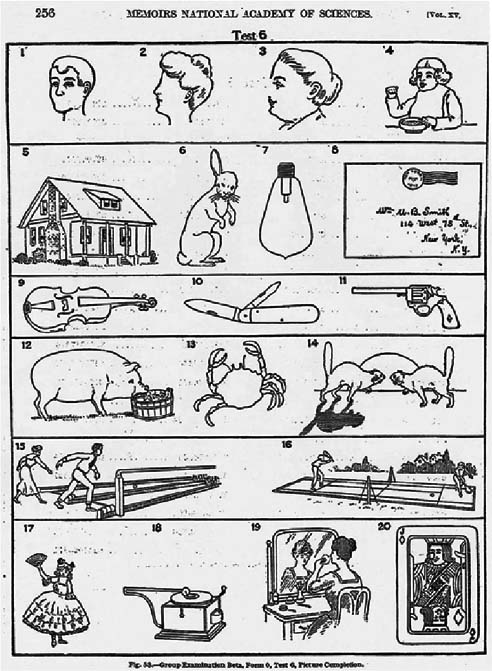
RELATED ENTRIES: Conscription and Volunteerism; World War I
1918 a
THE MAN's POEM AND THE WOMAN's RESPONSE
With conscription, opportunities arose for women to take work long denied them. Their fellow male workers were, generally speaking, uncomfortable with and opposed to the presence of women at “their” worksites. When an anonymous male machinist penned a sarcastic poem about female machinists employed during World War I, an anonymous female machinist responded with revealing zest.
The Man's Poem
The Reason Why
The Woman's Response
She Hands Him a Lemon
SOURCE: Wayne Broehl Jr., Precision Valley: The Machine Tool Companies of Springfield, Vermont (Englewood Cliffs, N.J.: Prentice-Hall, 1959), 98–99.
RELATED ENTRIES: Committee on Public Information; Women in the Workforce: World War I and World War II; World War I
1918 b
VERSE OF THE AMERICAN EXPEDITIONARY FORCE, 1918–1919
The American Expeditionary Force headquarters created a soldier's newspaper, The Stars and Stripes, which published a number of poems written by military personnel. These are some of the more revealing ones.
(UNTITLED)
Song of St. Nazaire
The Ward At Night
As Things Are
The Shepherds Feed Themselves And Feed Not My Flock
SOURCE: Alfred E. Cornebise, ed., Doughboy Doggerel (Athens: Ohio University Press, 1985).
RELATED ENTRIES: Literature and War; World War I
1918 c
SELECTED SONGS FROM THE COMPILATIONS OF JOHN JACOB NILES
Lt. John Jacob Niles, an Army aviator in France, was a musicologist and “song-catcher.” He recorded songs as he heard them sung in bistros and trains, and was especially taken by those that black doughboys had created. These are some of the more illuminating examples of those he published in Songs My Mother Never Taught Me.
The Hearse Song
Tell Me Now
Note 1: Field Thirteen was the Issoudun Graveyard. We had flying fields numbered up to 12, when some humorist hit onto the idea of numbering the graveyard 13.
SOURCE: John Jacob Niles, Songs My Mother Never Taught Me (New York: Gold Label Books, 1927).
RELATED ENTRIES: African Americans in the Military; Music and War; Niles, John Jacob
1918 d
PRESIDENT WOODROW WILSON'S FOURTEEN POINTS
As the United States and its allies prepared for making the peace at the end of World War I, Pres. Woodrow Wilson put forth the following principles that he hoped would help to establish the new international world order. Known as the “Fourteen Points,” it was a document that would help to define President Wilson's presidency and his postwar efforts at the peace conference in Paris, during which he tried to persuade his French and British allies to accept them. They did not, and neither did the Senate give its consent to the United States joining the newly-minted League of Nations.
(Delivered in Joint Session, January 8, 1918)
Gentlemen of the Congress:
It will be our wish and purpose that the processes of peace, when they are begun, shall be absolutely open and that they shall involve and permit henceforth no secret understandings of any kind. The day of conquest and aggrandizement is gone by; so is also the day of secret covenants entered into in the interest of particular governments and likely at some unlooked-for moment to upset the peace of the world. It is this happy fact, now clear to the view of every public man whose thoughts do not still linger in an age that is dead and gone, which makes it possible for every nation whose purposes are consistent with justice and the peace of the world to avow nor or at any other time the objects it has in view.
We entered this war because violations of right had occurred which touched us to the quick and made the life of our own people impossible unless they were corrected and the world secure once for all against their recurrence. What we demand in this war, therefore, is nothing peculiar to ourselves. It is that the world be made fit and safe to live in; and particularly that it be made safe for every peace-loving nation which, like our own, wishes to live its own life, determine its own institutions, be assured of justice and fair dealing by the other peoples of the world as against force and selfish aggression. All the peoples of the world are in effect partners in this interest, and for our own part we see very clearly that unless justice be done to others it will not be done to us. The programme of the world's peace, therefore, is our programme; and that programme, the only possible programme, as we see it, is this:
I. Open covenants of peace, openly arrived at, after which there shall be no private international understandings of any kind but diplomacy shall proceed always frankly and in the public view.
II. Absolute freedom of navigation upon the seas, outside territorial waters, alike in peace and in war, except as the seas may be closed in whole or in part by international action for the enforcement of international covenants.
III. The removal, so far as possible, of all economic barriers and the establishment of an equality of trade conditions among all the nations consenting to the peace and associating themselves for its maintenance.
IV. Adequate guarantees given and taken that national armaments will be reduced to the lowest point consistent with domestic safety.
V. A free, open-minded, and absolutely impartial adjustment of all colonial claims, based upon a strict observance of the principle that in determining all such questions of sovereignty the interests of the populations concerned must have equal weight with the equitable claims of the government whose title is to be determined.
VI. The evacuation of all Russian territory and such a settlement of all questions affecting Russia as will secure the best and freest cooperation of the other nations of the world in obtaining for her an unhampered and unembarrassed opportunity for the independent determination of her own political development and national policy and assure her of a sincere welcome into the society of free nations under institutions of her own choosing; and, more than a welcome, assistance also of every kind that she may need and may herself desire. The treatment accorded Russia by her sister nations in the months to come will be the acid test of their good will, of their comprehension of her needs as distinguished from their own interests, and of their intelligent and unselfish sympathy.
VII. Belgium, the whole world will agree, must be evacuated and restored, without any attempt to limit the sovereignty which she enjoys in common with all other free nations. No other single act will serve as this will serve to restore confidence among the nations in the laws which they have themselves set and determined for the government of their relations with one another. Without this healing act the whole structure and validity of international law is forever impaired.
VIII. All French territory should be freed and the invaded portions restored, and the wrong done to France by Prussia in 1871 in the matter of Alsace-Lorraine, which has unsettled the peace of the world for nearly fifty years, should be righted, in order that peace may once more be made secure in the interest of all.
IX. A readjustment of the frontiers of Italy should be effected along clearly recognizable lines of nationality.
X. The peoples of Austria-Hungary, whose place among the nations we wish to see safeguarded and assured, should be accorded the freest opportunity to autonomous development.
XI. Rumania, Serbia, and Montenegro should be evacuated; occupied territories restored; Serbia accorded free and secure access to the sea; and the relations of the several Balkan states to one another determined by friendly counsel along historically established lines of allegiance and nationality; and international guarantees of the political and economic independence and territorial integrity of the several Balkan states should be entered into.
XII. The turkish portion of the present Ottoman Empire should be assured a secure sovereignty, but the other nationalities which are now under Turkish rule should be assured an undoubted security of life and an absolutely unmolested opportunity of autonomous development, and the Dardanelles should be permanently opened as a free passage to the ships and commerce of all nations under international guarantees.
XIII. An independent Polish state should be erected which should include the territories inhabited by indisputably Polish populations, which should be assured a free and secure access to the sea, and whose political and economic independence and territorial integrity should be guaranteed by international covenant.
XIV. A general association of nations must be formed under specific covenants for the purpose of affording mutual guarantees of political independence and territorial integrity to great and small states alike.
In regard to these essential rectifications of wrong and assertions of right we feel ourselves to be intimate partners of all the governments and peoples associated together against the Imperialists. We cannot be separated in interest or divided in purpose. We stand together until the end.
For such arrangements and covenants we are willing to fight and to continue to fight until they are achieved; but only because we wish the right to prevail and desire a just and stable peace such as can be secured only by removing the chief provocations to war, which this programme does remove. We have no jealousy of German greatness, and there is nothing in this programme that impairs it. We grudge her no achievement or distinction of learning or of pacific enterprise such as have made her record very bright and very enviable. We do not wish to injure her or to block in any way her legitimate influence or power. We do not wish to fight her either with arms or with hostile arrangements of trade if she is willing to associate herself with us and the other peaceloving nations of the world in covenants of justice and law and fair dealing. We wish her only to accept a place of equality among the peoples of the world,—the new world in which we now live,—instead of a place of mastery.
SOURCE: U.S. National Archives & Records Administration. “Transcript of Woodrow Wilson's 14 Points.” http://www.ourdocuments.gov/doc.php?doc=62&page=transcript (August 11, 2005).
RELATED ENTRIES: Wilson, Woodrow; World War I
1919 a
FLORENCE WOOLSTON REFLECTS ON THE EFFECT OF WORLD WAR I ON HER NEPHEW BILLY
Florence Woolston, writing in The New Republic shortly after the Armistice, described how her young nephew Billy, growing up in a suburb she called “one hundred per cent patriotic,” reacted to World War I.
Billy, my nephew, is twelve years old. With the possible exception of the beef profiteers and a few superpatriots to whom life has been a prolonged Fourth of July oration, no one has got quite so much fun out of the war as Billy and his inseparable companions, Fritters, George and Bean-Pole Ross.
Clad in the khaki uniform of the Boy Scouts, with United War Campaign, Red Cross, War Saving, first, second, third and fourth Liberty Loan buttons, small American flags and service pins spread across their chests, they have lived the war from morning until night. I did not understand Billy's passionate allegiance to the Scout uniform until I discovered the great game of hailing automobiles bearing the sign, “Men in Uniform Welcome.” Billy has never been willing to accompany his family on automobile rides but the pleasure of this boulevard game has been never ending.
They call the suburb in which Billy lives one hundred per cent patriotic. Everybody is in war work. Even the children under five years have an organization known as the Khaki Babes. These infants in uniform assemble, kindergarten fashion and solemnly snip for the Red Cross. Billy's crowd is indefatigable in its labors. With the other Scouts, the boys usher at meetings, assist in parades, deliver bundles and run errands. They are tireless collectors of nutshells, peach pits and tinsel paper. As Victory Boys they are pledged to earn five dollars for the United War Workers. Since most of them expect to do this shovelling snow they are praying for a severe winter.
One bit of voluntary war work was carried on through the periods of gasolineless Sundays when the four boys took positions on Commonwealth Avenue in such a way as to obstruct passing vehicles. If a car did not carry a doctor's or military sign, they threw pebbles and yelled, “O you Slacker!” It was exciting work because guilty drivers put on full speed ahead and Billy admitted that he was almost run over, but he added that the cause was worth it.
In my school days history was a rather dull subject.
… It is not so with Billy. Modern history is unfolding to him as a great drama. Kings and tsars and presidents are live human beings. War has nothing to do with books. It is a perpetual moving picture with reels furnished twice a day by the newspapers. Wars were as unreal as pictorial combats with painted soldiers and stationary warships. Even the Civil War belonged to historical fiction. Once a year, on the 30th of May, a veteran in navy blue came to school and in a quavering voice told stories of his war days. Thrilling as they might have been, they always seemed to lack reality….
… Billy and his chums … know what boundaries mean; they pour over war maps and glibly recite the positions of the Allied troops. Billy has a familiarity with principal cities, rivers and towns that never could have been learned in lesson form. The war has created a new cosmopolitanism. The children of Billy's generation will never have the provincial idea that Boston is the centre of the world. They will see the universe as a great circle, perhaps, but all the Allies will occupy the centre.
I must confess, however, that Billy, Fritters, George and Bean-Pole Ross have a rather vague idea of what the war is about, but then so do others with more years to their credit. I asked Billy what caused the war originally, and he replied in a rather large and lofty way, “You see, the French took Alsace and Lorraine away from the Germans a long time ago and Germany wanted it back. She thought it would be nice to get hold of Paris, too, and conquer the French people, then they would have to pay taxes and indemnities to support Germany. So they started to march to Paris and then all the other countries decided to stop them.”
When I compare the anemic stereopticon travel talks of my school days with Billy's moving picture shows, I have the sense of a cheated childhood. We had nothing in our young lives like Crashing Through to Berlin, The Hounds of Hunland, Wolves of Kultur and The Brass Bullet. Billy's mental images have been built by such pictures as these with the additional and more educational films of the Committee on Public Information and the Pathé weekly where actual battle scenes, aeroplane conflicts and real naval encounters are portrayed.
In the matter of books, too, Billy has had high revel. I sowed a few wild oats with Oliver Optic and Horatio Alger wherein poor lads were conducted from prairie huts to the Executive mansion. Of course we had Scott and Cooper to make medieval times or Indian days vivid. But think of reading Over the Top and going to shake hands with the author, a live, red-blooded officer in the army! Billy revels in Private Peat, Hunting the Hun, Out of the Jaws of Hunland, From Base Ball to Boches, and With the Flying Corps. I’m afraid he will never have a Walter Scott period and I am sure it will be years before contemplative literature can hold his attention.
Of course, the war has given us all an enlarged vocabulary. Billy calls his school “the trench”; he and Fritters go “over the top,” “carry on,” play in dug-outs, move in units, carry kits, eat mess and have elaborate systems of wig-wagging and passwords. When he is unsuccessful in a parental encounter, Billy throws up his hands and cries “I surrender!” Hun, Boche and Bolshevik are terms of terrible opprobrium. There was a bloody fist fight at recess recently, when Henry Earl was called “O you Kaiser!” The mere suggestion of a German name brings forth expressions of loud disgust and none of the boys would use a toy made in Germany.
At present it is in fashion to collect war posters. Billy has a remarkable collection of Food, Red Cross, Marine, War Savings, Navy and United War Work Campaign posters. He has trudged miles and spent much ingenuity in getting them. His room is papered with them and it is a matter of deep regret that the family is unwilling to have the entire house so placarded. A thriving business goes on in poster trading and a steady stream of small boys passes the house carrying large rolls of posters. From Billy's room, after a visitation, come delighted exclamations, “Gee! what a bute!” “Say, I’ll give you a Join the Gas Hounds for a Beat Back the Huns.” “Fritters has two Teufelhunden and he's going to swap it for a Clear the Way and a Tell That to the Marines.”
Billy came to me with an ethical problem connected with his poster campaign. “I’ve got,” he declared, “five Joan of Arcs, three Must Children Starves, five Blot it Outs, a Britisher and a big Y. I can sell them and make lots of money. Would that be profiteering?” I thought it might be so considered by taxpayers. “Well,” he demanded, “If I sell them and buy Thrift Stamps that would be profiteering to help the war, and that would be all right, wouldn’t it?”
When a campaign is on, the boys find it hard to wait until the posters have done their work as propaganda. Sometimes a lucky boy gets a whole new set. Recently, there had been much buying and selling of addresses where posters may be obtained, five cents for a plain address, ten for a “guaranteed.” I mailed a postal card for Billy addressed to the Secretary of the Navy which read, “Kindly send me a full set of your Marine and Navy posters. I will display them if you wish.” Billy's collection numbers about two hundred but he knows boys who have a thousand posters. As evidence of his great delight in them, he made the following statement: “If the last comes to the last, and we couldn’t get coal and we had to burn all the furniture, I’d give up one set of duplicates, but only if the last comes to the last.”
Billy is a kind-hearted lad with humane instincts toward all creatures except flies. He feels, however, that the Kaiser can neither claim the protection of the S.P.C.A. nor demand the consideration usually afforded a human being. He loves to tell what he would do to the Kaiser. It is a matter of bitter disappointment that Mr. Hohenzollern is in Holland instead of in Billy's hands. At breakfast he issues bulletins of carnage. Some days he plans simple tortures like beheading, skinning, hanging, burning. At other times he concocts a more elaborate scheme such as splitting open the Kaiser's arms and putting salt on the wound, cutting his legs off at the knee and hanging his feet around his neck, or gouging out his eyes. A favorite idea is that of inoculating him with all the diseases of the world or to starve him for months and then eat a big Thanksgiving dinner in his presence.
Billy has had a full course in atrocities and is keen for reprisals. He longs to fly with an aviation unit, dropping bombs on Berlin, he aches to destroy a few cathedrals and palaces, burn all the German villages and poison the reservoirs. His description of what he would do to the Huns makes the Allied armistice sound like a presentation speech with a bunch of laurel.
There is a marked absence of patriotic sentiment with Billy and his chums. To them patriotism is action; they do not enjoy talking about it. When a Liberty Loan orator gushes about the starry banner, they roll their eyes expressively and murmur “Cut it out.” Of course, some of this is the self-conscious stoicism of the small boy. But there is a matter of fact attitude toward suffering and pain which is new and due to familiarity with the idea. Boys discuss the kinds of wounds, operations and war accidents as a group of medical students might refer to a clinic.
Death seems to give them no sense of mystery and awe. “Gee! a thousand killed today,” “That Ace has got his,” “Say, John Bowers was gassed and he's gone now.” They look over the casualty lists as grown-ups might read lists of guests at a reception. It may be because youth cannot understand the tragedy and heartache back of the golden stars on the service flags, but I think it goes deeper than that. These boys have a sense of courage and gallantry that makes the risking of life an everyday affair. Self-sacrifice is not a matter of poems and sermons and history, it is the daily news. Billy's attitude is that going to war is part of the game; when you’re a little boy you have to go to school; when you’re older, you draw your number and are called to camp—it's all in a day's work.
SOURCE: Florence Woolston, “Billy and the World War,” New Republic (January 25, 1919): 369–71.
RELATED ENTRIES: Committee on Public Information; Militarization and Militarism; Rationing in Wartime; World War I
1919 b
DUBOIS WRITES OF RETURNING SOLDIERS
W. E. B. Dubois, one of the founders of the National Association for the Advancement of Colored People (NAACP) and the editor of that organization's monthly newsletter The Crisis, was a vigorous proponent of the Wilson administration's war aims in 1918; he believed that black service in the war might be the catalyst for change in the attitudes of whites. His editorial, “Close Ranks,” in July 1918 advised NAACP readers that 1918 was “the great Day of Decision,” a year when his readers should “forget our special grievances and close our ranks shoulder to shoulder with our own white fellow citizens” to defeat “the menace of German militarism” which represented “death to the aspirations of Negroes and all darker races for equality, freedom and democracy.” He was not as sure in May 1919 after blacks, some of them returning black veterans, faced a new spate of brutal attacks in American streets.
The Crisis, May 1919
We are returning from the war! The Crisis and tens of thousands of black men were drafted into a great struggle. For bleeding France and what she means and has meant and will mean to us and humanity and against the threat of German race arrogance, we fought gladly and to the last drop of blood; for America and her highest ideals, we fought in far-off hope; for the dominant southern oligarchy entrenched in Washington, we fought in bitter resignation.
For the America that represents and gloats in lynching, disenfranchisement, caste, brutality and devilish insult—for this, in the hateful upturning and mixing of things, we were forced by vindictive fate to fight, also.
But today we return! We return from the slavery of the uniform which the world's madness demanded us to don to the freedom of civil garb. We stand again to look America squarely in the face and call a spade a spade. We sing: This country of ours, despite all its better souls have done and dreamed, is yet a shameful land.
It organizes industry to cheat us. It cheats us out of our land; it cheats us out of our labor. It confiscates our savings. It reduces our wages. It raises our rent. It steals our profit. It taxes without representation. It keeps us consistently and universally poor, and then feeds us on charity and derides our poverty.
It insults us.
This is the country to which we Soldiers of Democracy return. This is the fatherland for which we fought! But is is our fatherland. It was right for us to fight. The faults of our country are our faults. Under similar circumstances, we would fight again. But by the God of Heaven, we are cowards and jackasses if now that that war is over, we do not marshal every ounce of our brain and brawn to fight a sterner, longer, more unbending battle against the forces of hell in our own land.
Make way for Democracy! We saved it in France, and by the Great Jehovah, we will save it in the United States of America, or know the reason why.
SOURCE: The Crisis 18, no. 1 (May 1919): 13–14.
RELATED ENTRIES: African Americans in the Military; Du Bois, W. E. B.; Racial Integration of the Armed Forces; World War I
1919 c
AFRICAN-AMERICAN REACTION TO D.C. RACE RIOTS
Whites viciously attacked blacks and the black community in Washington, D.C., in mid-July. Some 46 died and about 250 were wounded in these two riots. A black woman recalled her reaction to the way blacks, a number of them returned veterans, resisted the attacks:
The Washington riots gave me the thrill that comes once in a lifetime. I was alone when I read between the lines of the morning paper that at last our men had stood like men, struck back, were no longer dumb, driven cattle. When I could no longer read for my streaming tears, I stood up, alone in my room, held both hands high over my head and exclaimed, “Oh, I thank God, thank God!” When I remember anything after this, I was prone on my bed, beating the pillow with both fists, laughing and crying, whimpering like a whipped child, for sheer gladness and madness. The pent-up humiliation, grief and horror of a lifetime—half a century—was being stripped from me.
SOURCE: Francis Grimke, The Race Problem (Washington, D.C., 1919), 8, quoted in Arthur Barbeau and Florette Henri, The Unknown Soldiers (Philadelphia: Temple University Press, 1974), 182.
RELATED ENTRIES: African Americans in the Military; Du Bois, W. E. B.; Race Riots; Racial Integration of the Armed Forces; World War I
1919 d
FACTS AND QUESTIONS CONCERNING THE NREF
The American forces stationed in North Russia (the North Russia Expeditionary Force, or NREF) were severely demoralized in 1919. Stranded in the ice-locked area until spring, soldiers petitioned in February, protesting the American involvement in the Russian Revolution. This petition includes many of the reasons that caused President Wilson to withdraw the troops in June:
- We officers enlisted and our men were drafted for the purpose of fighting Germany and her allies.
- This force was sent to Russia to prevent Germany from establishing naval bases in the far North.
- The American organisations have been split up and placed under British officers. England has undoubtedly many capable officers, but they are not in Russia. However we, ourselves, are woefully lacking in that respect. The manner in which this expedition has been mishandled is a disgrace to the civilized world.
- Our original purpose having been accomplished we are now meddling with a Russian revolution and counterrevolution.
- Is this consistent with the principles of American democracy?
- The majority of the people here seem to prefer Bolshevism to British intervention. They mistrust the British. It is our opinion that British diplomats pulled the wool over the eyes of our representatives, to the end that we were sent with this expedition in an effort to take the curse off the British.
- The few French here finally rebelled against British rule and have been given a French commander.
- WHERE IS OUR MONROE DOCTRINE? If we stood by, while Mexico was torn by revolutions, the sanctity of our borders violated and Americans murdered, on what basis is our presence here justified? A British officer here, who is more human than most, quite aptly described this expedition as an effort to put on a show with two men and an orange.
- We are fighting against enormous odds in men, artillery and material. Most of the men in the enemy forces have seen years of service. If they were not lacking in morale and discipline, we should have been wiped off the face of the earth ere this.
- Due to a pending election in England, and the fear of antagonizing the labor parties, no reenforcements [sic] have been sent out. In fact before the election, certain British officials placed themselves on record as having no intentions [sic] of sending more troops to Russia.
- We wonder what propaganda is at work in the States, which enables the War Department to keep troops here. It seems to us as though it is a question of potential dollars in Russia.
- We, a porition [sic] of the civilian army of America, organized to fight Germany, wonder why we are called upon to spend American lives aiding and abetting a counter-revolution in Russia while the great majority of the people here sit idly by watching the show, not idly either, for the [sic] most of the natives here are Bolshevists in sympathy. We have no heart in the fight. We are fighting neither for Russia or for Russian wealth but for our lives. We have earnestly endeavored to find some justification for our being here, but have been unable to reconcile this expedition with American ideals and principles instilled within us.
- We are removed 200 miles from our base, with an open country intervening, with no force except in a few villages to guard our lines and with the enemy within striking distance of the line. There is no military reason why we should be more than 20 miles from our base.
[Note from officer who confiscated the pamphlet:] The above was written by an American officer with the Dvina force and it is reported that it is widely circulated among the American troops at the front and the men consider that it fully covers their ideas regarding the reasons why American troops are kept here.
SOURCE: National Archives, Textual Records of the War Department General & Special Staffs, Record Group 165; Office of the Director of Intelligence (G-2), 1906–49; Security Classified Correspondence and Reports, 1917–41 (Entry 65); file 24–327 (59).
RELATED ENTRIES: Antiwar Movements; Russia, Interventions in
1919 e
LYRICS TO “HOW ’YA GONNA KEEP ’EM DOWN ON THE FARM (AFTER THEY’VE SEEN PAREE?)”
Returning veterans, having experienced a good deal of the world beyond their home counties for the first time, moved out of those counties in numbers considerably greater than had been the case in the decades before the war. The phenomenon was addressed in this popular song of 1919:
SOURCE: Lyrics (Sam Lewis and Joe Young) and music (Walter Donaldson) found at http://www.musicanet.org/robokopp/usa/reubenre.htm (August 11, 2005).
RELATED ENTRIES: Music and War; World War I
1919 f
EXCERPTS FROM THE DIARY OF SGT. WILL JUDY
Will Judy, a young Chicago attorney, kept a rich diary of his thoughts, impressions and experiences from the day he entered the military until some time after he was discharged after war's end. These selections capture what evidence from other sources indicates: a general lack of understanding of or enthusiasm for America's war aims, the development of camaraderie among military personnel, and the veteran's problem of how to deal with media-fed conceptions of the war held by those at home:
3 May 1917:
I fell asleep with the dread gone that in my old age the children might point to me and laugh among themselves that in the great war I stayed at home.
15 November 1917:
Hart looked up from the morning paper and inquired whether Belgium was for the Allies or Germany. I chided him but back in my thots was the belief that the heart of our people is hardly in the war. Every one tells a different reason why we are at war. Could we have a secret ballot tomorrow of the entire population, I believe the vote would be greatly in the favor of peace. Likely this is true in all wars. 27 August 1918:
… [W]e are not shouting loudly about making the world safe for democracy.
In truth I have not heard more than a half dozen times during my year in the army a discussion among the men or even the officers, of the principles for which we fight. We read of them here, there and everywhere but the men of their own accord and in an informal way seldom or never talk of them….
Almost nine-tenths of the soldier's conversation concerns stories about women, the location of wine shops, the likelihood of being able to purchase cigarets, the next trip to the bath house, what the censor did to the last batch of letters, what is the popular song back in the United States, what's the idea of fighting for France when they charge us high prices, and above all other subjects—“when do we eat?” 18 January 1919:
We talk much of comradeship in the coming civilian life. Like mystics, we are conscious of an association that will bind us into a passionate group different and superior, as we think, to all others.
[back in garrison duty in the States:]
1 June 1919:
France has bred in us the habit of acting first and asking questions afterward. Here red tape, insolence and much ado about nothing are the order of the day. The camp officials have not learned as did we, on fields of war, where our mistakes wrought their cost first upon us, perhaps at price of our lives. They do not possess our qualities of swift action, daring effort and great labor.
3 June 1919:
Supervised the sorting and packing of the division's records for shipment to the Adjutant General of the Army at Washington for permanent file.
We hear much about ourselves as heroes. A thousand questions are asked of us and we know now the answers they wish us to make. We must say that the enemy were fiends, that they butchered prisoners, that they quaked in fear as we came upon them in their trenches, that they were not nearly as brave as ourselves, that Americans are the best and bravest fighters of all nations, and that it was only necessary to shout “We are Americans.”
We are somewhat surprised but soon we learn that the populace insists upon dubbing us heroes; then we are swept into the pose against our will and wishes. We do not talk about the war unless the civilians ply us with questions and drive us into stories about our life on the battlefield. We have come back hating war, disgusted with the prattle about ideals, disillusioned entirely about the struggles between nations. That is why we are quiet, why we talk little, and why our friends do not understand. But the populace refuses to be disillusioned; they force us to feed their own delusions.
Soon we will take on the pose of brave crusaders who swept the battlefields with a shout and a noble charge. The herd among our own number will be delighted with this unexpected glory and within a few years, a cult will be made of it. An ounce of bravery on the battlefield will become a ton of daring in story as related time and again in the years to come. We as soldiers shall find ourselves made the patriotic guardians of our country, a specially honored class, against our will.
The populace is not to be blamed. They never will get away from the effects of the propaganda in the press. To them every American soldier in France was a fighter, rifle and bayonet in hand, rushing mid shot and shell across No Man's Land, and plunging the knife into the cowering enemy. Indeed, they relate to us tales of our own bravery to our surprise; we subdue our astonishment and then obligingly add little touches of exaggeration to the already dropsied story.
Four-fifths of the American soldiers in France never went over the top and scarcely a tenth of us saw a German soldier, other than a captured one….
19 June 1919:
… The twenty-two months in the army has taught many things to me. My experiences I would not trade for any ten years of my life. I have learned to like and to hate the army. At first I saluted grudgingly; then, as the spirit of the uniform won me, I took pride in saluting promptly and snappily. It caused me to be chivalrous in the presence of women and the aged; to conduct myself creditably to the flag; and to live up to the traditions of American honor.
I could not forget that I was a civilian first and a soldier second. Perhaps I can tell best my thot of war by saying that it is as a painted woman, more attractive at some distance. I hate war, I am a man of peace; I hope there will never be another war; but if my country fights again, right or wrong, I shall be among the first to have the tailor remodel the old uniform.
SOURCE: Will Judy, Soldier's Diary (Chicago: privately published, 1931).
RELATED ENTRIES: Committee on Public Information; World War I
1929
LYRICS TO “MARINES’ HYMN”
This version of the “Marines’ Hymn” contains the official verses, recognized in 1929, except for one change in verse 4—from “On the land as on the sea” to “In the air, on land and sea”—made in 1942. The references in the first two verses relate to the Mexican War and the campaign against the Barbary Pirates in 1805.
SOURCE: Marines, Marine Corps Band, http://www.ala.usmc.mil/band/hymn/hymnhistory2.asp (7/10/2005).
RELATED ENTRIES: Marine Corps; Music and War
1930
EXCERPT FROM NINETEEN NINETEEN BY JOHN DOS PASSOS
Many World War I veterans of combat had sufficient psychological trauma to leave them with many of the symptoms of what would in the 1970s be labeled “posttraumatic stress disorder.” Others were politically affected by their experiences, embittered by the hypocrisy of their leaders, and stunned by the impersonality and pointlessness of the carnage. The more articulate of these, on both sides, expressed their thoughts on paper. John Dos Passos was one of the first of such American writers in print; his Three Soldiers appeared in 1921. His trilogy, U. S. A., broke new literary ground in 1930. This passage is from the first book of that trilogy, Nineteen Nineteen.
The Body of an American
Whereas the Congress of the united states by a concurrent resolution adoptedon the 4th day of march last authrized the Secretary of war to cause to be brought to the united states the body of an American who was a member of the american expeditionary for cesin europe wholos this life during the world war and whose identity has not been established for burial in the memorial amphi theatre of the national cemetery atarlington virginia
In the tarpaper morgue at Chalons-sur-Marne in the reek of chloride of lime and the dead, they picked out the pine box that held all that was left of enie menie minie moe plenty other pine boxes stacked up there containing what they’d scraped up of Richard Roe and other person or persons unknown. Only one can go. How did they pick John Doe?
how can you tell a guy's a hundredpercent when all you’ve got's a gunnysack full of bones, bronze buttons stamped with the screaming eagle and a pair of roll puttees?
… and the gagging chloride and the puky dirt-stench of the yearold dead …
John Doe was born …
and raised in Brooklyn, in Memphis, near the lakefront in Cleveland, Ohio, in the stench of the stockyards in Chi, on Beacon Hill, in an old brick house in Alexandria Virginia, on Telegraph Hill, in a halftimbered Tudor cottage in Portland the city of roses, in the Lying-In Hospital old Morgan endowed on Stuyvesant Square, across the railroad tracks, out near the country club, in a shack cabin tenement apartmenthouse exclusive residential suburb; …
scion of one of the best families in the social register, won first prize in the baby parade at Coronado Beach, was marbles champion of the Little Rock grammarschools, crack basketballplayer at the Booneville High, quarterback at the State Reformatory, having saved the sheriff's kid from drowning in the Little Missouri River was invited to Washington to be photographed shaking hands with the President on the White House steps;—…
—busboy harveststiff hogcaller boyscout champeen cornshucker of Western Kansas bellhop at the United States Hotel in Saratoga Springs office boy callboy fruiter telephone lineman longshoreman lumberjack plumber's helper, worked for an exterminating company in Union City, filled pipes in an opium joint in Trenton, New Jersey.
Y.M.C.A. secretary, express agent, truckdriver, fordmechanic, sold books in Denver Colorado: Madam would you be willing to help a young man work his way through college? …
Naked he went into the army; they weighed you, measured you, looked for flat feet, squeezed your penis to see if you had clap, looked up your anus to see if you had piles, counted your teeth, made you cough, listened to your heart and lungs, made you read the letters on the card, charted your urine and your intelligence, gave you a service record for a future (imperishable soul)
and an identification tag stamped with your serial number to hang around your neck, issued O D regulation equipment, a condiment can and a copy of the articles of war.
Atten'sHUN suck in your gut you c—r wipe that smile off your face eyes right wattja tink dis is a choirch-social? For-war-D’ARCH.
John Doe and Richard Roe and other person or persons unknown drilled hiked, manual of arms, ate slum, learned to salute, to soldier, to loaf in the latrines, forbidden to smoke on deck, overseas guard duty, forty men and eight horses, shortarm inspection and the ping of shrapnel and the shrill bullets combing the air and the sorehead woodpeckers and the machineguns mud cooties gasmasks and the itch….
Say buddy cant you tell me how I can get back to my outfit?
Cant help jumpin when them things go off, give me the trots them things do. I lost my identification tag swimmin in the Marne, roughhousin with a guy while we was waitin to be deloused, in bed with a girl named Jeanne (Love moving picture wet French postcard dream began with saltpeter in the coffee and ended at the propho station);—
Say soldier for chrissake cant you tell me how I can get back to my outfit?
The service record dropped out of the filing cabinet when the quartermaster sergeant got blotto that time they had to pack up and leave the billets in a hurry.
The identification tag was in the bottom of the Marne.
The blood ran into the ground, the brains oozed out of the cracked skull and were licked up by the trenchrats, the belly swelled and raised a generation of bluebottle flies,
Woodrow Wilson brought a bouquet of poppies.
SOURCE: John Dos Passos, U.S.A.: Nineteen Nineteen (Boston: Houghton Mifflin, 1930).
RELATED ENTRIES: Antiwar Movements; Literature and War; Tomb of the Unknown Soldier; World War I
1932
“THE BONUSEERS BAN JIM CROW” BY ROY WILKINS
In 1924, approximately 25,000 impoverished veterans and their families converged on Washington, D.C., in the Bonus March. In this piece Roy Wilkins of the NAACP argued that the peaceful demonstration by black and white veterans revealed the possibility of immediately integrating the armed forces. Ultimately, the Army drove the bonus marchers out of the city and the military did not desegregate its ranks until 1948.
Floating clear on the slight breeze of a hot June night in Washington came a tinkling, mournful melody, a song known by now in every corner of the globe. Lilting piano notes carried the tune that set my foot patting, in spite of myself, on the trampled grass of the little hill. Then, as I was about to start humming the words, a voice took up the cadence and rode over the Anacostia Flats on the off-key notes—
Never, I thought, was there a more perfect setting for W. C. Handy's famous St. Louis Blues. No soft lights and swaying bodies here; no moaning trombone or piercing trumpet; no fantastic stage setting; no white shirt fronts, impeccably tailored band master or waving baton. Instead, a black boy in a pair of ragged trousers and a torn, soiled shirt squatting on a box before a piano perched on a rude platform four or five feet off the ground. A single electric light bulb disclosed him in the surrounding gloom. Skillfully his fingers ran over the keys, bringing out all the Handy secrets of the song. Plaintively he sang the well-known words. A little of the entertainer was here, for there is a little of it hidden in most of us, but the plaintive note was largely the reflection of an actual condition, not the product of an entertainer.
On the ground about and below him were grouped white and colored men listening, smoking and quietly talking. From my elevation I could see camp fires flickering here and there and hear the murmur of talk over the flats. Here was the main camp of the Bonus Army, the Bonus Expeditionary Force, as it chose to call itself, and here, in my musical introduction to it, was struck the note which marked the ill-starred gathering as a significant one for Negro Americans.
For in this army which had gathered literally to “Sing the Blues” with economic phrases, there was one absentee: James Crow. It is not strictly true, as I shall explain a little later, to say that Mr. Crow was not present at all; it is an absolute fact that he was Absent With Leave a great part of the time.
He was brought along and trotted out occasionally by some of the Southern delegations and, strange to say, by some of the colored groups themselves.
The men of the B.E.F. were come together on serious business; they had no time for North, East, South, West, black and white divisions. The main problem was not to prove and maintain the superiority of a group but to secure relief from the ills which beset them, black and white alike. In the season of despair it is foolhardy to expend energy in any direction except that likely to bring life and hope. At Washington, numbers and unity were the important factors, therefore recruits of any color were made welcome and Jim Crow got scant attention.
Here they were, then, the brown and black men who had fought (some with their tongues in their cheeks) to save the world for democracy. They were scattered about in various state delegations or grouped in their own cluster of rude shelters. A lonely brownskin in the delegation from the North Platte, Nebr.; one or two encamped with Seattle, Wash.; increasing numbers bivouacked with California and the northern states east of the Mississippi River; and, of course, the larger numbers with the states from below the Mason and Dixon line.
And at Anacostia, the main encampment, there was only one example of Jim Crow among the 10,000 men there and that, oddly enough, was started and maintained by colored bonuseers themselves, who hailed from New Orleans and other towns in Louisiana. They had erected a section of shacks for themselves and they insisted on their own mess kitchen.
A stroll down through the camp was an education in the simplified business of living, living not complicated by a maze of social philosophy and tabus. It is hard for one who has not actually seen the camp to imagine the crudity of the self-constructed accommodations in which these men lived for eight weeks.
Fairly regular company streets stretched across the flats, lined on both sides with shelters of every description. Here was a tent; here a piano box; there a radio packing case; there three doors arranged with the ground as the fourth side; here the smallest of “pup” tents; there a spacious canvas shelter housing eight or ten men; here some tin nailed to a few boards; there some tar paper.
Bedding and flooring consisted of straw, old bed ticks stuffed with straw, magazines and newspapers spread as evenly and as thickly as possible, discarded mattresses and cardboard.
At Anacostia some Negroes had their own shacks and some slept in with white boys. There was no residential segregation. A Negro “house” might be next door to a white “house” or across the street, and no one thought of passing an ordinance to “preserve property values.” In the California contingent which arrived shortly before I left there were several Negroes and they shared with their white buddies the large tents which someone secured for them from a government warehouse. The Chicago group had several hundred Negroes in it and they worked, ate, slept and played with their white comrades. The Negroes shared tasks with the whites from kitchen work to camp M.P. duty.
In gadding about I came across white toes and black toes sticking out from tent flaps and boxes as their owners sought to sleep away the day. They were far from the spouters of Nordic nonsense, addressing themselves to the business of living together. They were in another world, although Jim Crow Washington, D.C. was only a stone's throw from their doors.
All about were signs containing homely philosophy and sarcasm on the treatment of veterans by the country, such as: “The Heroes of 1918 Are the Bums of 1932.” I believe many of the white campers were bitter and sarcastic. They meant what they said on those signs. But disappointment and disillusionment is an old story to Negroes. They were philosophic about this bonus business. They had wished for so many things to which they were justly entitled in this life and received so little that they could not get fighting mad over what was generally considered among them as the government's ingratitude. They had been told in 1917 that they were fighting for a better world, for true democracy; that a new deal would come for them; that jobs would come to them on merit, that lynching would be stopped; that they would have schools, homes, justice and the franchise. But these Negroes found out as long ago as 1919 that they had been fooled. Some of them could not even wear their uniforms back home. So, while the indifference of the government to the bonus agitation might be a bitter pill to the whites, it was nothing unusual to Negroes. They addressed themselves to humorous take-offs in signs, to cards and to music, the latter two shared by whites.
Thus it was I came across such signs on Negro shacks as “Douglas Hotel, Chicago”; “Euclid Avenue”; “South Parkway”; and “St. Antoine St.” A card game had reunited four buddies from San Francisco, Detroit and Indianapolis and they were swapping stories to the swish of the cards.
Over in one corner a white vet was playing a ukulele and singing what could have been the theme song of the camp: “In a Shanty in Old Shanty Town.” On a Sunday afternoon the camp piano was played alternately by a brown lad with a New York accent, and a red-necked white boy from Florida, while a few rods away Elder Micheaux's visiting choir was giving voice, in stop-time, to a hymn, “God's Tomorrow Will Be Brighter Than Today.” Negroes and whites availed themselves of the free choice of patting their feet either outdoors to the piano or in the gospel tent to the choir.
Outside the main camp (there were four settlements) James Crow made brief and intermittent appearances, chiefly because the largest Southern delegations were not at Anacostia. But even in the Southern and border contingents there was no hard and fast color line. On Pennsylvania avenue, where the men had taken over a number of abandoned buildings in the process of being torn down, were camped the Carolina, Florida, Alabama and Texas delegations as well as a scattering from Virginia, Tennessee and West Virginia.
In a five story building a company of Negroes was assigned the fifth floor, but they all received treatment from the same medical center on the first floor. At first they all ate together, but there was so much confusion and so many men (not necessarily Negroes) were coming in on the tail end of the mess line, that a system whereby each floor took turns being first in the mess line was adopted. This was an equitable arrangement, but even here whites and Negroes lined up together and ate together; no absolute separation was possible, nor was it attempted.
In a mess kitchen which served only Southerners I saw Negroes and whites mixed together in line and grouped together eating. I was told there had been a few personal fights and a few hard words passed, but the attitude of the die-hard, strictly Jim Crow whites had not been adopted officially. Such Southern whites as I met showed the greatest courtesy and mingled freely with the Negroes.
Captain A. B. Simmons, colored, who headed his company, hails from Houston, Tex. He and his men were loud in their declarations of the fair treatment they had received on the march to Washington. They were served meals in Southern towns, by Southern white waitresses, in Main Street Southern restaurants along with their white companions. They rode freights and trucks and hiked together. Never a sign of Jim Crow through Northern Texas, Arkansas, Tennessee, or Virginia. Captain Simmons attended the regular company commanders’ councils and helped with the problems of administration. His fellow officers, all white Southerners, accorded him the same consideration given others of this rank.
His story was corroborated by others. A long, hardboiled Negro from West Virginia who had just stepped out of the mess line behind a white man from Florida said: “Shucks, they ain’t got time for that stuff here and those that has, we gets ’em told personally.” And said a cook in the North Carolina mess kitchen (helping whites peel potatoes): “No, sir, things is different here than down home.”
In general assemblies and in marches there were no special places “for Negroes.” The black boys did not have to tag along at the end of the line of march; there was no “special” section reserved for them at assemblies. They were shot all through the B.E.F. In the rallies on the steps of the nation's capitol they were in front, in the middle and in the rear.
One of the many significant aspects of the bonuseers’ banishment of Jim Crow is the lie it gives to United States army officials who have been diligently spreading the doctrine that whites and blacks could not function together in the army; that they could not use the same mess tents, mingle in the same companies, council together on military problems. The B.E.F. proved that Negroes and whites can do all these things together, that even Negroes and white Southerners can do them together.
How can the army higher-ups explain that? Why can’t the United States army with its equipment and its discipline enlist Negroes and whites together in all branches of the service? It can, but it will not. The army is concerned with refined democracy, with tabus, with the maintenance of poses. The B.E.F. is concerned with raw democracy and with reality. But hereafter the army will have to hide behind its self-erected tradition, for the B.E.F. has demonstrated, right under the august army nose, that the thing can be done.
And right there was the tragedy of it all. I stood again on the little rise above the Anacostia Flats and looked out over the camp on my last night in town. Men and women can live, eat, play and work together be they black or white, just as the B.E.F. demonstrated. Countless thousands of people know it, but they go on pretending, building their paper fences and their cardboard arguments. Back home in Waycross, Miami, Pulaski, Waxahachie, Pine Bluff, Cairo, Petersburg, Des Moines, Cincinnati, Philadelphia, Kansas City and St. Louis they go on pretending, glaring, jabbing, insulting, fighting. In St. Louis, where I first saw daylight, they separate them in everything except street cars.
A dump of a shanty town below the majestic Washington monument and the imperious national capitol…. Ragged torch bearers futilely striving to light the path for the blind overlords who will not see…. A blue camp, its cheerfulness undershot with tragedy…. A blue race problem, its surface gayety undershot with poignant sorrow….
As I turned away, stumbling in the dark over a hose which brought water to the camp from a nearby fire hydrant, a soft Negro voice and the tinkling piano notes came faintly to me.
SOURCE: The Crisis, October 1932, 316–17, 332. The editors of the encyclopedia wish to thank the Crisis Publishing Co., Inc., the publisher of the magazine of the National Advancement of Colored People, for the use of this material first published in the October 1932 issue of Crisis.
RELATED ENTRIES: African Americans in the Military; Bonus March; MacArthur, Douglas; Racial Integration of the Armed Forces; Veterans Administration; World War I
1933
EXCERPTS FROM COMPANY K BY WILLIAM MARCH
One of the more powerful and innovative novels about World War I was written by Sgt. William March, an Alabaman who served with the 5th Marines in France at Belleau Wood, Soissons, St Mihiel, and Blanc Mont. He was wounded and gassed, and received the Distinguished Service Medal and the Navy Cross. Company K consists of the personal statements of semi-fictional members of a company of marines not unlike his own comrades:
Private Richard Mundy
I decided to take my rifle apart and clean it thoroughly. I didn’t want to think about those prisoners any more, but as I sat there with my squad in the shallow trench, with the rifle parts scattered about me, I couldn’t help thinking about them. Corporal Foster was opening cans of monkey meat with a bayonet and Roger Inabinett divided the meat and the hardtack into eight equal parts.
Charlie Gordon got out his harmonica and began to play a lively tune, but Everett Qualls stopped him. Then Foster passed out the rations and each man took his share. At sight of the food, Bill Nugent took sick. He went to the edge of the trench and vomited. When he came back his face was white. Jimmy Wade had a canteen of cognac which he passed over to him and Bill took a big swig of it, but immediately he got up and vomited again. Then he lay stretched out and trembled.
“What's the matter with you, Bill?” asked Foster.
“Nothing,” he said.
“They’ve pulled that trick on the French a thousand times, and got away with it, too!” said Foster. “These Germans are smart hombres. You got to watch them all the time.”
Ahead of us, in the wheat field, the rays of the late sun lay flat on the trampled grain, but in the wood it was almost dark. Inabinett was playing with a cigarette lighter he had found in the wood. He kept snapping it with a clicking sound. “All it needs is a new flint,” he said. “It’ll be as good as new with another flint.”
I put my rifle back together and rubbed the butt with oil. I kept seeing those prisoners falling and rising to their knees and falling again. I walked to the end of the trench and looked over the top. A long way ahead was the sound of rifle fire and to the west there was intermittent shelling, but here, in the wood, everything was calm and peaceful. “You wouldn’t know we were in the war at all,” I thought.
Then I had an irresistible desire to go to the ravine and look at the prisoners again. I climbed out of the trench quickly, before anybody knew what I was going to do….
The prisoners lay where we had left them, face upward mostly, twisted in grotesque knots like angleworms in a can, their pockets turned outward and rifled, their tunics unbuttoned and flung wide. I stood looking at them for a while, silent, feeling no emotion at all. Then the limb of a tree that grew at the edge of the ravine swayed forward and fell, and a wedge of late sunlight filtered through the trees and across the faces of the dead men…. Deep in the wood a bird uttered one frightened note and stopped suddenly, remembering. A peculiar feeling that I could not understand came over me. I fell to the ground and pressed my face into the fallen leaves…. “I’ll never hurt anything again as long as I live,” I said…. “Never again, as long as I live…. Never! … Never! … Never! …”
Private Robert Nalls
Following the fighting at St. Mihiel, we were billeted in Blenod-les-Toul with an old French couple. They had had an only son, a boy named René, who had been killed early in the war, and they were constantly finding points in common between us and him. I had brown eyes, and René's eyes had also been brown; René had had long, slender fingers, and Sam Quillin's fingers were also long and slender. They found resemblances to René in every one: Jerry Blandford because his teeth were even and white; Roger Jones for his thick, curling hair and Frank Halligan because of the trick he had of closing his eyes and throwing back his head when he laughed. Their lives centered around their dead son. They talked about him constantly; they thought of nothing else.
After his death, the French government had sent them a small copper plaque showing in bas-relief the heroic face of a woman surrounded by a wreath of laurel, and under the woman's face were the words, “Slain on the Field of Honor.” It was not an unusual decoration. It was the sort of thing that a Government would send to the next of kin of all men killed in action, but the old couple attached great importance to it. In one corner of the room they had built a tiny shelf for the medal and its case, and underneath it the old woman had fixed up an altar with two candles that burned day and night. Often the old woman would sit for a long time silent before the altar, her hands twisted and old, resting her knees. Then she would go back and scrub her pans, or walk outside to the barn and look at her cow.
We remained in Blenod for five days, and then one night we got orders to move. The old couple had become very friendly with us by that time. They walked with us to the place of assembly, offering to carry our rifles or our packs. Then they stood in the muddy road, the September wind blowing against them strongly, crossing themselves and asking God to bring us all safely back.
A few weeks later, when we were miles away from Blenod, I saw the copper plaque again: It rolled out of Bernie Glass's kit bag while he was shaving one day. He picked it up quickly, but he knew that I had seen it.
“How could you do it, Bernie?” I asked; “how could you do a thing like that?”
“I don’t know that it's any of your business,” said Bernie, “but I thought it would make a good souvenir to take home.”
I never returned to Blenod, and I never saw that old couple again, but somehow I wish they knew that I am ashamed of the whole human race.
Private Albert Hayes
In addition to the chocolate and cigarettes which were sold to us at three times their regular value, the canteen put in a line of sweaters and knitted socks. It was cold in the trenches and I wanted one of the sweaters to wear next to my skin to keep me warm at nights. I picked out a yellow one because it looked comfortable, and paid the canteen ten dollars for it. After I got back to my billet, and was examining it closely, I discovered there was a tiny pocket knitted in the bottom of the sweater and that a piece of paper had been tucked into it. Here's what I read:
“I am a poor old woman, seventy-two years old, who lives at the poor farm, but I want to do something for the soldier boys, like everybody else, so I made this sweater and I am turning it over to the Ladies Aid to be sent to some soldier who takes cold easy. Please excuse bad knitting and bad writing. If you get a cold on your chest take a dose of cooking soda and rub it with mutton suet and turpentine mixed and don’t get your feet wet if you can help it. I used to be a great hand to knit but now I am almost blind. I hope a poor boy gets this sweater. It's not a very good one but I have put my love in every stitch and that's something that can’t be bought or sold.
“P.S. Don’t forget to say your prayers at night and please write regularly to your dear mother.”
Private Arthur Crenshaw
When I came home the people in my town declared “Crenshaw Day.” They decorated the stores and the streets with bunting and flags; there was a parade in the morning with speeches afterwards, and a barbecue at Oak Grove in the afternoon.
Ralph R. Hawley, President of the First National Bank and Trust Company, acted as toastmaster. He recited my war record and everybody cheered. Then he pointed to my twisted back and my scarred face and his voice broke with emotion. I sat there amused and uncomfortable. I wasn’t fooled in the slightest. There is an expressive vulgar phrase which soldiers use on such occasions and I repeated it under my breath.
At last the ceremonies were over and Mayor Couzens, himself, drove me in his new automobile to my father's farm beyond the town. The place had gone to ruin in my absence. We Crenshaws are a shiftless lot, and the town knows it. The floors were filthy, and there was a pile of unwashed dishes in the sink, while my sister Maude sat on the step eating an apple, and gazing, half asleep, at a bank of clouds. I began to wonder what I could do for a living, now that heavy farm work was impossible for me any more. All that afternoon I thought and at last I hit on the idea of starting a chicken farm. I got pencil and paper and figured the thing out. I decided that I could start in a small way if I had five hundred dollars with which to buy the necessary stock and equipment.
That night as I lay awake and wondered how I could raise the money, I thought of Mr. Hawley's speech in which he had declared that the town owed me a debt of gratitude for the things I had done which it could never hope to repay. So the next morning I called on him at his bank and told him of my plans, and asked him to lend me the money. He was very courteous and pleasant about it; but if you think he lent me the five hundred dollars you are as big a fool as I was.
Private Everett Qualls
One by one my cattle got sick and fell down, a bloody foam dripping from their jaws and nostrils. The veterinarians scratched their heads and said they had never seen anything like it. I knew what was the matter, but I didn’t say anything, and at last my stock was all dead. I breathed with relief then. “I have paid for what I did,” I thought; “now I can start all over.” But about that time a blight came upon my corn, which was well up and beginning to tassel: the joints secreted a fluid which turned red over night. The green blades fell off and the stalks withered and bent to the ground…. “This, too!” I thought; “this, too, is required of me!”
My crops were ruined, my cattle dead. I talked it over with my young wife. She kissed me and begged me not to worry so. “We can live some way this winter,” she said. “We’ll start again in the Spring. Everything will be all right.”
I wanted to tell her then, but I didn’t dare do it. I couldn’t tell her a thing of that sort. And so I went about hoping that He had forgotten and that my punishment was lifted. Then my baby, who had been so strong and healthy, took sick. I saw him wasting away before my eyes, his legs and arms turning purple, his eyes glazed and dead with the fever, his breathing sharp and strained.
I had not prayed for a long time, but I prayed now. “Oh, God, don’t do this,” I pleaded. “It's not his fault; it's not the baby's fault. I, I alone am guilty. Punish me, if You will—but not this way! … Not this way, God! … Please! …” I could hear my baby's breath rattling in the next room; I could hear the hum of the doctor's voice, the clink of an instrument against glass and the worried words of my wife. Then the baby's breathing stopped altogether and there was my wife's intaken wail of despair.
I beat my breast and flung myself to the floor and that scene I had tried to crush from my mind came back again. I could hear Sergeant Pelton giving the signal to fire and I could see those prisoners falling and rising and falling again. Blood poured from their wounds and they twisted on the ground, as I was twisting now on the floor…. One of the prisoners had a brown beard and clear, sunburned skin. I recognized him to be a farmer, like myself, and as I stood above him, I imagined his life. He, too, had a wife that he loved who waited for him somewhere. He had a comfortable farm and on holidays, at home, he used to drink beer and dance….
My wife was knocking on the door, but I would not let her in. Then I knew what I must do. I took my service revolver, climbed out of my window and ran to the grove of scrub oaks that divided my land. When I reached the grove, I put the barrel in my mouth and pulled the trigger twice. There came blinding pain and waves of light that washed outward, in a golden flood, and widened to infinity…. I lifted from the ground and lurched forward, feet first, borne on the golden light, rocking gently from side to side. Then wild buffaloes rushed past me on thundering hooves, and receded, and I toppled suddenly into blackness without dimension and without sound.
Private Sylvester Keith
I came out sullen and resentful, determined that such a thing should never happen again. I felt that if people were made to understand the senseless horror of war, and could be shown the brutal and stupid facts, they would refuse to kill each other when a roomful of politicians decided for them that their honor had been violated. So I organized “The Society for the Prevention of War” and gathered around me fifty young and intelligent men, whose influence, I thought, would be important in the years to come. “People are not basically stupid or vicious,” I thought, “they are only ignorant or ill informed. It's all a matter of enlightenment.”
Every Thursday the group gathered at our meeting place. They asked innumerable questions concerning the proper way to hold a bayonet, and the best way to throw hand grenades. They were shocked at the idea of gas attacks on an extended front, and the brutality of liquid fire left them indignant and profane.
I was pleased with myself and proud of my pupils. I said: “I am planting in these fine young men such hatred of war that when the proper time comes they will stand up and tell the truth without fear or shame.” But someone began organizing a company of National Guard in our town about that time and my disciples, anxious to protect their country from the horrors I had just described, deserted my society and joined in a body.
SOURCE: William March, Company K. (New York: Sagamore Press, 1957). Reprinted by permission of Harold Ober Associates Incorporated. Copyright 1933 by William March. Copyright renewed 1961 by The Merchants National Bank of Mobile and Patty C. Maxwell.
RELATED ENTRIES: Literature and War; World War I
1938
A MASSACHUSETTS VETERAN REFLECTS ON MEMORIAL DAY CEREMONIES
Many veterans feel called upon to honor those who did not return. A leader of the United Spanish[–American] War Veterans in Newburyport, Massachusetts, explained a Memorial Day ceremony in the late 1930s to those who had gathered to honor the memory and sacrifices of Newburyport men who had died in the service of their country.
The purpose of this ceremony is to honor those who preceded us to the land of the dead. This is the true patriotic day of the nation when the children of these men honor their fathers, the flag, and all for which the flag stands—bravery, glory, courage of people. It is fitting that the men who sleep beneath the flag of the Union should have graves decked with flowers in remembrance of this trying period of suffering and sorrow which molded this nation. This was in the cause of liberty and of God. It is only right that we quicken the memories of the dead. It is our purpose to preserve and protect Memorial Day. In times of peace it is the duty of us citizens to defend the flag and fulfill the patriotism of those who preceded us.
SOURCE: W. Lloyd Warner, The Living and the Dead (New Haven, Conn.: Yale University Press, 1959), 261.
RELATED ENTRIES: Memorial Day; Memory and War
1940 (to 1943)
WAR ACTIVITY, NOVEMBER 1943, AND CIVILIAN POPULATION CHANGE, 1940 TO NOVEMBER 1, 1943
Low per capita‘ defense contracting correlated with population decline during World War II in the South, as this table indicates.
| War contracts, dollars per capita of civilian population, 1940 | Civilian population change [%] | |
| Virginia | 821.08 | +4.8 |
| Tennessee | 630.65 | −3.3 |
| Louisiana | 613.88 | −1.8 |
| Alabama | 537.88 | −3.9 |
| Georgia | 474.60 | −4.1 |
| North Carolina | 360.92 | −6.1 |
| Mississippi | 279.18 | −8.6 |
| South Carolina | 296.24 | −5.4 |
| Arkansas | 215.73 | −10.9 |
SOURCE: Rudolph Heberle, The Impact of the War on Population Redistribution in the South (Nashville, Tenn.: Vanderbilt University Press, 1945), 21.
RELATED ENTRIES: Economy and War; World War II
1941
EXECUTIVE ORDER 8802: PROHIBITION OF DISCRIMINATION IN THE DEFENSE INDUSTRY
For at least a year before the beginning of U.S. involvement in World War II, the country engaged in rhetoric against our declared enemy—Nazi Germany—and its racist policies. At home, however, the social landscape was still rife with racial discrimination and segregation. Facing pressure by civil rights leader A. Philip Randolph to address this rift between rhetoric and reality, Pres. Franklin D. Roosevelt signed Executive Order 8802 on June 25, 1941. The order set up the Fair Employment Practices Commission, which was authorized to investigate racial discrimination in companies under contract to supply war materials. Only partly effective in its implementation, the order nonetheless represents one step in the federal government's efforts to use war policy to change years of segregation by race.
Reaffirming Policy of Full Participation in the Defense Program by All Persons, Regardless of Race, Creed, Color, or National Origin, and Directing Certain Action in Furtherance of Said Policy
June 25, 1941
WHEREAS it is the policy of the United States to encourage full participation in the national defense program by all citizens of the United States, regardless of race, creed, color, or national origin, in the firm belief that the democratic way of life within the Nation can be defended successfully only with the help and support of all groups within its borders; and
WHEREAS there is evidence that available and needed workers have been barred from employment in industries engaged in defense production solely because of considerations of race, creed, color, or national origin, to the detriment of workers’ morale and of national unity:
NOW, THEREFORE, by virtue of the authority vested in me by the Constitution and the statutes, and as a prerequisite to the successful conduct of our national defense production effort, I do hereby reaffirm the policy of the United States that there shall be no discrimination in the employment of workers in defense industries or government because of race, creed, color, or national origin, and I do hereby declare that it is the duty of employers and of labor organizations, in furtherance of said policy and of this order, to provide for the full and equitable participation of all workers in defense industries, without discrimination because of race, creed, color, or national origin;
And it is hereby ordered as follows:
- All departments and agencies of the Government of the United States concerned with vocational and training programs for defense production shall take special measures appropriate to assure that such programs are administered without discrimination because of race, creed, color, or national origin;
- All contracting agencies of the Government of the United States shall include in all defense contracts hereafter negotiated by them a provision obligating the contractor not to discriminate against any worker because of race, creed, color, or national origin;
- There is established in the Office of Production Management a Committee on Fair Employment Practice, which shall consist of a chairman and four other members to be appointed by the President. The Chairman and members of the Committee shall serve as such without compensation but shall be entitled to actual and necessary transportation, subsistence and other expenses incidental to performance of their duties. The Committee shall receive and investigate complaints of discrimination in violation of the provisions of this order and shall take appropriate steps to redress grievances which it finds to be valid. The Committee shall also recommend to the several departments and agencies of the Government of the United States and to the President all measures which may be deemed by it necessary or proper to effectuate the provisions of this order.
Franklin D. Roosevelt
The White House
June 25, 1941
SOURCE: U.S. National Archives & Records Administration, “Executive Order 8802: Prohibition of Discrimination in the Defense Industry (1941).” http://www.ourdocuments.gov/doc.php?doc=72&page=transcript (August 12, 2005).
RELATED ENTRIES: African Americans in the Military; Executive Order 8802; Executive Order 9981; Racial Integration of the Armed Forces; Randolph, A. Philip; Roosevelt, Franklin Delano
1942 (to 1946) a
LETTERS FROM BLACK SOLDIERS IN WORLD WAR II
The military remained segregated throughout World War II, with the exception of a number of white companies—decimated during the battle of the Bulge—that received platoons comprised of black volunteers. African Americans serving in these years found many discriminatory measures offensive; some wrote to government officials or black newspapers complaining.
Mr. William H. Hastie
[Deputy to Secretary of War Henry Stimson]
Dear Sir:
It has been several months since we have passed the necessary examination and approval of the Cadet Examining Board to qualify as an aviation Cadet.
During the Course of our examination we were stationed at Fort Sill, Okla, at which time several other soldiers took the examinations and have since then received their transfers to the Air Corp; but for some unknown reason we have not received ours.
Sir, we are college men and have had Senior R.O.T.C. training. We were also members of the Enlisted Reserve Corp. Since completing our basic training in Field Artillery we have been transferred to Fort Ord California to do basic training in the Quartermaster Corp. It seems, sir, as if we are going from one basic training to another and getting no nearer to the Air Corp. We are writing you hoping you may be able to give us either and or information so as to hasten our transfer to the Air Corp. It seems with aviation playing the vital part it is we should have hardly any trouble getting in. Our papers are in Washington awaiting disposition, as is the case of all Negro applicants. We hope you can help us. We close now awaiting your answer.
The Pittsburgh Courier
Dear Sir:
We are members of the 78 Aviation Sqdr, and its seem like we are not being treated fair. Most of us got trades of our own to help win this war.
But instead we are servant and ditch diggers and we want better, if it ever been slavery it is now, please help us because we want better.
They got us here washing diches, working around the officers houses and waiting on them, instead of trying to win this war they got us in ditches.
Please report this to the N.A.A.C.P. and tell them to do something about this slavery place, where a colored soldier haven’t got a chance.
Most of us are young and want to learn something, and we even got some that, want, action to help win this war.
And the sad part about it that most of us are volunteers, but they didn’t give us what we ask for, they gave us a pick.
If you want your colored brothers to get somewhere please report this to the President.
Pvt Jus Hill
To: The Pittsburgh Courier
Dear Gentlemen:
I am writing to you in regards to my classification in the army. I have been in the army air corp for the past ten months. Gentlemen I do not feel, and in fact I know I am not doing the best I could to help win this war. I realize the army has a tough job trying to place each man where they think he is best fitted or will do the best of service for the armed forces.
In my civilian life I was a small tool maker. I worked for Silling and Spences Co in Hartford, Conn. Then I was doing much for the war effort, and was in hopes I could continue in the service. In the past ten months I feel as though I have been a complete failure to myself, and to the helping to win this war. Beside that my morale is very low because of the fact I have given the army ten months to reclassify me to something I could do much than what I am doing.
I was in hopes I could become an airplane mechanic, but the field doesn’t seem to be open to negro soldiers.
I only hope and pray that I will hear from you soon as to what I could do, to get into some part of the service where I could use my trade.
Thanking you in advance.
MEDICAL DETACHMENT, DIVISION ARTILLERY, 2nd CAVALRY DIVISION
Fort Clark, Texas
April 23, 1943
The Atlanta Daily World
Dear Editor:
I would like to know if your paper approves of a General calling his soldiers “Nigger” to their face? I think that we are in this war to fight for the rigts of all minority races, the morale of this organization will be low if our soldiers are not addressed in the right manner.
Our colored chaplain was run off this post by the General Johnson solely because he protested to him against using the word “Nigger” when referring to colored troops. I feel that it is my right and privilege to protect against the unGodly ways that the men of the 2nd Cavalry Division are treated by their white Texas officers.
I hope that you will see that the colored people of this nation know that these conditions exist.
Believe me that these are true statements.
Mr. P.L. Prattis
Executive Editor
Pittsburgh Courier
Pittsburgh, 19, Penn.
Dear Sir:
This letter is being written with a purpose of extreme importance to the Negroes stationed here at this hospital. We hope and place confidence in your giving us the information deserved.
I have been stationed here for over two (2) months as a patient. I have not been overseas but there are plenty of Negro boys here who have. Most of these boys have companions who are white. They came back together. In the time that these boys have been here they have been together. They keep in the same wards, go to the same shows without any segregation. But when going to the mess halls for chow they are segregated. [A] few of the white boys sit at the tables allowed for colored. But the Sgt tells them to move because its not permitted in the mess halls. The white boys disapprove of this measure and ask why. The Sgt tells them its orders from the Lt. When we asked the Lt. he states that this is the South. We know this is the South but also the Army. My belief is that it can be stopped with a slight push from you. We would like for you to give your opinion on the matter remembering an article published in the August edition of the Courier based on a War Dept. directive banning discrimination and segregation in army camps and hospitals. We would like to have a copy of that directive and also the numbers of it. We will appreciate all that you can do for us.
We will be awaiting your reply with great anticipation.
Napier Field, Dothan, Alabama
19 November 1944
The Pittsburgh Courier
Dear Editor:
I’ve just returned from the Post Theatre. Being rather disgusted over the way I was ordered out of the Post Theatre tonight; I thought I would just write this little article to show or rather let the people back home know just how we are doing down in Alabama. It is getting to the place that all colored soldiers just have to wait until there is plenty space for all whites before they can even get a seat.
I decided to take in a movie tonight. After reaching the theatre, I found that they had only five (5) seats reserved for colored, (five seats in a row), so the usher ask me to get out, so I had to get out and perhaps wait until tomorrow. Not that I mine waiting, but just the insult I got from the usher. “Get out, there isn’t any seats for you colored boys.” Can you picture a personnel of approximately two hundred and seventy (270) trying to see a picture at the theatre, when only twenty-five (25) can see a picture a night. Only twenty seats per night for the colored soldiers.
The Army often practice, “keep up your morale by attending movies,” our morale would be very low if we had to see movies to keep it up in Napier Field.
This is something to laugh about. Two days ago a friend from Pittsburgh received a package from the Company he worked for before entering the army. It was a very nice package, he appreciated it to the highest. But one thing I notice on the outside of the package was; “To be mailed outside the limits of the continental United States.” It was addressed to Napier Field, Dotham, Ala. We as colored soldiers at Napier Field readily agree with this company. When they mailed this package, they mailed it outside the limits of the continental United States.
The Pittsburgh Courier
Dear Mr. Editor:
I have just finished reading your paper, the July 7th edition and I enjoyed it very much as usual. I have eighty five points myself, and I had hoped to be home by now but, for some reason or the other, we are all still over here. My outfit has been here in Europe three years to the date yesterday. Most of these guys have 103 points. I have been over here 28 months, but here is one fellow that has 144 points and he has been over here three years. We all think that we have not been treated fair by this point system here. Isn’t any kind of break for service troops. Most of us did not want to come in this army in the first place, and Mr. Eastland says we, the Negro soldier, has made America loose prestege in Europe, but it's just the other way around. There have been many times that Jim Crow and prejudice have made me very very shame to say that I was an American. And even here in Germany, the people are not as bad as we were told. The majority of the people here admire a colored man so it seems to me. I served in North Africa, Italy, France, and now Dutchland. I have worked very hard for our country. I can not understand why the people of America will let Bilbo's and others preach such hatred against the Negro citizens.
SOURCE: Phillip McGuire, ed., Taps for a Jim Crow Army: Letters from Black Soldiers in World War II (Lexington: University Press of Kentucky, 1993).
RELATED ENTRIES: African Americans in the Military; Port Chicago Mutiny; Racial Integration of the Armed Forces; World War II
1942 b
BLACK SERVICEMAN LESTER SIMONS's ACCOUNT OF TRAINING EXPERIENCE
Sgt. Lester Simons had been raised in Ann Arbor, Michigan, had attended an integrated high school, and had participated in numerous integrated athletic events in the year prior to his induction. His unit was sent to Arkansas for training in 1942 and he later described the trouble his unit encountered there.
On maneuvers we were in a wooded area. We had rifles but no ammunition, not even bayonets. Our officers had their 45s, and that was all the protection we had in an area that was getting more hostile every minute. It was decided that we would move about twenty miles down the road. As we marched along counting cadence, to our new destination, a group of mounted farmers came out of nowhere, or so it seemed. Their spokesman told our lieutenant to “Get those god-damned niggers off of the white highway and march ’em in the ditch.” The ditch he spoke of had several inches of water in it; water mocassins’ playground. Our lieutenant objected and told them if they weren’t careful the area would be placed under martial law (which should have been done in the beginning). The rednecks rode him down with their horses, then pistol-whipped him—one of their own color! The lieutenant was later given a medical discharge because of this beating; they damned near killed him.
SOURCE: Reprinted from Mary P. Motley, The Invisible Soldier: The Experience of the Black Soldier in World War II (Detroit, Mich.: Wayne State University Press, 1987).
Copyright © 1975 by Mary P. Motley, ed., by permission of the Wayne State University Press. Excerpt is from p. 46.
RELATED ENTRIES: African Americans in the Military; Port Chicago Mutiny; Racial Integration of the Armed Forces; World War II
1942 c
MARINE's LETTER TO FATHER CONCERNING HIS EXPERIENCE IN GUADALCANAL #1
Marine Lt. John Doyle speculated in a letter to his father, written on Guadalcanal in November 1942, on the effect of the combat experience on his personality and values.
What has it done to me? What does it mean to me?
I know that I have not become cruel or callous. I am sure that I am hardened. If a man cannot produce, I’ll push him into the most degrading, menial task I can find. A man that shrinks from duty is worse than a man lost. He should be thrown out of the entire outfit. He's not fit to live with the men with whom he is not willing to die. Death is easy. It happens often.
The toughest part is going on, existing as an animal. Wet, cold and hungry many times, a man can look forward only to the next day when the sun, flies and mosquitoes descend to devour him.
Few men fear bullets. They are swift, silent and certain. Shelling and bombing are more often the cursed bugaboos.
SOURCE: Harry Maule, ed. A Book of War Letters (New York: Random House, 1943), 185.
RELATED ENTRIES: Combat, Effects of; Marine Corps; World War II
1942 d
MARINE's LETTER TO FATHER CONCERNING HIS EXPERIENCE IN GUADALCANAL #2
Pfc. John Conroy, a Guadalcanal veteran, wrote to his father from a hospital in late 1942:
I have been shell-shocked and bomb-shocked. My memory is very dim regarding my civilian days…. Of course I’m not insane. But I’ve been living the life of a savage and haven’t quite got used to a world of laws and new responsibilities. So many of my platoon were wiped out, my old Parris Island buddies, that it's hard to sleep without seeing them die all over again. Our living conditions on Guadalcanal had been so bad—little food or hope—fighting and dying each day—four hours sleep out of 72—the medicos here optimistically say I’ll pay for it the rest of my life. My bayonet and shrapnel cuts are all healed up, however. Most of us will be fairly well in six months, but none of us will be completely cured for years.
SOURCE: Excerpt from Dixon Wecter, When Johnny Comes Marching Home, pp. 545–46. Copyright © 1944 by Dixon Wecter. Copyright © renewed 1972 by Elizabeth Farrar Wecter Pike. Reprinted by permission of Houghton Mifflin Company. All rights reserved.
RELATED ENTRIES: Combat, Effects of; Marine Corps; World War II
1942 e
MONICA ITOI SONE's ACCOUNT OF HER TRANSFER TO A JAPANESE INTERNMENT CAMP
In April 1942, the Army on the West Coast was directed to relocate all Japanese Americans living in the four westernmost states to a number of internment camps in Rocky Mountain states. A young Nisei (born in the United States of Japanese immigrant parents) described her family's experience:
General DeWitt kept reminding us that E day, evacuation day, was drawing near. “E day will be announced in the very near future. If you have not wound up your affairs by now, it will soon be too late.”
… On the twenty-first of April, a Tuesday, the general gave us the shattering news. “All the Seattle Japanese will be moved to Puyallup by May 1. Everyone must be registered Saturday and Sunday between 8 A.M. and 5 P.M.”
Up to that moment, we had hoped against hope that something or someone would intervene for us. Now there was no time for moaning. A thousand and one details must be attended to in this one week of grace. Those seven days sputtered out like matches struck in the wind, as we rushed wildly about. Mother distributed sheets, pillowcases and blankets, which we stuffed into seabags. Into the two suitcases, we packed heavy winter overcoats, plenty of sweaters, woolen slacks and skirts, flannel pajamas and scarves. Personal toilet articles, one tin plate, tin cup and silverware completed our luggage. The one seabag and two suitcases apiece were going to be the backbone of our future home, and we planned it carefully.
Henry went to the Control Station to register the family. He came home with twenty tags, all numbered “10710,” tags to be attached to each piece of baggage, and one to hang from our coat lapels. From then on, we were known as Family #10710.
[On the day set for relocation] we climbed into the truck…. As we coasted down Beacon Hill bridge for the last time, we fell silent, and stared out at the delicately flushed, morning sky of Puget Sound. We drove through bustling Chinatown, and in a few minutes arrived on the corner of Eighth and Lane. This are was ordinarily lonely and deserted but now it was gradually filling up with silent, labeled Japanese….
Finally at ten o’clock, a vanguard of Greyhound busses purred in and parked themselves neatly along the curb. The crowd stirred and murmured. The bus doors opened and from each, a soldier with rifle in hand stepped out and stood stiffly at attention by the door. The murmuring died. It was the first time I had seen a rifle at such close range and I felt uncomfortable….
Newspaper photographers with flash-bulb cameras pushed busily through the crowd. One of them rushed up to our bus, and asked a young couple and their little boy to step out and stand by the door for a shot. They were reluctant, but the photographers were persistent and at length they got out of the bus and posed, grinning widely to cover their embarrassment. We saw the picture in the newspaper shortly after and the caption underneath it read, “japs goodnatured about evacuation.”
Our bus quickly filled to capacity…. The door closed with a low hiss. We were now the Wartime Civil Control Administration's babies.
About noon we crept into a small town…. and we noticed at the left of us an entire block filled with neat rows of low shacks, resembling chicken houses. Someone commented on it with awe, “Just look at those chicken houses. They sure go in for poultry in a big way here.” Slowly the bus made a left turn, drove through a wire-fenced gate, and to our dismay, we were inside the oversized chicken farm….
The apartments resembled elongated, low stables about two blocks long. Our home was one room, about 18 by 20 feet, the size of a living room. There was one small window in the wall opposite the one door. It was bare except for a small, tinny wood-burning stove crouching in the center. The flooring consisted of two by fours laid directly on the earth, and dandelions were already pushing their way up through the cracks….
I stared at our little window, unable to sleep. I was glad Mother had put up a makeshift curtain on the window for I noticed a powerful beam of light sweeping across it every few seconds. The lights came from high towers placed around the camp where guards with Tommy guns kept a twenty-four hour vigil. I remembered the wire fence encircling us, and a knot of anger tightened in my breast. What was I doing behind a fence like a criminal? If there were accusations to be made, why hadn’t I been given a fair trial? Maybe I wasn’t considered an American anymore. My citizenship wasn’t real, after all. Then what was I? I was certainly not a citizen of Japan as my parents were. On second thought, even Father and Mother…. had little tie with their mother country. In their twenty-five years in America, they had worked and paid their taxes to their adopted government as any other citizen.
Of one thing I was sure. The wire fence was real. I no longer had the right to walk out of it. It was because I had Japanese ancestors. It was also because some people had little faith in the ideas and ideals of democracy.
SOURCE: Monica Itoi Sone, Nisei Daughter (Seattle: University of Washington Press, 1979). Reprinted by permission of the author.
RELATED ENTRIES: Civil–Military Relations; 442nd Regimental Combat Team of Nisei; Intelligence Gathering in War; Japanese Americans, Internment of; World War II
1942 (to 1945) f
INTERVIEWS WITH JAPANESE-AMERICANS REGARDING MISTREATMENT DURING WORLD WAR II
Two young Nisei interned in Manzanar angrily explained to government officials their refusal to attest to their loyalty to a country that had ignored their civil liberties in the passion of war:
First Nisei
A. Here is the thing. I’m supposed to be a citizen of the United States. At the time of registration, I asked him how far my citizenship went. I don’t know if there is such a thing as restricted citizenship in this country. I refused to answer because if there is such a thing as restricted citizenship, I have the right to refuse to answer. What security have we? If this can happen now, why can’t the same thing happen in five years?
Q. What has happened is unfortunate. But other minorities have had to face discrimination too. In my part of the country the Germans are probably treated worse than Japanese.
A. It's all right to be of a minority as long as you’re of the same race.
Q. I can’t see that. If you’re discriminated against because you belong to a minority group, it's as bad whatever race you belong to.
A. This is the reason you look at it differently; you are a white man. At the end of the war, animosities will be high. There will be high feelings against us. There will be a boycott of us if we start in business. At the end of the last war, the bad feeling didn’t continue against the Germans. But you can’t tell a German from an Englishman when he walks down the street. But when I go down the street they say, “There goes a Jap.” Perhaps it will be 15 years before this feeling will die down. I disagree with you when you say that 100,000 Japanese can be assimilated now. I know the [government is] doing what [it] can. But the one hundred thirty millions in this country are hostile. (After additional discussion of this same topic) Well, you’d better write me a ticket to Tule Lake….
Q. Your record doesn’t show any interest in Japan and you haven’t said anything that would indicate that you want to go to Japan. Why is it then that you object so strongly to question 28 [Loyalty to the United States]?
A. I have not been given citizenship rights so I don’t have to answer questions like that.
Second Nisei
Q. Don’t you feel that whatever has happened you should express your loyalty to the only country in which you now hold citizenship?
A. At the time of the draft I was deferred because of my dependents. At that time I said I’d die for this country in the event of war. That's the way I felt. But since I lost my business when I was young and just starting up I’ve changed my mind. You Caucasian Americans should realize that I got a raw deal.
Q. But things like these happen in a time of war. Evacuation was a war measure, an emergency measure.
A. They shouldn’t happen to citizens. What did a war with Japan have to do with evacuating me? You’ve got to realize that I am an American citizen just as much as you. Maybe my dad is not, because of Congress. He couldn’t naturalize. But my associates in school and college were Caucasians. It's been a hard road to take.
A first-generation (Issei) man and a second-generation (Nisei) woman who was married to an Issei responded to questions put to them by government officials regarding their negative responses on the loyalty questionnaire:
The Man (via a Translator)
A. He didn’t register because of the rumor that those who registered would be forced to leave [Tule Lake] and he had no place to go.
Q. Does he understand now that that isn’t so?
A. I guess he does.
Q. He can’t understand or speak English?
A. Very little.
Q. Does he plan to return to Japan after the war?
A. Yes.
Q. Does he feel more sympathy to Japan than to the United States?
A. His sympathy lies with Japan.
Q. Why?
A. He was a law abiding citizen, worked hard, respected law, and yet he was placed here. He can’t stand it any longer.
The Woman
Q. Are you disloyal?
A. Yes.
Q. Why?
A. Well—no reason. If I say “loyal” will they take me or leave me here?
Q. We don’t split families. If one member is on the segregation list the others in the family are given their choice of leaving or remaining. We don’t want you to answer a certain way just because your husband does. This hearing is just to determine your loyalty.
A. Then it doesn’t have anything to do with staying?
Q. No, you’ll be given the choice of following your husband or not.
A. Then I’m loyal.
A young Nisei woman explained to U.S. officials in September 1945 the family pressures that had led her to renounce her citizenship during the war:
I am a Nisei girl, age 20, born and raised in Alameda, California, until the time of evacuation in Feb. 1942. My father passed away in May 1940. So there is my mother … 56 years old, and my brother [now] 18 years old. We were living a normal American life until we were uprooted from our beloved home. It was the home and security my father and mother worked so hard for when they came to America. This America was strange to them but they wanted to make their home here and raise us as good American citizens. Not knowing the language they had a hard time…. My mother was especially taken back by [evacuation] since my father passed away, so you can imagine her bitterness. Being pushed from one WRA camp to another (Pleasanton, Turlock Assembly Center, Gila Center and Tule Center) only hardened her bitterness and I myself got pretty disgusted being shoved around but I reasoned that this would not happen under normal conditions. Life was not too hard up to Gila Center, but since segregation and coming here it has been a life of turmoil, anxiety and fear. My brother and I did not want to come here but we could not go against the wishes of our mother. She isn’t young anymore so this life of moving about hasn’t been easy for her so we obeyed her, thinking it was the only way to make up to all her unhappiness. We had life before us but mother's life is closer to end … so we couldn’t hurt her with any more worries. Since coming here I found out it was wrong in coming here. There are too many pro-Japanese organizations with too much influence. Naturally mother in the state of mind she was in would be greatly taken in by them. She had the family name in one of the organizations but we (my brother and I) absolutely refused to acknowledge it so she reluctantly withdrew our name…. When the renunciation citizenship came mother again wanted us to renounce. My brother luckily was under age but I could not fight against her this time. One [thing] that put a scare into me was that families would be separated. To me, I just had to sign on that paper, so I piled lies upon lies at the renunciation hearing. All horrid and untruthful lies they were. I didn’t mean anything I said at that time, but fear and anxiety was too strong. I have regretted that I took such a drastic step—in fact I knew I would regret it before I went into it but I was afraid if I was torn away from the family I would never see them again in this uncertain world. I should have had more confidence in America but being torn away from my home and all made things so uncertain. I would never have renounced if the Administration made it clear that there would be no family separation. But the Administration could not assure us that there would be no separation.
SOURCE: Richard Nishimoto, and Dorothy Swaine Thomas, Japanese-American Evacuation and Resettlement: I: The Spoilage (Berkeley: University of California Press, 1946).
Copyright © 1946 by The Regents of the University of California; reprinted by permission of the University of California Press.
RELATED ENTRIES: Civil–Military Relations; 442nd Regimental Combat Team of Nisei; Intelligence Gathering in War; Japanese Americans, Internment of; World War II
1943
EXCERPT FROM BILL MAULDIN's UP FRONT
The Army's system of replacing a unit's casualty losses with fresh troops during World War I and World War II amounted to sending both “green” privates, as well as seasoned veterans who had recovered from wounds, to replacement depots where they could expect to be “repple deppled” into the next unit in need of someone with their specific military knowledge and skills. But virtually all of those who had recovered from wounds wanted to return to their “buddies.” Hence the expression: “AWOL-to-thefront.” Cartoonist and commentator Bill Mauldin, who served in the war, explains:
When a soldier gets out of an army hospital he will most likely be thrown into a “repple depple.” This institution, identified in army regulations as a replacement depot, is a sort of clearinghouse through which soldiers who have been separated from their outfits or soldiers newly arrived from the States have to pass for reassignment.
I went through a repple depple at Palermo, Sicily, and my experience seems to have been typical. This establishment was operated by a paratrooper lieutenant (I don’t know why, either) who spent most of his time convincing us that paratrooping had a great postwar future. Several times I interrupted him to say that my outfit was only fifteen miles away and couldn’t I get over to them. Each time he told me that a truck would come within a few hours and pick me up. I believed this until I discovered two other guys from my outfit who had been waiting for this same truck for three weeks.
I guess the repple depple people didn’t trust us, because the place was surrounded by a very high wall and there were guards beyond that.
We waited until night fell, then we plotted our “break.” We persuaded one inmate, whose outfit had already gone and who had given up hope of salvation, to distract the guard while we went over the wall. As far as I know they still have my name and I’m still AWOL from a repple depple. I joined my outfit and caught the last boat to Salerno.
Later I learned that soldiers often languish in repple depples for months, only to be snapped up eventually by some outfit with which they are not familiar. A soldier's own outfit is the closest thing to home he has over here, and it is too bad when he has to change unnecessarily.
I heard of a soldier who spent his entire time overseas in repple depples, and went home on rotation without ever having been assigned. His home-town paper called him “a veteran of the Italian campaign.”
SOURCE: Bill Mauldin, Up Front (New York: Henry Holt, 1945).
RELATED ENTRIES: Literature and War; Mauldin, Bill; Replacement Depots; World War II
1944 a
EXCERPT FROM ERNIE PYLE's BRAVE MEN
Newsman Ernie Pyle and a GI friend watched troops passing by Italy in 1944 “after a siege in the front line.” He reported his observations.
Their clothes were muddy, and they were heavily laden. They looked rough, and any parade-ground officer would have been shocked by their appearance. And yet I said, “I’ll bet those troops haven’t been in the line three days.”
My friend thought a minute, looked more closely as they passed, and then said, “I’ll bet they haven’t been in the line at all. I’ll bet they’ve just been up in reserve and weren’t used, and now they’re being pulled back for a while.”
How can you tell things like that? Well, I based my deduction on the fact that their beards weren’t very long and, although they were tired and dirty, they didn’t look tired and dirty enough. My friend based his on that too, but more so on the look in their eyes. “They don’t have that stare,” he said.
A soldier who has been a long time in the line does have a “look” in his eyes that anyone who knows about it can discern. It's a look of dullness, eyes that look without seeing, eyes that see without conveying any image to the mind. It's a look that is the display room for what lies behind it—exhaustion, lack of sleep, tension for too long, weariness that is too great, fear beyond fear, misery to the point of numbness, a look of surpassing indifference to anything anybody can do. It's a look I dread to see on men.
And yet to me it's one of the perpetual astonishments of a war life that human beings recover as quickly as they do. For example, a unit may be pretty well exhausted, but if they are lucky enough to be blessed with some sunshine and warmth they’ll begin to be normal after two days out of the line. The human spirit is just like a cork.
SOURCE: Ernie Pyle, Brave Men (Lincoln: University of Nebraska Press, 2001).
RELATED ENTRIES: Censorship and the Military; Combat, Effects of; Frontline Reporting; Pyle, Ernie; World War II
1944 (to 1945) b
EXCERPTS FROM PACIFIC WAR DIARY 1942–1945, BY JAMES J. FAHEY
Seaman James Fahey's diary, the richest of its kind from the Pacific fleet during World War II, contains two revealing accounts. The first is of a kamikaze attack on November 27, 1944, and his shipmates’ reactions to finding some of the remains of the kamikaze pilot; the second is of his experiences ashore in the Hiroshima area after the Japanese surrender.
Monday, November 27, 1944: … One suicide dive bomber was heading right for us while we were firing at other attacking planes and if the 40 mm. mount behind us on the port side did not blow the Jap wing off it would have killed all of us. When the wing was blown off it, the plane turned some and bounced off into the water and the bombs blew part of the plane onto our ship. Another suicide plane crashed into one of the 5 inch mounts, pushing the side of the mount in and injuring some of the men inside. A lot of 5 inch shells were damaged. It was a miracle they did not explode. If that happened the powder and shells would have blown up the ship. Our 40 mm. mount is not too far away. The men threw the 5 inch shells over the side. They expected them to go off at any time. A Jap dive bomber crashed into one of the 40 mm. mounts but lucky for them it dropped its bombs on another ship before crashing. Parts of the plane flew everywhere when it crashed into the mount. Part of the motor hit Tomlinson, he had chunks of it all over him, his stomach, back, legs etc. The rest of the crew were wounded, most of them were sprayed with gasoline from the plane. Tomlinson was thrown a great distance and at first they thought he was knocked over the side. They finally found him in a corner in bad shape. One of the mt. Captains had the wires cut on his phones and kept talking into the phone, because he did not know they were cut by shrapnel until one of the fellows told him. The explosions were terrific as the suicide planes exploded in the water not too far away from our ship. The water was covered with black smoke that rose high into the air. The water looked like it was on fire. It would have been curtains for us if they had crashed into us.
Another suicide plane just overshot us. It grazed the 6 inch turret. It crashed into Leyte Gulf. There was a terrific explosion as the bombs exploded, about 20 ft. away. If we were going a little faster we would have been hit. The Jap planes that were not destroyed with our shells crashed into the water close by or hit our ships. It is a tough job to hold back this tidal wave of suicide planes. They come at you from all directions and also straight down at us at a very fast pace but some of the men have time for a few fast jokes, “This would be a great time to run out of ammunition.” “This is mass suicide at its best.” Another suicide plane came down at us in a very steep dive. It was a near miss, it just missed the 5 inch mount. The starboard side of the ship was showered with water and fragments. How long will our luck hold out? The Good Lord is really watching over us. This was very close to my 40 mm. mount and we were showered with debris. If the suicide plane exploded on the 5 inch mount, the ammunition would have gone up, after that anything could happen.
Planes were falling all around us, bombs were coming too close for comfort. The Jap planes were cutting up the water with machine gun fire. All the guns on the ships were blazing away, talk about action, never a dull moment. The fellows were passing ammunition like lightning as the guns were turning in all directions spitting out hot steel. Parts of destroyed suicide planes were scattered all over the ship. During a little lull in the action the men would look around for Jap souvenirs and what souvenirs they were. I got part of the plane. The deck near my mount was covered with blood, guts, brains, tongues, scalps, hearts, arms etc. from the Jap pilots. One of the Marines cut the ring off the finger of one of the dead pilots. They had to put the hose on to wash the blood off the deck. The deck ran red with blood. The Japs were spattered all over the place. One of the fellows had a Jap scalp, it looked just like you skinned an animal. The hair was black, but very short, and the color of the skin was yellow, real Japanese. I do not think he was very old. I picked up a tin pie plate with a tongue on it. The pilots tooth mark was into it very deep. It was very big and long, it looked like part of his tonsils and throat were attached to it. It also looked like the tongue you buy in the meat store. This was the first time I ever saw a person's brains, what a mess. One of the men on our mount got a Jap rib and cleaned it up, he said his sister wants part of a Jap body. One fellow from Texas had a knee bone and he was going to preserve it in alcohol from the sick bay. The Jap bodies were blown into all sorts of pieces. I cannot think of everything that happened because too many things were happening at the same time.
These suicide or kamikaze pilots wanted to destroy us, our ships and themselves. This gives you an idea what kind of an enemy we are fighting. The air attacks in Europe are tame compared to what you run up against out here against the Japs. The Germans will come in so far, do their job and take off but not the Japs. I can see now how the Japs sank the two British battleships Prince of Wales and the Repulse at the beginning of the war at Singapore. You do not discourage the Japs, they never give up, you have to kill them….
Monday, October 22, 1945: We covered another landing today. The convoy consisted of about 15 transports. The Army troops wore their heavy clothing. The Montpelier again served as flagship for the gunfire support unit. All guns were manned but nothing happened. These troops will take over the Matsuyama-Shikokku area of Japan. This will be the last landing for the U.S.S. Montpelier to cover.
I saw a monster of a Jap submarine. It was much longer than one of our destroyers. It must be the largest in the world. It had a catapult on the bow for launching planes. It also carried two planes.
During the rest of our two months stay in Japan, we visited many places and met many Japanese. The most famous place we visited was Hiroshima. We were one of the first to see the extensive damage caused by the atomic bomb. Hiroshima was the first city in history to be hit with an atomic bomb.
When we saw Hiroshima, a city of approximately half a million, it was deserted except for a few people walking through with white cloths over their nose and mouths. I will never forget what I saw there. You have to see it. I cannot explain it. A few frames of buildings were the only thing that was left standing. Everything was ground into dust. The city of Hiroshima was a city of large buildings. They were made of stone, cement and steel. I bought some pictures in the next town and could see how well constructed the buildings were. We passed a mother nursing her baby in the cellar of a destroyed house. She did not pay any attention to us as she sat there in the dust. Her whole family might have been wiped out and the both of them might die later from the effects of the bomb. We felt very sorry for them. The only thing they owned was the clothes on their backs, and that was not much. We saw a few stumps of trees that were barren. They were completely black from burning. The trolley cars were blown off the tracks. Only they did not look like trolley cars anymore. They were completely destroyed. I could just see pieces of them. The fire engines were still in the building. Everything was reduced to a lot of rubble, building and trucks. The enormous buildings with walls over a foot thick were all in small chunks. Even if you were in the basement of strongly built buildings of steel and cement, you would still suffer the effects of the bomb. No place was safe to hide. As far as the eye could see, there was nothing but destruction. The force from one of these bombs is fantastic. There is only one defense against the bomb, prevent it from falling.
When we left Hiroshima, we stopped at a town not too far away. I spent some time talking to a Jap who lived in the States for 32 years. He finally returned to Japan in 1940. He said it was a warm, sunny day when the bomb was dropped, about 8 A.M. He was thrown to the ground but thought that it was an earthquake. Then a huge red flame rose high into the sky. He said that Hiroshima burnt for two days. Out of a population of half a million, two hundred thousand were killed and another two hundred thousand were injured. People were still dying. He treated many of the bomb victims. He said that there must have been poison in the bomb because it affected the victims’ heads. It made them very sleepy and the next thing, they were dead. He was very angry and said the bomb never should have been dropped on Hiroshima because it did not help the war effort. He spoke very good English. While we were talking to him, some girls about 20 years old were cooking their meal over a little stove out on the sidewalk. It was a warm, sunny day but on the way back to our ship, the day became cool.
On our way back to the ship, we took a look at the damaged warships in the Kure Naval Base. It was quite a sight. Every Jap warship was severely damaged from the planes of Halsey's Third Fleet. They were hit with bombs and torpedoes. Every type of a warship was in the harbor. They even had a battleship with a flight deck on it. One of the Jap carriers we passed had some Jap sailors on it. They waved and we waved back. We also pulled alongside the Haruna. This is the ship Colin Kelley crashed into. He told his crew to bail out before he crippled the Jap battleship and lost his life for his country in the following action. The Haruna suffered extensive damage.
SOURCE: Excerpts from James J. Fahey, Pacific War Diary: 1942–1945 (New York: Avon Books, 1963), 224–26, 379–80. Copyright © 1963, and renewed 1991 by James J. Fahey. Reprinted by permission of Houghton Mifflin Company. All rights reserved.
RELATED ENTRIES: Combat, Effects of; Hiroshima; Literature and War; Manhattan Project; World War II
1944 (to 1950) c
BLACK SOLDIER's ENCOUNTER WITH RACISM AND ITS PSYCHOLOGICAL EFFECTS
A black solider—identified here as J.G.S.—experienced racism while in the service during World War II. He developed psychoneurotic disorders, was hospitalized, and was eventually discharged. Army psychiatrists recorded his case history and noted his successful recovery upon his return to a less discriminatory and racist atmosphere.
J.G.S. was born and raised in a small Northeastern town. A member of one of the few Negro families in that area, he experienced little discrimination and was generally accepted as an equal by his schoolmates. He completed junior college at the age of twenty with a very good scholastic record and thereafter held jobs as a public stenographer and chief clerk with the draft board. Just before his twenty-second birthday, he enlisted in the Army. Until then he had had only very limited contact with the manifestations of prejudice against his race. He had deliberately sought out an environment in which he could expect to find people, both Negro and white, who would not feel that he should act differently just because he was a member of a minority group. In this way, he was able largely to avoid discrimination and developed cultural values much closer to those of the white middle class than to those of his fellow Negroes in the South.
In the Army, however, J.G.S. found himself treated differently from other soldiers because he was a Negro. He had no choice as to where or with whom he worked. He was constantly and directly exposed to a set of values which differed radically from his own and to the manifestation of these values in discrimination, segregation, and rigidly prescribed patterns of behavior. He received his basic training in the South; later he was sent to clerical school and then assigned as a clerk, specializing in courts-martial, to an anti-aircraft artillery group.
Intelligent and relatively well educated, he was promoted rapidly and became a technician fourth grade in less than a year. Nevertheless, he was in constant conflict with many of his officers, especially those from the South. He resented any system which assigned Negroes to segregated units and on many occasions found himself in serious disagreement with his fellow Negro officers and enlisted men who accepted a second-class status. As a court stenographer he saw or heard about many instances of discrimination, which affected him in a very personal manner. Furthermore, as an educated Northern Negro he was considered by many of his white officers a troublemaker. Several times he was threatened with court-martial for treason. He was forbidden to give books to other soldiers and just before going overseas his commander denied him a pass to go to his home which was nearby; instead he received a two-hour lecture designed to make him give up his “liberal” values and accept his status as a Negro.
Early in his Army career the soldier began to develop psychiatric symptoms. During basic training he went on sick call several times with nausea, headaches, tenseness, and stuttering. While in clerical school he consulted a psychiatrist, but was not hospitalized. The symptoms continued after he joined the anti-aircraft group and became quite severe after his outfit left its former location in the Deep South and went overseas to North Africa. At times his stuttering was so incapacitating that he was unable to speak at all.
The morale of the outfit was poor primarily because of the discord between the white officers and Negro enlisted men. In May 1944, however, after about a year of overseas duty, the organization was disbanded because of reduced need for anti-aircraft protection, and J.G.S. was placed in charge of a quartermaster laundry receiving office. For two months until the replacement depot closed he supervised both white and Negro enlisted men. There was no difficulty and his headaches, nausea, and stuttering improved considerably. He was next sent to Italy and spent another two months working on courts-martial before being assigned to clerical duty with an Infantry division. Although he saw only intermittent combat, his symptoms now became quite severe. Again he was involved in a good deal of strife with white officers. Morale among the Negro troops was low and many resented being led by officers who seemed to hate them as much as the enemy. In addition there was frequent strife between Negro and white soldiers in rear areas. All this had a marked effect on J.G.S. and he spent almost a month at one time in the hospital because of his stuttering. Nevertheless, he was able to return to duty and served until returned to the States in the spring of 1945 after more than two years overseas.
Back in this country and on furlough, he became extremely disturbed over any evidence of discrimination, especially against Negro soldiers, who he felt deserved better. At that time he decided that he would never marry because he did not want a child of his exposed to the discrimination that he had experienced. On returning to camp he was hospitalized with a severe speech impediment and constant headaches. Several months later he was discharged.
Shortly after leaving service the veteran began receiving treatment for his speech disorder through the Veterans Administration while working as a government clerk in the Northeast. Free once again to avoid people who might be prejudiced against him because of his race, he gradually improved. By late 1947 when the treatment was terminated, he was making a good adjustment. He had married and had one child; he was happy in his home life. He had started taking courses with a view to obtaining a degree in business administration. By 1950 he was well on the way to accomplishing his educational objectives, although the necessity of holding a full-time job to support his family left him little time for studies.
SOURCE: From Eli Ginzberg, et al., eds., The Ineffective Soldier, vol. 2, Breakdown and Recovery. (New York: Columbia University Press), 105–08. Copyright © 1959 Columbia University Press. Reprinted with permission of the publisher.
RELATED ARTICLES: African Americans in the Military; Port Chicago Mutiny; World War II
1945 a
BLACK SERVICEMAN's ACCOUNT OF CONFRONTATION WITH BATTALION COMMANDER
Tech. Sgt. Willie Lawton recalled the means that some of his comrades used in 1945 to signal their extreme displeasure with their battalion commander.
We had an incident in the Philippines that just missed being a bloody war; the 93rd vs. the Dixie Division. This white outfit was there when we arrived. I do not remember the name of the place but it was in the vicinity of the Dole Pineapple Company. Our men had been overseas nineteen months without seeing any women to speak of so when the guys hit the Philippines they went hog wild. The Dixie Division couldn’t stand the Filipino girls going for the Negro soldiers. After several days there were small battles. The ultimate finally arrived; the Dixie Division was lined upon one side of the road for about two miles or more and the 93rd was lined up opposite them. Both sides had fixed bayonets, their guns were on-load and unlock. It took the colonels of every battalion from both divisions to get their men and bring the situation under control. They were real busy riding or running up and down that road to keep down outright war.
The next morning the colonel of my battalion called a meeting of all of the officers and NCOs. He marched us to a field and instead of talking some kind of sense we were severely reprimanded, so we knew where we stood. The thing we kept thinking about was those Dixie boys wouldn’t have been caught dead with the Filipino girls back home. Anyway, we were told that anyone would be busted in rank should he become involved with the girls of the country. Neither the officers nor the NCOs liked this directive, and instead of telling the enlisted what we were supposed to we told them exactly what had been said.
The colonel, being the colonel, was the only person who had a generator to furnish light in his tent at night. That night several men cut loose with their. 30 caliber rifles on that light and the upper part of his tent. Man, he came crawling out of that tent screaming bloody murder. The whole thing was settled without another word; he had gotten the message and there was no problem about our mixing with the women who came into our area.
SOURCE: Reprinted from Mary P. Motley, The Invisible Soldier: The Experience of the Black Soldier in World War II (Detroit, Mich.: Wayne State University Press, 1987).
Copyright © 1975 by Mary P. Motley, ed., by permission of the Wayne State University Press. Excerpt is from p. 101.
RELATED ARTICLES: African Americans in the Military; Port Chicago Mutiny; World War II
1945 (to 1970) b
BLACK SOLDIERS’ RECOLLECTIONS OF THEIR EXPERIENCES IN WORLD WAR II
Sgt. Floyd Jones, a black artilleryman in World War II and veteran of the bttle of the Bulge, recalled his decision to “set [my army experience] outside of the mainstream of my life.”
From the very beginning, when I realized there was going to be a conflict in which I would participate, I determined I was not going to allow myself to be warped by war. Therefore the time I spent in service was something I set outside of the mainstream of my life. I did my time with but one thought; in spite of hell I was going to return just as I left physically and mentally. While I was in the army I was a soldier, not an interested spectator, asking no quarter and giving none. When I stepped out of my uniform for the last time I stripped off the last vestige of army life and took up my life, to a great extent, where I had dropped it….
The time I spent in service was one of the greatest experiences I ever had. I saw much of the world I would most certainly would not have seen otherwise. I did not see the victims of the war that an infantryman, or a front line man, would encounter. I saw devastation but not the victims. I am sure this helped me remain an actor who would eventually remove his makeup and become himself once more.
Willie Lawton, a black veteran of World War II, had only unpleasant and bitter memories when interviewed in 1970:
I most certainly think the Negro GI of World War II did play a great part in the changed overt thinking and behavior of the white military because we’d take so much and that was all. But if I had it to do over again I would take off for Canada like many of the fellows have recently done. We were supposedly sent over there to do a job, fighting for our country, when it really added up to traveling half way around the world to endure the same insults from the same people….
The war was a thing I wanted to forget. I’ve never put on my uniform since I took it off. I’ve never marched in any parade. I have never applied for my citation. It is something I’d rather forget because it was a bad dream, a real nightmare.
SOURCE: Reprinted from Mary P. Motley, The Invisible Soldier: The Experience of the Black Soldier in World War II (Detroit, Mich.: Wayne State University Press, 1987). Copyright © 1975 by Mary P. Motley, ed., by permission of the Wayne State University Press. Excerpt is from pp. 103–04, 177–78.
RELATED ARTICLES: African Americans in the Military; Combat, Effects of; Port Chicago Mutiny; World War II
1945 c
SOLDIERS’ POEMS ON THE HORRORS OF WAR
Two GIs in the Italian war zone wrote poems for The Stars and Stripes that reveal the terror of those who experienced heavy combat:
Battle
Home From War
SOURCE: Charles A. Hogan and John Welsh, comps., Puptent Poets of the “Stars and Stripes, Mediterranean” (Naples, Italy: Stars and Stripes, 1945), 18, 109.
RELATED ARTICLES: Combat, Effects of; Literature and War; World War II
1945 d
JOHN CIARDI's “A BOX COMES HOME”
John Ciardi flew 16 missions as a gunner on an Army Air Force B-29 over Japan. He was then assigned to write letters of condolence to next of kin. After leaving the service, he wrote several successful volumes of poetry, some of which drew upon his wartime experience.
SOURCE: Robert Hedin, ed., Old Glory: American War Poems from the Revolutionary War to the War on Terrorism (New York: Persea Books, 2004), 223. Poem reprinted by permission from Ciardi Family Publishing Trust.
RELATED ENTRIES: American Veterans Committee; Literature and War, World War II
1945 e
EXCERPT FROM BILL MAULDIN's BRASS RING
Later in the war, after drawing several cartoons for The Stars and Stripes unflattering to officers, Bill Mauldin was ordered to report to Gen. George Patton for a “dressing down.” Supreme Allied Commander Gen. Dwight Eisenhower, one of Mauldin's many appreciative readers, saw to it that this interview would not end badly for the young sergeant. In any event, this is how Mauldin reported the meeting. The passage begins with Mauldin's entertaining description of an encounter he had enroute with MPs and a provost marshal who wanted to know what a sergeant was doing, alone, in a jeep that he claimed (correctly) had been assigned to him.
“If you’ll make a couple of calls we can get all this straightened out.” I offered.
“No doubt. The question is, who do we call?”
“Well, you could try General Patton's headquarters—there's a Major Quirk there—or maybe you could try Captain Harry Butcher at SHAEF.”
“Butcher?”
“He's General Eisenhower's aide.”
“Now we got Eisenhower in the act, with a lousy captain for an aide. If you’re going to try to bullshit your way out of this, you ought to at least study the tables of organization.”
“Sir, he's a captain in the navy. That's the same as a colonel in the army.”
“So Eisenhower, who runs the army in Europe, has a ship's captain for his aide…. Listen, I’ll make a deal with you, you loony bastard. I’ll call this Major Quirk. I don’t guarantee I’ll get him, mind you, but I’ll speak to his office. You got this thing on your mind about calling somebody's office, maybe it’ll relieve you or something. Actually, by rules we’re supposed to check all stories later anyway for a report, but as a favor I’ll do it right now. Meanwhile, we’re going to keep that jeep. You won’t need it any more.
“It's a deal, “ I said. “If I don’t have an appointment with Patton you keep the jeep.”
“General Patton, sergeant!”
He made the call. He didn’t get Quirk, but somebody in the office straightened him out. The provost was a sport. He even laughed a little.
“We’d better get this man on his way, corporal. We’ve made him late.”
“Oh, that's all right,” I said, airily, “the appointment was pretty well open, depending on when I got there.”
Patton had taken over Luxembourg's royal palace. I was scrutinized and passed by a small task force of vitaminpacked MPs with mirror-toed shoes and simonized headgear, then directed to Quirk's office in a downstairs wing of the magnificent building. The major turned out to be a nice man—so far I was having remarkably good luck with Patton's subordinates—and although he too inspected me carefully from head to toe, I could see that he was doing it for my own good. He led me through the story-book palace, full of huge, ornate, high-ceilinged rooms. Patton's office must have been the throne room, the grandest of them all. It had great double doors. One was ajar; standing slightly behind the major as he discreetly rapped, I could see the general's desk at the far end of the room, across an acre of carpet.
There he sat, big as life even at that distance. His hair was silver, his face was pink, his collar and shoulders glittered with more stars than I could count, his fingers sparkled with rings, and an incredible mass of ribbons started around desktop level and spread upward in a flood over his chest to the very top of his shoulder, as if preparing to march down his back, too. His face was rugged, with an odd, strangely shapeless outline, his eyes were pale, almost colorless, with a choleric bulge. His small, compressed mouth was sharply downturned at the corners, with a lower lip which suggested a pouting child as much as a no-nonsense martinet. It was a welcome, rather human touch. Beside him, lying in a big chair, was Willie, the bull terrier. If ever dog was suited to master this one was. Willie had his beloved boss's expression and lacked only the ribbons and stars. I stood in that door staring into the four meanest eyes I’d ever seen.
“Come in, major,” Patton said. Somehow, it broke the spell. There was that shrill voice again. Like the lower lip it brought him down to human proportions. We made the long trek across the room and came to a parade-ground halt before the desk, where I snapped out the kind of salute I used to make in high-school ROTC. Whatever of the paradeground soldier was still left in me, Patton brought it out.
“Hello, sergeant.” The general smiled—an impressive muscular feat, considering the distance the corners of his mouth had to travel—and came around the desk to offer his hand. I don’t know who was more astonished, Willie or me. The dog, rising with his master, literally fell out of the chair. As we shook hands, I stole a glance at the general's famous gun belt. He was wearing only one of his pearl-handled sixshooters. Under-gunned, shaking hands, smiling—all were hopeful signs. Patton told me to sit. I appropriated Willie's chair. The dog not only looked shocked now but offended. To hell with Willie. Butcher had been right. This was going to be O.K.
“Well, sir, I’ll be going,” the major said.
“Going where?” Patton snapped. “Stick around. I want you to hear this.”
The major hesitated for the barest instant, glanced at me—he was aware of the agreement for privacy—and took the adjacent chair. The old chill started back up my spine.
“Now then, sergeant, about those pictures you draw of those god-awful things you call soldiers. Where did you ever see soldiers like that? You know goddamn well you’re not drawing an accurate representation of the American soldier. You make them look like goddamn bums. No respect for the army, their officers, or themselves. You know as well as I do that you can’t have an army without respect for officers. What are you trying to do, incite a goddamn mutiny? You listen to me, sergeant, the Russians tried running an army without rank once. Shot all their leaders, all their brains, all their generals. The Bolsheviks made their officers dress like soldiers, eat with soldiers, no saluting, everybody calling everybody Comrade—and where did it get ‘em? While they ran an army like that they couldn’t fight their way out of a piss-soaked paper bag. Now they’ve learned their lesson. They put uniforms back on their officers. Some men are born to lead and don’t need those little metal dinguses on their shoulders. Hell, I could command troops in a G-string. But in wartime you’re bound to get some officers who don’t know how to act without being dressed for it. The Russians learned you have to have rank and if some comrade looks cross-eyed at a superior today he gets his teeth kicked in. When somebody says ‘frog’ he jumps. And now he fights. How long do you think you’d last drawing those pictures in the Russian army?”
The question turned out to be rhetorical. I opened my mouth to say that I realized the necessity of discipline and had never thought officers should be called Comrade, chosen by popular elections among their troops, or deprived of the dinguses on their shoulders. But I quickly shut it again, and kept it shut for the next twenty minutes or so as the general reeled off examples of the necessity for rank through four thousand years of military history.
For a while it was fascinating. Patton was a real master of his subject. I have an affinity for enthusiasts, anyway, in any field of endeavor; as I sat there listening to the general talk war, I felt truly privileged, as if I were hearing Michelangelo on painting. I had been too long enchanted by the army myself—as a child listening to my father's stories, as a high-school boy dreaming of West Point—to be anything but impressed by this magnificent old performer's monologue. Just as when I had first saluted him, I felt whatever martial spirit was left in me being lifted out and fanned into flame.
At one point, somewhere around the Hellenic wars, when once again the value of stern leadership was being extolled, I absently reached out to see if Willie's ear needed scratching. I was stopped by a dog owner's reflex which reminded me never to handle another man's pet uninvited. A glance at Willie confirmed this. Had I touched his ear it would have been with my left, or working hand, and I think he would have put me out of business, accomplishing in one snap what his master was trying to do the hard way.
When Patton had worked his way back through the Russian revolution to the present again, he got around to my cartoons.
“Sergeant,” he said, “I don’t know what you think you’re trying to do, but the krauts ought to pin a medal on you for helping them mess up discipline for us. I’m going to show you what I consider some prime goddamn examples of what I mean by creating disrespect.”
He opened a drawer and came up with a small batch of cutouts from Stars and Stripes. On top was a street scene I had drawn of a French town being liberated. A convoy of motorized infantry was being deluged by flowers, fruit, and wine, handed up from the street and dropped out of windows by hysterically happy citizens. Some of the soldiers were taking advantage of the general confusion and pelting the convoy commander, in an open command car in front, with riper samples of the fruit.
“My, sir,” says a junior officer, “what an enthusiastic welcome.”
The general held the next one up by the tips of his thumb and forefinger as if it were contaminated. It was a night scene of a war-battered opera house with a USO show advertised on the marquee: “GIRLS, GIRLS, GIRLS. Fresh from the States!” Queued up in the snow at the front door was a long line of weary-looking soldiers of various nationalities, mostly British and American, with their coat collars turned up against the raw weather and their sad faces filled with anticipation of the charms within. It was one of my better drawings: loaded with poignancy, I thought. Queued up at the stage door were the officers, of course, all spruced up and waiting to take the girls out. Some even had bouquets.
“Now this,” shrilled the general, “is the kind of goddamn … where are the words under this one? Somebody cut off the goddamn words!”
“Sir, there wasn’t any caption under that one.” Willie, the major, and I all jumped at the sound of my voice.
“No words!”
“No. sir. I didn’t think it needed any.”
“All right. You’ve got a bunch of messy goddamn soldiers in one line and a bunch of officers in another. What's it mean?”
He was going to let me speak again. It was really too much for Willie, who got up and stiffly walked to his master's side, ready for anything.
“Sir, it means the soldiers want to look at the girls and the officers want to take them out.”
“Well, what the hell's wrong with that?”
“Nothing, sir,” I weaseled. “I didn’t imply anything was wrong. I just thought it was a humorous situation.” No ordeal is worse than that of a cartoonist who has to explain his creation to a reader.
“You think the soldiers ought to get laid instead of the officers, don’t you?” Patton growled.
In spite of himself he couldn’t help grinning slightly at this; in spite of myself I couldn’t help liking him a little for it.
“Sir, it has been my experience that when USO or Red Cross girls are to be had the officers usually get them.”
“And what business is that of yours, sergeant?”
“None, sir. I just thought it was an amusing situation and I drew it as I saw it.”
“It doesn’t amuse me.”
“To tell you the truth, sir, it doesn’t seem very funny to me, either, any more,” I said, honestly.
“Well, by God, now we’re getting somewhere. Now, why did you draw this picture if it wasn’t to create disrespect for the officers?”
He sat back in his chair, put his fingertips together in a listening attitude, and I got my chance at my only speech of the day.
“General,” I said, “suppose a soldier's been overseas for a couple of years and in the line for a couple of months without a break, then he gets a few days in a rest area and goes to a USO show. He knows there's not much chance of getting next to one of the girls, but it would mean a lot to him if she’d circulate among the boys for a while after the show and at least give them the pleasure of talking to a girl from the States. Usually, there's not a chance. She arrives in a colonel's jeep two seconds before showtime and leaves in a gen … some other colonel's staff car before the curtain's down.”
Patton's eyes glittered menacingly, but he did not interrupt.
“All right, sir, the soldier goes back to his foxhole,” I said, “and he's thinking about it. He doesn’t blame the girl—after all, he figures, she's a free agent, she did her bit by entertaining him, and it's her own business how she entertains herself. Nobody in her right mind would go out with soldiers when officers have better whiskey and facilities. The soldier knows all this. And he doesn’t blame the officer for going after the girl, either. That's only human….”
“Jesus Christ, major, does this make sense to you?” the general growled. “Well, I told Butcher I’d let this man speak his piece.”
“I’m almost finished, sir. My point is, the soldier is back in his foxhole stewing about officers and thinking he's got the short end of the stick in everything, even women. Whether it makes sense or not, the fact is that he feels there's been an injustice, and if he stews long enough about this, or about any of the other hundreds of things soldiers stew about, he's not going to be thinking about his job. All right, sir, he picks up his paper and he reads a letter or sees a cartoon by some other soldier who feels the same way, and he says, ‘Hell, somebody else said it for me,’ and he goes back to his job.”
“All I’ve got to say to you, sergeant,” Patton said, “is that if this soldier you’re talking about is stewing it's because he hasn’t got enough to do. He wasn’t put in that hole to stew, or to think, or to have somebody else do his thinking for him in a goddamn newspaper.
“I don’t know where you got those stripes on your arm, but you’d put ‘em to a lot better use getting out and teaching respect to soldiers instead of encouraging them to bitch and beef and gripe and run around with beards on their faces and holes in their elbows. Now I’ve just got one last thing to say to you.” He looked at his watch. Forty-five minutes had gone by. “You can’t run an army like a mob.”
“Sir,” I protested, “I never thought you could.”
“Think over what I’ve said. All right, sergeant, I guess we understand each other now.”
“Yes, sir.”
We did not shake goodbye. My parting salute was at least as good as the first one, but I don’t think anyone noticed. The major and I started the long hike across the carpet and I heard Willie's chair creak as he climbed back on his perch.
Will Lang was waiting outside. As one of the instigators of the meeting he felt entitled to first crack at the story. I said Patton had received me courteously, had expressed his feelings about my work, and had given me the opportunity to say a few words myself. I didn’t think I had convinced him of anything, and I didn’t think he had changed my mind much, either.
Years later I read Butcher's account of reading Lang's Time story to Patton over the phone. When he quoted me as saying I hadn’t changed Patton's mind, there was a chuckle. When he came to the part about the general not changing my mind, either, there was a high-pitched explosion and more talk about throwing me in jail if I ever showed up again in Third Army. Time didn’t print the part about the general violating the agreement by keeping the major in the office during the interview. If I’d been quoted on that I’m convinced he’d have set Willie after me.
SOURCE: Bill Mauldin, The Brass Ring (New York: W. W. Norton, 1971). Reprinted by permission of the Estate of Bill Mauldin and the Watkins/Loomis Agency.
RELATED ARTICLES: Mauldin, Bill; Patton, George S.; World War II
1945 f
EXCERPTS FROM COMPANY COMMANDER BY CHARLES B. MACDONALD
Charles MacDonald's Company Commander is one of the best autobiographical accounts by an American of combat in the European theater of operations. He led his advancing infantry company effectively for several months against German resistance, losing only a few of his men. His straightforward prose provides insights into two dilemmas that frontline officers like MacDonald sometimes confronted: subordinates who killed an enemy POW and superiors who proved to be disappointing.
It seemed that since we were now in a “quiet” position every officer in the division with the rank of major or above wanted to inspect the company area. They condemned the men for not having shaved or for wearing knit wool caps without their helmets, evidently an unpardonable misdemeanor, or for untidy areas around the dugouts. The officers did not inspect my 1st Platoon area, however, usually passing it over with the excuse that it was a bit far to walk, but we laughed inwardly, knowing that it was the threat of enemy shelling that kept most of them away.
I finally protested the inspections to Captain Anderson, and a captain from regiment was sent up a few days later with the primary mission of inspecting my 1st Platoon area. That was the virtual end of the inspections, however; either from my protest or the fact that all the inspection-minded “brass” had satisfied their egos with visits to “the front.” We wondered how many Silver Stars and Distinguished Service Crosses came from the visits.
“Come out with your hands up or I’ll shoot your nuts off, you Nazi sonofabitch!” a soldier yelled.
He fired a single shot into the underbrush.
The fir branches stirred. A dark figure emerged slowly from the brush, and I could see that it was a German soldier with his hands raised high above his head. He wore no cap or helmet, but a dirty, blood-stained bandage stretched across his forehead. Choosing each step carefully, he advanced across the firebreak.
“Do not shoot. Do not shoot.”
Two of my men grabbed him roughly and searched him for weapons.
“I have no gun,” the German said in carefully chosen English. “My comrades have left me when I am wounded.”
“Bring him along,” I said, designating two men to walk with him. “We’ll send him back when we get where we’re going.”…
I turned my attention to the prisoner, directing the two men who were with him to take him to the A Company positions. I had lost contact with the rear CP group by radio and wanted them to contact Lieutenant Smith, who should be at the A Company positions now. The men were afraid they could not find the positions. Our circuitous route through the woods had confused them, but they said they would try.
“Would you be kind to give me cigarette?” the prisoner asked.
“Why you Nazi sonofabitch,” one of the guards answered, kicking the prisoner in the rear, “of all the goddamned nerve. If it wasn’t for you and all your — kind, all of us could be smoking now.”
The patrol from the 1st Platoon returned….
The two men who had taken the prisoner to the rear returned. They had made a quick trip.
“Did you get him back OK?” I asked.
“Yessir,” they answered and turned quickly toward their platoons.
“Wait a minute,” I said. “Did you find A Company?
What did Lieutenant Smith say?”
The men hesitated. One spoke out suddenly.
“To tell you the truth, Cap’n, we didn’t get to A Company. The sonofabitch tried to make a run for it. Know what I mean?”
“Oh, I see,” I said slowly, nodding my head. “I see.”
The buildings along the street grew in height and density until we knew that at last we were in the outskirts of Leipzig. Civilians formed in thick bunches as if to watch a parade.
A voice beckoned me from an open window, and I recognized a soldier from battalion headquarters. The Colonel was inside and wanted to see me. I halted the column, and the men sat down on the edges of the sidewalks, unperturbed by the unabashed stares of the curious civilians.
Inside the building the Colonel and the battalion staff were eating breakfast. The sight startled me at first and I said a bad word to myself. The pursuit of the war could not wait long enough for the rifle companies to eat, but there was time for battalion headquarters to breakfast in the luxury of a house that the sweat of the rifle companies had taken. I passed it off as another of the injustices to which we had become accustomed.
The battalion staff arrived on the hill, and Colonel Smith overrode my objections to firing the machine guns. I did not object because I saw the men from the patrol squad had reached the railroad tracks and four Germans jumped up from their foxholes and surrendered. I knew the town was ours. The other two squads from the 3d Platoon started down the hill, and the 1st Platoon followed.
The six machine guns chattered, their tracers spanning the town in a great fiery arc to burn themselves into the hill beyond. Lieutenant Reed called for artillery on the fleeing Germans.
An enemy machine gun opened up suddenly from the railroad tracks to the right front. The fire was high over our heads and did no damage, but the battalion staff cleared the hill as if by magic. The enemy gunner fired another burst, and I told our own machine gunners to cease firing, almost grateful to the enemy gunner who had fired and cleared the hill of the battalion staff.
We had already set up our defenses for the night in Altsattel and were delighted to find that the town still had electricity, when Colonel Smith arrived. I was dead tired from the fifteen-mile walk, and I felt that if he said to continue, I would surely fall to the ground exhausted.
He said we would continue to the next town of Prostiborg, however, and I cursed to myself, but there was nothing to do but forget our fatigue and move on.
I assembled the company at the eastern edge of town, and the machine gunners went into position in the last buildings, covering a wide expanse of valley which ended in a high tree-covered ridge which the highway crossed a mile and one-half from Altsattel. According to my map, Prostiborg lay at the foot of the ridge on the other side, two miles from Altsattel.
I sent the 3d Platoon forward initially, deciding it would be foolish to expose the entire company in the open valley until we discovered if the ridge would be defended. The battalion staff arrived and watched with me from a small knoll at the edge of town.
“Have your men push right along, Mac,” the Colonel said. “There's nothing out there.” The phrase had become so familiar that it was maddening.
As if it had been waiting for the cue, a round of incoming artillery whistled overhead. It was so strange to hear a round of enemy artillery, that we were almost convinced that it was one of our own rounds, but a second round a few minutes later exploded a hundred yards from the knoll and removed any doubt. It was a German gun. The battalion staff cleared the knoll in one dash, and I was left to run the attack without interruption.
“I’ll bet battalion thinks we’re in cahoots with the Krauts,” Lieutenant Reed said, and winked.
SOURCE: Excerpts from Charles B. MacDonald, Company Commander (New York: Ballantine Books, 1947), 82–83, 141–42, 264, 300–01, 303–04. Copyright © 1947 by Charles B. MacDonald. Copyright renewed © 1975 by Charles B. MacDonald. Reprinted by permission of Brandt and Hochman Literary Agents, Inc.
RELATED ARTICLES: Literature and War; World War II
1946 a
REMARKS OF NAVAJO VETERAN ON SERVING IN THE MILITARY
“John Nez,” a Rimrock Reservation Navajo, could speak English and had been to school for 10 years before being drafted in 1941. When he returned after the war, he was unwilling to be a traditional “reservation Indian.”
I was glad at first to get back and see the folks. Then I got too lonely. It was too lonesome. I didn’t like the country too well. Not only around here, but the whole New Mexico. I didn’t like the people. Not only the Indians but also the Mexicans and the white people. It just seems that I didn’t get along here. It was especially the Indians around here; too much government control, don’t have as much freedom. I felt after being in the army and being told to do this and that, that when I got back I could make a living the way I wanted to instead of being told what to do…. When I was away from the reservation, I felt that I had more freedom and I can go anyplace where a white man goes like bars and places that are restricted to Indians on the reservation. I went around with white boys a lot of places where I can’t do it here in New Mexico…. I wanted to put up some kind of business. I started thinking about it while I was in France in the hospital. Ever since they talk about getting GI loans, I thought anybody could get it. I didn’t know it was so difficult. I was thinking about a small trading post. I was thinking about going to school and getting commercial training first. Eddie and I start going around asking people in government administration about it, but it didn’t turn out right.
[The former headman of his community talked to an anthropologist about “John's” behavior after returning from the service:]
I heard John say that he wants to be in big cities, be with white people all the time, and keep clean like he did in the army. But that's what he said when he first got back and still had some money. Now he's broke, and I haven’t heard him say it any more. And he's still living out here with the rest of us…. I don’t know how he was acting before he go to army, but people just been telling me he came back from army and he got a little bit smart among his people when he came home. He told his people that he been to army and he got wounded over there, and white doctors got him well. And he says he's brave, he says, nobody could kill him. That's why he's drinking all the time, he says, he wants to fight with his people. He says he knows how to fight and was trained for it. That's when he's drinking he says that…. He thought he had lots of money, and he could drink all he wanted. Then he got broke pretty soon and lose all that money. He thought he had plenty of money to do anything, and nobody would bother him.
[“John” was asked to look at some “Veteran's Apperception Test” pictures of vague, shadowy forms and to construct a story to accompany them:]
#5. This veteran just got back from overseas. The other fellow is a white man. He is trying to get him behind a house because he is a bootlegger and he knows the GI has a lot of money and he is trying to sell him some liquor at a high price. But the soldier refused to listen to him. He's got a lot of experience. He was a corporal in the army and so he went home. He is a good soldier.
#2. This soldier has been away for quite a long time and he's finally got home. He came home to the reservation and found everything about the same as when he left. He stayed around home for a few months—then he re-enlists. He went back to Europe to Germany on occupation duties. [Why did he go back into the army?] For several reasons. Because he doesn’t like to stay around home and it's too lonesome and he couldn’t find a job that would suit him.
#1. This soldier came home a second time. First he came home and then he re-enlist again but this time he came home for good. He came home with sergeant stripes. A lot of people were waiting for him when he came home. This time he learned mechanics job. So he got himself a job downtown. [And then what happens?] And that's where he is.
#6. (Laughs) The two brothers from somewhere in the reservation came back from the armed service. They were both in the Marine Corps in the same division. They were fighting Japs in the South Pacific. They were doing special duties in the Signal Corps. They came home after the Jap defeat. They came home and found folks and everything were the same. And they don’t know just what to do yet. But they don’t want to stay around home [Why?] They got a hard time getting readjusted back to civilian life. They been away too long. [Tell me a little about why they have a hard time.] They just don’t feel right around home, they feel that they should go outside the reservation where they can become free….
SOURCE: Evon Z. Vogt, “Navajo Veterans,” Papers of the Peabody Museum of American Archaeology and Ethnology, Harvard University, vol. 41, no. 1, 1951: 53–54, 183–84. Reprinted courtesy of the Peabody Museum of American Archaeology and Ethnology, Harvard University.
“John Nez” found it very difficult to live on the reservation after Army service. “Yazi Begay,” who knew no English and had never been away from Rimrock before being drafted, found the post-service readjustment to reservation life easier, albeit he had changed some of his ways.
When I came back from the army, came back home, I don’t like it here very well. It's kind of quiet. Where I been there's lots of noise, lots of noise, lots of things to see. Out here there's nothing to see, just woods. Nothing going on. Just sleep on the ground, not on a bed. Long ways to go to town too. I don’t like to stay around here. I felt that way for about a month. Kind of lonesome to go back over to the camps. Also the whole Rimrock area here, it seems a whole lot changed around. But now I don’t feel that way. Now I’m all right….
Well, when I came back from the army, my home was the same as it was when I left. But when I came back I said, “I’m going to change it a little bit different.” They were living the old way when I came home. It's a whole lot different now. I made a new house and some hogans. It's a whole lot better now. The time I left, they made a fire right on the ground inside the hogan. They had it that way when I came home too. But now I don’t do that. I just get hold of a big cook stove. That's what I’m using now. When I came back I said to my wife and her folks, “How come you still living the old way? You should build a hogan the new way and make it nice inside.” Now I make it a whole lot different; got a new stove and everything. The old way what people used to do, they didn’t put any stove in hogan. The fire made it all black inside hogan. I want it like the white people's way. Keep the hogan nice and clean. That's the way I like it.
[The headman in “Yazi's” community talked about “Yazi” with an anthropologist, Evon Vogt:]
Yazi Begay was telling me about himself. When he first went to the army, he says he know just a few words of English and it was hard when he got into the army, especially when he don’t understand English. After he got used to it and learned a few words of English it wasn’t so hard. First he said he was with some Mexican who taught him some English words. He got along like that. And he seen lots of things that were hard for him to do. He stay down there three years. He says he learned a lot of white people's things. Lots of different kinds of things. Machine guns, bombs, everything. He would rather be in that way he says. He wish he could understand English just as well as white people. He just wish that but he don’t understand English. He says the white people are a long way ahead of us. Way ahead. We will never catch up. They are making a lot of things. Airplanes. Machine guns. And they sure know how to handle soldiers. He says he learned that when he was down there. He says he is glad that he seen all that, and he's glad he's been over the ocean. First when he start, he never did like it. But after all he liked it. He says he wish he knew more education like them other boys do. When he first came back, he says he had a little money ahead. He could have built up a little store or something else, so as to make a good living—if he only knew how to read, he says he could do that. But he can’t do it now he says. He likes white ways just as much as he knows English. He would go on if he knew more English.
[The wife of the Rimrock trader talked about “Yazi” too:]
There has been more change in Yazi Begay than anybody else. He kept himself clean when he got back, and he knew a few words of English. He was a regular old Navaho when he left, but now he's not so bashful. He comes right up to the counter and tells me what he wants. When he first got back, he bought a toothbrush, toothpaste, towel, washrag, bar of soap, shaving cream—everything to keep himself clean.
SOURCE: Evon Z. Vogt, “Navajo Veterans,” Papers of the Peabody Museum of American Archaeology and Ethnology, Harvard University, vol. 41, no. 1, 1951: 158, 160–61. Reprinted courtesy of the Peabody Museum of American Archaeology and Ethnology, Harvard University. Compare E. Vogt and J. Adair, “Navajo and Zuni Veterans,” American Anthropologist (1949): 547 ff.
RELATED ENTRIES: GI Bills; Native Americans in the Military; World War II
1946 b
EXCERPTS FROM HIROSHIMA, BY JOHN HERSEY
John Hersey's straightforward report on his interviews with a number of survivors of the atomic bombing of Hiroshima was published in its entirety as a single issue of The New Yorker magazine on August 31, 1946. His frank style was compelling, as these passages indicate, and its impact on Americans and others throughout the world would be significant.
Dr. Fujii sat down cross-legged in his underwear on the spotless matting of the porch, put on his glasses, and started reading the Osaka Asahi. He liked to read the Osaka news because his wife was there. He saw the flash. To him—faced away from the center and looking at his paper—it seemed a brilliant yellow. Startled, he began to rise to his feet. In that moment (he was 1,550 yards from the center), the hospital leaned behind his rising and, with a terrible ripping noise, toppled into the river. The Doctor, still in the act of getting to his feet, was thrown forward and around and over; he was buffeted and gripped; he lost track of everything, because things were so speeded up; he felt the water.
Dr. Fujii hardly had time to think that he was dying before he realized that he was alive, squeezed tightly by two long timbers in a V across his chest, like a morsel suspended between two huge chopsticks—held upright.
Everything fell, and Miss Sasaki lost consciousness. The ceiling dropped suddenly and the wooden floor above collapsed in splinters and the people up there came down and the roof above them gave way; but principally and first of all, the bookcases right behind her swooped forward and the contents threw her down, with her left leg horribly twisted and breaking underneath her. There, in the tin factory, in the first moment of the atomic age, a human being was crushed by books.
Outside the gate of the park, Father Kleinsorge found a faucet that still worked—part of the plumbing of a vanished house—and he filled his vessels and returned. When he had given the wounded the water, he made a second trip. This time the woman by the bridge was dead. On his way back with the water, he got lost on a detour around a fallen tree, and as he looked for his way through the woods, he heard a voice ask from the underbrush, “Have you anything to drink?” He saw a uniform. Thinking there was just one soldier, he approached with the water. When he had penetrated the bushes, he saw there were about twenty men, and they were all in exactly the same nightmarish state: their faces were wholly burned, their eyesockets were hollow, the fluid from their melted eyes had run down their cheeks. (They must have had their face upturned when the bomb went off; perhaps they were anti-aircraft personnel.) Their mouths were mere swollen, pus-covered wounds, which they could not bear to stretch enough to admit the spout of the teapot. So Father Kleinsorge got a large piece of grass and drew out the stem so as to make a straw, and gave them all water to drink that way.
Dr. Sasaki and his colleagues at the Red Cross Hospital watched the unprecedented disease unfold and at last evolved a theory about its nature. It had, they decided, three stages. The first stage had been all over before the doctors even knew they were dealing with a new sickness; it was the direct reaction to the bombardment of the body, at the moment when the bomb went off, by neutrons, beta particles, and gamma rays. The apparently uninjured people who had died so mysteriously in the first few hours or days had succumbed in this first stage. It killed ninety-five per cent of the people within a half mile of the center, and many thousands who were farther away. The doctors realized in retrospect that even though most of these dead had also suffered from burns and blast effects, they had absorbed enough radiation to kill them. The rays simply destroyed body cells—caused their nuclei to degenerate and broke their walls. Many people who did not die right away came down with nausea, headache, diarrhea, malaise, and fever, which lasted several days. Doctors could not be certain whether some of these symptoms were the result of radiation or nervous shock. The second stage set in ten or fifteen days after the bombing. Its first symptom was falling hair. Diarrhea and fever, which in some cases went as high as 106, came next. Twenty-five to thirty days after the explosion, blood disorders appeared: gums bled, the white-blood-cell count dropped sharply, and petechiae appeared on the skin and mucous membranes. The drop in the number of white blood corpuscles reduced the patient's capacity to resist infection, so open wounds were usually slow in healing and many of the sick developed sore throats and mouths. The two key symptoms, on which the doctors came to base their prognosis, were fever and the lowered white-corpuscle count. If fever remained steady and high, the patient's chances for survival were poor. The white count almost always dropped below four thousand; a patient whose count fell below one thousand had little hope of living. Toward the end of the second stage, if the patient survived, anemia, or a drop in the red blood count, also set in. The third stage was the reaction that came when the body struggled to compensate for its ills—when, for instance, the white count not only returned to normal but increased to much higher than normal levels. In this stage, many patients died of complications, such as infections in the chest cavity.
SOURCE: From John Hersey, Hiroshima. (New York: Alfred A. Knopf, 1985). Copyright 1946, 1985, and 1974 by John Hersey. Used by permission of Alfred A. Knopf, a division of Random House, Inc.
RELATED ENTRIES: Literature and War; Hiroshima; Manhattan Project; World War II
1947
EXCERPTS FROM BILL MAULDIN's BACK HOME
Bill Mauldin returned from the war a Pulitzer prizewinning cartoonist syndicated in more than 100 newspapers. After practicing his trade for some time stateside, he presented a number of his observations in Back Home, published in 1947. These passages by a staunch liberal and enthusiastic member of the American Veterans Committee reflect on the benefits of the GI Bill of Rights, the Baby Boom, the problems vets with families faced in finding housing, his own “survivor guilt,” his rejection of racist, anti-Semitic, and ethnocentric views rampant in the service, his championing of Japanese Americans, and his fear that Cold War America might pursue foreign and military policies that would support fascist dictatorships in the world and militarism at home.
The people who feared that the army had created a generation of bums were in for a surprise when it turned out that veteran-students were as a rule far above their classmates in applying themselves to their work and in scholastic achievement. Many people who teach in schools where numbers of veterans have enrolled feel that most of them were sobered and matured considerably by their wartime experiences and army service and thus have a far greater appreciation of the values of an education than their classmates who, for the most part, are still dependent upon their parents for support and spending money and haven’t yet been faced with the hard facts of life. Also, a hell of a lot of the college vets were married, and marital responsibility can keep a young gent's nose to the grindstone like nothing else. Carl Rose did a New Yorker cartoon in this connection which is a real masterpiece. He filled a full page with a detailed drawing of a commencement exercise, with hundreds of young men in caps and gowns looking somewhat wryly at the distinguished old speaker on the platform, who says, as dozens of young wives sit on the side lines with babies swarming over them, “…. and as you leave these tranquil, ivied walls to face the stern realities of life…. ”
Two great problems beset the veterans who went back to school: money, because the GI Bill of Rights provided them with a sum that fell pitifully short of the amount required for the barest necessities; and housing. While I didn’t do many drawings about the schools themselves, I spattered a lot of ink around on the housing situation.
I had had more than a speaking acquaintance with the international fracas that had just ended, and couldn’t subdue a sneaking feeling of wonderment and guilt that old man Mars, who had started me in the same boat with several million other guys, had kicked most of them in the teeth, but had in the end treated me so well. I have talked with several other gents who came out of the war in better shape than when they went in, and they have told me they share that feeling. None of us has been inclined to act like a slob about it —weeping in his beer about the fortunes of war and his poor lost comrades and that sort of spectacular stuff —but we all had friends who were killed or crippled or had their lives, marriages, or careers wrecked in the past few years, and while we went ahead and enjoyed our good fortune, we did a little silent thinking to ourselves. It does throw a slight damper on your exuberance.
Somewhere in my early childhood and in the army I developed a rather suspicious and rebellious attitude toward stuffed shirts, and since it has been my experience that more stuffed shirts are to be found in the higher ranks of wealth and position than anywhere else, I find myself more often in sympathy with the people who oppose the “elite” than not.
I remember that one of the first shocks I got when I went to live in California after being discharged was the attitude among many residents toward the Japanese-Americans on the West Coast. I had grown up in New Mexico and Arizona, where I had heard some talk in my childhood about the “Japs” and the “Chinks” who “worked so cheaply and threatened the standard of living of the white men,” but there hadn’t been much of it, because in the places where I had lived Orientals were very scarce. The prejudices I had picked up early in life were confined to a vague feeling of aloofness toward people of Mexican extraction, who account for a good part of the population in that area, and a mild anti-Semitism, which came more from hearsay than anything else. So, because my childhood had been luckily devoid of extensive indoctrination in the glories of being a white Protestant, I came out of the army minus the few prejudices I had carried into it. During my service, I had seen some boorish Negroes, some unpleasant Jews, and some obnoxious Catholics, but I couldn’t honestly say that there were any more bums in their ranks than among the “pure.” The behavior of the soldiers I saw was good or bad in accordance with their upbringing and their character, rather than with their faith or ancestry.
It would be lovely if the statement, made by so many idealists, were true—that association with all races, creeds, and colors in the army cured everybody of his prejudices. Men from some areas had been taught almost from birth by family, friends, teachers, and even clergymen in some cases, to hate racial or religious groups other than their own. A few years in the army will not delouse a mind that has been that thoroughly poisoned. If a drunken Negro soldier made a spectacle of himself, he was typical of all Negroes; if a Jewish soldier was brave, he proved that Jews are troublesome; if he was timid, he proved the Jews are cowards; if he had money, he proved that Jews are selfish; if he was broke, he proved that Jews are worthless. To the minds of the indoctrinated, a bad non-Aryan was typical of his group, while a bad Aryan was nothing but a single renegade. Those of us whose indoctrination had been slight were lucky, because we were able to see all kinds of people under all kinds of conditions and were able to apply logic and come out with the conclusion that there are heels and heroes in every family.
But if my other prejudices had just sort of disappeared, I became positively lyrical about the Japanese-Americans. I saw a great deal of them in Italy where they had been formed into a battalion that fought with the 34th Division, and into two full regiments that sort of free-lanced around doing heavy fighting for everybody. Some of the boys in those outfits were from the West Coast, and some from Hawaii. A great deal has been written about their prowess, and I won’t go into details, except to say that, to my knowledge and the knowledge of numerous others who had the opportunity of watching a lot of different outfits overseas, no combat unit in the army could exceed them in loyalty, hard work, courage, and sacrifice. Hardly a man of them hadn’t been decorated at least twice, and their casualty rates were appalling. And if a skeptic wonders whether these aren’t just “Japanese characteristics,” he would do well to stifle the thought if he is around an infantry veteran who had experience with the Nisei unit.
If we must become strong in arms again, we should agitate against the professional militarists, the imperialists, the bigots, and the little Führers in our midst; it would be a terrible thing if the strength we built up fell into their hands. And we have even more reason to raise hell about our policy of buddying up with the world's worst characters – many of whom were recently our enemies – and lending support to oppressive regimes such as those in Greece and China. I think our way of life can bear inspection if it needs the world's fascists for allies.
I don’t trust the army, I don’t like the army, and I even poke fun at its recruiting program. Perhaps, under all the pompous and high-sounding words I have mouthed about why we should have an army, I want it around so I can draw more pictures about it.
SOURCE: Bill Mauldin, Back Home (New York: William Morrow [William Sloane], 1947), 60–61, 129, 154, 162–65, 302–03, 309–10. © William Mauldin. Reprinted by permission from HarperCollins Publishers.
RELATED ENTRIES: American Veterans Committee; Baby Boom; 442nd Regimental Combat Team of Nisei; G.I. Bills; Japanese Americans, Internment of; World War II
1948 a
PSYCHIATRIC CASE HISTORY OF WORLD WAR II TAILGUNNER
A psychiatrist wrote this case history of an AAF veteran whose neurosis appears to have stemmed, in large measure, from his religious sensitivity about his having killed many innocent people.
Born to a very religious Midwestern family, P.P.T. started attending church at an early age. As well as being the religious center of his community, the church was also a major factor in much of its social life. As he grew up, graduating from high school and taking his first job, he came to accept the religious precepts as basic to his way of life. He attended services twice a week and participated actively in church affairs. Religion was his guide as well as his solace. To flout its doctrines was to flout not only his God and his family, but the whole community of which he was a part. After leaving school P.P.T. worked for four years as a truck driver and construction laborer before entering the Army at age of twenty-two.
During the first nine months of his service career he was shifted rapidly from one air field to another—Florida, Utah, Colorado, Washington, Oregon, Nebraska. By the time this training was completed he was qualified to work as a gunner on the large bombers and had attained the rank of sergeant. Although this was not the type of duty he would have chosen he accepted it. Next he was sent to England and joined a bomber squadron that had already amassed an impressive record in raids over France and Germany. His first mission was an easy one, but after that it was very difficult. The flak was almost always heavy and enemy fighters were everywhere. His pilot was killed on one raid, his bombardier on another. Once they just barely made it back to England after losing three engines and putting out a fire in the cockpit.
P.P.T. was frightened, but even more, he felt terribly guilty. Every time his plane went up its only purpose was to drop bombs on defenseless people. His job as a gunner was to kill enemy fliers and he did his job. But it seemed all wrong to him. This was contrary to his religion and everything that he had learned prior to entering the Army. He felt that he was guilty of participating in a never ending series of heinous crimes for which his family, his community, and his God must always condemn him. He became jittery, could not sleep, and vomited frequently. Yet he kept going and completed his twenty-five missions in a commendable manner. Seven months after leaving the United States he was on his way home again.
After a furlough, he returned to duty still completely obsessed with guilt. If anything, his state was worse than when he had been in combat. He didn’t want to do anything, could not eat or sleep and had the sensation that ants were crawling all over his body. Hospitalized, he poured forth his preoccupations to the doctor: “There was the raid the day before Christmas. We had to go. I didn’t want to kill those poor people…. I shot down a man, a German. I feel guilty about it. We shouldn’t kill people. Here they hang people for that…. I guess that is what bothers me most. I killed somebody…. I think about that German I shot down. I know it was him or me, but I just can’t forget that I saw him blow up. Up to then it was just an airplane. Then I realized that there was a man in the plane…. I keep trying to think that it is all behind me, but I can’t. I just think about it and get upset. I can’t read or go to classes without thinking about it. You have fighters coming at you in bed and you can’t do anything about it. I keep dreaming about it. I just can’t help it.” The doctor tried to convince him that he had only been doing his duty, but to no avail, and he was finally discharged virtually unimproved by his hospital stay.
Within two months of leaving the Army P.P.T. started work in a steel plant. At first he found it difficult to work; he was plagued with frequent thoughts and dreams of combat. He did not go to church or associate with his old friends. Gradually, however, he began to participate in community activities and finally started going to church again. By 1948, although still rather restless and suffering from insomnia, he had almost fitted himself back into his old pattern of life. He enjoyed his job, went hunting and fishing for recreation, and was thinking of getting married. He felt far less guilty than he had when he returned from Europe. Later he married and had two children. He feels very much a part of his community again and has, as he sees it, returned to a religious way of life.
SOURCE: From Eli Ginzberg, et al., eds., Breakdown and Recovery, vol. 11 of The Ineffective Soldier (New York: Columbia University Press, 1959), 113–15. Copyright © 1959 Columbia University Press. Reprinted with permission from the publisher.
RELATED ENTRIES: Combat, Effects of; World War II
1948 b
EXECUTIVE ORDER 9981: DESEGREGATION OF THE ARMED FORCES
On July 26, 1948, Pres. Harry Truman signed an order banning racial discrimination in the armed forces. He later explained that his intention was to end segregation in the armed forces as well. The Committee on Equality of Treatment and Opportunity created by this order recommended such desegregation, which was quickly implemented by the Navy and Air Force. Truman's action thus became a watershed not only in military history, but in social history as well. Alongside a range of other social reforms taking effect in the middle of the century, Executive Order 9981 was instrumental in opening up opportunities to African Americans in the later decades of the 20th century.
Establishing the President's Committee on Equality of Treatment and Opportunity In the Armed Forces.
WHEREAS it is essential that there be maintained in the armed services of the United States the highest standards of democracy, with equality of treatment and opportunity for all those who serve in our country's defense:
NOW THEREFORE, by virtue of the authority vested in me as President of the United States, by the Constitution and the statutes of the United States, and as Commander in Chief of the armed services, it is hereby ordered as follows:
- It is hereby declared to be the policy of the President that there shall be equality of treatment and opportunity for all persons in the armed services without regard to race, color, religion or national origin. This policy shall be put into effect as rapidly as possible, having due regard to the time required to effectuate any necessary changes without impairing efficiency or morale.
- There shall be created in the National Military Establishment an advisory committee to be known as the President's Committee on Equality of Treatment and Opportunity in the Armed Services, which shall be composed of seven members to be designated by the President.
- The Committee is authorized on behalf of the President to examine into the rules, procedures and practices of the Armed Services in order to determine in what respect such rules, procedures and practices may be altered or improved with a view to carrying out the policy of this order. The Committee shall confer and advise the Secretary of Defense, the Secretary of the Army, the Secretary of the Navy, and the Secretary of the Air Force, and shall make such recommendations to the President and to said Secretaries as in the judgment of the Committee will effectuate the policy hereof.
- All executive departments and agencies of the Federal Government are authorized and directed to cooperate with the Committee in its work, and to furnish the Committee such information or the services of such persons as the Committee may require in the performance of its duties.
- When requested by the Committee to do so, persons in the armed services or in any of the executive departments and agencies of the Federal Government shall testify before the Committee and shall make available for use of the Committee such documents and other information as the Committee may require.
- The Committee shall continue to exist until such time as the President shall terminate its existence by Executive order.
Harry Truman
The White House
July 26, 1948
SOURCE: U.S. National Archives & Records Administration, “Executive Order 9981: Desegregation of the Armed Forces (1948).” http://www.ourdocuments.gov/doc.php?doc=84&page=transcript (August 14, 2005).
RELATED ENTRIES: African Americans in the Military; Executive Order 8802; Executive Order 8802; Racial Integration of the Armed Forces; Truman, Harry S.
1949 (to 1950)
ATTITUDE OF VETERANS AND NONVETERAN FATHERS DURING WORLD WAR II TOWARD PERSONALITY CHARACTERISTICS OF FIRST-BORN
Veterans surveyed by academics after the war complained of what they regarded as their wives’ permissive rearing of their children, especially when the children had been too young to remember their fathers before the war. Fathers who had not served in the military and had not been separated from their families had few of these kinds of complaints.
| Traits | War-separated | Non-separated |
| Criticized | ||
| Highly emotional | 7 | 5 |
| Unhappy | 2 | - |
| Stubborn | 5 | 4 |
| Disrespectful | 3 | - |
| Selfish | 3 | 1 |
| Demanding | 3 | - |
| Unresponsive | 7 | - |
| “Sissy” | 9 | 5 |
| Other | 16 | 11 |
| Total | 62 | 29 |
| Approved | ||
| Intelligent | 11 | 17 |
| Verbal | 4 | 5 |
| Creative | 1 | 3 |
| Disciplined | 3 | 5 |
| “Good” | 2 | 8 |
| Self-reliant | 2 | 5 |
| Sense of humor | 3 | 5 |
| Friendly | 3 | 10 |
| Good natured | 1 | 3 |
| Interested | 1 | 5 |
| Other | 3 | 8 |
| Total | 34 | 74 |
NOTE: Figures indicate numbers of responses, not percentages.
SOURCE: Lois Stolz and Herbert Stolz, Father Relations of War-Born Children. (Stanford, Calif.: Stanford University Press, 1950), 31, 66.
RELATED ENTRIES: Baby Boom; Combat, Effects of; World War II
1950 a
WORLD WAR II VETERAN's ACCOUNT OF EXPERIENCE IN SERVICE
A World War II veteran from the Midwest wondered whether his military service had helped him to see beyond his hometown:
The service made me see that this is rather a small-minded town…. Here they don’t count on a person's ability. All they are interested in here is what's gone before—what the person, or people with him, have done in the past. I found this in the service, that it was the man's intelligence and ability which decided he would go ahead, and how far he would go. There's no prejudice because of your name—Romero or Smith or Brown. But here if you don’t have a perfect background, it's no good. In the service a man gets ahead maybe by playing politics a bit. But there your past doesn’t count a damn thing. It is your present that counts, and what you can do in the future. In this town I know I could do lots of jobs as well as perhaps half of the people here, but I wouldn’t even have a chance, simply because of my [unpopular father].
I like to be left alone and do what I please, without someone forever forming a criticism of whatever I do. In a big city you get lost—or a fairly big city. But even if I hadn’t been in service, I doubt if I’d ever have stayed in Midwest. I always realized that there were very few opportunities here for me. I’ve got a lot of ambition and so on, and even though I don’t know whether my plans will come through or not, if they don’t it will be simply because I’m not working. I’m not going to let this town of Midwest stop me from working them out.
SOURCE: Robert Havighurst, The American Veteran Back Home (New York: Longmans, Green, 1951), 119–20.
RELATED ENTRIES: Geneva and Hague Conventions; Korean War
1950 b
LYRICS TO THE R.O.T.C. SONG
Since 1916, one of the main sources of junior officers for each of the services has been the college-based Reserve Officer Training Corps (ROTC). Until the last quarter of the 20th century, few officers who entered via ROTC made it to flag rank (general or admiral), and service academy graduates looked down upon their “Rotsie” compeers. Colin Powell, a ROTC graduate of the City University of New York, went on to become chairman of the Joint Chiefs of Staff. His success represents a growing trend away from those earlier prejudices, reflected in this song, sung to the tune “My Bonnie.”
These Navy versions of “My Bonnie” have become quite popular in the Fleet since the Second World War. The first expresses the Marine Pilots’ unhappiness at having to operate from escort carriers (CVE's) with their small flight decks, and their envy of the Navy pilots flying from the large carriers (CVA's). “The R.O.T.C. Song” has sprung up from the goodnatured rivalry between the Naval Academy midshipmen and the members of the Naval Reserve Officer Training Corps.
SOURCE: Joseph W. Crosley and the United States Naval Institute, The Book of Navy Songs. (Annapolis: United States Naval Academy, 1955).
RELATED ENTRIES: Music and War; ROTC Programs
1950 c
RANDOM HOUSE's BENNETT CERF PRAISING MILITARY AFTER ATTENDING
By 1950 the services had become skilled at promoting their usefulness to the public-opinion shapers of the nation with such programs as the Joint Civilian Orientation Conference. Bennett Cerf attended one such “dog-and-pony-show” (as these came to be called by those who staged them) and reported his “ten days with the armed forces” in the Saturday Review, shortly before the beginning of the Korean War.
It's become fashionable to remember just where you were or what you were doing when the news broke about Pearl Harbor. Should the invasion of South Korea prove an equally fateful moment in world history, I for one will have no trouble remembering where I heard about it. I was on the hangar deck of the Midway, the queen of the U.S. Navy's carriers, steaming to sea for a rendezvous with Task Force 23 and a brief but intensive series of naval operations in the 1950 manner. It was a stunning climax to a session of talks by top Government officials at the Pentagon Building, a display of new weapons and infantry tactics at Fort Benning, Georgia, and an inspiring show of the latest equipment and striking power of the Air Force at Eglin Base, Florida. The program was arranged for the Seventh Joint Orientation Conference, and that I was invited to be a member of it I consider one of the biggest honors and luckiest breaks of my career.
At Fort Benning, Georgia (the population of the post exceeds 30,000; the area comprises 282 square miles), the JOC had its first taste of life in the field, and the sounding of reveille at 5:45 A.M. provoked a stream of reminiscences about World War I which were, unfortunately, listened to by nobody…. A display of our remarkable new recoilless weapons (and other arms still considered secret) had the audience gasping…. The airborne troops begin their parachute training in a control tower exactly like the one that packed them in at the New York World's Fair and is now operating at Steeplechase Park. The stunt they perform just five weeks later give you goose pimples! …
I came home revitalized and simply busting to shout from the housetops this deep-felt conviction: when and if a war comes with Russia or anybody else this country is blessed with the basic equipment and leadership to knock hell out of them. We need more fighter planes and more carriers. We need more men in the armed forces. Our intelligence and propaganda departments need bolstering most of all. The money already allotted to defense has been, on the whole, wisely spent. In light of day-today news developments, increased appropriations are not only a wise investment but an absolute “must.” When your life is at stake, you don’t haggle over the cost.
SOURCE: Saturday Review, July 22, 1950, 3 ff.
RELATED ENTRIES: Cold War; Frontline Reporting; Korean War
1950 d
EXCERPT FROM HARRY J. MAIHAFER's FROM THE HUDSON TO THE YALU: WEST POINT IN THE KOREAN WAR
Lt. Harry Maihafer graduated from West Point in 1949. Within a year he was a platoon leader in the Korean War. His autobiographical account of that experience includes this insight into his humanity and professionalism.
A cave—there appeared to be one far to my front—a dark rectangle at the base of a steep slope. I pointed it out to the leader of the 75-mm recoilless rifle crew. The gun was brought into position, sighted carefully, and fired. There was an ear-splitting roar, the characteristic sheet of flame to the weapon's rear, and an instant later a puff of smoke in the distance, about fifty yards short of the cave. The crew resighted and fired again. This time the shell hit on the hillside, a few yards to the left of the cave's mouth. I called an adjustment, and a third round was fired. This one was almost exactly on target and hit only a few yards from the opening.
I looked through my binoculars and waited for the smoke to clear so as to make another adjustment. Suddenly I saw frenzied activity. People came running from the cave, waving their arms and holding up strips of white. Soon there seemed to be a crowd, a hundred or more, apparently all civilians. They moved slightly in our direction, then stopped. Three figures detached themselves from the group and kept coming.
The three were a long time getting to us, but eventually we saw they were older, white-bearded men carrying flags of truce—bamboo poles with white articles of clothing tied to the ends. They labored up our hill and told their story to an interpreter.
When the fighting had come this way, the people of their village had taken refuge in a large cave known to all who lived in this area. Earlier in the day, enemy soldiers had come and tried to join them in the cave. But the people, especially the women, had shrieked that the Communist soldiers must go, that they would only bring trouble for all. Some of the villagers had wanted to come tell the Americans what was happening, but the Communists had threatened to kill them. Finally the soldiers had left, but only after cautioning them not to go to the Americans, who would be sure to kill any who came forth.
The leader had come to ask safe passage for his people. He and his two courageous companions were offering themselves as test cases—possible victims—in case the Communist warnings were true. I assured the leader they could pass through without harm, and the three patriarchs returned and led their people forward. Slowly the column, a ragged procession of old men, women, and children, wound its way up our mountain. I shuddered to think what would have happened had one of our shells actually entered the cave.
SOURCE: Harry J. Maihafer, From the Hudson to the Yalu: West Point [Class of 1949] in the Korean War (College Station: Texas A & M University Press, 1993), 106. Reprinted by permission of the Texas A&M University Press.
RELATED ENTRIES: Cold War; General Orders, No. 100; Geneva and Hague Conventions; Korean War
1951
RECALL OF GEN. DOUGLAS MACARTHUR
When the Korean War began, President Truman was empowered to appoint Gen. Douglas MacArthur to the position of commander of United Nations forces there. After MacArthur oversaw a successful end-around amphibious landing at Inchon, U.S.–UN troops routed the North Korean army and drove north towards the border with China. With increasing frequency, General MacArthur differed publicly with his commander in chief about questions of military strategy and policy. MacArthur wrote to the leadership of the Veterans of Foreign Wars of “unleashing Chang Kai-shek,” the defeated Nationalist Chinese leader who had withdrawn with several hundred thousand of his troops to the island of Taiwan. After Chinese forces began flooding into North Korea (something MacArthur had assured the president would not occur), he wrote House Speaker Joe Martin, insisting that the war could only be won by going “all-out” and bombing Chinese bases and staging areas in Manchuria. The president and the Joint Chiefs of Staff, reluctant to risk widening the war, disagreed fundamentally on these issues, and Gen. Omar Bradley, Army chief of staff, told a congressional committee as much, and defended the president's decision to relieve MacArthur of command and replace him with Gen. Matthew Ridgway. Truman explained that decision to the nation, and the world:
I want to talk plainly to you tonight about what we are doing in Korea and about our policy in the Far East.
In the simplest terms, what we are doing in Korea is this: We are trying to prevent a third world war.
I think most people in this country recognized that fact last June. And they warmly supported the decision of the Government to help the Republic of Korea against the Communist aggressors. Now, many persons, even some who applauded our decision to defend Korea, have forgotten the basic reason for our action.
It is right for us to be in Korea. It was right last June. It is right today.
I want to remind you why this is true.
The Communists in the Kremlin are engaged in a monstrous conspiracy to stamp out freedom all over the world. If they were to succeed, the United States would be numbered among their principal victims. It must be clear to everyone that the United States cannot—and will not—sit idly by and await foreign conquest. The only question is: When is the best time to meet the threat and how?
The best time to meet the threat is in the beginning. It is easier to put out a fire in the beginning when it is small than after it has become a roaring blaze.
And the best way to meet the threat of aggression is for the peace-loving nations to act together. If they don’t act together, they are likely to be picked off, one by one….
This is the basic reason why we joined in creating the United Nations. And since the end of World War II we have been putting that lesson into practice—we have been working with other free nations to check the aggressive designs of the Soviet Union before they can result in a third world war.
That is what we did in Greece, when that nation was threatened by aggression of international communism.
The attack against Greece could have led to general war. But this country came to the aid of Greece. The United Nations supported Greek resistance. With our help, the determination and efforts of the Greek people defeated the attack on the spot.
Another big Communist threat to peace was the Berlin blockade. That too could have led to war. But again it was settled because free men would not back down in an emergency….
The question we have had to face is whether the Communist plan of conquest can be stopped without general war. Our Government and other countries associated with us in the United Nations believe that the best chance of stopping it without general war is to meet the attack in Korea and defeat it there.
That is what we have been doing. It is a difficult and bitter task.
But so far it has been successful.
So far, we have prevented World War III.
So far, by fighting a limited war in Korea, we have prevented aggression from succeeding and bringing on a general war. And the ability of the whole free world to resist Communist aggression has been greatly improved.
We have taught the enemy a lesson. He has found out that aggression is not cheap or easy. Moreover, men all over the world who want to remain free have been given new courage and new hope. They know now that the champions of freedom can stand up and fight.
Our resolute stand in Korea is helping the forces of freedom now fighting in Indochina and other countries in that part of the world. It has already slowed down the timetable of conquest….
We do not want to see the conflict in Korea extended. We are trying to prevent a world war—not to start one. The best way to do this is to make plain that we and the other free countries will continue to resist the attack.
But you may ask: Why can’t we take other steps to punish the aggressor? Why don’t we bomb Manchuria and China itself? Why don’t we assist Chinese Nationalist troops to land on the mainland of China?
If we were to do these things we would be running a very grave risk of starting a general war. If that were to happen, we would have brought about the exact situation we are trying to prevent.
If we were to do these things, we would become entangled in a vast conflict on the continent of Asia and our task would become immeasurably more difficult all over the world.
What would suit the ambitions of the Kremlin better than for military forces to be committed to a full-scale war with Red China?
The course we have been following is the one best calculated to avoid an all-out war. It is the course consistent with our obligation to do all we can to maintain international peace and security. Our experience in Greece and Berlin shows that it is the most effective course of action we can follow….
If the Communist authorities realize that they cannot defeat us in Korea, if they realize it would be foolhardy to widen the hostilities beyond Korea, then they may recognize the folly of continuing their aggression. A peaceful settlement may then be possible. The door is always open.
Then we may achieve a settlement in Korea which will not compromise the principles and purposes of the United Nations.
I have thought long and hard about this question of extending the war in Asia. I have discussed it many times with the ablest military advisers in the country. I believe with all my heart that the course we are following is the best course.
I believe that we must try to limit war to Korea for these vital reasons: to make sure that the precious lives of our fighting men are not wasted; to see that the security of our country and the free world is not needlessly jeopardized; and to prevent a third world war.
A number of events have made it evident that General MacArthur did not agree with that policy. I have therefore considered it essential to relieve General MacArthur so that there would be no doubt or confusion as to the real purpose and aim of our policy.
It was with the deepest personal regret that I found myself compelled to take this action. General MacArthur is one of our greatest military commanders. But the cause of world peace is more important than any individual.
The change in commands in the Far East means no change whatever in the policy of the United States. We will carry on the fight in Korea with vigor and determination in an effort to bring the war to a speedy and successful conclusion.
The new commander, Lt. Gen. Matthew Ridgway, has already demonstrated that he has the great qualities of military leadership needed for this task.
We are ready, at any time, to negotiate for a restoration of peace in the area. But we will not engage in appeasement. We are only interested in real peace.
Real peace can be achieved through a settlement based on the following factors:
One: the fighting must stop.
Two: concrete steps must be taken to insure that the fighting will not break out again.
Three: there must be an end to the aggression.
A settlement founded upon these three elements would open the way for the unification of Korea and the withdrawal of all foreign forces.
In the meantime, I want to be clear about our military objective. We are fighting to resist an outrageous aggression in Korea. We are trying to keep the Korean conflict from spreading to other areas. But at the same time we must conduct our military activities so as to insure the security of our forces. This is essential if they are to continue the fight until the enemy abandons its ruthless attempt to destroy the Republic of Korea.
This is our military objective—to repel attack and to restore peace.
In the hard fighting in Korea, we are proving that collective action among nations is not only a high principle but a workable means of resisting aggression. Defeat of aggression in Korea may be the turning point in the world's search for a practical way of achieving peace and security.
The struggle of the United Nations in Korea is a struggle for peace.
The free nations have united their strength in an effort to prevent a third world war.
That war can come if the Communist rulers want it to come. But this Nation and its allies will not be responsible for its coming.
We do not want to widen the conflict. We will use every effort to prevent that disaster. And so in doing we know that we are following the great principles of peace, freedom, and justice.
SOURCE: U.S. State Department Bulletin, 16 April 1951.
RELATED ENTRIES: Civil–Military Relations; Korean War; MacArthur, Douglas; Truman, Harry S.
1953
CASE HISTORY OF WORLD WAR II PSYCHIATRIC CASUALTY
Psychiatrists serving with the Army and Veterans Administration conducted these case histories of World War II psychiatric casualties. One case history described the experience of one veteran, including his condition a decade after combat stress had been experienced:
The youngest of five children, U.V. left his parents’ Midwestern farm shortly after completing two years of high school and secured employment as a carpenter's helper in a nearby town. Married in 1937, he continued working at this trade until inducted late in 1942. Assigned to an anti-aircraft unit, he participated in the Normandy invasion and in the campaign across northern France. He was in good health and his character and efficiency ratings were “excellent.”
After about two months of combat he was knocked unconscious by the blast of an aerial bomb. Because he complained of headaches, dizziness, and a “roaring in the ears,” the aid station transferred him to the evacuation hospital where his condition was at first described as “mild.” However, his headaches grew worse, and his dizziness was accompanied by spells of nausea and vomiting. U.V. developed increasing nervous tension, had battle dreams, and jumped at any loud noise. Five months of hospitalization in England failed to reveal any organic basis for his persistent headaches but he showed no improvement. He was evacuated to the United States where his hospitalization continued for another seven months in general and convalescent hospitals. Finally, shortly before V-J Day, he was given a medical discharge with a diagnosis of psychoneurosis, acute, severe, anxiety state.
U.V. went back to the family farm and tried to return to the carpentry trade but could not make it. He could not tolerate the noises nor could he climb ladders. Unable to work, he puttered around the farm, and received as his only cash income the 70 percent disability compensation which the Veterans Administration had awarded him. Successive examinations failed to reveal any improvement in his emotional state. He started a liberal arts course at a junior college but soon dropped out. He was not considered suitable for training under Public Law 16 until he improved.
Over the next few years he worked occasionally at odd jobs but never for long. He had difficulties in securing jobs because he detailed his symptoms and his disabilities to any prospective employer. At times, he was able to work reasonably well but either he quit or his temporary work had ended. One employer reported (in 1950) that the veteran was “an excellent painter and carpenter but that he doesn’t seem able to work. He frequently blew up on a job and went to pieces.” His wife had left him and later divorced him.
He is still rated as 50 percent disabled by the Veterans Administration and the last information (1953) indicates that for the past several years he had been earning some money by working as a part-time contact man for the local post of a veterans’ service organization. But his supervisor reports that he could never qualify for a service representative since he appears to be incapable of assuming responsibility. Even with close supervision he had not been doing very well since he made more promises to veterans seeking help than he could possibly fulfill. In communal activities, he would start out on a new project with great enthusiasm but soon tired and moved on to something else.
SOURCE: Eli Ginzberg et al., eds., Breakdown and Recovery, vol. 2, The Ineffective Soldier (New York: Columbia University Press, 1959), 231–32. Copyright © 1959 Columbia University Press. Reprinted with permission of the publisher.
RELATED ENTRIES: Combat, Effects of; World War II
1957 (to 1958)
EXCERPT FROM BORN ON THE FOURTH OF JULY BY RON KOVIC
The Cold War with the Soviet Union was a very real one to Americans like young Ron Kovic in the 1950s:
We joined the cub scouts and marched in parades on Memorial Day. We made contingency plans for the Cold War and built fallout shelters out of milk cartons. We wore spacesuits and space helmets. We made rocket ships out of cardboard boxes. And one Saturday afternoon in the basement Castiglia [a friend] and I went to Mars on the couch we had turned into a rocket ship…. And the whole block watched a thing called the space race begin. On a cold October night Dad and I watched the first satellite, called Sputnik, moving across the sky above our house like a tiny bright star. I still remember standing out there with Dad looking up in amazement at that thing moving in the sky above Massapequa. It was hard to believe that this thing, this Sputnik, was so high up and moving so fast around the world, again and again. Dad put his hand on my shoulder that night and without saying anything I quietly walked back inside and went to my room thinking that the Russians had beaten America into space and wondering why we couldn’t even get a rocket off the pad….
The Communists were all over the place back then. And if they weren’t trying to beat us into outer space, Castiglia and I were certain they were infiltrating our schools, trying to take over our classes and control our minds. We were both certain that one of our teachers was a secret Communist agent and in our next secret club meeting we promised to report anything new he said during our next history class. We watched him very carefully that year.
SOURCE: Ron Kovic, Born of the Fourth of July (New York: Akashic Books, 2005). Reprinted with the permission of the author and Akashic Books (website: http://www.akashic.com).
RELATED ENTRIES: Born on the Fourth of July; Cold War; Film and War; Literature and War; Marine Corps; Vietnam War
1961
PRES. DWIGHT D. EISENHOWER's FAREWELL ADDRESS
Dwight Eisenhower served two terms as president of the United States. At the end of his second term, in early 1961, he gave his farewell address, which included a warning about what he called “the military–industrial complex.” His experience as a student at the Army Industrial College, as a planner for the U.S. Army's mobilization prior to U.S. entry into World War II, as supreme Allied commander of European forces, and as president give his words the authority on the subject that they have enjoyed ever since.
Delivered on January 17, 1961
Good evening, my fellow Americans.
First, I should like to express my gratitude to the radio and television networks for the opportunity they have given me over the years to bring reports and messages to our nation. My special thanks go to them for the opportunity of addressing you this evening.
Three days from now, after a half century of service of our country, I shall lay down the responsibilities of office as, in traditional and solemn ceremony, the authority of the presidency is vested in my successor.
This evening I come to you with a message of leave-taking and farewell, and to share a few final thoughts with you, my countrymen.
Like every other citizen, I wish the new president, and all who will labor with him, Godspeed. I pray that the coming years will be blessed with peace and prosperity for all. Our people expect their president and the Congress to find essential agreement on questions of great moment, the wise resolution of which will better shape the future of the nation.
My own relations with Congress, which began on a remote and tenuous basis when, long ago, a member of the Senate appointed me to West Point, have since ranged to the intimate during the war and immediate post-war period, and finally to the mutually interdependent during these past eight years.
In this final relationship, the Congress and the Administration have, on most vital issues, cooperated well, to serve the nation well rather than mere partisanship, and so have assured that the business of the nation should go forward. So my official relationship with Congress ends in a feeling on my part, of gratitude that we have been able to do so much together.
We now stand ten years past the midpoint of a century that has witnessed four major wars among great nations. Three of these involved our own country. Despite these holocausts America is today the strongest, the most influential and most productive nation in the world. Understandably proud of this pre-eminence, we yet realize that America's leadership and prestige depend, not merely upon our unmatched material progress, riches and military strength, but on how we use our power in the interests of world peace and human betterment.
Throughout America's adventure in free government, such basic purposes have been to keep the peace; to foster progress in human achievement, and to enhance liberty, dignity and integrity among peoples and among nations.
To strive for less would be unworthy of a free and religious people.
Any failure traceable to arrogance or our lack of comprehension or readiness to sacrifice would inflict upon us a grievous hurt, both at home and abroad.
Progress toward these noble goals is persistently threatened by the conflict now engulfing the world. It commands our whole attention, absorbs our very beings. We face a hostile ideology global in scope, atheistic in character, ruthless in purpose, and insidious in method. Unhappily the danger it poses promises to be of indefinite duration.
To meet it successfully, there is called for, not so much the emotional and transitory sacrifices of crisis, but rather those which enable us to carry forward steadily, surely, and without complaint the burdens of a prolonged and complex struggle—with liberty the stake. Only thus shall we remain, despite every provocation, on our charted course toward permanent peace and human betterment.
Crises there will continue to be. In meeting them, whether foreign or domestic, great or small, there is a recurring temptation to feel that some spectacular and costly action could become the miraculous solution to all current difficulties. A huge increase in the newer elements of our defenses; development of unrealistic programs to cure every ill in agriculture; a dramatic expansion in basic and applied research—these and many other possibilities, each possibly promising in itself, may be suggested as the only way to the road we wish to travel.
But each proposal must be weighed in light of a broader consideration; the need to maintain balance in and among national programs—balance between the private and the public economy, balance between the cost and hoped for advantages—balance between the clearly necessary and the comfortably desirable; balance between our essential requirements as a nation and the duties imposed by the nation upon the individual; balance between the actions of the moment and the national welfare of the future. Good judgment seeks balance and progress; lack of it eventually finds imbalance and frustration.
The record of many decades stands as proof that our people and their Government have, in the main, understood these truths and have responded to them well in the face of threat and stress.
But threats, new in kind or degree, constantly arise. Of these, I mention two only.
A vital element in keeping the peace is our military establishment. Our arms must be mighty, ready for instant action, so that no potential aggressor may be tempted to risk his own destruction. Our military organization today bears little relation to that known by any of my predecessors in peacetime, or indeed by the fighting men of World War II or Korea.
Until the latest of our world conflicts, the United States had no armaments industry. American makers of plowshares could, with time and as required, make swords as well. But now we can no longer risk emergency improvisation of national defense; we have been compelled to create a permanent armaments industry of vast proportions. Added to this, three and a half million men and women are directly engaged in the defense establishment.
We annually spend on military security more than the net income of all United States corporations.
This conjunction of an immense military establishment and a large arms industry is new in the American experience. The total influence—economic, political, even spiritual—is felt in every city, every statehouse, every office of the federal government. We recognize the imperative need for this development. Yet we must not fail to comprehend its grave implications. Our toil, resources and livelihood are all involved; so is the very structure of our society.
In the councils of government, we must guard against the acquisition of unwarranted influence, whether sought or unsought, by the military-industrial complex. The potential for the disastrous rise of misplaced power exists and will persist.
We must never let the weight of this combination endanger our liberties or democratic processes. We should take nothing for granted. Only an alert and knowledgeable citizenry can compel the proper meshing of the huge industrial and military machinery of defense with our peaceful methods and goals, so that security and liberty may prosper together.
Akin to, and largely responsible for the sweeping changes in our industrial-military posture, has been the technological revolution during recent decades. In this revolution, research has become central, it also becomes more formalized, complex, and costly. A steadily increasing share is conducted for, by, or at the direction of, the Federal government.
Today, the solitary inventor, tinkering in his shop, has been overshadowed by task forces of scientists in laboratories and testing fields. In the same fashion, the free university, historically the fountainhead of free ideas and scientific discovery, has experienced a revolution in the conduct of research. Partly because of the huge costs involved, a government contract becomes virtually a substitute for intellectual curiosity.
For every old blackboard there are now hundreds of new electronic computers. The prospect of domination of the nation's scholars by federal employment, project allocations, and the power of money is ever present—and is gravely to be regarded. Yet, in holding scientific research and discovery in respect, as we should, we must also be alert to the equal and opposite danger that public policy could itself become the captive of a scientific-technological elite.
It is the task of statesmanship to mold, to balance, and to integrate these and other forces, new and old, within the principles of our democratic system—ever aiming toward the supreme goals of our free society.
Another factor in maintaining balance involves the element of time. As we peer into society's future, we—you and I, and our government—must avoid the impulse to live only for today, plundering for, for our own ease and convenience, the precious resources of tomorrow. We cannot mortgage the material assets of our grandchildren without asking the loss also of their political and spiritual heritage. We want democracy to survive for all generations to come, not to become the insolvent phantom of tomorrow.
Down the long lane of the history yet to be written America knows that this world of ours, ever growing smaller, must avoid becoming a community of dreadful fear and hate, and be, instead, a proud confederation of mutual trust and respect.
Such a confederation must be one of equals. The weakest must come to the conference table with the same confidence as do we, protected as we are by our moral, economic, and military strength. That table, though scarred by many past frustrations, cannot be abandoned for the certain agony of the battlefield.
Disarmament, with mutual honor and confidence, is a continuing imperative. Together we must learn how to compose differences, not with arms, but with intellect and decent purpose. Because this need is so sharp and apparent I confess that I lay down my official responsibilities in this field with a definite sense of disappointment. As one who has witnessed the horror and the lingering sadness of war—as one who knows that another war could utterly destroy this civilization which has been so slowly and painfully built over thousands of years—I wish I could say tonight that a lasting peace is in sight. Happily, I can say that war has been avoided. Steady progress toward our ultimate goal has been made. But, so much remains to be done. As a private citizen, I shall never cease to do what little I can to help the world advance along that road.
So—in this my last good night to you as your president—I thank you for the many opportunities you have given me for public service in war and peace. I trust that in that service you find some things worthy; as for the rest of it, I know you will find ways to improve performance in the future.
You and I—my fellow citizens—need to be strong in our faith that all nations, under God, will reach the goal of peace with justice. May we be ever unswerving in devotion to principle, confident but humble with power, diligent in pursuit of the Nations’ great goals.
To all the peoples of the world, I once more give expression to America's prayerful and continuing aspiration:
We pray that peoples of all faiths, all races, all nations, may have their great human needs satisfied; that those now denied opportunity shall come to enjoy it to the full; that all who yearn for freedom may experience its spiritual blessings; that those who have freedom will understand, also, its heavy responsibilities; that all who are insensitive to the needs of others will learn charity; that the scourges of poverty, disease and ignorance will be made to disappear from the earth, and that, in the goodness of time, all peoples will come to live together in a peace guaranteed by the binding force of mutual respect and love.
Now, on Friday noon, I am to become a private citizen. I am proud to do so. I look forward to it.
Thank you, and good night.
SOURCE: “Eisenhower's Farewell Address,” http://TomPaine.com, http://www.tompaine.com/feature.cfm/ID/3749 (accessed May 27, 2005).
RELATED ENTRIES: Cold War; Economy and War; Eisenhower, Dwight D.; Militarization and Militarism; Military-Industrial Complex
1964
VETERAN HAROLD BOND's REFLECTIONS ON RETURNING TO MONTE CASSINO
Veterans may be slow initially in associating with veterans’ organizations but, as time passes, the impact of military service stands out more clearly in their memories. Harold Bond, a veteran of World War II in Italy, took his family back to the scene in the early 1960s to share with them his reminiscences.
Monte Cassino has haunted my mind for the past twenty years. The last time I saw the abbey and the town was on a cold, wet afternoon in late February 1944, when I was being evacuated to an army field hospital. I had been an infantry soldier engaged in the bitter fighting on the German Gustav Line. This was the worst combat of the entire war for me, and during the long years of peace that followed, memories of it came back again. Scenes and incidents which I would have been happy to forget remained disconcertingly vivid. They were troublesome memories, and sometimes I brooded over them.
Like other ex-soldiers after the war, I was caught up in the business of starting a career in the workaday world and raising a family. There is little connection between a great battle and the ordinary rounds of life in peacetime, and as the war slipped further into the past I rarely heard mention of Monte Cassino and almost never had occasion to talk about it. Yet I found myself now and again reflecting on the terrible fighting. With experiences such as those I had had so deeply branded on my mind, I could not help wondering what they finally did mean to me and to the others with whom I had shared them. Had they consisted, after all, merely of senseless suffering without meaning, or was there a significance in them that I had been unable to discover?
SOURCE: Harold Bond, Return to Cassino (New York: J.M. Dent & Sons, 1964), 1.
RELATED ENTRIES: Combat, Effects of; Memory and War; World War II
1965 a
SEYMOUR MELMAN ON AMERICA's AGING METAL-WORKING MACHINERY
In 1965 Columbia University economist Seymour Melman carried President Eisenhower's warning (see document 1961 above) to the next level with a critique of the ways that massive military spending was sapping the nation's economic vitality. This brief passage from his book Our Depleted Society offers a taste of his analysis:
In 1963, the United States reached the position of operating the oldest stock of metal-working machinery of any industrial country in the world….
Here is a portrait of antiquity in American production. The percentage of machines in use that was twenty years old or older in 1963:
| % | |
| Machine Tools | 20 |
| Ships and Railroad Equipment | 41 |
| Construction, Mining, Materials Handling | 25 |
| Precision Instruments and Mechanisms | 15 |
| Electrical Equipment | 16 |
| Automobiles | 23 |
| Office Machines | 14 |
| Special Industry Machinery | 28 |
Since 1925 the McGraw-Hill organization has been conducting national “inventories” of the machine tools and other equipment in American industry. The following data show the proportion of metal-cutting machines in American industry found to be ten years old or older at the indicated times:
| 1925………44 |
| 1945………38 |
| 1930………52 |
| 1949………43 |
| 1935………67 |
| 1953………55 |
| 1940………72 |
| 1958………60 |
| 1963………64 |
The growing age of the machine tools in use in American factories means that 2.2 million basic manufacturing machines are not being replaced by newer equipment that could incorporate many technical improvements.
SOURCE: Seymour Melman, Our Depleted Society (New York: Rinehart & Winston: 1965), 50.
RELATED ENTRIES: Cold War; Economy and War; Military–Industrial Complex; Vietnam War
1965 b
SELECTIVE SERVICE SYSTEM's CHANNELING MANPOWER MEMO
The Selective Service System, created in 1948 to provide military personnel that would be deployed on an as-needed basis, as well as a pool of semi-experienced reserves, was defended by President Truman when he proposed it as a measure that would “raise the physical standard of the nation's manpower, lower the illiteracy rate, develop citizenship responsibilities, and foster the moral and spiritual welfare of our young people.” It also served to encourage those who preferred to acquire skills “vital to the national interest” to do so if they wished to be made exempt from military service. This memo was prepared by the director of the system's office in 1965 to provide information to new local Selective Service board members charged with determining who was to be considered exempt.
One of the major products of the Selective Service classification process is the channeling of manpower into many endeavors and occupations; activities that are in the national interest. This function is a counterpart and amplification of the System's responsibility to deliver manpower to the armed forces in such a manner as to reduce to a minimum any adverse effect upon the national health, safety, interest, and progress. By identifying and applying this process intelligently, the System is able not only to minimize any adverse effect, but to exert an effect beneficial to the national health, safety and interest.
The line dividing the primary function of armed forces manpower procurement from the process of channeling manpower into civilian support is often finely drawn. The process of channeling by not taking men from certain activities who are otherwise liable for service, or by giving deferments to qualified men in certain occupations, is actual procurement by inducement of manpower of civilian activities which are manifestly in the national interest.
While the best known purpose of Selective Service is to procure manpower for the armed forces, a variety of related processes takes place outside delivery of manpower to the active armed forces. Many of these may be put under the heading of “channeling manpower.” Many young men would have not pursued a higher education if there had not been a program of student deferments. Many young scientists, engineers, tool and die makers, and other possessors of scarce skills would not remain in their jobs in the defense effort if it were not for a program of occupational deferment. Even though the salary of a teacher has historically been meager, many young men remain in that job seeking the reward of deferment. The process of channeling manpower by deferment is entitled to much credit for the large amount of graduate students in technical fields and for the fact that there is not a greater shortage of teachers, engineers, and other scientists working in activities which are essential to the national interest.
The opportunity to enhance the national well-being by inducing more registrants to participate in fields which relate directly to the national interest came about as a consequence, soon after the close of the Korean episode, of the knowledge within the System that there was enough registrant personnel to allow stringent deferment practices employed during war time to be relaxed or tightened as the situation might require. Circumstances had become favorable to induce registrants, by the attraction of deferment, to matriculate in schools and pursue subjects in which there was beginning to be a national shortage of personnel. These were particularly in the engineering, scientific, and teaching professions.
In the Selective Service System, the term “deferment” has been used millions of times to describe the method and means used to attract to the kind of service considered to be the most important, the individuals who were not compelled to do it. The club of induction has been used to drive out of areas considered to be less important to the areas of greater importance in which deferments were given, the individuals who did not or could not participate in activities which were considered essential to the Nation. The Selective Service System anticipates evolution in this area. It is promoting the process by the granting of deferments in liberal numbers where the national need clearly would benefit.
Soon after Sputnik I was launched it became popular to reappraise critically our educational, scientific, and technological inventory. Many deplored our shortage of scientific and technical personnel, inadequacies of our schools, and shortage of teachers. Since any analysis having any connection with manpower and its relation to the Nation's survival vitally involves the Selective Service System, it is well to point out that for quite some time the System had been following a policy of deferring instructors who were engaged in the teaching of mathematics and physical and biological sciences. It is appropriate also to recall the System's previously invoked practice of deferring students to prepare themselves for work in some essential activity and the established program of deferring engineers, scientists, and other critically skilled persons who were working in essential fields.
The Congress, in enacting the Universal Military Training and Service legislation declared that adequate provisions for national security required maximum effort in the fields of scientific research and development, and the fullest possible utilization of the Nation's technological, scientific, and other critical manpower resources. To give effect to this philosophy, the classifying boards of the Selective Service System defer registrants determined by them to be necessary in the national health, safety, or interest. This is accomplished on the basis of evidence of record in each individual case. No group deferments are permitted. Deferments are granted, however, in a realistic atmosphere so that the fullest effect of channeling will be felt, rather than be terminated by military service at too early a time.
Registrants and their employers are encouraged and required to make available to the classifying authorities detailed evidence as to the occupations and activities in which registrants are engaged. It is not necessary for any registrant to specifically request deferment, but his selective service file must contain sufficient current evidence on which can be based a proper determination as to whether he should remain where he is or be made available for service. Since occupational deferments are granted for no more than a year at a time, a process of periodically receiving current information and repeated review assures that every deferred registrant continues to contribute to the overall national good. This reminds him of the basis of his deferment. The skills as well as the activities are periodically reevaluated. A critical skill that is not employed in an essential activity does not qualify for deferment.
It is in this atmosphere that the young man registers at age 18 and pressure begins to force his choice. He does not have the inhibitions that a philosophy of universal service in uniform would engender. The door is open for him as a student to qualify if capable in a skill needed by his nation. He has many choices and he is prodded to make a decision.
The psychological effect of this circumstantial climate depends upon the individual, his sense of good citizenship, his love of country and its way of life. He can obtain a sense of well being and satisfaction that he is doing as a civilian what will help his country most. This process encourages him to put forth his best effort and removes to some degree the stigma that has been attached to being out of uniform.
In the less patriotic and more selfish individual it engenders a sense of fear, uncertainty, and dissatisfaction which motivates him, nevertheless, in the same direction. He complains of the uncertainty which he must endure; he would like to be able to do as he pleases; he would appreciate a certain future with no prospect of military service or civilian contribution, but he complies with the needs of the national health, safety, or interest—or he is denied deferment.
Throughout his career as a student, the pressure—the threat of loss of deferment—continues. It continues with equal intensity after graduation. His local board requires periodic reports to find out what he is up to. He is impelled to pursue his skill rather than embark upon some less important enterprise and is encouraged to apply high skill in an essential activity in the national interest. The loss of deferred status is the consequence for the individual who has acquired the skill and either does not use it, or uses it in a nonessential activity.
The psychology of granting wide choice under pressure to take action is the American or indirect way of achieving what is done by direction in foreign countries where choice is not allowed. Here, choice is limited but not denied, and it is fundamental that an individual generally applies himself better to something he has decided to do rather than something he has been told to do.
The effects of channeling are manifested among student physicians. They are deferred to complete their education through school and internship. This permits them to serve in the armed forces in their skills rather than as unskilled enlisted men.
The device of pressurized guidance, or channeling, is employed on Standby Reservists of which more than 2 1/2 million have been referred by all services for availability determinations. The appeal to the Reservist who knows he is subject to recall to active duty unless he is determined to be unavailable is virtually identical to that extended to other registrants.
The psychological impact of being rejected for service in uniform is severe. The earlier this occurs in a young man's life, the sooner the beneficial effects of pressured motivation by the Selective Service System are lost. He is labeled unwanted. His patriotism is not desired. Once the label of “rejectee” is upon him all efforts at guidance by persuasion are futile. If he attempts to enlist at 17 or 18 and is rejected, then he receives virtually none of the impulsion the System is capable of giving him. If he makes no effort to enlist and as a result is not rejected until delivered for examination by the Selective Service System at about age 23, he has felt some of the pressure but thereafter is a free agent.
This contributed to establishment of a new classification of I-Y (registrant qualified for military service only in time of war or national emergency). The classification reminds the registrant of his ultimate qualification to serve and preserves some of the benefit of what we call channeling. Without it or any other similar method of categorizing men in degrees of acceptability, men rejected for military service would be left with the understanding that they are unfit to defend their country, even in war time.
From the individual's viewpoint, he is standing in a room which has been made uncomfortably warm. Several doors are open, but they all lead to various forms of recognized, patriotic service to the Nation. Some accept the alternatives gladly—some with reluctance. The consequence is approximately the same.
The so-called Doctor Draft was set up during the Korean episode to insure sufficient physicians, dentists, and veterinarians in the armed forces as officers. The objective of that law was to exert sufficient pressure to furnish an incentive for application for commission. However, the indirect effect was to induce many physicians, dentists, and veterinarians to specialize in areas of medical personnel shortage and to seek outlets for their skills in areas of greatest demand and national need rather than of greatest financial return.
Selective Service processes do not compel people by edict as in foreign systems to enter pursuits having to do with essentiality and progress. They go because they know that by going they will be deferred.
Delivery of manpower for induction, the process of providing a few thousand men with transportation to a reception center, is not much of an administrative or financial challenge. It is in dealing with the other millions of registrants that the system is heavily occupied, developing more effective human beings in the national interest.
SOURCE: The Selective Service: Its Concepts, History, and Operation (Washington, D.C.: Government Printing Office: September 1967).
RELATED ENTRIES: All Volunteer Force; Cold War; Conscription and Volunteerism; Draft Evasion and Resistance;Selective Service System; Vietnam War
1965 c
CASE REPORT ON PSYCHIATRIC ILLNESS OF SUBMARINER's WIFE
Men on Polaris submarines armed with nuclear missiles were deployed for as many as six months at a time each year. This caused a strain on some of their families, as this case report indicates:
Mrs. A., a 32-year-old mother of five, married for 15 years to a chief petty officer, had never previously had psychiatric difficulties. Two weeks before her husband was due home, she experienced a sudden onset of anxiety and was seen in the emergency room that same evening. The anxiety was intense and accompanied by uncontrollable weeping and a persistent, diffuse headache. She felt all would be well if her husband would return “tomorrow.” She denied any anger at his being away, but lamented the hardship to her and her family caused by the frequent patrols. On the visit to the psychiatrist the next day, she spoke with considerable anger about the previous years of hardship. “If only I could show him what he's done to us!”
SOURCE: Richard Isay, “The Submariners’ Wives Syndrome,” Psychiatric Quarterly 42 (1968): 648. With kind permission of Springer Science and Business Media.
RELATED ENTRIES: Families, Military; Medicine and War; Vietnam War
1965 d
LETTER HOME FROM SERVICEMAN ON COMBAT EXPERIENCE
By the summer of 1965, thousands of Marines had been landed in the northernmost quadrant of South Vietnam, initially intended to protect the U. S. Air Force base at Da Nang. Soon they were inflicting and taking heavy casualties. A number wrote home of their experiences and feelings, as did Pfc. Richard Marks:
When we finally get out of this it will be quite awhile to readjust to normal life, of not jumping at each sound, and just living like an animal in general. Values even change—a human life becomes so unimportant, and the idea of killing a V.C. is just commonplace now—just like a job. In a way it all scares me more than being shot at.
I am a regular combat veteran now, and I have all the hair raising stories to go with it, and I am only 19 years old. I have just grown up too fast, I wonder when it is all going to catch up to me and kick me in the teeth, and it is bound to happen.
SOURCE: Gloria M. Kramer, ed., The Letters of Richard Marks, Pfc., USMC (Philadelphia: Lippincott, 1967), 85.
RELATED ENTRIES: Combat, Effects of; Vietnam War
1965 (to 1967) e
EXCERPTS FROM A RUMOR OF WAR BY PHILIP CAPUTO
Philip Caputo was a junior officer in “I” Corps of the U.S. Marines, serving in the northern quadrant of South Vietnam from 1965 to 1966. His memoir, A Rumor of War, was one of the more eye-opening and frank accounts of combat and its consequences of those written by Vietnam veterans.
For Americans who did not come of age in the early sixties, it may be hard to grasp what those years were like—the pride and overpowering self-assurance that prevailed. Most of the thirty-five hundred men in our brigade, born during or immediately after World War II, were shaped by that era, the age of Kennedy's Camelot. We went overseas full of illusions, for which the intoxicating atmosphere of those years was as much to blame as our youth.
War is always attractive to young men who know nothing about it, but we had also been seduced into uniform by Kennedy's challenge to "ask what you can do for your country" and by the missionary idealism he had awakened in us. America seemed omnipotent then: the country could still claim it had never lost a war, and we believed we were ordained to play cop to the Communists’ robber and spread our own political faith around the world. Like the French soldiers of the late eighteenth century, we saw ourselves as the champions of "a cause that was destined to triumph." So, when we marched into the rice paddies on that damp March afternoon, we carried, along with our packs and rifles, the implicit convictions that the Viet Cong would be quickly beaten and that we were doing something altogether noble and good. We kept the packs and rifles; the convictions, we lost.
The discovery that the men we had scorned as peasant guerrillas were, in fact, a lethal, determined enemy and the casualty lists that lengthened each week with nothing to show for the blood being spilled broke our early confidence. By autumn, what had begun as an adventurous expedition had turned into an exhausting, indecisive war of attrition in which we fought for no cause other than our own survival….
[In May, 1967], following a tour as the CO of an infantry training company in North Carolina, an honorable discharge released me from the Marines and the chance of dying an early death in Asia. I felt as happy as a condemned man whose sentence has been commuted, but within a year I began growing nostalgic for the war.
Other veterans I knew confessed to the same emotion. In spite of everything, we felt a strange attachment to Vietnam and, even stranger, a longing to return. The war was still being fought, but this desire to go back did not spring from any patriotic ideas about duty, honor, and sacrifice, the myths with which old men send young men off to get killed or maimed. It arose, rather, from a recognition of how deeply we had been changed, how different we were from everyone who had not shared with us the miseries of the monsoon, the exhausting patrols, the fear of a combat assault on a hot landing zone. We had very little in common with them. Though we were civilians again, the civilian world seemed alien. We did not belong to it as much as we did to that other world, where we had fought and our friends had died.
I was involved in the antiwar movement at the time and struggled, unsuccessfully, to reconcile my opposition to the war with this nostalgia. Later, I realized a reconciliation was impossible; I would never be able to hate the war with anything like the undiluted passion of my friends in the movement. Because I had fought in it, it was not an abstract issue, but a deeply emotional experience, the most significant thing that had happened to me. It held my thoughts, senses, and feelings in an unbreakable embrace. I would hear in thunder the roar of artillery. I could not listen to rain without recalling those drenched nights on the line, nor walk through woods without instinctively searching for a trip wire or an ambush. I could protest as loudly as the most convinced activist, but I could not deny the grip the war had on me, nor the fact that it had been an experience as fascinating as it was repulsive, as exhilarating as it was sad, as tender as it was cruel.
This book is partly an attempt to capture something of its ambivalent realities. Anyone who fought in Vietnam, if he is honest about himself, will have to admit he enjoyed the compelling attractiveness of combat. It was a peculiar enjoyment because it was mixed with a commensurate pain. Under fire, a man's powers of life heightened in proportion to the proximity of death, so that he felt an elation as extreme as his dread. His senses quickened, he attained an acuity of consciousness at once pleasurable and excruciating. It was something like the elevated state of awareness induced by drugs. And it could be just as addictive, for it made whatever else life offered in the way of delights or torments seem pedestrian.
I have also attempted to describe the intimacy of life in infantry battalions, where the communion between men is as profound as any between lovers. Actually, it is more so. It does not demand for its sustenance the reciprocity, the pledges of affection, the endless reassurances required by the love of men and women. It is, unlike marriage, a bond that cannot be broken by a word, by boredom or divorce, or by anything other than death. Sometimes even that is not strong enough. Two friends of mine died trying to save the corpses of their men from the battlefield. Such devotion, simple and selfless, the sentiment of belonging to each other, was the one decent thing we found in a conflict otherwise notable for its monstrosities….
At times, the comradeship that was the war's only redeeming quality caused some of its worst crimes—acts of retribution for friends who had been killed. Some men could not withstand the stress of guerrilla-fighting: the hairtrigger alertness constantly demanded of them, the feeling that the enemy was everywhere, the inability to distinguish civilians from combatants created emotional pressures which built to such a point that a trivial provocation could make these men explode with the blind destructiveness of a mortar shell.
Others were made pitiless by an overpowering greed for survival. Self-preservation, that most basic and tyrannical of all instincts, can turn a man into a coward or, as was more often the case in Vietnam, into a creature who destroys without hesitation or remorse whatever poses even a potential threat to his life. A sergeant in my platoon, ordinarily a pleasant young man, told me once, “Lieutenant, I’ve got a wife and two kids at home and I’m going to see ’em again and don’t care who I’ve got to kill or how many of ’em to do it.”
General Westmoreland's strategy of attrition also had an important effect on our behavior. Our mission was not to win terrain or seize positions, but simply to kill: to kill Communists and to kill as many of them as possible. Stack ’em like cordwood. Victory was a high body-count, defeat a low kill-ratio, war a matter of arithmetic. The pressure on unit commanders to produce enemy corpses was intense, and they in turn communicated it to their troops. This led to such practices as counting civilians as Viet Cong. “If it's dead and Vietnamese, it's VC,” was a rule of thumb in the bush. It is not surprising, therefore, that some men acquired a contempt for human life and a predilection for taking it….
I came home from the war with the curious feeling that I had grown older than my father, who was then fifty-one. It was as if a lifetime of experience had been compressed into a year and a half. A man saw the heights and depths of human behavior in Vietnam, all manner of violence and horrors so grotesque that they evoked more fascination than disgust. Once I had seen pigs eating napalm-charred corpses—a memorable sight, pigs eating roast people.
I was left with none of the optimism and ambition a young American is supposed to have, only a desire to catch up on sixteen months of missed sleep and an old man's conviction that the future would hold no further surprises, good or bad.
I hoped there would be no more surprises. I had survived enough ambushes and doubted my capacity to endure many more physical or emotional shocks. I had all the symptoms of combat veteranitis: an inability to concentrate, a child-like fear of darkness, a tendency to tire easily, chronic nightmares, an intolerance of loud noises—especially doors slamming and cars backfiring—and alternating moods of depression and rage that came over me for no apparent reason. Recovery has been less than total.
SOURCE: Philip Caputo, A Rumor of War (New York: Holt, Rinehart and Winston, 1977), xii, xiv-xv, xvii-xviii, 4. Copyright © 1977 by Philip Caputo. Reprinted by permission of Henry Holt and Company, LLC.
RELATED ENTRIES: Antiwar Movements; Cold War; Combat, Effects of; Tiger Force Recon Scandal; My Lai Massacre; Marine Cops; Vietnam War
1966 a
LETTERS FROM VIETNAM GISON KILLING ENEMIES IN COMBAT
These three GIs wrote home of their thoughts upon knowing they had killed enemy personnel:
Dear Nancee,
I received your letter yesterday evening, and it was good to hear from you again. I am fine—just a little beat. I had guard duty last night, so I am tired. We had some visitors when I was on guard the other night. About 30 V.C. tried to get into our compound. You see, what we mainly guard are helicopters. Anyway, a few tried to blow up some copters. I saw them about 20 feet from where I was. I fired a few rounds in their direction, so I might have hit one. You see, the next morning they had an investigation of the area in which I saw the V.C., and they found traces of human blood.
When I was getting off the ship, I said a silent prayer for God not to make me try to kill anyone. Because He's the only one who has the right to take a life—after all, He put us here. He can take us when He wants.
But Nancee, it was either him or me.
Hi Gram,
It was good to hear from you. I was so glad to hear from home. It felt good. My arm was giving me a little trouble this week, but okay today. Tell everyone I said hi. My back is giving me some trouble. Say, do you know when I got shot I cried, and I grabbed my gun and rifle and said dear God don’t let me die, then I started to yell and cry and stood up. I was shooting all over, then he shot back, and I saw where he was at. I killed him. When he fell from the tree, I ran to him. I was bleeding and I was shaking very bad. When I saw him, I don’t know what came over me, but I emptied all I had in him, some 87 holes they found in him. After an hour or so, I was okay. It's no fun shooting a person, and now whenever I see a person who is a Vietnamese I think of that time out there, and I start shaking and I don’t know if I should kill them or what. Say, how I wish I was home. It's no fun out here. I feel lost and all alone out here so far from home. I am not doing too good. Please take care of yourself, okay? And please say a prayer for me that I get back okay. I tell you it's bad out here.
Dear Marilyn and Lowell,
Hi! How is everything going for the two of you and the kids? Just fine, I hope. Everything is going pretty good for me here at the present time.
Since the last time I wrote, a few new things have been happening. Since the last time, I’ve turned from a nice quiet guy into a killer. That raid I told you about that they kept canceling came off on the thirtieth, but my platoon didn’t go. The next one was on the fifth, and we weren’t supposed to go, either. About ten o’clock that morning we got the word to get ready.
We went in by helicopter, and after reaching shore we set up outside a village. My lieutenant after a while asked for eight guys to go on a combat patrol with him, and I of course volunteered to go.
We were supposed to search an area that was cleared earlier, but they weren’t sure if any Vietcong were left or not.
While we were walking along, a shot just missed the lieutenant, and everyone hit the deck. Just before it happened, I was looking up into the trees and saw the muzzle flash from the rifle. After we hit the deck, the lieutenant yelled and asked if anyone saw him. I was raising my rifle up towards the tree just then, and I said “yeah” as I pulled the trigger. I have an automatic rifle and fired about 14 or 15 rounds into the tree where I saw the flash, and the Vietcong came falling out.
I always wondered what it would feel like to kill someone, but after it happened I didn’t feel any different. It didn’t bother me a bit, and I sort of felt good about it. I didn’t feel proud because I killed him, but proud that I didn’t freeze up when the time came. I figured his next shot might have been at me and I beat him to it.
That was the only thing that happened around me, and the next morning everyone went back to the ships. We had a couple of guys killed and some wounded, but just how many I don’t know.
Well, I guess that is about it for now, so I’ll close for the time being. Take care of yourself for now and don’t work too hard. I’ll write again soon.
SOURCE: Glenn Munson, ed., Letters from Vietnam (New York: Parallax, 1966), 53, 73, 123.
RELATED ENTRIES: Combat, Effects of; Vietnam War
1966 b
LETTER FROM VIETNAM GI OBJECTING TO ANTIWAR PROTESTERS
This marine wrote home upset by the news of increasing protests against the war. He urged his family to “show your patriotism,” and asked rhetorically: “After all, I am not fighting for nothing. Am I?!!”
Hi Mom, Dad, and all,
I just received your letter. The days are getting longer, so it seems. It won’t be too long and I’ll be back home again. I’m so anxious to get back home that it isn’t even funny. I’m so happy that Dad ordered my car, and I can’t wait to see it. Thank you, Dad, I’m so very proud of you and really, Dad, you’re the greatest.
It's hard to sleep, eat, or even write any more. This place has definitely played hell with us. It's been a long hard road, Mom and Dad, and I think I’ve proved myself so far. I know you all have a great confidence in me, and I know I can do any job assigned to me. I’ve engaged with the Vietcong and Hard Core so many times, I lost track of them. I’ve got a right to boast a little cause I know I was right in hitting the licks, just like other good Marines have done and are doing and always will. We’ve put long hours of sweat and blood in this soil, and we will do our best to get these people freedom. Also protect America from Communism.
I only wish I could do something to encourage the boys that are burning their draft cards to stand up and take their responsibilities for their country, family, and friends. You can’t defeat Communism by turning your backs or burning your draft cards. Anyone who does it is a disgrace and plain yellow. They haven’t got the guts to back up their fathers and forefathers before them. Their lives have gone to waste if the sons today are too afraid to face the facts.
There, I’ve said what has been on my mind! I hope this doesn’t bore you but I just had to put it down on paper.
Mom, Dad, and kids, whenever the national anthem is being played, whether over TV, radio, or at a game, please, please, stand up. Show your patriotism. After all, I am not fighting for nothing.
Am I?!!
We’ve got to have a flag, also; do we have one?
Dad, try in every way, whether little or big, to push a little of the patriotism kick into Bob and Ron! Please! Also religion.
GO TO MASS…
Goodbye for now, and God bless you all.
I love you all.
SOURCE: Glenn Munson, ed., Letters from Vietnam (New York: Parallax, 1966), 106
RELATED ENTRIES: Antiwar Movements; Conscription and Volunteerism; Draft Evasion and Resistance; Families, Military; Vietnam War
1966 c
AIR FORCE OFFICER DALE NOYD's LETTER OF RESIGNATION
Troubled by what he regarded as the immoral character of the war being waged by the United States in Vietnam, Capt. Dale Noyd, U.S. Air Force, a man with 11 years of experience, refused to train pilots for service there and tendered this letter of resignation, hoping to be released before the end of his term on moral grounds. He was sentenced to a year in prison by a general court-martial:
1. I, Dale Edwin Noyd, Captain, FR28084, under paragraph 16m, AFR 36–12, hereby voluntarily tender my resignation from all appointments in the USAF….
2b. I am opposed to the war that this country is waging in Vietnam; and for the past year—since it has become increasingly clear that I will not be able to serve out my obligation and resign from the Air Force—I have considered various stratagems that would obviate my participation in, and contribution to, that war. Among other alternatives, I have considered grounding myself or seeking an assignment other than in Southeast Asia. But these choices were not an honest confrontation of the issues and they do not do justice to my beliefs. The hypocrisy of my silence and acquiescence must end—I feel strongly that it is time for me to demand more consistency between my convictions and my behavior. Several months ago I came to a decision that would reflect this consistency and sought counsel in what alternatives I might have. This letter is a result of that decision….
2c. Increasingly I find myself in the position of being highly involved and caring about many moral, political, and social issues—of which the war in Vietnam is the most important—and yet I cannot protest and work to effect some change. Not only may my convictions remain unexpressed and the concomitant responsibilities unfulfilled, but I am possibly confronted with fighting in a war that I believe to be unjust, immoral, and which makes a mockery of both our constitution and the charter of the United Nations—and the human values which they represent. Apart from the moral and ethical issues, and speaking only from the point of view of the super-patriot, it is a stupid war and pernicious to the self-interest of the United States. I am somewhat reluctant to attempt an analysis of the role of this country in the affairs of Southeast Asia for two reasons: First, I have nothing to say that has not been eloquently stated by men such as Senators Fulbright and Morse, U Thant, Fall, Sheehan, Morgenthau, Goodwin, Scheer, Terrill, Raskin, Lacouture, and, of course, the spokesmen for most of the nations of the free world; and secondly, any brief statement almost of necessity will hazard the same defects that have been characteristic of our foreign policy and its public debate—simplistic and obfuscated by cliches and slogans. Nevertheless, because of the gravity of my circumstances and the unusual nature of my resignation, I shall state some of the observations and premises from which I have made my judgments. First of all, in a nation that pretends to an open and free society, hypocrisy and subterfuge have pervaded our conduct and policy in Southeast Asia at least since 1954. This is not only in relations with the Vietnamese and in our pronouncements to the other nations of the world, but also with the American people. One need look no further than our public statements in order to detect this. I insist on knowing what my government is doing and it is clear that this right has been usurped. Although I am cognizant that an open society may have its disadvantages in an ideological war with a totalitarian system, I do not believe that the best defense of our freedoms is an emulation of that system….
2g. It is an immoral war for several reasons. It is not only because our presence is unjustified and for what we are doing to the Vietnamese—as I have discussed above—but also because of our “sins” of omission. This country is capable of achieving for its people, and encouraging in other nations, enormous social advancement, but we are now throwing our riches—both of material and of purpose—into the utter waste of the maelstrom of increasing military involvement. If we as a nation really care about people, then we had best make concepts like freedom and equality real to all our citizens—and not just political sham—before we play policeman to the world. Our righteousness is often misplaced. Our behavior in Vietnam is immoral for another set of reasons which concern our conduct of that war. As many newsmen have witnessed, time and again we have bombed, shelled, or attacked a “VC village” or “VC structures” and when we later appraise the results, we label dead adult males as “VC” and add them to the tally—and fail to count the women and children. Our frequent indiscriminate destruction is killing the innocent as well as the “guilty.” In addition, our left-handed morality in the treatment of prisoners is odious—we turn them over to the ARVN for possible torture or execution with the excuse that we are not in command but are only supporting the South Vietnam government. Again, this hypocrisy needs no explication. Also frighteningly new in American morality is the pragmatic justification that we must retaliate against the terrorist tactics of the VC. Perhaps most devastatingly immoral about the war in Vietnam are the risks we are assuming for the rest of the world. Each new step and escalation appears unplanned and is an attempt to rectify previous blunders by more military action. The consequences of our course appear too predictable, and although we as a people may elect “better dead than red,” do we have the right to make this choice for the rest of mankind?
2h. I am not a pacifist; I believe that there are times when it is right and necessary that a nation or community of nations employ force to deter or repel totalitarian aggression. My three-year assignment in an operational fighter squadron—with the attendant capacity for inflicting terrible killing and destruction—was based on the personal premise that I was serving a useful deterrent purpose and that I would never be used as an instrument of aggression. This, of course, raises the important and pervasive question for me: What is my duty when I am faced with a conflict between my conscience and the commands of my government? What is my responsibility when there is an irreparable division between my beliefs in the ideals of this nation and the conduct of my political and military leaders? The problem of ultimate loyalty is not one for which there is an easy solution. And, unfortunately, the issues are most often obscured by those who would undermine the very freedoms they are ostensibly defending—by invoking “loyalty” and “patriotism” to enforce conformity, silence dissent, and protect themselves from criticism. May a government or nation be in error? Who is to judge? As Thoreau asked, “Must the citizen ever for a moment, or in the least degree, resign his conscience, to the legislator? Why has every man a conscience, then? I think that we should be men first, and subjects afterwards. It is not desirable to cultivate a respect for the law, so much as for the right. The only obligation which I have a right to assume, is to do at any time what I think right…. Law never made men a whit more just; and, by means of their respect for it, even the well-disposed are daily made the agents of injustice.” The individual must judge. We as a nation expect and demand this—we have prosecuted and condemned those who forfeited their personal sense of justice to an immoral authoritarian system. We have despised those who have pleaded that they were only doing their job. If we are to survive as individuals in this age of acquiescence, and as nations in this time of international anarchy, we must resist total enculturation so that we may stand aside to question and evaluate—not as an Air Force officer or as an American, but as a member of the human species. This resistance and autonomy is difficult to acquire and precarious to maintain, which perhaps explains its rarity. Camus puts it succinctly: “We get into the habit of living before acquiring the habit of thinking.” We must not confuse dissent with disloyalty and we must recognize that consensus is no substitute for conscience. As Senator Fulbright has stated, “Criticism is more than a right; it is an act of patriotism—a higher form of patriotism, I believe, than the familiar ritual of national adulation. All of us have the responsibility to act upon this higher patriotism which is to love our country less for what it is than for what we would like it to be.” …
2j. I have attempted to sincerely state the values and beliefs that are both most meaningful in my life and relevant to my present dilemma. It would appear that I am no longer a loyal Air Force officer if this loyalty requires unquestioning obedience to the policies of this nation in Vietnam. I cannot honestly wear the uniform of this country and support unjust and puerile military involvement. Although it may be inconsistent, I have been able to justify (or rationalize) my position here at the Academy by my belief that my contribution in the classroom has had more effect in encouraging rationalism, a sense of humanism, and the development of social consciousness than it has had in the inculcation of militarism. My system of ethics is humanistic—simply a respect and love for man and confidence in his capability to improve his condition. This is my ultimate loyalty. And, as a man trying to be free, my first obligation is to my own integrity and conscience, and this is of course not mitigated by my government's permission or command to engage in immoral acts. I am many things before I am a citizen of this country or an Air Force officer; and included among these things is simply that I am a man with a set of human values which I will not abrogate. I must stand on what I am and what I believe. The war in Vietnam is unjust and immoral, and if ordered to do so, I shall refuse to fight in that war. I should prefer, and respectfully request, that this resignation be accepted.
SOURCE: Noyd v. McNamara, Secretary of Defense, et al., Records and briefs, U.S. District Court, Denver, Colorado, 1967.
RELATED ENTRIES: Antiwar Movements; Censorship and the Military; Hitchcock, Ethan Allen; Vietnam War
1966 (to 1971) d
EXCERPTS FROM SOLDADOS: CHICANOS IN VIET NAM
Chicano veterans of the Vietnam Ware spoke about their background and wartime experiences in Soldados: Chicanos in Viet Nam. Excerpts from four of these accounts are reprinted here.
Manuel “Peanuts” Marin
Seabees—Navy
Tour of Duty: August 1966 to April 1967
…. One of the reasons that went through my mind for joining the service was that I was once an illegal alien. I was brought over from Mexico at the age of one. Being a permanent resident, I felt that it was a good trade for being allowed to live here (U.S.) and go to school. By serving this country, I felt it was a way of paying off. It still goes, regardless of what has happened in between, whether I’d disagree with the politics of being in the service or not. I’m still sincere about this.
When I was about to finish boot camp, they told me that the school for which I had signed up, storekeeper school, was full. They told me there were a few other things I could do. I could go on sea duty and eventually I could apply for a school, or I could choose another school that was open. I wanted to go to storekeeper's school because my friend was going. I’m an impatient person. There was no way I was going on a ship. I hoped that eventually I was going to get into school. I wanted to get my training then. So I signed up for electricians’ mate school. I didn’t know the slightest thing about being an electrician.
I went to electrician school, and I couldn’t handle it. I could do the manual part, but I couldn’t handle the theory stuff. Some real nice people tried to help me pass the test, but I couldn’t do it…. From there I was sent to Coronado, California, where they put me in the worst job possible, which was doing mess hall work. I was there for three months. It was hard work because we’d get up at four in the morning and work until seven or eight at night. After those three months, I was sent to a maintenance unit. That was a lot better because it was an eight to five job. That's when I got in the Seabees. Most of the sailors that were in maintenance were Seabees, and that's how I ended up in Vietnam.
Frank “Yogi” Delgado, Infantryman
25th Division—Army
Tour of Duty: August 1966 to February 1967
… The town closest to Fort Polk was Leesville. It was about the size of Corcoran. We used to call it Fleasville or Diseaseville. Louisiana is as bad as Alabama when it comes to segregation. We went to Leesville one time. It was me, a gabacho (white man) Jimmy Smith, and this mayate (black man) who went to this restaurant to eat. We were in our khaki uniforms, and we were waiting to be served. We waited for a while, and then we noticed other people were being served and waited on. Finally I asked this fat, redneck waitress, “Hey! When are you going to take my order?” She looked at us and said, “Hey! We don’t serve niggers here.” I have never been a person to go around fighting. I think I have only been in a couple of fights in my whole life. But I got mad in this situation and so did the gabacho. I felt that I had to do something. That's when the mayate said, “Naw, man, just look around you.” We looked at the bar, and there were about ten rednecks looking at us—just staring at us. The best thing to do in that situation, which we did, was get up and leave. What are you going to do?
I’ll never forget that incident. The war had been going on for two years already, and we were in our army uniforms trying to get a meal. And they pull that s—on us?
All this time I still had the attitude, I’ll take one day at a time. Somehow I knew I would make it. But I wasn’t going to [sic] go ask for it. I wasn’t going to join airborne. I wasn’t going to volunteer for the infantry. I had a lot of camaradas (comrades) that did. That's fine, but that wasn’t for me. I didn’t volunteer for infantry, but that's what I got.
Larry Holguin, Infantryman
Third Marine Division
Tour of Duty: June 1968 to September 1969
At first you’re scared, but after awhile the susto (fear) seems to go away. You will find that your fright will make you do things that you don’t think you can do. Once you get past that, everything else just becomes a reflex. It's more of not thinking and just doing it. The longer you go into your tour, the sharper you get….
I thought about my mom a lot—my parents, which helped me out a lot. I didn’t want my mom to suffer as far as my not coming back. The way I thought about it was, if I was going to come back, I would come back whole. If I wasn’t, I wouldn’t come home. When I first went overseas, the only thing I wanted to do was make my mom and dad proud of me. But as things went along, it seemed to fade away. It didn’t become as important. What became more important was being able to get home safely.
When you’re over there (Vietnam), it's a high in itself. You figure that nobody can touch you and that nobody could even hurt you. It's just a phase of emotions that you go through, everybody goes through; and you can’t change them because they’re there. The only thing is to forget about them and hope the ideas don’t ever come back because you’re surprised at what a human body can do to another without even thinking about it. But only with the right reasons or the right surroundings can you do this. You just can’t do it because you want to do it. You’d be a basket case. You’d be in trouble. Civilization and culture are made so you aren’t supposed to go around blowing people up. It's like getting mad and wanting to kill the person right away. And that's what we did in Vietnam.
Freddie Delgado, Infantry
9th Mechanized Unit, 101st Airborne
Tour of Duty: April 1970 to March 1971
… They discharged me from Fort Lewis, Washington. They gave me my papers saying, “You, as of now, are a free man.” We got there about midnight, and they paid us about three in the morning. When I left Fort Lewis, I had $600 in my pocket.
The first thing I experienced when I got back to the world was that people looked more healthy, more gordos (fat). They weren’t as small. I said to myself, “Boy, are they feeding you people right over here.”
There was an incident that happened at my sister's house. We were watching TV when I got up to change the station. At the same time a jet plane was flying over and made a sonic boom. It rattled the window and s—. I hit the ground automatically. When I got up, I felt embarrassed. My sister and my little brother didn’t think it was funny. They realized what was happening to me. After a little bit we started to laugh it off.
One time I was asleep and my dad was sleeping there in the same room when all of a sudden, I gave a big, old grunt. My father told me, “Estas aquí. Ya no estas allá” (“you are here now, you are not there anymore”). That happened the first night I was there. I woke up relieved. I got used to it fast. There was a time people were really talking about the Vietnam War, but I didn’t talk about it. Even if I would have told them what happened, they wouldn’t have believed me. So I decided not to say anything about it when people would ask me questions about Vietnam.
When I came home, I saw some guys with long hair. I was pissed off at them because they didn’t go where I went. I guess most of the guys were caught in the middle of the war because we were drafted. After I was home for a few months, I let my hair grow long.
SOURCE: Reprinted with permission of copyright holder Charley Trujillo. From Charley Trujillo, Soldados: Chicanos in Vietnam (San Jose: Chusma House, 1990).
RELATED ENTRIES: Combat, Effects of; Conscription and Volunteerism; Latinos in the Military; Vietnam War
1967 (and 2003) a
POSTINGS TO TIGER FORCE WEBSITE IN RESPONSE TO TOLEDO BLADE REVELATIONS
In the spring and summer of 1967, a platoon belonging to “Tiger Force,” the elite reconnaissance battalion of the 101st Airborne Division, murdered a number of unarmed Vietnamese in the Song Ve valley and the Chu Lai area of Quang Nam province. When The Toledo Blade broke the story of the botched Army investigation in a series of investigative reports in October 2003, several veterans of Tiger Force units in Vietnam, most of them incredulous, posted communications on that unit's website (http://www.tigerforcerecon.com). Here are two such posts:
HANK-
I would appreciate it if you would send this out to the Tigers for me.
I have been thinking about the recent story about the killing of unarmed civilians in Vietnam by members of the Tiger Force, and the one thing I keep coming back to is the fact that Vietnam was a very long time ago, and there is nothing we can do about what happened in the past.
What we can do however, is set aside our individual differences, and offer understanding and support for the Tigers who are still fighting the Vietnam War today.
I have been in touch with Rion Causey, and have read the transcript of the interview with Doug Teeters.
They (and I am sure there are more), are still suffering emotionally over what took place back then, and now the important thing is that we, as Tigers both past and present, pull together and try to help them out.
The cold reality of life is that this thing will blow over soon, and eventually be forgotten by the vast majority of people in this country, except for the people involved, and those who care about them. Let's stick together and take care of our own.
As Always,
Lance (“DOC MAT”) Matsumonji
SUBJECT: Ok, wrapping our arms around this problem
We have a forum here and I am believing it is a forum of some pretty good Vietnam veterans, men who didn’t dodge the draft, men who put their lives on the line for their country, men who became soldiers. These have also been men that were faced with moral quandries that presented themselves by being put in situations where decisions of life or death, and large consequence was confronted and certainly these decisions added to our difficulty with the war. I don’t care if someone was in supply or on the front lines at this stage of the game. If you went to Vietnam you were a cut above those that didn’t. If you were an American soldier you had to endure the news of fellow soldiers being killed and wounded, but you also had to deal with the news of a faction of the citizens in the United States that appeared to vilify you and what you stood for and in the end, many of us found a troubling conflict about how we were going to process that.
This story won’t kill us. In the end it will make us stronger as a group, in the end it will probably be good for us. I suggest everyone read as much of these links as they can stomach and talk about them.
If you look at the numbers, the number of people in this investigation at the outside, as stated, it appears to be about 18 men. The Song Ve incidents were from around May of 1967 to August 1967. Of those 18 the crimes ranged from the killing of “innocent” civilians, to the mutilating of dead bodies and on to less severe “crimes”. Further of those 18 the one person that I personally found the most culpable seemed to die suffering from his own guilt and that would be Sam Ybarra, but several others who were objects of the investigation died while serving in Vietnam.
Out of the total number of men that passed through the Tiger Force Rosters over the years this represents a small percentage. As a few of you have heard, I like to draw some parallels to Columbine High School on this. Remember, many of us were just beyond High School so to place weaponry and responsibility on our heads of the magnitude we were confronting certainly became a difficult proving and testing ground. There were a lot of men that did just fine, certainly the vast majority. In the army we got used to the screw ups making our lives difficult, causing us to lose our weekend passes and those people who screwed up, lost it, tipped over, they were in the fray. Men are not perfect, we leave that distinction to God. We don’t want to taint the memories of those who have lost their lives in service to their country but at the same time we don’t want to ignore the accusations and attempt to hide from or cover up what may serve future soldiers and may need to be brought out.
The exploration of the Toledo Blade's activities has led me to some very interesting information and due to my knowledge and involvement in the Tiger Force there is an honest fascination and appreciation of much of the stories brought to light. Are the stories true? I can only answer for my small part of the equation. Some of what they attributed to me was accurate, but some was not. For example they said I saw P.O.W.'s being murdered. I didn’t, to my present day knowledge. Further they indicated I lied to the investigator. I attempted to be honest with the investigators but we all wondered about the usefulness of the investigation in view of what the Tiger Force and it's members had already been through. In the end the investigator told me that this investigation was consuming his life and asked me to answer a few questions by saying “I don’t remember”. It was Oak Creek Colorado, we were standing outside an old hotel and it was near freezing at night. I told him, fine, if it would make his life easier, ask the questions, and I answered, “I don’t remember.” This was after I had spent several days and lost a job over this investigation.
I told Joe Mahr, of the Toledo Blade to think about it. A stint in Vietnam was more difficult than any prison sentence. It's pretty obvious that if all these soldiers had spent their years in Vietnam in prison instead we’d have over 58,000 additional people working on behalf of the United States today, educated and paying taxes. Our greatest societal punishment, the death penalty, didn’t look a whole lot different than what actually happened to many of the men who were objects of this investigation. Thousands of planes fly the skies, it is only the one that crashes that makes the news and it is a good question of what could be served by this investigation. Well, I’m older now and perhaps some good could be served. Not by punishing the men further, and over the years they have demonstrated they aren’t a threat to society post war, by their lives, so it was a special situation. Something should be done. Perhaps something has been done.
These stories were based upon a four and a half year investigation by the Department of the Army Criminal Investigation Department (CID). The Toledo Blade reporters were able to procure a copy of this from a person who worked in the hierarchy of the National Archives of Records who felt the story had been under reported. This person has since passed away as well. Harold Fischer, a Tiger Force medic and person that I have attempted to remain connected to, and I Dan Clint, sought to procure a copy of this report and we succeeded in getting copies. Fischer and I were not objects of the investigation, were listed as witnesses. We had the trauma of seeing these things, of reading these reports several months earlier and we kept it largely to ourselves. I didn’t know how to broach the subject with the others that I had acquaintance with via this web site. Fischer kept saying, “I had no idea”. Neither did I. Our initial sense of the investigation was that it centered primarily around the activities of Sam Ybarra. Sam seemed to lose it even more severely, morally, when his best friend and fellow “homey” “Boots” Green was killed. His stated hatred of the Vietnamese translated into his policy of shoot first and ask questions later and I for one was distressed that these were not always “clean” enemy confrontations.
For Fischer and I, we seemed to hold to higher moral ground, but even that higher moral ground was shaky and difficult in view of the circumstances. The two young boys working at a table in the jungles manufacturing Chi-Comm grenades. They were maybe 12 and 14 and they grabbed grenades and were dumping them on us. For them, was it playing at war? Did they know better? One of them was shot and killed and the other took off running. That was the day that Fague was shot in the arm in pursuit of the fleeing lad. Were they simply civilians doing honest work? Could we have laid our rifles down and persuaded them to stop lobbing grenades at us. You’d better laugh here. But it was interesting, Sergeant Haugh was in front of me and I could tell he didn’t want to shoot them. He was looking for a way out. In a way, most of us were looking for a way out, an honorable way out. Not a draft dodging cowardice way out. Like rats in a cage, we weren’t looking for food we were just wanting out.
The story countering this article needs to be told and I am confident it will be. But there is something here for us now. We can understand how these students, say, these children of Columbine High School, the young kids starting their lives, how they were going about their lives, working hard, getting good grades, thinking about their futures when two of the boys in their midst went on a killing rampage. Suddenly everything changed for these students. When someone asks them, “Where are you going to High School?” The pride of their efforts and their accomplishments suddenly becomes secondary to the larger national attention of the two schmucks that put the name “Columbine High” into an unpleasant national spotlight. Two out of how many really great kids? Well, there are parallels, but there are also certainly differences. We are older, we are men, we are paratroopers, we have demonstrated our courage under fire and in the end we will know how to understand the tragedy of these kids and how they are victims of the actions of a small minority and that will make us more compassionate and understanding and temper us a little more. In the end it will make us better friends.
As for our unit now in Iraq, these stories making the national media, the training these new soldiers are receiving as a result of our experiences in Vietnam, the difficult moral decisions of war are being addressed differently and better resultant from our having faced them. I believe the improvements are built upon the backs of us as men who waded through the streams of these complex jungles and carried our friends and our country with us.
With all of that said, Reporters are the pits eh.
Dan Clint
SOURCE: Two letters to the webmaster of the http://TigerForceRecon.com website, late 2003. Reprinted with permission from http://www.tigerforcerecon.com.
RELATED ENTRIES: Combat, Effects of; My Lai Massacre; Vietnam War
1967 (to 1969) b
ENVIRONMENTAL EFFECTS OF WAR IN VIETNAM
By 1967, the efforts of the United States to destroy the “cover” used by the enemy in South Vietnam heated up; the spraying of jungles, forests, and rice paddies (aiming at defoliation and crop destruction) with such plant killers as Agent Orange, rose dramatically, as this table indicates:
| Defoliation and Crop Destruction Coverage, 1962–70 (Acres) | |||
|---|---|---|---|
| Defoliation | Crop Destruction | Total | |
| 1962 | 4,940 | 741 | 5,681 |
| 1963 | 24,700 | 247 | 24,947 |
| 1964 | 83,486 | 10,374 | 93,860 |
| 1965 | 155,610 | 65,949 | 221,559 |
| 1966 | 741,247 | 103,987 | 845,144 |
| 1967 | 1,486,446 | 221,312 | 1,706,758 |
| 1968 | 1,267,110 | 63,726 | 1,330,836 |
| 1969 | 1,198,444 | 64,961 | 1,263,405 |
| 1970 | 220,324 | 32,604 | 252,928 |
| Total | 4,747,587 | 481,897 | 5,229,484 |
SOURCE: MACV, Command History 1970, vol. 2, xiv-6.
RELATED ENTRIES: Environment and War; Vietnam War
1968 a
ACCOUNTS OF SERVICEMEN's COMBAT-RELATED PSYCHIATRIC DISORDERS
A psychiatrist described a typical case—from around 1968—of “pseudocombat fatigue syndrome:”
This 22-year old LCPL USMC with 2 years of active duty and 4 months of service in Viet Nam was hospitalized aboard Repose after he “froze” while under enemy fire. At the time of admission he was grossly anxious, tremulous, and agitated. His speech was in explosive bursts, interrupted by periods of preoccupied silence; he reported only vague memory for his combat experiences of recent weeks and the incident which had precipitated his evacuation from the field. He was immediately treated with chlorpromazine in a dosage similar to that of Case I, and 24 hours later his symptoms had remarkably improved. He was calm and communicative, and history could be obtained. This indicated longstanding problems with emotional and impulse control which had caused difficulties in social, family, and school relationships. He enlisted in the Marine Corps after impulsively quitting high school; and his 2 years of service had been marked by frequent emotional upheavals, marginal performance of duty, and a total of nine disciplinary actions for a variety of minor offenses. His initial 2 months of Viet Nam duty had been comparatively peaceful. As his unit made more contacts with the enemy over the next 2 months, however, he grew increasingly apprehensive, and this became more severe after he received a minor shrapnel wound. On the night prior to hospitalization, he was involved in a brief but intense fire fight, and he “froze” in a state of tremulous dissociation. He was sedated, maintained in the field overnight, and then evacuated to the hospital ship in the morning. There his treatment program was very similar to that of Case I, utilizing both chemotherapy and group and individual psychotherapy; he showed early good results with almost complete initial disappearance of anxiety symptoms. It was noted that some tremulousness and apprehension recurred, however, whenever new casualties arrived aboard or when combat ashore was visible or audible from the ship. He then demonstrated acute exacerbation of symptoms when confronted with the prospect of possible return to duty, and he was finally evacuated out of the combat zone with the diagnosis of emotionally unstable personality after 10 days of hospitalization.
SOURCE: Robert E. Strange, “Hospital Ship Psychiatric Evacuees,” in P. Bourne, ed., The Psychology and Physiology of Stress (New York: Academic Press, 1969), 83–84.
Another Vietnam-era Army psychiatrist described the background of a psychiatric case from the combat zone:
Henry was a 21-year-old enlisted man who had been in Viet Nam for some 7 months prior to his referral. He was a member of an airborne unit that had been engaged in fairly heavy combat since its arrival. Four weeks prior to his referral, the company had been surrounded while on a search and destroy operation. A saturation bombing of the area was requested. After the bombing, the enemy withdrew and the company returned to base camp. The cost, however, had been heavy. A number of Henry's close buddies had been killed or wounded. Henry did not remember talking very much about the buddies upon his return to base camp. He was all caught up with the realization that he had emerged unscathed. Besides, he was to leave on R & R the following week. The unit did not engage in combat during that week. Henry had a good deal of time to contemplate what he would be doing when he got to Thailand. His description of R & R was of a complete surrender to pleasure. There were girls and “booze.” The days and nights were quiet. He had no thought of killing or being killed. However, R & R lasted only 5 days. As the time came to return to Viet Nam, he noticed that his heart was beating more rapidly, that he was sick to his stomach, and that he was restless and “all tied up in knots.” Upon return, he heard that the unit had a new CO who was reputed to be a “bastard” and a “glory-hound, John Wayne type.” The actual return to the unit was a lonely affair. There had been another mission in his absence. Casualties had again been high. Of the squad to which he was assigned, he was now the only “old timer.” “I felt like a stranger in my own home, and that home didn’t look so good either.” He began to get suspicious of the new men. He thought that they were talking about him and planning to steal the things that he had brought back from Thailand. The next evening, Henry picked up an M-16. He pointed it at one of the new men, accused the man of wanting to laugh at him, and threatened to shoot. A number of men jumped on him. He was subdued and evacuated shortly thereafter.
SOURCE: Gary Tischler, “Combat Zone Patterns,” in Peter Bourne, ed., The Psychology and Physiology of Stress (New York: Academic Press, 1969), 37–38.
RELATED ENTRIES: Combat, Effects of; Vietnam War; Psychiatric Disorders, Combat-Related; Psychiatry, Military
1968 b
DEFENSE AND NASA SPENDING IN VARIOUS STATES
The impact of spending by the “military–industrial complex” during the Vietnam War, as at other times during the four decades of Cold War, varied considerably across the United States, as this table indicates. For the states listed below, defense and NASA spending in 1968 is measured in terms of the percentage of the state's total work force.
| State | Percent |
| Alaska | 31.6 |
| Hawaii | 18.8 |
| District of Columbia | 15.6 |
| Virginia | 14.1 |
| Maryland | 9.9 |
| Utah | 9.9 |
| Georgia | 9.7 |
| Colorado | 9.6 |
| California | 9.3 |
| Connecticut | 9.2 |
| Arizona | 9.0 |
| South Carolina | 8.8 |
| Texas | 8.4 |
| New Mexico | 8.3 |
| Oklahoma | 8.1 |
| Washington | 8.1 |
| New Hampshire | 7.8 |
| Mississippi | 7.3 |
| Note: Figures are as of June 30, 1968. |
SOURCE: “Economies in Arms Mean Leaner Times for Many Workers,” U.S. News & World Report (1970), reproduced in Seymour Melman, ed., The War Economy of the United States (New York, 1971), 231.
RELATED ENTRIES: Economy and War; Military–Industrial Complex; Vietnam War
1969
SURVEY OF VETERANS’ OPINIONS ON EFFECTS OF SERVICE
Gallup pollsters asked thousands of Army veterans of World War II, Korea, and Vietnam three questions about the possible benefits they felt they had acquired as a result of their military service. Despite the popular view during the Vietnam War (and among many to this day) that Vietnam veterans were transformed by the war in ways terribly different from their predecessors, only a few differences between their experiences and those of their fellow veterans can be detected in the responses to these questions:
Table 1: Benefits of Military Service
“Here is a List of Benefits Veterans Sometimes Say They Have Gained from Military Service. Please Read Through the List and Pick as Many or as Few Statements That Describe the Benefits You Feel You Gain from Your Military Service.”
| Army Veterans | ||||
| Total | WWII | Korea | Vietnam | Vietnam Veterans in College |
| Intangible Rewards | ||||
| Satisfaction of Serving my country | ||||
| 79% | 82% | 78% | 64% | 62% |
| Chance to travel and see the world | ||||
| 72 | 71 | 76 | 68 | 67 |
| Sense of accomplishment | ||||
| 41 | 40 | 43 | 39 | 49 |
| Character Development | ||||
| Developed sense of responsibility | ||||
| 63 | 61 | 66 | 62 | 57 |
| Discipline | ||||
| 62 | 63 | 67 | 46 | 47 |
| Self-confidence | ||||
| 56 | 56 | 59 | 53 | 56 |
| Social Benefits | ||||
| Helped me to get along better with people | ||||
| 61 | 61 | 62 | 61 | 53 |
| Personal lifetime friendships | ||||
| 42 | 40 | 41 | 50 | 45 |
| Helped me socially | ||||
| 23 | 22 | 25 | 24 | 15 |
| Civilian Career Benefits | ||||
| GI benefits for education | ||||
| 48 | 41 | 57 | 63 | 92 |
| Became a more effective supervisor | ||||
| 31 | 30 | 32 | 35 | 41 |
| Helped me to get a job in civilian life | ||||
| 18 | 18 | 17 | 16 | 12 |
| (“None” and “no opinion” responses omitted) |
Table 2: Effect on a Man's Character
“In General, Do You Think Service in the Armed Forces Has a Good or Bad Effect on a Man's Character?”
| Army Veterans | ||||
| Total | WWII | Korea | Vietnam | Vietnam Veterans in College |
| Good | ||||
| 79% | 80% | 80% | 72% | 65% |
| Bad | ||||
| 4 | 4 | 2 | 13 | 10 |
| Other answers | ||||
| 14 | 13 | 16 | 11 | 20 |
| No opinion | ||||
| 3 | 3 | 2 | 4 | 5 |
“Why Do You Say That?”*
| Army Veterans | ||||
| Total | WWII | Korea | Vietnam | Vietnam Veterans in College |
| Percent who say army service has a good effect on a man's character | ||||
| 79% | 80% | 80% | 72% | 65% |
| Maturity | ||||
| 27% | 24% | 33% | 31% | 31% |
| Discipline | ||||
| 22 | 26 | 19 | 10 | 9 |
| Responsibility/independence | ||||
| 20 | 19 | 21 | 20 | 15 |
| Learns how to get along with people | ||||
| 18 | 19 | 16 | 12 | 12 |
| Learns and acquires general experience | ||||
| 7 | 6 | 6 | 10 | 13 |
| Acquires training, special schooling, and education | ||||
| 4 | 5 | 3 | 1 | 0 |
| Improves personal well-being, habits | ||||
| 4 | 5 | 2 | 4 | 2 |
| (Top mentions) | ||||
| *Open, free-response question. |
SOURCE: Opinion Research Corp., The Image of the Army (Princeton, N.J.: Opinion Research Corp., 1969), 73, 77.
RELATED ENTRIES: American Legion; AMVETS; Korean War; Veterans of Foreign Wars; Vietnam Veterans against the War; Vietnam Veterans of America; Vietnam War; World War II
1970 a
OPEN LETTER OF CHICANA GI WIDOW
A Chicana widow of a GI who died in Vietnam sent an open “letter to Chicano G.I.s,” printed in Right on Post, a underground GI newspaper, in August 1970:
It is my intention in writing this letter that I will place some very important questions in your minds. It is also my most sincere hope that I may save your women, and your mothers the heartache and sorrow I have experienced.
It has been almost three years since my husband was killed in Viet Nam, leaving me without a man and my daughter without a father.
Recalling the memory of my husband, I’ve asked myself many times why he died in a war I knew nothing about. And the truth that I found was not easy to accept. Because I then realized my husband died for nothing. Not only did he die for nothing, but he fought and killed in the name of a government that has shamed and discriminated against our race for over two hundred years. This same government that robbed our land and kept us as slaves to work his fields. The same government that won’t allow our children to speak our language in his racist schools. The same government that denied us our rights as human beings.
Every day our chicano brothers are being sent to Viet Nam and every day they’re coming home in boxes. Our fight is not in Viet Nam fighting people who are fighting for their land and freedom. Our fight is here in this country; for our land and our freedom.
The rich white pig has used us as his slaves enough, I say. Ya Basta to the white pig politician and Ya Basta to the white pig businessman. Ya Basta! I want freedom and justice for myself and my people.
SOURCE: Larry Waterhouse and Mariann G. Wizard, Turning the Guns Around (New York: Praeger, 1971), 99. Reprinted with permission of Greenwood Publishing Group, Inc., Westport, Conn. Compare L. Nielson, “Impact of Permanent Father Loss on … Male War Orphans” (Ph.D. diss., University of Utah, 1971).
RELATED ENTRIES: Families, Military; Latinos in the Military; Vietnam War
1970 b
WIDOW OF AIR FORCE PILOT's ACCOUNT OF HER EXPERIENCE AND ATTITUDE TOWARD THE WAR
The wife of a young officer killed in Vietnam spoke in 1970 of her loss and of the war:
The war came home to me on the 4th of March when I learned that my husband had been killed. I am not bitter about this war. I’m extremely shocked and grieved over his death. He was a professional officer and it seemed inevitable that he would go to war. I am the daughter of a career officer and I’ve grown up really all over the world. I’ve always had in the back of my mind that I would want to marry a military man, and while we were stationed in Germany I met my husband. On the morning of Tuesday, March the 4th, my Principal came to my classroom and asked me to go into the office with him. [She was a primary school teacher.] I did, and there were two officers who had been sent to notify me that my husband was missing in Vietnam. Of course, I had many telephone calls to make, to his parents and to the rest of our families, and I stayed at school to make those. I couldn’t go home then, and shortly after that a friend came and she took me home. I spent the rest of the day at home sitting and waiting for more news, and also for the first telegram that had been promised to confirm this notification of missing. Since his death I’ve been surrounded by family and friends and I’ve also returned to my teaching job where I’ve been since last September.
Many people do consider this war to be an immoral war, to be unjust. I feel the United States entered this war under an agreement and we must continue there as long as we can fulfill our duty to that country, even though it does mean tremendous suffering for families and a tremendous economic strain on the country. We can’t lose the ship halfway at sea. That he did not die in vain—I would never believe that nor would any one who knew him or anybody as dedicated to the military as he was. I’ve lived with it for two and a half years with my husband, at times I’ve thought maybe I should be a man so that I could also serve my country. I’m an American first and foremost even though I’ve lived in different countries and enjoyed different countries thoroughly. They’ve afforded me different experiences, but the United States is my fatherland, and I respect and admire it's Government and it's military force. My husband's death was not a useless death. It was untimely.
SOURCE: Robert Jones (producer), The War Comes Home (New Films Co., 1972). The editors are grateful for the permission to print these remarks.
RELATED ENTRIES: Families, Military; Vietnam War
1970 c
EXCERPTS FROM “PENTAGON PAPERS” SUPREME COURT BRIEFS
In 1970 analyst Daniel Ellsberg leaked a rather pessimistic internal Pentagon evaluation of the Vietnam War to the New York Times. The Nixon administration secured a temporary restraining order on the publication of these documents from the 2nd Circuit Court of Appeals, and the case, involving questions of prior restraint of the press, and national security, was heard on appeal by the Supreme Court; the Court quashed the restraint, and the Times published the “Pentagon Papers."
Excerpt from the Brief Submitted by the United States
ARGUMENT
I. The First Amendment Does Not Bar a Court From Enjoining the Publication by A Newspaper of Articles that Pose A Grave and Immediate Danger to the Security of the United States
A. The First Amendment does not provide an absolute bar to any prior restraint upon the publication by the newspaper of particular material.
1. The issue before the Court, although of great importance, is narrow. There is no question here of any blanket attempt by the government to enjoin the publication of a newspaper, or any attempt to impose a generalized prohibition upon the publication of broad categories of material. The only issue is whether, in a suit by the United States, the Frist Amendment bars a court from prohibiting a newspaper from publishing material whose disclosure would pose a "grave and immediate danger to the security of the United States."
In the Times case, the Court of Appeals fro the Second Court affirmed the district court's denial of a preliminary injuction, except with respect to a limited group of documents…. As to those documents, the court continued the preliminary injunction, but remanded the case for the district court to determine, in further in camera proceedings, whether any of those specified items met the standard of “grave and immediate danger” to the national security. The government has not sought review of the portion of the judgement of the court of appeals that otherwise affirmed the denial of the preliminary injunction.
In the Post case, the government similarly had not challenged the court of appeals’ affirmance of the district court's denial of the preliminary injunction, except insofar as that court declined to impose the same condition as the Second Circuit had imposed on the Times case. In other words, the government is urging only that the Post should be prohibited from publishing those materials within the categories specified by the court of appeals in the Times case that pose a "grave and immediate danger" to national security.
The answer to narrow this question does not depend upon the fact that all of the material whose publication the government is seeking to prevent is classified either "top secret" or "secret", that all of the it was obtained illegally from the government and that both the Times and the Post hold such material without any authorization from the government. For whatever the classification this material has, and however the newspaper may have come into possession of it, we submit tht the First Amendment does not preclude an injunction preventing the newspaper from publishing it.
The standard adopted by the Second Circuit is that of "grave and immediate" dander to national security. Since the effect of particular action upon diplomatic relations may be extremely severe in the long run even though its immediate impact is not clear or great, we believe that, insofar as this standard involves the conduct of foreign affairs, the word "immediate" should be construed to mean "irreparable." Indeed, in the delicate area of foreign relations frequently it is impossible to show that something would pose an "immediate" danger to national security, even though the long-run effect upon such security would be grave and irreparable.
SOURCE: Brief for the United States, New York Times Company v. United States of America, the U.S. Supreme Court Reports, October Term, 1970, no. 1873. Found on National Security Archives Website, http://www.gwu.edu/~nsarchiv/NSAEBB/NSAEBB48/usbrief.pdf (accessed 7/13/2005).
Excerpt from the Brief Submitted by theNew York Times
CONCLUSION
This country's experience with censorship of political speech is happily almost non-existent. Through wars and other turbulence, we have avoided it. Given the choice of risks, we have chosen to risk freedom, as the First Amendment enjoins us to do.
We have not opted for some naïve insistence that all our processes of government take place in the open, or that those charged with heavy responsibilities, executive, legislative or judicial, be denied privacy in their decisional processes. But we have preserved the values of decisional privacy without resorting to censorship. We have met the needs for privacy by safeguarding it at the source, as in the Government's internal procedures for maintaining informational security. In some limited measure, we have used the deterrent force of the criminal sanction to safeguard privacy and security. But we have not censored.
As our affidavits show, press and government have a curious, interlocking, both cooperative and adversary relationship. This has been the case more or less in this country since the extension of manhood suffrage, and the rise of an idependent, rather than party-connected, or faction-connected press. It is not a tidy relationship. It is unruly, or to the extent that it operates under rules, these are unwritten and even tacit ones. Unquestionably, every so often it malfunctions from the point of view of one or the other partner to it. The greater power within it lies with the Government. The press wields the countervailing power conferred upon it by the First Amendment. If there is something near a balance, it is an uneasy one. Any redressing of it at the expense of the press, as this case demonstrates, can come only at the cost of incursions into the First Amendment.
In effect, in this case the Court is asked, without benefit of statute, to redress the balance, to readjust the uneasy arrangement which has, after all, served us well. That which the Government seeks in this case is outside the framework of both law and history.
Except as it inferentially affirms the judgment of the District Court, the judgment of the Court of Appeals should be reversed, and the case remanded with directions to dismiss the complaint.
SOURCE: Brief for the Petitioner, New York Times Company, New York Times Company v. United States of America, the U.S. Supreme Court Reports, October Term, 1970, no. 1873. Found on National Security Archives Website, http://www.gwu.edu/~nsarchiv/NSAEBB/NSAEBB48/nytbrief.pdf (accessed 7/13/2005).
RELATED ENTRIES: Cold War; Media and War; Pentagon Papers; Vietnam War
1971 a
LETTERS TO EDITORS OF SGT FURY AND HIS HOWLING COMMANDOS
Enthusiastic fans of the Marvel comic book series “Sergeant Fury and His Howling Commandos” wrote the series editor in 1970 and early 1971. The first letter is from a Specialist/5 in Vietnam.
Dear Editor:
I have been a regular reader of Marvel mags for many years. They have provided me with pleasure throughout my college years and afterwards. It has never occurred to me that one day I might be writing to you. However, something has come to my attention of late and I feel that I must write to you collectively.
At the present time I am serving with the “Free World Forces” in Viet Nam. As an American citizen I too feel like “Nick Fury,” “… Fact is, the American fightin’ man has always been there when the call came…. I ain’t saying’ whether we’re right or wrong.” I am here doing my duty. I may be opposed but I am doing my job the best way I can.
Now I’m gonna cut all this formal jazz n get to the point, And the point is … I’ve got, as we say here in the Nam, a case. Here's why.
I used to be out in the field. Not as a grunt or a Howling Commando type, but out there close to it doing the job my government trained me to do. Out there you have a lot of time to think. You pick up on things, real easy. Things you never thought about back in the world. Out there I used to pick up your mags at the PX, read em’ and think about them. You guys have been saying stuff for a long time. Good things that tell it like it is. Believe me, your audience digs it. I do ’n became a legit KOF [Keeper of the Flame] turning my buddies on to you.
When your Aug. SGT. FURY came out I flipped. I bought all I could without cornering the market. I started leaving them places and passing them on to people. I left them in places where people who normally wouldn’t read them would be exposed to it. Any place where guys just pick up something to read while waiting for something to happen. The ish [issue] became a real topic of rap sessions. People who never before were aware sort of got turned on to new ideas. It became sort of a collectors’ item in a very short time. A lot of us were waiting for the next ish to arrive. Here's where my “case” comes in.
IT NEVER CAME.
So I figured someone screwed up … it is the army and it does happen. There was nothing to do but wait. Oct ish time came and still no Marvels. I got transfered to another unit cause my old unit was going home. Low and behold I was assigned to Saigon to work. Now Saigon is the New York City, Allice's Resturant, and big PX of Viet Nam. You can get it no matter what you want. N’ you know what? There ain’t a Marvel Mag in a PX in Nam.
Seems like you guys have stepped on some toes and hit some nerves and the “big wigs” have had you censored. How does that grab you?
It is not because there is not a market. The “other” mags are coming in and being bought. The only difference is the absence of the Marvel line.
Now I don’t expect you guys to believe what follows. I have a hard time believing it myself. A couple of weeks ago I had this dream. I didn’t really dig it, but you guys should know about it. It wasn’t a good trip, but here goes.
I was out in the field humping an M-16 and sweatin like a polar bear in Miami. We came upon this old fort a relic of the French. It was rubble, like somebody had really done a job on the place. You could tell that whoever was hole’ up in there had gotten blown away … but good. Being hot we dropped our gear an took ten. I went out back to check the place out and found this old fatigue shirt. I was gonna send it to you but it was so old it has fallen apart, so's I’m sending you the name tape which is all that's left … “Cpt. AMERIKA.”
Like I said, it was a dream and a bad one. I din’t like it and I hope it “never happens”, God, I really do.
But, right now, I got a real bad case.
“… you know if you gotta fight, you do … but it’d sure be great if we all wised up and decided to chuck all the fighting.”
Sgt. Nick Fury, August, 1970.
RFO, TTV, KOF (in exile) Sp/5 Keith A. Mishne 275-40-5723, Co. A 519 Sp. Bn. APO S.F. 96307
[From the Editors:] Amen to that, Brother Keith—and we hope you’re out of exile soon. That name tape you found sort of worried us, until we realized that it had to be a plant. Guess the Cong don’t know how to spell “America.”
But, seriously, we’ve got a stack of letters from Nam complaining that our books disappeared. We don’t know what's happened yet, but we’ve got a guy checking it out with the distributor, and when we know something, we’ll pass it on to you guys soonest.
Dear Stan, Gary, and John:
How about having Sgt. Nick Fury, Sgt. Bob Jenkins [leader of the “Missouri Marauders”], and Captain Savage on a mission together?
Also, I would like to see the return of all the Marauders and to see the Howlers fighting the Japanese again.
[From the Editors:] Well, Tray, we’re putting it to our assemblage of battle mag buffs. What d’ya say, ya goldbricks?!
Dear Stan, Gary, and John:
After reading an old ish last Thursday, I came to the conclusion that you guys deserve the three-star medal for your fine portrayal of our military forces. Too often our country's young criticize and deride the Armed Forces of the United States. Our boys in khaki are fighting for democracy and protecting freedom and liberty.
Your portrait of our unsung heroes is a credit to the future's hopes for our land. I thank you personally and for the men with whom I’ll be serving in the ensuing months. Peace
[From the Editors:] We’re proud to receive your thanks, Usher. Even though we’re not about to say that America's armed forces are always perfect, it's safe to say that we at Marvel can certainly appreciate the heroic part our men played in World War II.
SOURCE: Stan Lee and Al Kurzrok, SGT Fury and His Howling Commandos, Mag. Management Co., I, no. 88, June 1971.
RELATED ENTRIES: Captain Marvel Comic Books; Cold War; Literature and War; Militarization and Militarism; Vietnam War; World War II
1971 b
INTERVIEW WITH U.S. ARMY COL. DAVID H. HACKWORTH
Col. David Hackworth may have been the most decorated man in the history of the U.S. Army. He and Marine Corps general Victor Krulak were among the most perceptive military critics of the ways the Vietnam War was being waged. Aware that his next assignment would have virtually assured him of future promotion to flag rank, Hackworth boldly chose to grant a public interview on ABC's “Issues and Answers,” aired nationwide on Sunday, June 27, 1971, laying out the errors being committed and explaining why he was resigning from the Army.
Interview with U.S. Army Col. David H. Hackworth SUNDAY, 27 JUNE 1971 GUEST: Colonel David H. Hackworth, U.S. Army INTERVIEWED BY: Howard Tuckner, ABC News Saigon Correspondent
MR. TUCKNER: You have served in Korea, you have served in Vietnam for a long time, you have served back at the Pentagon. How do you rate the training of U.S. Army troops who came to Vietnam?
COLONEL HACKWORTH: I think in the main the training for Vietnam from the standpoint of the individual soldier, the young officer, and even the battalion, brigade, and division staff officers and senior commanders has been totally inadequate.
I think that our training was geared to the individual replacement system of World War II. The curriculum was wrong, the quality of the instructors and the leaders was—in my judgment we didn’t have the type people that should have been there. The commanders there should have been—the battalion commanders should have commanded battalions in Vietnam. The company commanders should have commanded companies, here, and leaders should have been the finest leaders our country could have mustered to provide the young soldiers with the type training, the realistic training that they needed to confront a guerrilla enemy in Vietnam.
And I’d like to just make the point that when my welltrained, STRAC, one of the finest units in the U.S. Army arrived in Vietnam in June and July of 1965, the mistakes they made were criminal. The number of dead that they have killed among themselves, men that were shot by their comrades, artillery that had fallen on them. Great mistakes were made because of improper training, being not prepared for the war, even though we had from 1953 to 1965 to prepare for the war.
MR. TUCKNER: In your view did poor training lead to higher casualties in Vietnam?
COLONEL HACKWORTH: I am convinced of it. I think that our casualties were at least thirty percent higher because of—or even higher than that, but I’d say, just safely, thirty percent higher because of troops that were not properly trained.
I participated in a study group in the Pentagon in ’67 and early ’68 which considered U.S. casualties caused by friendly fires and the group was composed of highly experienced personnel that had served in Vietnam and it was our conclusion that fifteen to twenty percent of the casualties caused in Vietnam were the result of friendly fire—one man shooting another man; artillery, friendly artillery firing on a friendly element; friendly helicopters firing on a friendly unit; tac air striking a friendly unit; and I could count you, in my own case, countless personal examples. For example, during the battle of Dak To, June the seventeenth, a rocket ship came into my A Company's position by mistake and released its rockets right on top of the company killing the executive officer and wounding twenty-nine other troopers.
I can recall in September of 1965 as my battalion was deployed, artillery was fired in the wrong place killing seven men in one of my platoons.
MR. TUCKNER: Can it be said that the generals in the U.S. Army, many of them, did not really adjust to the tactics of this war?
COLONEL HACKWORTH: I think the average general that came to Vietnam did not have a good concept, good appreciation of the nature of guerrilla warfare. In most cases because of their lack of even reading in depth about guerrilla warfare, they were not prepared for the war and they had to fall back on Korea and World War II and they used the thought process and the techniques that worked successfully there, moving in large formations, making battalion and brigade airmobile assaults on a small LZ and having everything very tidy, artillery in position and fighting much as we did on the plains of Europe.
I don’t feel that too many division commanders, or even separate brigade commanders, really understood the name of the game.
MR. TUCKNER: Did this mean more U.S. casualties, this misunderstanding of the name of the game, as you put it?
COLONEL HACKWORTH: Absolutely. Absolutely. I think probably one of the most classic examples is Hamburger Hill. Here was a hill that had to be taken. Hundreds and hundreds of casualties occurred taking this hill. They had the hill for a few days, the Americans did, and pulled off. So what was the point of taking the hill? Why not stand back if the enemy is on it and bomb, but why use infantry to take the hill?
MR. TUCKNER: Did the upper echelon of the Army really ever become changed on this war? Did they learn from their mistakes?
COLONEL HACKWORTH: I don’t think so. I don’t think that the top level ever developed a realistic strategic plan nor did they ever have tactics to support that strategic plan.
MR. TUCKNER: Why?
COLONEL HACKWORTH: I think that the top managers of the Army—and there is a big difference between a leader, a combat leader and a manager, the top managers were so involved in systems analysis, in the normal bureaucracy of it all that they were fighting from day to day just to move the paper that crossed their desk and they couldn’t see the forest for the trees.
In February when we went into Laos, we went into Laos conventionally. The idea was to block the enemy's supply routes. So we dropped in there. We paid a horrible—the Vietnamese paid a horrible price. Tremendous mistakes were made. Again, conventional thinking. Conventional thinking put us in that operation rather than having a light, mobile guerrilla force, but a guerrilla force that belonged to the Government of Vietnam, or the American Army operating in there like guerrillas. It takes a thief to catch a thief. What we need is a thief. We don’t need a conventionally trained FBI agent dashing through the woods with a large force behind him.
We need small people, well trained, highly motivated, and this is what we have not had, because what we have now among the Army is a bunch of shallow dilettantes who run from pillar to post trying to punch their card, serving minimum time at company level because the exposure—you are very close to the heat of the furnace there, meaning you can get in trouble easily.
MR. TUCKNER: Have you found that many other U.S. Army officers who have been here in Vietnam feel the way you do?
COLONEL HACKWORTH: Most of my young friends—that would be captains, majors and lieutenant colonels—who have a considerable amount of experience in Vietnam, feel as I do. A number of very highly qualified full colonels whom I know feel as I do, and I suppose there are a few generals who feel as I do, but in the main this group unfortunately—I suppose it is because of the nature of the beast—is not highly vocal regarding their views because if one would become highly vocal you might become a Billy Mitchell. It might be the end of your career.
MR. TUCKNER: Hasn’t this silence meant that some who have died in this war might have been saved?
COLONEL HACKWORTH: That is right, and that is why perhaps we who have not been vocal should be charged for just criminal neglect, because it is our obligation, it is our responsibility, not only to train our soldiers well, to lead our soldiers well, but to make sure that there are no mistakes made, that they are protected as well as possible from mistakes and error and once you make mistakes they must be surfaced, critiqued, identified, and remedial action taken.
MR. TUCKNER: Colonel, I understand that because of the fact that you are considered one of the best infantry officers in the Army you have been asked a number of times to go to the War College, which is preparation for becoming general one day.
COLONEL HACKWORTH: Yes, I have been asked to go to War College for three years straight, and my reason for refusing is that I just simply felt that we were on the battlefield, we were engaged in a critical battle, and I didn’t need to go to school at the time to learn anything. I was learning it on the battlefield and I was transferring the skills that I had to my men and probably saving lives.
I can recall in November of 1969 a major general here in Vietnam told me that, when I asked him, should I extend again, he said, “Hack, get out. The war for the U.S. Army is over with in Vietnam.”
He said, “You’ve got all the right tickets and all the right credentials. Go on to War College now and prepare yourself for bigger things.”
MR. TUCKNER: Colonel, we have heard a lot about body count in this war. What about it?
COLONEL HACKWORTH: Well, it has been used as a rule of measurement of success. The body count has cost us a lot. It has cost us unnecessary casualties because always in the chain of command one commander is pressuring the other commander for what is the success, what is the body count and it ends up you are calling the platoon leader, “How many have you killed?”
The platoon leader is in a firefight and he hasn’t a clue of how many he has killed, but he may have to stop the fight. He may have to expose a few soldiers to go out and count the bodies during the fight. He may lose the momentum of the attack to stay on the enemy and pursue him while he is counting bodies. He may have to squat on the enemy and count the bodies.
It has also really weakened the moral fiber of the officer corps because it has taught them to lie; it has taught them to exaggerate because, again, it is a form of success. It is “How many touchdowns do you have? What is the final score of the game?” And the body count has been greatly exaggerated as a result of this and I would say it has been exaggerated to the tune of twenty to twenty-five percent.
MR. TUCKNER: Do you know of any example specifically where you were involved in trying to substantiate body count that you didn’t think was accurate?
COLONEL HACKWORTH: Yes. I could give several good examples. One which comes to mind is a battle which was fought with a great number of friendly maneuver elements, found—reputedly found—an enemy force; we encircled the enemy force. All night long artillery, rockets, fighter bombers were placed on the enemy for us, and came the dawn when we swept the enemy positions there was a total of enemy dead on the battlefield of not more than twenty.
When I crossed over to the other side of the canal that we were fighting on to talk to the commander of the other battalion which was the other half of the encirclement force, the brigade commander came in and started talking about such a brilliant victory we had and that we killed something like two hundred seventy-five or two hundred eighty enemy dead, and this was a classic battle. It illustrated the techniques of mobile warfare, how we could drop on an enemy force, find them, fix them, surround them, and then destroy them, and I pointed out to the brigade commander, the acting brigade commander, I should say, that there wasn’t that many dead on the battlefield. We had only killed, I would say, no more than twelve or fifteen and the colonel on the other side had told me he had six or seven, so there couldn’t have been twenty or twenty-two or so and I was told there were two hundred eighty killed.*
This is what had been reported to Division. I said, “Well, it is not right. We only had—This battalion is reported to have a strength of three hundred and if we killed two hundred eighty that would leave less than twenty able-bodied men, able to remove the bodies from the battlefield,” which is a normal VC technique, which was his excuse for why the bodies weren’t on the battlefield.
He said, “Well, that night the survivors carried them off.”
I said, “Look, we had the enemy completed surrounded; there was no corridor in which he could escape. If there were a small path that he could have gained escape through our lines that would have meant that every survivor would have had to carry seven or eight bodies plus all their individual weapons.” I think there were five total individual weapons found on the battlefield, and this complete battle was a total lie in my judgment.
I was called in by the commander at the time to endorse his after-action report, this report which had all of these bodies in it, and great other irregularities and falsehood, I think designed to make this individual look like Rommel or look like some great tactician and very, very effective combat leader. And I refused to do it. And he and I had somewhat of a major confrontation.
Also during this time I was asked to sign a statement, a narrative statement to support an award for the Distinguished Service Cross for this individual who didn’t even get out of his helicopter during the “battle,” and I refused to do that.
It was insinuated if I would sign one or two of these documents that I would be—my unit would be considered, possibly, for a unit citation as a result of this action, which I, of course, refused to go along with.
MR. TUCKNER: Did you sign it?
COLONEL HACKWORTH: Absolutely not.
MR. TUCKNER: When leading U.S. government officials, people like former Secretary of Defense McNamara, come to Vietnam for a visit, do they get the clear, straight picture?
COLONEL HACKWORTH: I think what we do for a presentation for a senior official such as Mr. McNamara is put on a razzle-dazzle briefing, complete with charts and extremely well rehearsed briefing officers, and we try to put our best foot forward to try to look as good as possible. Perhaps a scenario would go kind of like this:
After the briefing Mr. McNamara turned to General Wheeler, who was with him, or to General Westmoreland, who I would think accompanied him, and said, “What do you think about that?” And General Wheeler said, “Great battle! We are knockin’ ’em dead.” And General Westmoreland would have said, “We really got ’em that time! This is a typical action in Vietnam of your U.S. modern Army in action! We have really nailed them and that is the way we are nailing them and that is why we are winning this war. Just give us a few more troops, a few more resources, and we will have ’em on the run. There's light at the end of the tunnel.”
He didn’t say the VC was holding the candle but he said the end is in sight.
So as a consequence, Mr. McNamara, believing this, perhaps—because it looked real enough to believe—went back and he is sitting—again part of the scenario with the President, and Mr. Johnson says, “How's it going in Vietnam?” And McNamara says, “We are winning.”
MR. TUCKNER: Colonel, in 1968 you were so highly thought of that you were selected from a group of a few officers to contribute to a report to General Westmoreland. What did you say in that report?
COLONEL HACKWORTH: Well, my comments were very exciting insofar as the Army staff was concerned. I felt they were truthful and I said that in my judgment at the time this paper was written in 1968, the U.S. Army had badly botched the war in Vietnam and I had considered from a tactical standpoint we had lost the war.
And now my experience three years later only confirms those comments to General Westmoreland.
MR. TUCKNER: What's happened since then? Has there been any change? Have your comments helped anything?
COLONEL HACKWORTH: No, I don’t think so. I said that I felt there have been no viable reforms. I felt that the corruption that exists in Vietnam, the graft, the failure to produce continues to exist. I felt that the military had not established any strategic goals, nor had there been any tactical concept developed to support the strategic goals which were not developed and announced.
I felt that we sent an Army to Vietnam that was not prepared to fight the war. We sent an Army that was top-heavy in administrators and logisticians and bloody thin on fighters, not trained for the war. I felt that we didn’t understand the nature of the war in the military. I felt that just everything we had done in Vietnam had been done wrong.
MR. TUCKNER: Do you think it is possible, Colonel, that past United States Presidents who have been involved during the Vietnam War, the present Administration, do you think it is possible they may feel they are getting the straight truth, but that it might not be?
COLONEL HACKWORTH: Well, my thing is infantry, which I am very familiar with, and I don’t know what happens at the higher echelons. I know the nature of the beast in the military is to sanitize a report to look good. I have seen what has happened at brigade level where the whole situation has been distorted.
I think it is highly probable that all of these beautiful briefings and excellent reports were so production-line Hollywoodized that by the time they got to the President and they got to the people who were making decisions, they didn’t have the real facts; they didn’t understand what was happening.
MR. TUCKNER: Colonel, what do you think of the Vietnamization program? Is it viable now?
COLONEL HACKWORTH: Well, my view of Vietnamization is, it is a nice word. I think that it has been glamorized; I think that it has been Madison Avenued; I think that it is perhaps a PR's dream. It is a public-relations gimmick.
I have been with the Vietnamese a long time and I have seen great improvements, significant improvement, but I haven’t seen the improvements that I read about in many papers, and different magazines, and I hear leading statesmen of our nation say. I don’t think the Vietnamese are that good. I don’t think the whole Vietnamization thing is real.
MR. TUCKNER: If the enemy chose to react and if American troops were not here, what do you think would happen to the Vietnamese Army?
COLONEL HACKWORTH: I think if the enemy had the capability of launching a concerted attack I would think we would find ourselves in a situation as we were in in ’63, ’64, and early ’65, really, because of the American involvement here, was to save the shattered Vietnamese Army. We were losing on the average of, as I recall, almost a battalion of Vietnamese a week in ’65 and I think we would find the same situation developing. If the North Vietnamese, who I feel have the capability—they certainly proved they were pretty dangerous and tough up in Laos—and we find that we recently made a foray into Cambodia, and the enemy is much harder in Cambodia. Last April the targets we were striking along my zone in Cambodia were like taking candy from a baby. Now you go to Cambodia and you find the enemy with his stuff together. He is tough; he is moving back into the areas we used to raid with ease. I think we are going to find it more and more difficult of making these raids into Cambodia.
MR. TUCKNER: Do you think that the programs that the U.S. military and perhaps the U.S. mission had here did not fit the situation for Vietnamization?
COLONEL HACKWORTH: Exactly. We gave them a sheet of music designed by the military and that is what they had to dance by, and the whole organization of the Vietnamese Army in my judgment has been wrong; it has not been tailored or designed to fight the guerrilla in this type of warfare and we have given them a lot of sophisticated equipment, helicopters, sensor devices, radars, complicated vehicles, other complicated equipment that the Vietnamese are just incapable of using, incapable of maintaining, so we have given them now all kinds of sophisticated junk and asked them to use this. Vietnamization now will suddenly win the war because the Vietnamese have helicopters. We will suddenly win the war because the Vietnamese have the M-16 rifle, but it takes a lot more than a piece of equipment or a complicated piece of equipment such as radar and sensors and so on for them to win the war.
Instead of saying, “What you need is well-trained soldiers, what you need is highly motivated soldiers, what you need is soldiers who are similar to the Viet Cong soldiers who are fighting for an ideal, who are fighting for something—similar to Christianity; who are fighting for a cause, a crusade, not fighting to get a Honda or get a new watch or get a portable radio or to have a nice house, but fighting for a cause, and this is what has not been inculcated in the whole army of Vietnam.
MR. TUCKNER: Colonel, do you feel it is possible you have become too emotionally involved in Vietnam?
COLONEL HACKWORTH: I have become emotionally involved in Vietnam. One couldn’t have spent the number of years I have spent in Vietnam without becoming emotionally involved. One couldn’t see the number of young studs die or be terribly wounded without becoming emotionally involved.
I just have seen the American nation spend so much of its wonderful, great young men in this country. I have seen our national wealth being drained away. I see the nation being split apart and almost being split asunder because of this war, and I am wondering to what end it is all going to lead to.
*Clearly, during the interview my chronology as pertaining to the subject of body count at the Battle of My Phouc Tay (Thanh Phu) was confused. Though the count was inflated by almost one-third by acting Brigade CO Hunt the morning after the battle, the figure of (approximately) 280 did not come to my attention until six weeks later, when Hunt showed me the draft copy of his “History of the Battle of Thanh Phu” and attempted to get my endorsement of it. Similarly, no prolonged discussion about the battle took place between Hunt and myself until that time.
SOURCE: Colonel David H. Hackworth, interview by Howard Tuckner, ABC News Issues and Answers, ABC, 27 June 1971.
RELATED ENTRIES: Censorship and the Military; Hitchcock, Ethan Allen; Media and War; Vietnam War
1971 c
DRUG USE IN THE ARMY
Drug use by Army personnel in Vietnam exceeded that of those stationed elsewhere in the world in 1971, but not, for the most part, by drastically different amounts, as this table indicates:
Percentage of U.S. Army Using Drugs in the Last Twelve Months (1971) by Place of Service
| Type of Drug | |||||
|---|---|---|---|---|---|
| Service Location | Marijuana (%) | Other Psychedelic Drugs (%) | Stimulants (%) | Depressants (%) | Narcotic Drugs (%) |
| Continental | |||||
| U.S. | 41.3 | 28.4 | 28.9 | 21.5 | 20.1 |
| Europe | 40.2 | 33.0 | 23.0 | 14.0 | 13.1 |
| Viet Nam | 50.9 | 30.8 | 31.9 | 25.1 | 28.5 |
| Other S.E. | |||||
| Asia | 42.0 | 23.2 | 24.7 | 18.1 | 17.6 |
| Total Army | 42.7 | 29.4 | 28.0 | 20.4 | 20.1 |
SOURCE: U.S. Senate, Drug Abuse in the Military: Hearing Before the Subcommittee on Drug Abuse in the Military of the Committee on Armed Services, 92nd Cong., 2nd sess., 1972, 127, cited in Savage and Gabriel, “Cohesion and Disintegration in the American Army: An Alternative Perspective,” Armed Forces and Society 2 (1975): 351.
RELATED ENTRIES: Combat, Effects of; Medicine and War; Psychiatry, Military; Vietnam War
1971 d
DID VIETNAM TURN GIS INTO ADDICTS?
Even given the tendency of soldiers in Vietnam to use drugs slightly more frequently than soldiers elsewhere (see document 1971c above), their use did not result long-term addictions. When those returning from tours of duty in Vietnam were surveyed at a later date, it appears that only those who had used heroin, one of the most addictive drugs, were likely to have continued to use it:
Incidence and Frequency of Drug Use Among Vietnam Enlisted Returnees, Oakland Overseas Processing Center—1—13 March 1971 (1,010 Vietnam Enlisted Separatees—E-1—6, Age 26 or Below)
| Before Vietnam | During Vietnam | Current (last 30 days) | |
| Marihuana: | 45.80% | 58.50% | 37.10% |
| total users | (461) | (592) | (374) |
| Amphetamines: | 14.00% | 16.40% | 5.76% |
| total users | (141) | (165) | (58) |
| Barbiturates: | 11.32% | 15.46% | 7.04% |
| total users | (114) | (156) | (71) |
| Acid (LSD, peyote, and the like): | 12.67% | 9.54% | 4.16% |
| total users | (127) | (96) | (42) |
| Heroin or morphine: | 6.17% | 22.68% | 16.15% |
| total users | (62) | (228) | (163) |
| Opium: | 7.75% | 19.59% | 9.14% |
| total users | (78) | (196) | (92) |
SOURCE: K.E. Nelson and J. Panzarella, “Prevalence of Drug Use, Enlisted Vietnam Returnees Processing for ETS Separation, Oakland Overseas Processing Center,” unpublished ms., 1971, cited in John Helmer, Bringing the War Home (New York: Free Press, 1974), 78.
RELATED ENTRIES: Combat, Effects of; Medicine and War; Psychiatry, Military; Vietnam War
1972
REMARKS OF BLACK VETERAN ON HIS RETURN TO PENNSYLVANIA
A black Vietnam veteran from Pennsylvania talked about his moment of horror:
Ya know, some of the fellows in Vietnam, they become hardened; ah, they develop a crustation or something that affords them the benefit of not having their conscience bother them. Now these guys might go out to the field. They might kill women, children.
Ya know, I cannot do this. I tried to develop this shield of force or whatever it was, and I really tried hard. I talked to guys who had; guys who could laugh at this, to try and formulate some way ya know, to help myself, so I could live, and on several occasions when I said I killed or was responsible for the death of my fellow man.
But, um, there's one time that really stands out in my mind, that I feel contributed greatly to my having to spend six months in a psychiatric ward. I was out on patrol and came to a village and the Cong had been there and they had killed about everyone. The ones that they hadn’t killed were dying and there was one child there, and they hadn’t harmed her; she was a very small child. And one of the officers said that she could inform the Cong, and that we were waiting for them we knew they’d be back because they’d left supplies here.
And he wanted this child killed, and as I looked at him I could see that this really meant something to him (to have her killed); and it was going to help him believe in what he was doing.
I could see that in his face. It was like it was unspoken. And I didn’t want to help him. I didn’t mind helping my fellow man, but I didn’t want to help him with that. But what can you do when someone puts a gun to your head (or in your hand).
So, I killed the child…. and a couple of weeks later, as a result of this, my head blew up. I lapsed into a psychosis or something like this. When I was in the psychiatric ward I once saw my chart and it had “schitzophrenic reations.”
I really felt as though when I was in the ward that I was an invalid. Ah, I had no physical handicap whatsoever, but some vital, ah, ah, basic, ah, central or part of my mind was affected to the extent that I really couldn’t manage.
I finally left that talk about killing that person, that girl, I don’t really have that much trouble providing I stay away from mirrors. But if I go out every face is a mirror, ya know what I mean?
I don’t know what I see but I’ll just say this, that it immediately transports me back to Vietnam. And I relive what happened over there.
I wanted to burn Pittsburgh and possibly Philly. But it's not that I’m adverse to war, it's just that I had changed so much and Pittsburgh hadn’t.
SOURCE: Robert Jones (producer), The War Comes Home (New Film Co., 1972). The editors are grateful for the permission to print these remarks.
RELATED ENTRIES: African Americans in the Military; Combat, Effects of; Racial Integration of the Armed Forces; Vietnam War
1973
WAR POWERS RESOLUTION
An attempt by Congress to assert a more powerful role in war-making decisions, the War Powers Resolution of 1973 was enacted during a time when a public—wary from increased intelligence surveillance during the Cold War and the news of break-in of the Democratic National Committee headquarters at the Watergate Hotel—pressured elected officials to institute measures to address the possible misuse of governmental power. The resolution required presidents to inform Congress within 48 hours if U.S. military personnel were deployed in combat overseas and to withdraw them within 60 days unless sanctioned by Congress.
Public Law 93–148
93rd Congress, H. J. Res. 542
November 7, 1973
Joint Resolution Concerning the war powers of Congress and the President.
Resolved by the Senate and the House of Representatives of the United States of America in Congress assembled,
SHORT TITLE
SECTION 1. This joint resolution may be cited as the "War Powers Resolution".
PURPOSE AND POLICY
SEC. 2. (a) It is the purpose of this joint resolution to fulfill the intent of the framers of the Constitution of the United States and insure that the collective judgement of both the Congress and the President will apply to the introduction of United States Armed Forces into hostilities, or into situations where imminent involvement in hostilities is clearly indicate by the circumstances, and to the continued use of such forces in hostilities or in such situations.
(b) Under article I, section 8, of the Constitution, it is specifically provided that the Congress shall have the power to make all laws necessary and proper for carrying into execution, not only its own powers but also all other powers vested by the Constitution in the Government of the United States, or in any department or officer thereof.
(c) The constitutional powers of the President as Commander-in-Chief to introduce United States Armed Forces into hostilities, or into situations where imminent involvement in hostilities is clearly indicated by the circumstances, are exercised only pursuant to (1) a declaration of war, (2) specific statutory authorization, or (3) a national emergency created by attack upon the United States, its territories or possessions, or its armed forces.
CONSULTATION
SEC. 3. The President in every possible instance shall consult with Congress before introducing United States Armed Forces into hostilities or into situation where imminent involvement in hostilities is clearly indicated by the circumstances, and after every such introduction shall consult regularly with the Congress until United States Armed Forces are no longer engaged in hostilities or have been removed from such situations.
REPORTING
SEC. 4. (a) In the absence of a declaration of war, in any case in which United States Armed Forces are introduced—
(1) into hostilities or into situations where imminent involvement in hostilities is clearly indicated by the circumstances;
(2) into the territory, airspace or waters of a foreign nation, while equipped for combat, except for deployments which relate solely to supply, replacement, repair, or training of such forces; or
(3) in numbers which substantially enlarge United States Armed Forces equipped for combat already located in a foreign nation; the president shall submit within 48 hours to the Speaker of the House of Representatives and to the President pro tempore of the Senate a report, in writing, setting forth—
(A) the circumstances necessitating the introduction of United States Armed Forces;
(B) the constitutional and legislative authority under which such introduction took place; and
(C) the estimated scope and duration of the hostilities or involvement.
(b) The President shall provide such other information as the Congress may request in the fulfillment of its constitutional responsibilities with respect to committing the Nation to war and to the use of United States Armed Forces abroad
(c) Whenever United States Armed Forces are introduced into hostilities or into any situation described in subsection (a) of this section, the President shall, so long as such armed forces continue to be engaged in such hostilities or situation, report to the Congress periodically on the status of such hostilities or situation as well as on the scope and duration of such hostilities or situation, but in no event shall he report to the Congress less often than once every six months.
CONGRESSIONAL ACTION
SEC. 5. (a) Each report submitted pursuant to section 4(a)(1) shall be transmitted to the Speaker of the House of Representatives and to the President pro tempore of the Senate on the same calendar day. Each report so transmitted shall be referred to the Committee on Foreign Affairs of the House of Representatives and to the Committee on Foreign Relations of the Senate for appropriate action. If, when the report is transmitted, the Congress has adjourned sine die or has adjourned for any period in excess of three calendar days, the Speaker of the House of Representatives and the President pro tempore of the Senate, if they deem it advisable (or if petitioned by at least 30 percent of the membership of their respective Houses) shall jointly request the President to convene Congress in order that it may consider the report and take appropriate action pursuant to this section.
(b) Within sixty calendar days after a report is submitted or is required to be submitted pursuant to section 4(a)(1), whichever is earlier, the President shall terminate any use of United States Armed Forces with respect to which such report was submitted (or required to be submitted), unless the Congress (1) has declared war or has enacted a specific authorization for such use of United States Armed Forces, (2) has extended by law such sixty-day period, or (3) is physically unable to meet as a result of an armed attack upon the United States. Such sixty-day period shall be extended for not more than an additional thirty days if the President determines and certifies to the Congress in writing that unavoidable military necessity respecting the safety of United States Armed Forces requires the continued use of such armed forces in the course of bringing about a prompt removal of such forces.
(c) Notwithstanding subsection (b), at any time that United States Armed Forces are engaged in hostilities outside the territory of the United States, its possessions and territories without a declaration of war or specific statutory authorization, such forces shall be removed by the President if the Congress so directs by concurrent resolution.
CONGRESSIONAL PRIORITY PROCEDURES FOR JOINT RESOLUTION OR BILL
SEC. 6. (a) Any joint resolution or bill introduced pursuant to section 5(b) at least thirty calendar days before the expiration of the sixty-day period specified in such section shall be referred to the Committee on Foreign Affairs of the House of Representatives or the Committee on Foreign Relations of the Senate, as the case may be, and such committee shall report one such joint resolution or bill, together with its recommendations, not later than twenty-four calendar days before the expiration of the sixty-day period specified in such section, unless such House shall otherwise determine by the yeas and nays.
(b) Any joint resolution or bill so reported shall become the pending business of the House in question (in the case of the Senate the time for debate shall be equally divided between the proponents and the opponents), and shall be voted on within three calendar days thereafter, unless such House shall otherwise determine by yeas and nays.
(c) Such a joint resolution or bill passed by one House shall be referred to the committee of the other House named in subsection (a) and shall be reported out not later than fourteen calendar days before the expiration of the sixty-day period specified in section 5(b). The joint resolution or bill so reported shall become the pending business of the House in question and shall be voted on within three calendar days after it has been reported, unless such House shall otherwise determine by yeas and nays.
(d) In the case of any disagreement between the two Houses of Congress with respect to a joint resolution or bill passed by both Houses, conferees shall be promptly appointed and the committee of conference shall make and file a report with respect to such resolution or bill not later than four calendar days before the expiration of the sixty-day period specified in section 5(b). In the event the conferees are unable to agree within 48 hours, they shall report back to their respective Houses in disagreement. Notwithstanding any rule in either House concerning the printing of conference reports in the Record or concerning any delay in the consideration of such reports, such report shall be acted on by both Houses not later than the expiration of such sixtyday period.
CONGRESSIONAL PRIORITY PROCEDURES FOR CONCURRENT RESOLUTION
SEC. 7. (a) Any concurrent resolution introduced pursuant to section 5(b) at least thirty calendar days before the expiration of the sixty-day period specified in such section shall be referred to the Committee on Foreign Affairs of the House of Representatives or the Committee on Foreign Relations of the Senate, as the case may be, and one such concurrent resolution shall be reported out by such committee together with its recommendations within fifteen calendar days, unless such House shall otherwise determine by the yeas and nays.
(b) Any concurrent resolution so reported shall become the pending business of the House in question (in the case of the Senate the time for debate shall be equally divided between the proponents and the opponents), and shall be voted on within three calendar days thereafter, unless such House shall otherwise determine by yeas and nays.
(c) Such a concurrent resolution passed by one House shall be referred to the committee of the other House named in subsection (a) and shall be reported out by such committee together with its recommendations within fifteen calendar days and shall thereupon become the pending business of such House and shall be voted on within three calendar days after it has been reported, unless such House shall otherwise determine by yeas and nays.
(d) In the case of any disagreement between the two Houses of Congress with respect to a concurrent resolution passed by both Houses, conferees shall be promptly appointed and the committee of conference shall make and file a report with respect to such concurrent resolution within six calendar days after the legislation is referred to the committee of conference.
Notwithstanding any rule in either House concerning the printing of conference reports in the Record or concerning any delay in the consideration of such reports, such report shall be acted on by both Houses not later than six calendar days after the conference report is filed. In the event the conferees are unable to agree within 48 hours, they shall report back to their respective Houses in disagreement.
INTERPRETATION OF JOINT RESOLUTION
SEC. 8. (a) Authority to introduce United States Armed Forces into hostilities or into situations wherein involvement in hostilities is clearly indicated by the circumstances shall not be inferred—
(1) from any provision of law (whether or not in effect before the date of the enactment of this joint resolution), including any provision contained in any appropriation Act, unless such provision specifically authorizes the introduction of United States Armed Forces into hostilities or into such situations and stating that it is intended to constitute specific statutory authorization within the meaning of this joint resolution; or
(2) from any treaty heretofore or hereafter ratified unless such treaty is implemented by legislation specifically authorizing the introduction of United States Armed Forces into hostilities or into such situations and stating that it is intended to constitute specific statutory authorization within the meaning of this joint resolution.
(b) Nothing in this joint resolution shall be construed to require any further specific statutory authorization to permit members of United States Armed Forces to participate jointly with members of the armed forces of one or more foreign countries in the headquarters operations of high-level military commands which were established prior to the date of enactment of this joint resolution and pursuant to the United Nations Charter or any treaty ratified by the United States prior to such date.
(c) For purposes of this joint resolution, the term "introduction of United States Armed Forces" includes the assignment of member of such armed forces to command, coordinate, participate in the movement of, or accompany the regular or irregular military forces of any foreign country or government when such military forces are engaged, or there exists an imminent threat that such forces will become engaged, in hostilities.
(d) Nothing in this joint resolution—
(1) is intended to alter the constitutional authority of the Congress or of the President, or the provision of existing treaties; or (2) shall be construed as granting any authority to the President with respect to the introduction of United States Armed Forces into hostilities or into situations wherein involvement in hostilities is clearly indicated by the circumstances which authority he would not have had in the absence of this joint resolution.
SEPARABILITY CLAUSE
SEC. 9. If any provision of this joint resolution or the application thereof to any person or circumstance is held invalid, the remainder of the joint resolution and the application of such provision to any other person or circumstance shall not be affected thereby.
EFFECTIVE DATE
SEC. 10. This joint resolution shall take effect on the date of its enactment.
SOURCE: Almanac of Policy Issues, http://www.policyalmanac.org/world/archive/war_powers_resolution.shtml (July 22, 2005).
RELATED ENTRIES: Cold War; War Powers Resolution; Vietnam War
1975
LT. KEFFER's REFLECTIONS ON ATTENDING A REUNION OF BUCHENWALD SURVIVORS
Fredric Keffer, a World War II veteran of the 6th Armored Division, made a different kind of trip with his son Tom to the 30th reunion of the survivors of Buchenwald; he had been a part of the first Allied unit to reach the camp. Keffer described the reunion for his “Super-Sixer” comrades, and commented on the meaning to him of what had transpired a generation before:
On April 11, 1945, HERBERT GOTTSCHALK and I crossed through a hole in a twelve-foot-high double barbed wire enclosure and were suddenly swarmed upon and cheered and tossed up and down and madly jostled, embraced, and crushed by the 21,000 political prisoners of Buchenwald Concentration Camp. We had arrived in an M-8 scout car, just four of us, HARRY WARD and JAMES HOYT (radio operator and driver, both of whom remained with the scout car) and HERB and myself, on a side trip several kilometers away from the main body of Combat Team 9. We had come—the first American soldiers—minutes after the brutal SS guards had fled. We had come, in fact, because many of the guards had been picked up by our main body, and we wanted to find out just what it was they were fleeing. And those wonderful prisoners, those emaciated and battered skeletons of men, had somehow summoned-up a last bit of adrenalin for joyous welcome. There was little else left in them, and it didn’t seem likely that any could survive another year, even in a hospital.
Yet here we were, HERB and I, over thirty years later, on September 20, 1975, being honored by nearly a hundred healthy and hearty Belgian survivors of Buchenwald, members of an organization very much like our Association, called the Amicale de Buchenwald. And we were assured that they were in close touch with many survivors from France, Netherlands, Denmark, Poland, Czechoslovakia, indeed from all over Europe—even from West and East Germany; and in fact we met one German anti-Nazi who had spent ten years, from 1935 to 1945, in various Nazi prisons. It was the first time we had seen Buchenwalders since 1945, and we were amazed and delighted by their tenacity of body and exuberence of spirit. Our Belgian hosts, together with their wives and a few fellow prisoners from outside Belgium, were assembled in the sumptuous new Congress Palace in Liège. Any Super-Sixer who had seen the crumbling town of Liège in 1945 would hardly have been prepared for the bustling, sky-scrapered, traffic-choked, steel-mill-smoked, river-polluted metropolis of 1975, complete with Holiday Inn right next door to the Congress Palace. I had trouble adjusting to the reality of today, just as my son TOM, who came with me, had trouble adjusting to a past which had produced concentration camps.
TOM and I began our journey into present and past with a drive around Bastogne, through northern Luxembourg, and across the Our River into Germany. We had to look hard to see any evidence of those awful days of 1944–45 in the cold snow. We were able, with real effort, to find one miserable little pile of rocks that looked like it might once have been part of the massive Sigfried Line. Here and there in Luxembourg one finds a German tank, an 88, or an American tank, but only because some local group has carefully maintained these relics like stuffed animals in a museum. And in Clervaux there even is a museum, yes Sir, a genuine museum, where you pay admission to look at such rare old specimens as GI helmets and OD shirts, and carbines and M1 rifles, and K rations (and even German counterparts) which were carefully collected from all that good old American (and German) litter that was left on Luxembourg battlefields. We stared in disbelief. Somehow none of this seemed to be real anymore….
On Sunday noon there was a formal meeting, with speeches. [Maurice] Bolle chaired. A fiery speech with pounding on the rostrum was presented by a Frenchman who was introduced as head of the International Congress of ex-Concentration Camp Prisoners. A non-fiery, 40-minute speech in soporific French was given by the president of the Belgian group. Bolle read a “wish I could be with you” telegram from a comrade in Moscow, in French, but broken with several “STOP”s in English. I was moved to give a short speech, in English of course, to thank them all on behalf of my fellow soldiers and to say that the liberation of Buchenwald and indeed of the European continent was what World War II was all about. I didn’t say so, but if I had ever had any doubts that our participation in that war was right and just, those doubts had been completely dispelled on greeting and being greeted by these wonderful men of Buchenwald….
There was one little session in Liège that I have saved mention until last. Bolle brought a small group together, gave each American a handsome pewter plate memento, and then read a speech (in English, followed by translation into German by BONNIE ELDER). This Speech which expressed his worries about the future, was directed to us Americans and most specifically to TOM and to his generation. How easy it is, he said, to forget the terrors of fascism, and how hard it is to prevent fascism from arising. The principal reason he spends his time and energy keeping the Amicale de Buchenwald functioning is to educate the public and make people aware of the brutalities that might come again. He cannot rest, even at age 85. How can he get more publicity, he kept asking.
The question has no simple answer. I had already given a portion of my own answer by inviting TOM to accompany me to Liège. Another portion of my answer has been to write this account. I hope that many Super-Sixers will pass this on to their sons and daughters. Memories of evil get erased, for life must go on, and new generations cannot be locked into the past. But they would do well to remember the past.
SOURCE: Fredric Keffer, The Super-Sixer [6th Armored Newsletter] 26 (January 1976): 3–6.
RELATED ENTRIES: Combat, Effects of; Memory and War; World War II
1976 a
EXCERPTS FROM BOOK TWO (INTELLIGENCE ACTIVITIES AND THE RIGHTS OF AMERICANS) OF THE CHURCH COMMITTEE REPORT
During the Cold War the Federal Bureau of Investigation, the National Security Agency, the Central Intelligence Agency, and military intelligence bureaus gathered information about American citizens, manipulated the media, and plotted secret wars and assassinations overseas. One FBI operation, COINTELPRO, engaged in counterintelligence measures against radical political groups and civil rights leaders such as Martin Luther King for some seven years (1965–1971) until its existence and conduct came to public attention. It was thereupon formally disbanded. For two decades there existed few constraints on how the information was obtained or what was done with it. With the disclosure of the break-in to the Democratic National Committee headquarters at the Watergate hotel in Washington in 1972, and the overthrow of Pres. Salvatore Allende in Chile in 1973, Congress began to act. In 1974 Congress gave teeth to the 1966 Freedom of Information Act by requiring prompt responses to requests for information held by government agencies and placing the burden of proof upon the agency for any “secret” classification of such documents. In 1975 the Rockefeller Commission reported its findings on CIA activities within the United States, and in April 1976 the public was presented with this revealing Senate report on “Governmental Operations with respect to Intelligence Activities,” commonly referred to as the “Church Committee Report,” after the committee's chair, Senator Frank Church (D, Idaho).
UNITED STATES SENATE
APRIL 26 (legislative day, April 14), 1976
I. INTRODUCTION AND SUMMARY
The resolution creating this Committee placed greatest emphasis on whether intelligence activities threaten the “rights of American citizens.”
The critical question before the Committee was to determine how the fundamental liberties of the people can be maintained in the course of the Government's effort to protect their security. The delicate balance between these basic goals of our system of government is often difficult to strike, but it can, and must, be achieved. We reject the view that the traditional American principles of justice and fair play have no place in our struggle against the enemies of freedom. Moreover, our investigation has established that the targets of intelligence activity have ranged far beyond persons who could properly be characterized as enemies of freedom and have extended to a wide array of citizens engaging in lawful activity.
Americans have rightfully been concerned since before World War II about the dangers of hostile foreign agents likely to commit acts of espionage. Similarly, the violent acts of political terrorists can seriously endanger the rights of Americans. Carefully focused intelligence investigations can help prevent such acts. But too often intelligence has lost this focus and domestic intelligence activities have invaded individual privacy and violated the rights of lawful assembly and political expression. Unless new and tighter controls are established by legislation, domestic intelligence activities threaten to undermine our democratic society and fundamentally alter its nature.
We have examined three types of “intelligence” activities affecting the rights of American citizens. The first is intelligence collection—such as infiltrating groups with informants, wiretapping, or opening letters. The second is dissemination of material which has been collected. The third is covert action designed to disrupt and discredit the activities of groups and individuals deemed a threat to the social order. These three types of “intelligence” activity are closely related in the practical world. Information which is disseminated by the intelligence community or used in disruptive programs has usually been obtained through surveillance. Nevertheless, a division between collection, dissemination and covert action is analytically useful both in understanding why excesses have occurred in the past and in devising remedies to prevent those excesses from recurring.
A. Intelligence Activity: A New Form of Governmental Power to Impair Citizens’ Rights
A tension between order and liberty is inevitable in any society. A Government must protect its citizens from those bent on engaging in violence and criminal behavior, or in espionage and other hostile foreign intelligence activity. Many of the intelligence programs reviewed in this report were established for those purposes. Intelligence work has, at times, successfully prevented dangerous and abhorrent acts, such as bombings and foreign spying, and aided in the prosecution of those responsible for such acts.
But, intelligence activity in the past decades has, all too often, exceeded the restraints on the exercise of governmental power which are imposed by our country's Constitution, laws, and traditions….
Our investigation has confirmed that warning. We have seen segments of our Government, in their attitudes and action, adopt tactics unworthy of a democracy, and occasionally reminiscent of the tactics of totalitarian regimes. We have seen a consistent pattern in which programs initiated with limited goals, such as preventing criminal violence or identifying foreign spies, were expanded to what witnesses characterized as “vacuum cleaners”, sweeping in information about lawful activities of American citizens….
C. Summary of the Main Problems
…. Too many people have been spied upon by too many Government agencies and too much information has been collected. The Government has often undertaken the secret surveillance of citizens on the basis of their political beliefs, even when those beliefs posed no threat of violence or illegal acts on behalf of a hostile foreign power. The Government, operating primarily through secret informants, but also using other intrusive techniques such as wiretaps, microphone “bugs”, surreptitious mail opening, and break-ins, has swept in vast amounts of information about the personal lives, views, and associations of American citizens. Investigations of groups deemed potentially dangerous—and even of groups suspected of associating with potentially dangerous organizations—have continued for decades, despite the fact that those groups did not engage in unlawful activity. Groups and individuals have been harassed and disrupted because of their political views and their lifestyles. Investigations have been based upon vague standards whose breadth made excessive collection inevitable. Unsavory and vicious tactics have been employed—including anonymous attempts to break up marriages, disrupt meetings, ostracize persons from their professions, and provoke target groups into rivalries that might result in deaths. Intelligence agencies have served the political and personal objectives of Presidents and other high officials. While the agencies often committed excesses in response to pressure from high officials in the Executive branch and Congress, they also occasionally initiated improper activities and then concealed them from officials whom they had a duty to inform.
Governmental officials—including those whose principal duty is to enforce the law—have violated or ignored the law over long periods of time and have advocated and defended their right to break the law.
The Constitutional system of checks and balances has not adequately controlled intelligence activities. Until recently the Executive branch has neither delineated the scope of permissible activities nor established procedures for supervising intelligence agencies. Congress has failed to exercise sufficient oversight, seldom questioning the use to which its appropriations were being put. Most domestic intelligence issues have not reached the courts, and in those cases when they have reached the courts, the judiciary has been reluctant to grapple with them.
Each of these points is briefly illustrated below, and covered in substantially greater detail in the following sections of the report.
1. The Number of People Affected by Domestic Intelligence Activity
United States intelligence agencies have investigated a vast number of American citizens and domestic organizations. FBI headquarters alone has developed over 500,000 domestic intelligence files, and these have been augmented by additional files at FBI Field Offices. The FBI opened 65,000 of these domestic intelligence files in 1972 alone. In fact, substantially more individuals and groups are subject to intelligence scrutiny than the number of files would appear to indicate, since typically, each domestic intelligence file contains information on more than one individual or group, and this information is readily retrievable through the FBI General Name Index.
The number of Americans and domestic groups caught in the domestic intelligence net is further illustrated by the following statistics:
—Nearly a quarter of a million first class letters were opened and photographed in the United States by the CIA between 1953–1973, producing a CIA computerized index of nearly one and one-half million names.
—At least 130,000 first class letters were opened and photographed by the FBI between 1940–1966 in eight U.S. cities.
—Some 300,000 individuals were indexed in a CIA computer system and separate files were created on approximately 7,200 Americans and over 100 domestic groups during the course of CIA's Operation CHAOS (1967–1973).
—Millions of private telegrams sent from, to, or through the United States were obtained by the National Security Agency from 1947 to 1975 under a secret arrangement with three United States telegraph companies.
—An estimated 100,000 Americans were the subjects of United States Army intelligence files created between the mid 1960's and 1971.
—Intelligence files on more than 11,000 individuals and groups were created by the Internal Revenue Service between 1969 and 1973 and tax investigations were started on the basis of political rather than tax criteria.
—At least 26,000 individuals were at one point catalogued on an FBI list of persons to be rounded up in the event of a “national emergency”.
2. Too Much Information Is Collected For Too Long Intelligence agencies have collected vast amounts of information about the intimate details of citizens’ lives and about their participation in legal and peaceful political activities. The targets of intelligence activity have included political adherents of the right and the left, ranging from activitist to casual supporters. Investigations have been directed against proponents of racial causes and women's rights, outspoken apostles of nonviolence and racial harmony; establishment politicians; religious groups; and advocates of new life styles….
3. Covert Action and the Use of Illegal or Improper Means
(a) Covert Action.—Apart from uncovering excesses in the collection of intelligence, our investigation has disclosed covert actions directed against Americans, and the use of illegal and improper surveillance techniques to gather information. For example:
(i) The FBI's COINTELPRO—counterintelligence program—was designed to “disrupt” groups and “neutralize” individuals deemed to be threats to domestic security. The FBI resorted to counterintelligence tactics in part because its chief officials believed that the existing law could not control the activities of certain dissident groups, and that court decisions had tied the hands of the intelligence community. Whatever opinion one holds about the policies of the targeted groups, many of the tactics employed by the FBI were indisputably degrading to a free society. COINTELPRO tactics included:
—Anonymously attacking the political beliefs of targets in order to induce their employers to fire them;
—Anonymously mailing letters to the spouses of intelligence targets for the purpose of destroying their marriages;
—Obtaining from IRS the tax returns of a target and then attempting to provoke an IRS investigation for the express purpose of deterring a protest leader from attending the Democratic National Convention;
—Falsely and anonymously labeling as Government informants members of groups known to be violent, thereby exposing the falsely labelled member to expulsion or physical attack;
—Pursuant to instructions to use “misinformation” to disrupt demonstrations, employing such means as broadcasting fake orders on the same citizens band radio frequency used by demonstration marshalls to attempt to control demonstrations, and duplicating and falsely filling out forms soliciting housing for persons coming to a demonstration, thereby causing “long and useless journeys to locate these addresses”;
—Sending an anonymous letter to the leader of a Chicago street gang (described as “violence-prone”) stating that the Black Panthers were supposed to have “a hit out for you”. The letter was suggested because it “may intensify … animosity” and cause the street gang leader to “take retaliatory action”.
(ii) From “late 1963” until his death in 1968, Martin Luther King, Jr., was the target of an intensive campaign by the Federal Bureau of Investigation to “neutralize” him as an effective civil rights leader. In the words of the man in charge of the FBI's “war” against Dr. King, “No holds were barred.” …
The FBI mailed Dr. King a tape recording made from microphones hidden in his hotel rooms which one agent testified was an attempt to destroy Dr. King's marriage. The tape recording was accompanied by a note which Dr. King and his advisors interpreted as threatening to release the tape recording unless Dr. King committed suicide….
(b) Illegal or Improper Means.—The surveillance which we investigated was not only vastly excessive in breadth and a basis for degrading counterintelligence actions, but was also often conducted by illegal or improper means. For example:
(1) For approximately 20 years the CIA carried out a program of indiscriminately opening citizens’ first class mail. The Bureau also had a mail opening program, but cancelled it in 1966. The Bureau continued, however, to receive the illegal fruits of CIA's program. In 1970, the heads of both agencies signed a document for President Nixon, which correctly stated that mail opening was illegal, falsely stated that it had been discontinued, and proposed that the illegal opening of mail should be resumed because it would provide useful results. The President approved the program, but withdrew his approval five days later. The illegal opening continued nonetheless. Throughout this period CIA officials knew that mail opening was illegal, but expressed concern about the “flap potential” of exposure, not about the illegality of their activity….
4. Ignoring the Law
Officials of the intelligence agencies occasionally recognized that certain activities were illegal, but expressed concern only for “flap potential.” Even more disturbing was the frequent testimony that the law, and the Constitution were simply ignored…. The man who for ten years headed FBI's Intelligence Division testifed that:
… “never once did I hear anybody, including myself, raise the question: ‘Is this course of action which we have agreed upon lawful, is it legal, is it ethical or moral.’ We never gave any thought to this line of reasoning, because we were just naturally pragmatic.” …
5. Deficiencies in Accountability and Control
The overwhelming number of excesses continuing over a prolonged period of time were due in large measure to the fact that the system of checks and balances—created in our Constitution to limit abuse of Governmental power—was seldom applied to the intelligence community. Guidance and regulation from outside the intelligence agencies—where it has been imposed at all—has been vague. Presidents and other senior Executive officials, particularly the Attorneys General, have virtually abdicated their Constitutional responsibility to oversee and set standards for intelligence activity. Senior government officials generally gave the agencies broad, general mandates or pressed for immediate results on pressing problems. In neither case did they provide guidance to prevent excesses and their broad mandates and pressures themselves often resulted in excessive or improper intelligence activity….
6. The Adverse Impact of Improper Intelligence Activity
Many of the illegal or improper disruptive efforts directed against American citizens and domestic organizations succeeded in injuring their targets. Although it is sometimes difficult to prove that a target's misfortunes were caused by a counter-intelligence program directed against him, the possibility that an arm of the United States Government intended to cause the harm and might have been responsible is itself abhorrant….
7. Cost and Value
Domestic intelligence is expensive. We have already indicated the cost of illegal and improper intelligence activities in terms of the harm to victims, the injury to constitutional values, and the damage to the democratic process itself. The cost in dollars is also significant. For example, the FBI has budgeted for fiscal year 1976 over $7 million for its domestic security informant program, more than twice the amount it spends on informants against organized crime. The aggregate budget for FBI domestic security intelligence and foreign counterintelligence is at least $80 million. In the late 1960s and early 1970s, when the Bureau was joined by the CIA, the military, and NSA in collecting information about the anti-war movement and black activists, the cost was substantially greater.
Apart from the excesses described above, the usefulness of many domestic intelligence activities in serving the legitimate goal of protecting society has been questionable. Properly directed intelligence investigations concentrating upon hostile foreign agents and violent terrorists can produce valuable results. The Committee has examined cases where the FBI uncovered “illegal” agents of a foreign power engaged in clandestine intelligence activities in violation of federal law. Information leading to the prevention of serious violence has been acquired by the FBI through its informant penetration of terrorist groups and through the inclusion in Bureau files of the names of persons actively involved with such groups. Nevertheless, the most sweeping domestic intelligence surveillance programs have produced surprisingly few useful returns in view of their extent. For example:
—Between 1960 and 1974, the FBI conducted over 500,000 separate investigations of persons and groups under the “subversive” category, predicated on the possibility that they might be likely to overthrow the government of the United States. Yet not a single individual or group has been prosecuted since 1957 under the laws which prohibit planning or advocating action to overthrow the government and which are the main alleged statutory basis for such FBI investigations.
—A recent study by the General Accounting Office has estimated that of some 17,528 FBI domestic intelligence investigations of individuals in 1974, only 1.3 percent resulted in prosecution and conviction, and in only “about 2 percent” of the cases was advance knowledge of any activity—legal or illegal—obtained.
[Conclusion]
In considering its recommendations, the Committee undertook an evaluation of the FBI's claims that domestic intelligence was necessary to combat terrorism, civil disorders, “subversion,” and hostile foreign intelligence activity. The Committee reviewed voluminous materials bearing on this issue and questioned Bureau officials, local police officials, and present and former federal executive officials.
We have found that we are in fundamental agreement with the wisdom of Attorney General Stone's initial warning that intelligence agencies must not be “concerned with political or other opinions of individuals” and must be limited to investigating essentially only “such conduct as is forbidden by the laws of the United States.” The Committee's record demonstrates that domestic intelligence which departs from this standard raises grave risks of undermining the democratic process and harming the interests of individual citizens. This danger weighs heavily against the speculative or negligible benefits of the ill-defined and overbroad investigations authorized in the past. Thus, the basic purpose of the recommendations contained in Part IV of this report is to limit the FBI to investigating conduct rather than ideas or associations.
The excesses of the past do not, however, justify depriving the United States of a clearly defined and effectively controlled domestic intelligence capability. The intelligence services of this nation's international adversaries continue to attempt to conduct clandestine espionage operations within the United States. Our recommendations provide for intelligence investigations of hostile foreign intelligence activity.
Moreover, terrorists have engaged in serious acts of violence which have brought death and injury to Americans and threaten further such acts. These acts, not the politics or beliefs of those who would commit them, are the proper focus for investigations to anticipate terrorist violence. Accordingly, the Committee would permit properly controlled intelligence investigations in those narrow circumstances.
Concentration on imminent violence can avoid the wasteful dispersion of resources which has characterized the sweeping (and fruitless) domestic intelligence investigations of the past. But the most important reason for the fundamental change in the domestic intelligence operations which our Recommendations propose is the need to protect the constitutional Rights of Americans.
In light of the record of abuse revealed by our inquiry, the Committee is not satisfied with the position that mere exposure of what has occurred in the past will prevent its recurrence. Clear legal standards and effective oversight and controls are necessary to ensure that domestic intelligence activity does not itself undermine the democratic system it is intended to protect.
SOURCE: U.S. Senate. Final Report of the Select Committee to Study Governmental Operations with Respect to Intelligence Activities, Book Two: Intelligence Activities and the Rights of Americans, http://www.aarclibrary.org/publib/church/reports/book2/contents.htm.
RELATED ENTRIES: American Civil Liberties Union; Cold War; Intelligence Gathering in Warfare; War on Terrorism
1976 b
REMARKS OF DESERTER ON EVE OF HIS SURRENDER TO AUTHORITIES
Austin Hodge, a Marine Corps deserter and war resister, addressed a group gathered in a church in 1976 on the eve of his surrendering himself to authorities after living “underground” for seven years:
“I have given up my home, my family, my wife and son, moved from city to city, taken countless menial jobs because in my heart I could not support a war so incredibly hideous that it was far beyond my capacity as a human being to conceive. [I am turning myself in because I want to confront the military with my moral opposition to the war and to actively join in the struggle for amnesty for my fellow exiles.]
You live from minute to minute. You can’t be honest with friends. You can’t stay in one place. You can’t have a job for more than three months…. My father [a retired Navy Chief Petty Officer] has been my greatest supporter all along.”
SOURCE: Unitarian Universalist World 7 (March 15, 1976): 1.
RELATED TOPICS: All Volunteer Force; American Civil Liberties Union; Antiwar Movements; Conscientious Objection; Conscription and Volunteerism; Draft Evasion and Resistance; Pacifism; Vietnam War
1977
REMARKS OF MOTHER ON THE DEATH OF HER SON AND THE PARDON OF DRAFT RESISTERS
Alberta Mierun's son may or may not have volunteered. In any event, he was killed in Vietnam and she expressed her anger in a letter to the editor of her city's evening paper shortly after President Carter announced his pardon of Vietnam-era draft resisters:
So President Carter is giving pardons. Maybe he will give my son a pardon.
In case he doesn’t know where he is, I will give him his address:
Sgt. James Roberts, Calvary Cemetery.
If this cannot be done, then why should the evaders get pardons and come home as if they were heroes?
It's boys like my son who are the heroes, but it's the evaders who are getting the glory for not going into a war that was not declared war. Big deal!
They were nothing but cowards.
SOURCE: The Pittsburgh Press, January 29, 1977.
RELATED ENTRIES: All Volunteer Force; Antiwar Movements; Conscription and Volunteerism; Draft Evasion and Resistance; Families, Military; Vietnam War
1988
EDITORIAL ON LOSS OF MILITARY SERVICE AS A RITE OF PASSAGE BY GERALD A. PATTERSON
Veteran Gerald Patterson, father of two teenage boys and associate editor of The Pittsburgh Post-Gazette, offered his thoughts on the pluses and minuses of “the draft” some fifteen years after the institution of the all volunteer force. He argued that, while the draft may have provided vital GI Bill benefits, and the discipline to get “some kids … on track” that President Harry Truman had promised in 1948, a voluntary military was preferable, in that “individuality and sensitivity stood a somewhat better chance of survival under a [college] logic professor than a drill sergeant.”
Missing the Military Rite of Passage
As someone who matured during that three-decade stretch of our history when going into “the service” was a rite of passage, I often reflect on my two sons being able to grow up without having to undergo that experience … and wonder how much better (or worse) off they are for having missed it.
I don’t have in mind missing a war, for probably 90 percent of the 14,900,987 persons drafted into the armed forces during that period from 1940 to 1973 (with but a single, 15-month pause in the late ’40s) were never exposed to hostile fire.
What I am thinking of is the exposure to the ordinary discipline and restrictions of military life at that key stage of their development. Having been exposed to three years, 11 months and 10 days of it, I have to confess that I felt a lot better seeing my guys going off to college dorms than to boot camps (in no small part because I perceived that individuality and sensitivity stood a somewhat better chance of survival under a logic professor than a drill sergeant).
But I say that not without a degree of ambivalence, an awareness that they would, indeed, be missing some worthwhile lessons. My quarrel with the military was always that it took so long to teach what it had to convey about growing up—and that you couldn’t drop out if you felt satiated.
After all, I say to myself, these kids will now never know the euphoric barracks atmosphere on a once-a-month payday as a bunch of young fellows with weekend passes prepare to descend on a town (an excitement that always seemed somewhat keener to me than arrival of spring break at college). Or the awesome relief of having your discharge papers handed to you under honorable conditions after an interminable wait and being, at last, free to go.
Perhaps it is the absurdities of service life that remain most vivid in our memories. The sight of a hundred young men in fatigues “policing the area,” stooping down to pick up cigarette butts among blades of grass and then, when those had all disappeared, spent matches, looking not unlike a flock of pigeons bobbing about Market Square. Being ordered to undergo sun-lamp treatments because our work at Strategic Air Command headquarters in England kept us underground all day and when we got out of our mountain hideaway there were rarely any rays to be absorbed.
I keep returning to the time element because that was my strongest emotion during that period, the feeling that I was marking so much time. So coiled had I become that weeks after it was over, I was enrolled in journalism school, a soon-to-be 23-year-old freshman among teen-agers. Though I had been a staff sergeant for two years, I worked full-time at night at the New York Herald Tribune as a “copy boy,” so anxious was I to catch up.
But—in addition to the rich experiences of spending a summer at Barksdale Air Force Base in Shreveport, La., when the weather was so drainingly hot that life was reduced to a strange study in slow motion, after having just completed a numbing winter at Sampson Air Force Base at Geneva, N.Y., and having felt, day after day, the howling arctic wind coming off frozen Lake Seneca—what somehow made “the service” worthwhile for so many of us were the financial benefits accrued.
How many would ever have been able to go to college or get that no-down-payment first home at 5 percent interest were it not for the GI Bill? It seemed then, as it does now, more than fair payment for those who hadn’t been shot up or forced to see the actual face of war.
It's been 15 years now since the last man was drafted and though there are some 27.5 million veterans in the country (the vast majority former enlistees), the sight of a man in military uniform, once so commonplace, is becoming less and less familiar, one almost restricted to airports and bus terminals.
Those in the armed services are there in a more purely voluntary way now. For so many of us who enlisted in other times, there wasn’t really that much of a choice. The atmosphere, the peer pressure were such that one was swept up and almost carried down to the recruiting station. Few wanted to be left behind, excluded from this challenging, manly experience and the chance to get away from home, away from that familiar street corner or ice-cream parlor booth. Never mind that the terms of enlistment were for four years; when you are 18 or 19 there is time to squander.
Today those pressures—and the allure of a soldier's uniform—are much diminished and enlisting (economic need aside) appears to be more of a personal decision than a mass movement. Fortunately, the military lifestyle still attracts enough young people to make conscription unnecessary.
Though the remunerations are better than ever, it seems to me that, as long as there is a military, there will only be a certain small percentage of young men and women truly suited for the life. To the vast majority, alas, there will always be basic flaws. It will, of necessity, always be a job one cannot quit and one that demands that you either show up for work in the morning or go on sick call and demonstrate your inability to function. For sure, some kids need those restrictions to get themselves on track, but still it's a reassuring thing to see that at least now it's a path they themselves choose.
SOURCE: Pittsburgh Post-Gazette, 3 March 1988, C, 11. Copyright, Pittsburgh Post-Gazette, 2005, all rights reserved. Reprinted with permission.
RELATED ENTRIES: All Volunteer Force; Cold War; Conscription and Volunteerism; Selective Service System
2000
“PRINCIPLES OF ETHICAL CONDUCT … THE ULTIMATE BAIT AND SWITCH” BY PETER L. DUFFY
Peter L. Duffy was a senior engineering manager (GS-15) at the Naval Undersea Warfare Center, Newport, Rhode Island, when, sometime in the early 1990s, he read Pres. George H. W. Bush's Executive Order 12731, “Principles of Ethical Conduct for Government Officers and Employees.” In time this and the misconduct of three of his superiors inspired him to accept the order's invitation to “blow the whistle.” Soon he found his career destroyed. He wrote this account of his experience while serving a two-year research fellowship with MIT's Security Studies Program.
On October 17, 1990, President George H. W. Bush signed Executive Order 12731, entitled “Principles of Ethical Conduct for Government Officers and Employees.” This order specifically requires all federal civil servants to “respect and adhere to the fundamental principles of ethical service” to include that “Employees shall disclose waste, fraud, abuse, and corruption to appropriate authorities.” A little over ten years later his son, President George W. Bush, made a point to make his first presidential memorandum to the heads of all executive departments and agencies be on the subject of “Standards of Official Conduct.” In that memorandum, President Bush asked his heads to ensure “that all personnel within your departments and agencies are familiar with, and faithfully observe, applicable ethics laws and regulations, including the following general principles from the Standards of Ethical Conduct for Employees of the Executive Branch.” One of the fourteen principles of this executive order requires every federal employee to stand up and be a whistleblower if the situation ever presents itself. What this order does not tell you is that this is the ultimate federal “bait and switch” trick.
On 18 August 2000, I took the bait by submitting a complaint to the Navy alleging executive misconduct by the top three members of the Senior Executive Service (SES) at my command. This was not an anonymous hotline call. It was in writing, sent certified mail with my “John Hancock” at the bottom of the page. It also included evidence to back up my allegations. I was a GS-15 senior engineering manager and the actions I took in reporting this misconduct were by the book. It was an internal Navy matter and I went to the “appropriate authorities,” the Naval Inspector General (IG). The allegations were made in confidence because I believe in the presumption of innocence. When the head of the Inspector General's Office for Special Inquiries told me it would be difficult for them to conduct this investigation and maintain my confidentiality I immediately waived my right to it. I did what was right and what was expected of me and assumed without question that I would be treated fairly by the Navy. This was the first of a series of bad assumptions on my part.
Over the next year and a half the Naval IG conducted an investigation and wrote its report. In the end, two of the three senior executives retired the day before they were due to be removed from federal service1 because “the facts of this case suggest a premeditated, conspiratorial effort to defraud the Government.”2 The third executive retired after invoking his “Fifth Amendment right against self-incrimination” and declined to answer any more of the IG investigator's questions.3 The scheme in question allowed these executives to bank their vacation time, which would then lead to a huge financial windfall, at taxpayer's expense, when they retired. Banking their vacation time however didn’t stop them from still taking their vacations. These executives annually took many weeks off, claiming it was for religious observation. The estimated retirement payout to these three executives was $694,210.4 Much of this leave was taken away from them upon their removal, saving the U.S. taxpayer hundreds of thousands of dollars.56 Subsequent investigations, because the misconduct was more widespread than I even realized, resulted in at least four more members of the SES being suspended without pay.7 This was an unprecedented number of disciplinary actions against members of the federal government's elite SES Corps.
The switch took place the moment I submitted my complaint to the Naval IG, although I certainly didn’t realize it at the time. That was the moment when I went from dutiful civil servant to institutional threat. This is because when you blow the whistle on serious executive wrongdoing you immediately create a situation where you are perceived as being potentially harmful to the very institution you set out to protect. In this case the harm comes in two forms.
First, it caused embarrassment to the Navy leadership, the very leaders who were at the helm when all this took place on their watch. The misconduct in question had gone on for more than seven years and took place right under the noses of the admirals and captains who were supposedly in command of these activities. Additionally, independent Navy audit teams with the charge to expose waste, fraud and abuse conducted regular command evaluations. Their efforts to uncover this wrongdoing were about as effective as the independent accounting audits at Enron and WorldCom. Our command received nothing but outstanding reviews.8 By blowing the whistle, I not only uncovered the executive misconduct but also glaringly exposed the ineptitude of those in charge and the failure of the protective systems that were supposedly in place.
A second form of institutional harm is the potential liability of the agency if the whistleblower faces retaliation. This liability derives from the Whistleblower Protection Act (WPA), which purports to protect those civil servants who have the courage, or one could legitimately argue stupidity, to stand up and expose corruption. What most civil servants may not realize is that the WPA only covers very specific personnel actions taken against them. This law does not protect federal employees against some of the subtle, but no less effective, punitive tactics that retaliators employ to punish them for disclosing their wrongdoing.
As a consequence of this, once I filed my complaint and provided my evidence and testimony, the Navy lost no time in abandoning me—even though it was abundantly clear that I was vulnerable and working in a hostile environment. My whistleblower status was actually exposed by a senior Navy admiral when he betrayed to the most senior of the accused executives that I was the complainant.910 Once the IG interviews started it didn’t take long for word to spread throughout the activity that hunting season was open and I had antlers. Inappropriate, subtle offers of awards and time off that were made behind closed doors quickly turned into not so subtle threats behind closed doors. To escape this situation I used personal vacation “leave” time. Then, while on leave and within 48 hours of the IG investigators interviewing the subject executives, my vacation time was backed out and I was unknowingly placed on a “Leave Without Pay” status. A coworker who became aware of what was being done to me was immediately directed not to contact me or accept any calls from me.11 Six weeks after realizing my pay had been stopped I had to return to the same hostile environment in order to restore my family's income. Additionally, as part of my return and as further punishment for my actions, I was forced to move out of my GS-15 office and into a GS-12 cubical. My performance evaluation, for the year in question, went from the highest to the lowest with no explanation. A tire on my brand new vehicle was slashed in the parking lot. These were all classic whistleblower reprisal tactics that were meant to threaten, embarrass and humiliate. Each and every one of these incidents was reported to naval authorities at the time they occurred. Each and every one was ignored and the reprisals kept coming. The switch was real. I had been disowned and in the process the Navy leadership involved abandoned the institutional values they swore to uphold: Honor, Courage, Commitment.
Now, let's juxtapose the treatment I incurred with that of some of the players involved. The activity commander, who authorized the stoppage of my pay was transferred to a prestigious job in Washington, DC and given a meritorious medal prior to his departure. The executive director, one of the SES members forced out of the federal government, got to return three months later as an announced guest of honor at the same commander's change of command ceremony. The two most senior executives that were fired now work for a local defense contractor and at least one is regularly seen around the campus he once led.12 Three of the four senior executives, who were suspended without pay, were authorized by the Navy to work for private contractors during their suspensions.13 Two of them went to work for local defense contractors supporting the very activity from which they had been suspended.14 The person who advised the senior Navy officials to authorize these executives to circumvent their pay suspensions just so happens to be responsible for the ethics program at our activity.15 Finally, several of the subordinates to the removed executives, who participated in the corrupt scheme and who helped to facilitate its execution have now been placed in some of the most senior management positions at this command.
Numerous times throughout this difficult ordeal I reached out to various Navy leaders, both military and civilian. All, with the exception of one, ignored my plight and subordinated the principle of doing the right thing to the Darwinian principle of doing what is necessary to protect their own careers. Only one, a member of the SES and one of the few not involved in the exposed scheme, came to my aid as best he could and provided me with a safe harbor at a time when I was in dire need. In the end the corrupt scheme was exposed, the senior executives were punished and preventative corrective actions were taken. I survived a battering that no employee should be expected to endure. With my career in ruins and after being subjected to seven consecutive “120 day details” into meaningless positions I agreed to move on to a two-year Intergovernmental Personnel Act (IPA) assignment at the Massachusetts Institute of Technology. Never once, during this three-year ordeal, has any Navy official ever approached me to acknowledge, never mind recognize, the sacrifice I made by practicing the kind of ethical behavior the government disingenuously promotes.
In the final analysis, the Government needs to decide if they are truly going to get serious about ethics. Our federal commitment to ethics should not merely focus on whether accepting a cup of coffee from a contractor, pulling up CNN on your government computer or being sure to disclose to your supervisor that you own stock in IBM is the ethical thing to do. Our federal commitment to ethics should center on individuals evaluating right and wrong and choosing to do right. Lawmakers can’t legislate it. Presidents can’t order it. The development of this ability requires open, honest discussion at all organizational levels, about important issues that confront us in the workplace. It must be done in an environment where those that are critical should not fear being beaten for having the courage to question it. In the end we must trust that the consensus of many consciences, developed in an environment of openness, will yield sound ethical courses of action. In the meantime, until that day comes, someone needs to put a warning label on Executive Order 12731, “Following this order may be hazardous to your career and your health.”
Notes
1 Merit Systems Protection Board, Agency's Prehearing Submission, Docket Numbers BN-0752-02-0153-I-1 and BN-0752-02-0162-I-1, 7 Nov 02, Page 6
2 Naval Inspector General, Report of Investigation, Senior Official Case 20000836, 12 Feb 02, Page 5
3 Naval Inspector General, Report of Investigation, Senior Official Case 20000836, 12 Feb 02, Page 21
4 Naval Inspector General, Report of Investigation, Senior Official Case 20000836, 12 Feb 02, Page 4
5 U.S. Merit Systems Protection Board Appeal, 1 Jul 02, Page 2, Block 12
6 U.S. Merit Systems Protection Board Appeal, 12 Jul 02, Page 2, Block 12
7 Personal discussion with Executive Director NUWC Div. Newport, 3 Dec 02
8 Personal email, 19 June 00, Subj: NAVSEA IG Command Performance Inspection
9 Naval Inspector General Transcript 14 Aug 01, Pgs 4–7
10 Naval Inspector General Transcript 30 Aug 01
11 Personal discussion with former NUWCDIVNPT, Code 40 Administrator, 26 Jun 01
12 http://www.rite-solutions.com
13 Personal discussion with Executive Director NUWC Div Newport, 3 Dec 02
14 Personal discussion with Executive Director NUWC Div Newport, 3 Dec 02
15 Personal discussion with Executive Director NUWC Div Newport, 3 Dec 02
SOURCE: Peter L. Duffy, “Principles of Ethical Conduct … The Ultimate Bait and Switch,” MIT Security Studies Program, Breakthroughs [of MIT Security Studies Program] 13, no. 1 (Spring, 2004): 8–12.
RELATED ENTRIES: Civil–Military Relations; Cold War; Hitchcock, Ethan Allen; Military–Industrial Complex
2001
“THE HARVEST MATRIX 2001”
The terrorist attacks on the World Trade Center and the Pentagon on September 11, 2001, produced an upsurge of patriotic sentiment, horror, and rage within the United States, and a groundswell of sympathy and solidarity for America from abroad. It also inspired poets to react with lines like these by Margaret Shaughnessy of Pittsburgh:
SOURCE: Transcript from “The Poetry of War: NPR Reviews Poems Inspired by Past Conflicts,” All Things Considered, January 24, 2005. Printed with permission of the author.
RELATED ENTRIES: Literature and War; War on Terrorism
2004 a
YALE LAW SCHOOL FACULTY SUIT AGAINST DEPARTMENT OF DEFENSE REGARDING ON-CAMPUS RECRUITMENT
In 2004, most of the faculty of Yale University's Law School joined in a suit against the Department of Defense. Their concern related to on-campus recruitment. The commentary of the lead plaintiff in the suit and a professor who did not join the others in the suit follow.
Why we are suing
ROBERT A. BURT, Alexander M. Bickel Professor of Law
As a service to our students, Yale Law School administers an employment program that provides computerized scheduling of job interviews with, and information about, prospective employers. Since 1978, the Law School has required all employers participating in our program to pledge that they exclude no one from employment on grounds of race, gender, religion, or sexual orientation. We adopted this nondiscrimination requirement as part of our general educational mission to ensure that all of our students are treated with equal respect in any school-sponsored activity, inside or outside the classroom. In our employment program specifically, the faculty concluded that none of our students should be subjected to the indignity of encountering a discriminatory job listing (“No ______s need apply”).
The United States military cannot sign our nondiscrimination pledge because it withholds employment based on sexual orientation. We have not barred the military from access to our students on this ground. For the military and other employers unwilling to sign our nondiscrimination pledge, we make available contact information for all of our students and, at the invitation of any individual student or student organization, we permit use of Law School meeting rooms. We understand that some of our students are interested in employers who do not qualify for participation in the interview program we administer. We respect the right of these students to reach their own moral judgments about prospective employers. But in our own program, we are not willing to practice, or actively to assist in the implementation of, invidious discrimination.
In May 2002, the Department of Defense announced that unless the Law School exempted the military from our nondiscrimination pledge, the entire university would lose almost all federal funds—more than $300 million, most of which goes to the School of Medicine, primarily for cancer research. (None of these funds go to the Law School.) In response to this demand, the Law School faculty voted to exempt the military temporarily, in order to protect the university against loss of federal funds while various means were pursued to vindicate our nondiscrimination policy. After this temporary exemption had lasted for three semesters, it became apparent that none of the approaches by university officials to the DOD offered any clear prospect that we would be able to reinstate our nondiscrimination policy. Accordingly, in October 2003, 44 members of the Law School faculty—two-thirds of the voting members—filed suit in Federal District Court for Connecticut seeking a declaration that the DOD had no constitutional or statutory authority for its threatened action. (The DOD invoked the Solomon Amendment, a law that authorizes the federal government to cut off federal funds if a university prevents military recruiting on campus. Our suit charges both that the DOD has misinterpreted the Solomon Amendment and that the amendment as interpreted by the DOD would itself violate the Constitution.) A few weeks later, a separate lawsuit was filed by two Law School student organizations seeking the same result.
We have gone to court to carry out our obligations as teachers and as members of the university faculty. As teachers, we have a duty to our students to protect them against unjust discrimination. The military exclusion of gays and lesbians based on their sexual orientation has no rational relationship to their capacity to perform military service. The Supreme Court recently concluded that state criminal sodomy laws are unconstitutional because they “demean the lives of homosexual persons.” The military exclusion has the same wrongful implication.
As faculty members, we also have a duty to defend the autonomy of the university in carrying out its educational mission. The Supreme Court recently ruled that universities are constitutionally entitled to deference in making “educational judgments [about matters] essential to [their] educational mission.” Such deference must apply not only to university decisions favoring diversity through affirmativeaction admissions policies, as the Court specifically held; universities must also be free to ensure that the diverse characteristics of their students—not only race but other defining attributes such as sexual orientation—are fully respected and protected in the academic environment.
Moreover, the threat to university autonomy in our case has implications beyond our educational goal of protecting our gay and lesbian students. If the DOD action is upheld, virtually no issue of educational policy would be exempt from the government's dictate. Government control over universities’ federal funding could potentially become government control over universities’ admissions, courses of study, or faculty hiring.
Since World War II, American universities have become increasingly dependent on federal government funding to maintain research activities, especially in the sciences. The government does have a legitimate interest in assuring that funds given to universities for, say, cancer research are not spent for some other, unrelated purposes. But in our case the government is trying to use its cancer research funding as a lever to control the Law School faculty's decisions about matters with no conceivable relevance to the government's funding program.
We cannot properly serve as teachers and scholars if the federal government is able to exploit the financial dependence of universities in order to override educational judgments on any matter of its choosing. We cannot properly educate our students if we are forced to engage in activities that demean the equal dignity of some of our students. We look to the courts for protection against these wrongful exercises of government power.
Why Yale should open its interview program to the military
PETER H. SCHUCK, Simeon E. Baldwin Professor of Law
There is much to applaud in the legal challenge brought by my Yale Law School colleagues. “Don’t ask, don’t tell” is not a principled policy of tolerance or equality. Instead, it is a political compromise between the earlier flat ban on gays in the military and the full acceptance of them that equality demands. It places both gay and straight soldiers in a painfully ambiguous situation, encourages dissimulation and exploitation (if not outright blackmail) of gays, and reinforces existing stigmas. In practice, the policy has caused the cruel outing and arbitrary discharge of many gay soldiers who boast proud records of devoted military service. DOD's refusal to clarify its own policies and interpretations under the Solomon Amendment has, moreover, created needless uncertainty, contention, and, now, litigation. At the same time, its opaque regulatory process, which seems to permit the government to cut off funds without affording Yale administrative review, raises serious questions of due process. For all these reasons, a legal test of DOD's policy is both overdue and welcome—although, like the federal court that recently ruled preliminarily against the law schools in a similar suit, I do not see how this law violates the First Amendment rights of Yale faculty and students.
Let us assume that my litigating colleagues turn out to be right on the law—either that our interviewing rules as applied to the military do not violate the Solomon Amendment or that this law violates the Constitution. This ruling would still leave us with a very important question of pedagogical policy: should Yale have adopted this policy toward military recruiters in the first place?
I have my doubts. Let me be clear about my own normative position: I oppose “don’t ask, don’t tell.” I favor equal treatment for gays. I support the assertion of academic autonomy in the face of political pressures. My colleagues are right to defend these positions. But Yale should be dedicated to another norm as well. As a matter of principle, Yale should treat our students as mature individuals who are sufficiently well educated to be able to assess the evidence and make their own choices among potential employers without needing to be “protected” by us.
Why should Yale screen employers’ practices and norms for some of the most thoughtful, critical, and well-informed young adults in the world? Can’t students make up their own minds about whether they want to work for organizations whose views on sexual orientation may differ from those of their teachers? What vision of intellectuality, character, and maturity does Yale convey when it relieves students of their duty as autonomous adults and citizens to make their own moral choices? Given Yale's vaunted quest for diversity, is it not inconsistent, perhaps even intolerant, for Yale to place even small obstacles in the path of its students’ exposure to a worldview—opposition to gays in the military—that was resoundingly endorsed by a democratic (and Democratic) Congress, affirmed by administrations of diverse ideological stripes, upheld by the courts, and preached by some of the great religions to which many of the students subscribe? How much liberality and subtlety of mind do Yale faculty exhibit when their interviewing rules treat all versions of that worldview as a single species of invidious homophobia to be categorically condemned and marginalized—regardless of whether it proceeds from the kind of blind hatred that murdered Matthew Shepard or from ethical traditions or prudential concerns shared by many thoughtful, morally scrupulous people?
In truth, Yale's interviewing policy is not meant to be evenhanded. Rather, it is designed to allow Yale faculty to make a political and moral statement about employers whose practices offend us. Consider an analogy. Suppose the Acme Corporation made it a bit more difficult for black applicants, but not for others, to arrange job interviews—say, by making blacks call an additional number or travel farther. Acme could not legitimately defend this practice on the ground that it did not discriminate against black applicants but instead merely denied them the benefit of the fastertrack option available to other students. This analogy, I think, indicts Yale's interviewing policy a fortiori. Here, after all, Yale is disadvantaging an employment practice that unlike race discrimination is perfectly legal, a practice that reflects a hard-won political and moral consensus (although one that I do not share).
Yale's policy should be truly evenhanded. It should allow its placement resources to be used on an entirely equal basis by all employers whose policies with regard to sexual orientation are legal in the jurisdictions where their lawyers work, so long as they affirmatively disclose those policies to students and certify their legality. The real issue is not what Yale thinks about the military's refusal to hire gays—the school has already made that crystal clear—but how our students view it. Yale's moral and pedagogical duty to our students is to cultivate their capacity for independent thinking, explain the faculty's view (if, as here, it has one) on “don’t ask, don’t tell”—and then get out of the way. The students’ duty is to listen carefully—and then make up their own minds, without their professors’ thumbs on the scales.
SOURCE: Reprinted from “The Law Professors vs. the Military.” Yale Alumni Magazine January/February 2004, http://www.yalealumnimagazine.com.
RELATED ENTRIES: All Volunteer Force; American Civil Liberties Union; Conscription and Volunteerism; Iraq War; Militarization and Militarism; War on Terrorism
2004 b
STATEMENT BY CHRISTIAN LEADERS CONDEMNING A “THEOLOGY OF WAR”
Shortly before election day, on October 24, 2004, evangelist Jerry Falwell told a CNN audience that he hoped President Bush would “blow [all the terrorists] away in the name of the Lord.” These remarks prompted some 200 Christian theologians to take exception to Farewell's views by issuing this statement, which was published in a paid advertisement in USA Today.
In their statement “Confessing Christ in a World of Violence,” more than 200 theologians and ethicists—many from leading evangelical institutions—wrote:
“A ‘theology of war,’ emanating from the highest circles of American government, is seeping into our churches as well…. The roles of God, church, and nation are confused by talk of an American ‘mission’ and ‘divine appointment’ to ‘rid the world of evil.’”
They continued: “In this time of crisis, we need a new confession of Christ.”
- Jesus Christ knows no national boundaries.
- Christ commits Christians to a strong presumption against war. Christians have a responsibility to count the cost, speak out for the victims, and explore every alternative before a nation goes to war.
- Christ commands us to see not only the splinter in our adversary's eye, but also the beam in our own.
- Christ shows us that love of enemy is the heart of the gospel.
- Christ teaches us that humility is the virtue befitting forgiven sinners.
- We reject the false teaching that a war on terrorism takes precedence over ethical and legal norms.
- We reject the false teaching that America is a “Christian nation,” representing only virtue, while its adversaries are nothing but vicious.
- We reject the false teaching that any human being can be defined as outside the law's protection, and the demonization of perceived enemies, which only paves the way to abuse.
- We reject the false teaching that those who are not for the United States politically are against it or that those who fundamentally question American policies must be with the “evil-doers.”
Peacemaking is central to our vocation in a troubled world. We urge Christians and others to remember Jesus’ teachings in making their decisions as citizens.
SOURCE: Sojourners Website, http://www.sojo.net/action/alerts/confessing_christ.pdf.
RELATED ENTRIES: Iraq War; Just War Theory; Religion and War; War on Terrorism
2004 c
INTERVIEW WITH YALE GRADUATE TYSON BELANGER WHO SERVED IN THE IRAQ WAR
The “Where-They-Are-Now” reporter for the Yale Alumni Magazine interviewed First Lieutenant Tyson Belanger, USMC, a veteran of the assault on Baghdad in 2003.
Tyson Belanger ’98
A first lieutenant in the Marine Corps infantry based at Camp Pendleton, California, Belanger led a platoon of marines in amphibious assault vehicles to Baghdad in the Iraq War. He expects to be redeployed to Iraq soon.
Y: Why did you decide to go into the Marine Corps?
B: I wanted to get beyond the books in my international relations studies and see international relations firsthand.
Y: The perception is that it's very unusual for an Ivy League graduate to go into the military.
B: I think that's a terrible misconception, dating from just the last 20 years. If you go to Woolsey Hall, you’ll see the veterans on the wall. There's a very strong tradition at Yale of military service. I think it's only a recent phenomenon that students from Yale don’t tend to be engaged in and involved in international security.
Y: And why do you think that is?
B: I think people are very interested in service, they just don’t necessarily feel that service in the military is the way for them to serve. I think, however, that that's a mistake, because I think that we could use the talents and perspectives of Yale graduates in the military. And I want to make it very clear that I was far from the only Yalie who fought in the Iraq War.
Y: What was it like to be part of the war?
B: It's a bit of an understatement to say that it was memorable. Something that I was most surprised by and most impressed by was how much the Iraqi people welcomed us. We would drive down the streets and there would be thousands of them lining the streets, cheering for us.
Several of my marines mentioned—and it felt like it was true—that we were rock stars at least for that short time. And for me, that was the only explanation for how few casualties we had in the war.
Y: How did you feel after you came home?
B: I felt very good about what we did. I genuinely felt that we were liberating the people of Iraq, giving them an opportunity to live in a way that they haven’t had experience with in their past, and that this was something that they wanted—the opportunity to govern themselves. I think now that the military solution has been provided, what remains is the political solution.
Y: What do you do when you are not at war? For fun?
B: Watch videos? Not much. September 11 meant a lot to me, and it's created a sense of urgency in everything I do. I’ve cut down to the bone a lot of what I do and I focus on my friends, my family, and my marines.
Y: Where were you on September 11?
B: I was at the infantry officers’ course at the time. We cancelled our classes, we went on high alert, and we were ready to defend the FBI academy and the marine base at Quantico. There was myself on the line, with the chance that if I didn’t learn something, somebody could die. With the question of life or death, there's a clarity about what's important.
Y: There does not seem to be that clarity in the country as a whole. How do you feel about the mixed reactions to the Iraq action here at home?
B: I respect it, because I know that in their hearts they do support my marines as individuals, and they recognize that they have families. And it is healthy, as a democracy, to debate, discuss, and consider the direction of the country.
Y: Any regrets?
B: I regret putting my friends and family through the experience. My poor parents were watching the television, two televisions, as often as they could during the war. It makes them upset that I keep volunteering, but they understand, they recognize that I’m following my path in doing what I’m doing.
Y: It's definitely hard to hear every day on the news that American soldiers have been killed.
B: It's easy to count American casualties. It's much more difficult to quantify the intangible benefits to the Iraqis and to feel the value of what we’re doing. But the people who go, in particular me and my marines, recognize that it's a sacrifice worth making. I’m excited about the possibility of going back to Iraq. I’m studying Arabic in preparation.
SOURCE: Reprinted from “Where they are now: Tyson Belanger ’98,” Yale Alumni Magazine January/February 2004, http://www.yalealumnimagazine.com.
RELATED ENTRIES: All Volunteer Force; Conscription and Volunteerism; Iraq War; Marine Corps; War on Terrorism
- Art, Culture, and Memory
- “Star-Spangled Banner, The”
- Apocalypse Now
- Beetle Bailey
- Born on the Fourth of July
- Combat!
- Deer Hunter, The
- Farewell to Arms, A
- From Here to Eternity
- Hiroshima
- M*A*S*H
- Naked and the Dead, The
- Platoon
- Red Badge of Courage
- Twelve O’ Clock High
- WarGames
- Ali, Muhammad
- Atrocity and Captivity Narratives
- Baby Boom
- Best Years of Our Lives, The
- Bierce, Ambrose
- Bridges at Toko-Ri, The
- Caine Mutiny
- Captain Marvel Comic Books
- Dr. Strangelove
- Enola Gay Controversy
- Film and War
- Gun Ownership
- Hunt for Red October, The
- Language and War
- Literature and War
- Mauldin, Bill
- Media and War
- Memorial Day
- Memorials and Monuments
- Memory and War
- Military Reenactments
- Murphy, Audie
- Music and War
- Musical Theater and War
- Newsreels
- Niles, John Jacob
- Radio in World War II
- Rambo
- Sad Sack, The
- Saving Private Ryan
- Seven Days in May
- Sport and War
- Television and War
- Theater and War
- Victory Gardens
- Visual Arts and War
- War Brides
- Wargaming
- Wayne, John
- Economics and Labor
- Aerospace Industry
- Arms Trade
- Baby Boom
- Civilian Conservation Corps
- Conscription and Volunteerism
- Economy and War
- Filibustering
- Greenbacks
- Gunboat Diplomacy
- Impressment
- Labor Strikes
- Marshall Plan
- Military–Industrial Complex
- Munitions Industry
- National System of Interstate and Defense Highways
- New York City Anti-Draft Riots
- Rationing in Wartime
- Revolutionary War Food Riots
- War Industries Board
- War Labor Board
- War Profiteering
- Women in the Workforce: World War I and World War II
- Education
- Environment, Health, and Medicine
- Gender
- Barton, Clara
- Camp Followers
- Commission on Training Camp Activities
- Families, Military
- Gays and Lesbians in the Military
- Mahan, Dennis Hart
- Nurses, Military
- Pinups
- Rosie the Riveter
- Sampson, Deborah
- Sexual Abuse and Harassment
- Stratton, Dorothy C.
- Tailhook Convention
- Victory Gardens
- War Brides
- Women in the Military
- Women in the Workforce in World War I and World War II
- Women's International League for Peace and Freedom
- Media and Journalism
- Enola Gay Controversy
- Brady, Mathew B.
- Censorship and the Military
- CNN
- Combat-Zone Photography
- Committee on Public Information
- Frontline Reporting
- Greeley, Horace
- Mauldin, Bill
- Media and War
- Militant Liberty
- My Lai Massacre
- Newsreels
- Office of Censorship
- Office of War Information
- Pentagon Papers
- Political Cartoons
- Propaganda and Psychological Operations
- Pyle, Ernie
- Radio Free Europe
- Radio in World War II
- Recruiting Advertisements
- Television and War
- Voice of America
- Law and Justice
- United States v. Seeger and Welsh v. United States
- American Civil Liberties Union
- Andersonville
- Articles of War
- Court of Military Appeals
- Customs of War
- Desertion
- Doolittle Board
- Draft Evasion and Resistance
- Espionage and Sedition Acts
- Executive Order 8802
- Fort Pillow Massacre
- General Orders, No. 100
- Geneva and Hague Conventions
- Genocide
- Impressment
- Just War Theory
- My Lai Massacre
- Posse Comitatus Act
- Prisoners of War
- Quantrill's Raiders
- Tiger Force Recon Scandal
- Uniform Code of Military Justice
- People-Military Leaders and Figures
- Arnold, Henry Harley
- Brant, Joseph and Margaret “Molly” Brant
- Butler, Smedley Darlington
- Chief Joseph
- Crazy Horse
- Custer, George Armstrong
- Davis, Jefferson
- Eisenhower, Dwight D.
- Forrest, Nathan Bedford
- Geronimo
- Grant, Ulysses S.
- Halsey, William F., Jr.
- Hitchcock, Ethan Allen
- Jones, John Paul
- Lee, Robert E.
- LeMay, Curtis Emerson
- Lynch, Jessica
- MacArthur, Douglas
- Mahan, Alfred Thayer
- Marshall, George Catlett
- Mitchell, William “Billy”
- Murphy, Audie
- Nimitz, Chester William
- Osceola
- Patton, George
- Pershing, John Joseph
- Pontiac
- Powell, Colin
- Rickover, Hyman
- Ridgway, Matthew Bunker
- Roosevelt, Theodore
- Sampson, Deborah
- Schwarzkopf, H. Norman
- Scott, Winfield
- Sheridan, Philip H.
- Sherman, William Tecumseh
- Spaatz, Carl
- Stratton, Dorothy C.
- Tecumseh
- York, Alvin Cullum
- Planning, Strategy, and Command and Control
- Aerial Bombardment
- All Volunteer Force
- Berlin Crises
- Civil Defense
- Civil–Military Relations
- Coastal Patrolling
- Colonial Militia Systems
- Continental Army
- Cuban Missile Crisis
- Desertion
- European Military Culture, Influence of
- Goldwater–Nichols Act
- Homeland Security
- Impressment
- Intelligence Gathering in War
- Joint Chiefs of Staff
- Marine Corps
- McNamara, Robert S.
- Merchant Marine
- Militarization and Militarism
- Military Bases
- Militia Groups
- National Guard
- National Security Council Memorandum-68
- National War College
- Nitze, Paul Henry
- Nuclear Strategy
- Prisoners of War
- Private Military Contractors
- Public Opinion and Policy in Wartime
- Rangers
- Reconstruction
- Replacement Depots
- Rumsfeld, Donald
- Selective Service System
- Strategic Air Command
- Systems Analysis
- Think Tanks
- War Powers Resolution
- Washington, George
- Weinberger–Powell Doctrine
- Politics
- Enola Gay Controversy
- Ali, Muhammad
- American Civil Liberties Union
- Antiwar Movements
- Civil–Military Relations
- Draft Evasion and Resistance
- Eisenhower, Dwight D.
- Filibustering
- Geneva and Hague Conventions
- Genocide
- Goldwater–Nichols Act
- Holocaust, U.S. Response to
- Impressment
- Isolationism
- Jackson, Andrew
- Lincoln, Abraham
- McKinley, William
- McNamara, Robert S.
- My Lai Massacre
- Nitze, Paul Henry
- Pacifism
- Polk, James K.
- Posse Comitatus Act
- Powell, Colin
- Prisoners of War
- Public Opinion and Policy in Wartime
- Roosevelt, Franklin Delano
- Roosevelt, Theodore
- Rumsfeld, Donald
- Truman, Harry S.
- Veteran Status and Electability
- War Powers Resolution
- Washington, George
- Wilson, Woodrow
- Women's International League for Peace and Freedom
- Race and Ethnicity
- 442nd Regimental Combat Team of Nisei
- 54th Regiment of Massachusetts Volunteer Infantry
- African Americans in the Military
- Ali, Muhammad
- Atrocity and Captivity Narratives
- Brownsville Riot
- Buffalo Soldiers
- Continental Army, Foreign Officers in
- Davis, Benjamin O. Sr.
- Du Bois, W. E. B.
- Executive Order 9981
- Fighting 69th
- Foreign Officers in the Continental Army
- German and Italian Americans, Internment of
- Great Migration
- Harlem Hellfighters
- Hastie, William Henry
- Indian Army Scouts
- Japanese Americans, Internment of
- Latinos in the Military
- Native Americans in Colonial Wars and the Revolutionary War
- Native Americans in the Military
- Port Chicago Mutiny
- Powell, Colin
- Race Riots
- Racial Integration of the Armed Forces
- Randolph, A. Philip
- Schuyler, George
- Shaw, Robert Gould
- Young, Charles
- Zoot Suit Riot
- Religion
- Science and Technology
- Aerospace Industry
- Armored Vehicles
- Arms Trade
- Computer Technology and Warfare
- Defense Advanced Research Projects Agency
- Manhattan Project
- Munitions Industry
- National Space Program
- National System of Interstate and Defense Highways
- Oppenheimer, J. Robert
- Satellite Technology
- Technology and Revolutionary Changes in Military Affairs
- Ultra and Enigma
- Soldiering and Veterans’ Affairs
- American Legion
- American Veterans Committee
- AMVETS
- Bonus March
- Combat, Effects of
- Disabled American Veterans
- GI Bills
- Grand Army of the Republic
- Memory and War
- Psychiatric Disorders, Combat Related
- Revolutionary War Pensions
- Society of the Cincinnati
- Tomb of the Unknown Soldier
- Veterans Administration
- Veterans Day
- Veterans of Foreign Wars
- Vietnam Veterans against the War
- Vietnam Veterans of America
- Wars
- Boxer Rebellion
- Central America and the Caribbean, Interventions in
- Civil War
- Cold War
- Colonial Wars
- Indian Wars: Eastern Wars
- Indian Wars: Seminole Wars
- Indian Wars: Western Wars
- Iraq War
- Korean War
- Mexican War
- Mormons, Campaign against the
- Peacekeeping Operations
- Persian Gulf War
- Philippine War
- Revolutionary War
- Russia U.S. Intervention in
- Spanish–American War
- Vietnam War
- War of 1812
- War on Terrorism
- World War I
- World War II
- Loading...
Get a 30 day FREE TRIAL
-
 Watch videos from a variety of sources bringing classroom topics to life
 -
Read modern, diverse business cases
-
Explore hundreds of books and reference titles
Read next

More like this
Sage Recommends
We found other relevant content for you on other Sage platforms.
Have you created a personal profile? Login or create a profile so that you can save clips, playlists and searches