
Entry
Reader's guide
Entries A-Z
Subject index
Road Rage
In its broadest sense, the term road rage can refer to any display of aggression by a driver. However, it is often used to refer to the more extreme acts of aggression such as physical assault or homicide that occur as a direct result of a disagreement between drivers. This type of behavior has become common in the United States and the rest of the industrially developed world. An individual may be a victim one day and a perpetrator the next.
Road rage is characterized by driver recklessness and “automobile anarchy,” which include such mundane actions as unsignaled or unsafe lane changes, tailgating, slow starts, abrupt braking, and crowding when lanes reduce in number. These actions may be accented by obscene gestures, shouting, or blasting the horn. They have become so pervasive and routine that one elderly gentlemen commented that if he had “not received ‘the bird’ at least once,” he had not gone anywhere that day. In the 1990s, incidents of road rage were up 51% in the first half of the decade, involving millions of victims—and few confessed perpetrators.
Aggressive driving is not new, but it has been on the increase as a result of the rise in the number of automobiles on the road in recent years. Since 1998, there has been an increase of 17% in the number of cars on the road and a 10% increase in the number of drivers. Furthermore, the number of miles driven has increased 35% since 1987, but the number of miles of road has increased only 1%. These statistics mean a lot more vehicles on the existing miles of roads. This chronic congestion of the roadways has made habitual road rage a constant feature of modern life.
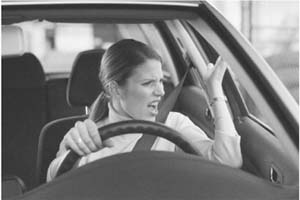
Road rage was coined about 1988 to make the public aware that frustrated, angry people sometimes use their vehicles to vent emotions. These emotions often seem triggered when a driver deliberately or inadvertently behaves inappropriately toward another driver. In some cases, venting emotions includes aggressive behaviors that have resulted in serious injury or death.
Leon James, a professor of psychology at the University of Hawaii, found that an astounding 80% of drivers are angry most or all the time while driving. Some reasons given for this state include traffic congestion, impatience at stoplights, waiting for parking spaces or for passengers to get into their cars, and the narrowing of multilane highways. These hardly seem worthy of the kind of anger generated by many hostile drivers. To understand this phenomenon, one must examine the psychology of driving.
Driving is a combination of public and private acts. Cars provide isolation and protection for drivers while propelling them through the world. Cars also provide a sense of personal power that seems to be proportional to the size and engine capability of the vehicle. In comfort, safety, anonymity, and in control of their environment, drivers feel free to behave in ways they probably never would if they were face to face with another person.
No longer are drivers satisfied with the compact or mid-sized grocery-getters or go-cart sized sports cars. If they can afford it, “road warriors” want cars they can “take control” in. Sports utility vehicles (SUVs) fit the bill for many. The average SUV is equipped with a four-wheel-drive transmission and a large engine, and even requires a ladder to enter because it is so high off the ground. These huge vehicles certainly exceed what is necessary to move a family from one place to another, but they do seem to play a vital role in feeding owners' fantasies (women as well as men) of power and importance.
...
- Aggression
- Aggression: Biological Theories
- Aggression: Evolutionary and Anthropological Theories
- Aggression: Feminist Perspective
- Aggression: Sociological Theories
- Alcohol and Aggression
- Antisocial Personality Disorder
- Batterers and Abusive Partners
- Cycle Theory of Violence
- Elder Abuse
- Family Violence
- Homicide
- Mass Violence
- Media, Violence in the
- Motives for Murder
- Paraphilia
- Pedophilia
- Police Brutality
- Predicting Violent Behavior
- Psychopaths
- Rape
- Road Rage
- Robbery
- Serial Murder
- Sexual Offenses
- Stalking
- Violent Behavior: A Psychological Case Study
- Violent Behavior: Personality Theories
- Violent Behavior: Psychoanalytic Theories
- Women and Violence
- Criminal Investigation
- Ballistics
- Criminal Justice Practitioner
- Criminalistics
- Cyberstings
- False Confessions
- False Memory Syndrome
- FBI Top 10 Most Wanted List
- Federal Bureau of Investigation (FBI)
- Forensic Science
- Geographic Profiling
- Predicting Violent Behavior
- Prevention of Crime and Violent Behavior
- Profiling
- Signature Killers
- Threat Assessment
- Uniform Crime Reports (UCR)
- ViCLAS
- Victimology
- Cults
- Death Penalty
- Family Violence
- Battered Child Syndrome
- Battered Woman's Syndrome
- Batterers and Abusive Partners
- Child Abuse
- Child Killers
- Children as Victims of Sex Crimes
- Cycle Theory of Violence
- Elder Abuse
- Exploitation of Children
- Family Homicide
- Family Violence
- Gender Violence
- Homicide
- MacDonald, Jeffery Robert
- Methods of Murder
- Munchausen Syndrome by Proxy
- Murder-Suicide
- Poisoners
- Rape
- Simpson, O. J.
- Victimology
- Violent Behavior
- Women and Violence
- Yates, Andrea
- Forensic Science
- Gangs
- Government-Sanctioned Violence
- Homicide
- Aeronautical Mass Murder
- Arson
- Assassins
- Child Killers
- Death Penalty
- Family Homicide
- Homicide
- Homicide, Motivation for Murder
- Homicide, Perceptions of
- Homicide: Types of, and Degrees of Murder
- Juvenile Killers
- Lust Murder
- Mass Murder
- Mass Violence
- Medical Murders
- Motives for Murder
- Paraphilia
- Poisoners
- Poisoning: Medical Settings
- Product Tampering
- Psychopaths
- Rippers
- School Shootings
- Serial Murder
- Signature Killers
- Spree Murders
- Stalking
- Trophy Taking
- Vampires, Werewolves, and Witches
- Vehicular Homicide
- Victimology
- Workplace Violence and Homicide
- Juvenile Crime
- Kidnapping
- Legal Response to Violent Crime
- Brady Bill
- Brawner Test
- Court-Mandated Treatment
- Court-Ordered Psychological Assessments
- Courts, Organization of
- Cyberstings
- Gun Control
- Homicide, Types of, and Degrees of Murder
- Jurisdiction
- M'Naughten Rule
- Megan's Law
- Not Guilty by Reason of Insanity (NGRI)
- Prevention of Crime and Violent Behavior
- Self-Defense, Actions Taken in
- Sex Offender Registry
- Tarasoff Decision
- Three Strikes and You're Out!
- Victim and Witness Protection Act of 1982 (VWPA)
- Victim Compensation for Violent Crimes
- Victimology
- Victims of Crime Act, 1984 (VOCA)
- Mass Murder
- Aeronautical Mass Murder
- Arson
- Bin Laden, Osama
- Columbine/Littleton School Shooting
- Ethnic Cleansing
- Ferguson, Colin
- Genocide
- History of Violence in Religions
- Huberty, James Oliver
- In Cold Blood
- Jonesboro, Arkansas School, Shooting
- Kinkel, Kipland (Kip)
- MacDonald, Jeffrey
- Manson, Charles/The Manson Family
- Mass Murder
- Mass Violence
- McVeigh, Timothy
- Media, Violence in the
- Nichols, Terry
- Oklahoma City Bombing
- School Shootings
- St. Valentine's Day Massacre
- Terrorism
- War Atrocities
- Workplace Homicide/Violence
- Yates, Andrea
- Motives for Violence
- Aggravating and Mitigating Circumstances
- Aggression
- Alcohol and Aggression
- Batterers and Abusive Partners
- Beltway Snipers
- Cycle Theory of Violence
- Drug Trade
- Family Violence
- Gender Violence
- Helter-Skelter
- Homicide, Motivation for Murder
- Less-Dead
- Medical Murders
- Motives for Murder
- Munchausen Syndrome by Proxy
- Paraphilia
- Pedophilia
- Predicting Violent Behavior
- Profiling
- Rape
- Road Rage
- Robbery
- Serial Murder
- Sexual Offenses
- Substance Abuse and Homicide
- Vehicular Homicide
- Vigilantism
- Organized Crime
- Police and Violence
- Psychological Theories and Diagnoses for Violent Behavior
- Aggression: Psychological Theories
- Antisocial Personality Disorder
- Arsonist's Portrait
- Attachment Deficiency and Violence
- Brawner Test
- Court-Ordered Psychological Assessment
- Diagnostic and Statistical Manual of Mental Disorders (DSM)
- Jekyll and Hyde Syndrome
- Juvenile Firesetters
- Less-Dead
- M'Naughten Rule
- MacDonald Triad
- Mentally Disordered Offenders
- Motives for Murder
- Paraphilia
- Pedophilia
- Predicting Violent Behavior
- Psychopathology Checklist-Revised (PCL-R)
- Psychopaths
- Psychosocial Risk Factors for Violent Behavior
- Violence: Phenomenology
- Violent Behavior: A Psychological Case Study
- Violent Behavior: Personality Theories
- Violent Behavior: Psychoanalytic Theories
- XYY Syndrome
- Serial Murder
- Serial Murderers
- Albright, Charles
- Bathory, Countess Elizabeth
- Beck, Martha, and Ray Fernandez
- Beltway Snipers
- Berkowitz, David Richard
- Bernardo, Paul, and Karla Homolka
- Bundy, Theodore “Ted”
- Chikatilo, Andrei
- Dahmer, Jeffrey
- DeSalvo, Albert Henry
- Dodd, Westley Allan
- Gray, Dana Sue
- Hoch, Johann Otto (Bluebeard)
- Hog Trail Killings
- Jack the Ripper
- Jones, Genene
- Kaczynski, Theodore
- Kevorkian, Jack
- Lake, Leonard, and Charles Ng
- Landru, Henri Desiré
- Manson, Charles
- Milat, Ivan
- Parker, Bonnie, and Clyde Barrow
- Ramirez, Richard
- Sells, Tommy Lynn
- Williams, Wayne
- Zebra Killings
- Zodiac Murders
- Sex Crimes
- Terrorism
- Victimology
- Aggression: Feminist Perspective
- Battered Child Syndrome
- Battered Woman's Syndrome
- Batterers and Abusive Partners
- Elder Abuse
- Family Violence
- Gender Violence
- Predicting Violent Behavior
- Prevention of Crime and Violent Behavior
- Profiling
- Rape
- Robbery
- Threat Assessment
- Victim and Witness Protection Act (1984)
- Victim Compensation for Violent Crimes
- Victimology
- Victims of Crime Act (1984)
- Vigilantism
- Violent Crime
- Aeronautical Mass Murder
- Aggression
- Air Rage
- Antisocial Personality Disorder
- Arson
- Battered Child Syndrome
- Battered Woman's Syndrome
- Batterers and Abusive Partners
- Child Abuse
- Child Killers
- Community Attitudes Toward Violent Crime
- Cycle Theory of Violence
- Death Penalty
- Drug Trade
- Elder Abuse
- Family Homicide
- Family Violence
- Gangs
- Gender Violence
- Homicide
- Juvenile Firesetters
- Juvenile Killers
- Juvenile Offenders
- Lust Murder
- Mass Murder
- Mass Violence
- Media, Violence in the
- Medical Murders
- Methods of Murder
- Motives for Murder
- Murder-Suicide
- Neo-Nazi Skinheads
- Organized Crime
- Paraphilia
- Pedophilia
- Poisoners
- Poisoning: Medical Settings
- Police Brutality
- Predicting Violent Behavior
- Product Tampering
- Psychopaths
- Psychosocial Risk Factors for Violent Behavior
- Rape
- Rippers
- Road Rage
- Robbery
- School Shootings
- Serial Murder
- Sex Offenders
- Sexual Offenses
- Signature Killers
- Stalking
- Stranger Violence
- Suicide by Cop
- Team Killers
- Terrorism
- Trophy Taking
- Uniform Crime Reports (UCR)
- Vampires, Werewolves, and Witches
- ViCLAS
- Victimology
- Vigilantism
- Violent Behavior
- Violent Female Juvenile Offenders
- War Atrocities
- White Supremacists
- Women and Violence
- Workplace Violence and Homicide
- XYY Syndrome
- Loading...
Get a 30 day FREE TRIAL
-
 Watch videos from a variety of sources bringing classroom topics to life
 -
Read modern, diverse business cases
-
Explore hundreds of books and reference titles

Read next

More like this
Sage Recommends
We found other relevant content for you on other Sage platforms.
Have you created a personal profile? Login or create a profile so that you can save clips, playlists and searches