
Entry
Reader's guide
Entries A-Z
Subject index
Battered Woman's Syndrome
The term battered woman's syndrome (BWS), first coined by Dr. Lenore Walker in 1979, describes a pattern of psychological and behavioral characteristics found in women living in violent relationships. It also provides a possible explanation for why abused women continue to remain in battering relationships.
Central to the concept of BWS is the theory of learned helplessness. Learned helplessness theory predicts that an individual's self-efficacy can be diminished through abusive interactions. The aversive experiences associated with trauma lower the victim's perception of effectiveness in being able to control what happens to him or her.
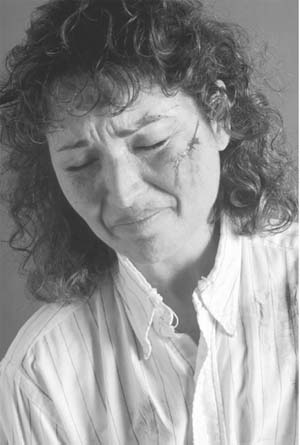
Spousal abuse is pervasive in many societies and cultures, especially where women are the victims. Every year thousands of women are injured or killed as a result of intimate violence. In the United States, there is a high correlation between spousal abuse and alcohol consumption. After an attack, the husband or partner often vows to change and is contrite. This “honeymoon” phase leads to a tensionbuilding phase that often culminates in another violent attack.
Characteristics of BWS
Walker specifies that a woman who has experienced two complete battering cycles can be classified as a battered woman. Battering cycles are characterized by a period of tension building, followed by an acute battering episode, and ending with a reconciliation or loving period. BWS has been described as a subgroup of what the American Psychological Association (APA) defines as post-traumatic stress disorder (PTSD). Although there is not one definitive profile of a sufferer of BWS, generally there are four main characteristics:
- The woman accepts responsibility for her batterer's actions.
- The woman is unable to place the responsibility for the violence elsewhere.
- The woman fears for her life and/or the lives of her children.
- The woman believes her abuser is omnipresent and omniscient.
Battered women also frequently suffer from low self-esteem and severe stress reactions. In addition, some argue that battered women may not be able to accurately discern the level of dangerousness in a given incident. They contend that BWS/PTSD can explain how, because of flashbacks or other experiences associated with past victimization, a victim of prior abuse can regard a current situation as dangerous when objectively it is not.
Applications
The emergence of BWS in domestic violence research has brought wide public attention to the conditions of battered women and, combined with feminist advocacy, has prompted changes in the trials of battered women charged with killing their abusers.
BWS has been used in criminal cases since the late 1970s. Contrary to popular belief, it has not been used as a discrete defense to criminal charges. Rather, it is typically used, along with other relevant information, to support claims of self-defense. The term generally relates to expert testimony that describes the social and psychological effects of continued battering, and characterizes the history of the relationship between the defendant and the decedent.
Criticisms
Early criticism of BWS centered on the use of learned helplessness theory to explain why battered women remain in violent relationships. Specifically, women's advocates believed that because of the word helplessness, the theory could be easily misinterpreted to perpetuate the image of women as mentally weak, powerless, or incompetent. Such criticism has led researchers to distinguish learned helplessness from being helpless. The theory suggests that continual battering, with unsuccessful attempts to escape, diminishes a woman's motivation to respond. What results is a state of “learned” helplessness in which the battered woman loses the ability to foresee what she will do to produce a particular outcome (end the abuse, escape the relationship, etc.).
...
- Aggression
- Aggression: Biological Theories
- Aggression: Evolutionary and Anthropological Theories
- Aggression: Feminist Perspective
- Aggression: Sociological Theories
- Alcohol and Aggression
- Antisocial Personality Disorder
- Batterers and Abusive Partners
- Cycle Theory of Violence
- Elder Abuse
- Family Violence
- Homicide
- Mass Violence
- Media, Violence in the
- Motives for Murder
- Paraphilia
- Pedophilia
- Police Brutality
- Predicting Violent Behavior
- Psychopaths
- Rape
- Road Rage
- Robbery
- Serial Murder
- Sexual Offenses
- Stalking
- Violent Behavior: A Psychological Case Study
- Violent Behavior: Personality Theories
- Violent Behavior: Psychoanalytic Theories
- Women and Violence
- Criminal Investigation
- Ballistics
- Criminal Justice Practitioner
- Criminalistics
- Cyberstings
- False Confessions
- False Memory Syndrome
- FBI Top 10 Most Wanted List
- Federal Bureau of Investigation (FBI)
- Forensic Science
- Geographic Profiling
- Predicting Violent Behavior
- Prevention of Crime and Violent Behavior
- Profiling
- Signature Killers
- Threat Assessment
- Uniform Crime Reports (UCR)
- ViCLAS
- Victimology
- Cults
- Death Penalty
- Family Violence
- Battered Child Syndrome
- Battered Woman's Syndrome
- Batterers and Abusive Partners
- Child Abuse
- Child Killers
- Children as Victims of Sex Crimes
- Cycle Theory of Violence
- Elder Abuse
- Exploitation of Children
- Family Homicide
- Family Violence
- Gender Violence
- Homicide
- MacDonald, Jeffery Robert
- Methods of Murder
- Munchausen Syndrome by Proxy
- Murder-Suicide
- Poisoners
- Rape
- Simpson, O. J.
- Victimology
- Violent Behavior
- Women and Violence
- Yates, Andrea
- Forensic Science
- Gangs
- Government-Sanctioned Violence
- Homicide
- Aeronautical Mass Murder
- Arson
- Assassins
- Child Killers
- Death Penalty
- Family Homicide
- Homicide
- Homicide, Motivation for Murder
- Homicide, Perceptions of
- Homicide: Types of, and Degrees of Murder
- Juvenile Killers
- Lust Murder
- Mass Murder
- Mass Violence
- Medical Murders
- Motives for Murder
- Paraphilia
- Poisoners
- Poisoning: Medical Settings
- Product Tampering
- Psychopaths
- Rippers
- School Shootings
- Serial Murder
- Signature Killers
- Spree Murders
- Stalking
- Trophy Taking
- Vampires, Werewolves, and Witches
- Vehicular Homicide
- Victimology
- Workplace Violence and Homicide
- Juvenile Crime
- Kidnapping
- Legal Response to Violent Crime
- Brady Bill
- Brawner Test
- Court-Mandated Treatment
- Court-Ordered Psychological Assessments
- Courts, Organization of
- Cyberstings
- Gun Control
- Homicide, Types of, and Degrees of Murder
- Jurisdiction
- M'Naughten Rule
- Megan's Law
- Not Guilty by Reason of Insanity (NGRI)
- Prevention of Crime and Violent Behavior
- Self-Defense, Actions Taken in
- Sex Offender Registry
- Tarasoff Decision
- Three Strikes and You're Out!
- Victim and Witness Protection Act of 1982 (VWPA)
- Victim Compensation for Violent Crimes
- Victimology
- Victims of Crime Act, 1984 (VOCA)
- Mass Murder
- Aeronautical Mass Murder
- Arson
- Bin Laden, Osama
- Columbine/Littleton School Shooting
- Ethnic Cleansing
- Ferguson, Colin
- Genocide
- History of Violence in Religions
- Huberty, James Oliver
- In Cold Blood
- Jonesboro, Arkansas School, Shooting
- Kinkel, Kipland (Kip)
- MacDonald, Jeffrey
- Manson, Charles/The Manson Family
- Mass Murder
- Mass Violence
- McVeigh, Timothy
- Media, Violence in the
- Nichols, Terry
- Oklahoma City Bombing
- School Shootings
- St. Valentine's Day Massacre
- Terrorism
- War Atrocities
- Workplace Homicide/Violence
- Yates, Andrea
- Motives for Violence
- Aggravating and Mitigating Circumstances
- Aggression
- Alcohol and Aggression
- Batterers and Abusive Partners
- Beltway Snipers
- Cycle Theory of Violence
- Drug Trade
- Family Violence
- Gender Violence
- Helter-Skelter
- Homicide, Motivation for Murder
- Less-Dead
- Medical Murders
- Motives for Murder
- Munchausen Syndrome by Proxy
- Paraphilia
- Pedophilia
- Predicting Violent Behavior
- Profiling
- Rape
- Road Rage
- Robbery
- Serial Murder
- Sexual Offenses
- Substance Abuse and Homicide
- Vehicular Homicide
- Vigilantism
- Organized Crime
- Police and Violence
- Psychological Theories and Diagnoses for Violent Behavior
- Aggression: Psychological Theories
- Antisocial Personality Disorder
- Arsonist's Portrait
- Attachment Deficiency and Violence
- Brawner Test
- Court-Ordered Psychological Assessment
- Diagnostic and Statistical Manual of Mental Disorders (DSM)
- Jekyll and Hyde Syndrome
- Juvenile Firesetters
- Less-Dead
- M'Naughten Rule
- MacDonald Triad
- Mentally Disordered Offenders
- Motives for Murder
- Paraphilia
- Pedophilia
- Predicting Violent Behavior
- Psychopathology Checklist-Revised (PCL-R)
- Psychopaths
- Psychosocial Risk Factors for Violent Behavior
- Violence: Phenomenology
- Violent Behavior: A Psychological Case Study
- Violent Behavior: Personality Theories
- Violent Behavior: Psychoanalytic Theories
- XYY Syndrome
- Serial Murder
- Serial Murderers
- Albright, Charles
- Bathory, Countess Elizabeth
- Beck, Martha, and Ray Fernandez
- Beltway Snipers
- Berkowitz, David Richard
- Bernardo, Paul, and Karla Homolka
- Bundy, Theodore “Ted”
- Chikatilo, Andrei
- Dahmer, Jeffrey
- DeSalvo, Albert Henry
- Dodd, Westley Allan
- Gray, Dana Sue
- Hoch, Johann Otto (Bluebeard)
- Hog Trail Killings
- Jack the Ripper
- Jones, Genene
- Kaczynski, Theodore
- Kevorkian, Jack
- Lake, Leonard, and Charles Ng
- Landru, Henri Desiré
- Manson, Charles
- Milat, Ivan
- Parker, Bonnie, and Clyde Barrow
- Ramirez, Richard
- Sells, Tommy Lynn
- Williams, Wayne
- Zebra Killings
- Zodiac Murders
- Sex Crimes
- Terrorism
- Victimology
- Aggression: Feminist Perspective
- Battered Child Syndrome
- Battered Woman's Syndrome
- Batterers and Abusive Partners
- Elder Abuse
- Family Violence
- Gender Violence
- Predicting Violent Behavior
- Prevention of Crime and Violent Behavior
- Profiling
- Rape
- Robbery
- Threat Assessment
- Victim and Witness Protection Act (1984)
- Victim Compensation for Violent Crimes
- Victimology
- Victims of Crime Act (1984)
- Vigilantism
- Violent Crime
- Aeronautical Mass Murder
- Aggression
- Air Rage
- Antisocial Personality Disorder
- Arson
- Battered Child Syndrome
- Battered Woman's Syndrome
- Batterers and Abusive Partners
- Child Abuse
- Child Killers
- Community Attitudes Toward Violent Crime
- Cycle Theory of Violence
- Death Penalty
- Drug Trade
- Elder Abuse
- Family Homicide
- Family Violence
- Gangs
- Gender Violence
- Homicide
- Juvenile Firesetters
- Juvenile Killers
- Juvenile Offenders
- Lust Murder
- Mass Murder
- Mass Violence
- Media, Violence in the
- Medical Murders
- Methods of Murder
- Motives for Murder
- Murder-Suicide
- Neo-Nazi Skinheads
- Organized Crime
- Paraphilia
- Pedophilia
- Poisoners
- Poisoning: Medical Settings
- Police Brutality
- Predicting Violent Behavior
- Product Tampering
- Psychopaths
- Psychosocial Risk Factors for Violent Behavior
- Rape
- Rippers
- Road Rage
- Robbery
- School Shootings
- Serial Murder
- Sex Offenders
- Sexual Offenses
- Signature Killers
- Stalking
- Stranger Violence
- Suicide by Cop
- Team Killers
- Terrorism
- Trophy Taking
- Uniform Crime Reports (UCR)
- Vampires, Werewolves, and Witches
- ViCLAS
- Victimology
- Vigilantism
- Violent Behavior
- Violent Female Juvenile Offenders
- War Atrocities
- White Supremacists
- Women and Violence
- Workplace Violence and Homicide
- XYY Syndrome
- Loading...
Get a 30 day FREE TRIAL
-
 Watch videos from a variety of sources bringing classroom topics to life
 -
Read modern, diverse business cases
-
Explore hundreds of books and reference titles

Read next

More like this
Sage Recommends
We found other relevant content for you on other Sage platforms.
Have you created a personal profile? Login or create a profile so that you can save clips, playlists and searches