
Entry
Reader's guide
Entries A-Z
Subject index
Maternal Homicide
What is most striking about child homicide are the very high rates during the first few months of life and that the offender is the mother of the child. Figure 1 shows rates by age of children from birth to age 18. Two data sources were used from 1996 to 2000: state homicide rates from California and national rates from the FBI.
Figure 1 shows that homicide rates among new-borns are the second highest in the 18-year lifespan. The newborn rate is not exceeded until about age 15 in California and about age 16 nationally. What is also noteworthy is that the homicide rates in Figure 1 drop sharply and remain low between age 6 and age 12; this period has the lowest homicide rates in the human lifespan and reflect the high level of surveillance of children during that period by parents, schools, and other agencies.
Figure 1 Age-Specific Homicide Rates: California and United States, 1996-2000
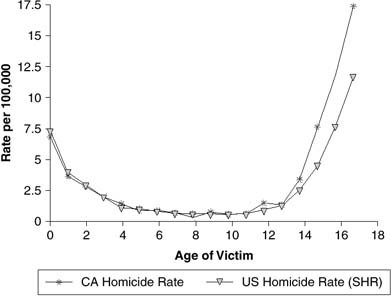
Sources: California Department of Justice, Criminal Justice Statistics Center, Homicide file; U.S. Department of Justice; Federal Bureau of Investigation Uniform Crime Reports.
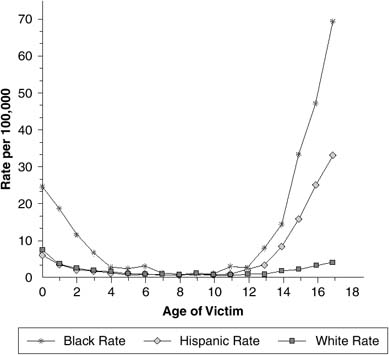
Figure 2 gives the rates adjusted by age for Black, White, and Hispanic children in California from 1987 through 2002.
As Figure 2 indicates, the curves for race and ethnic groups follow the same general form as Figure 1. However, the rates for Black victims are much higher in the first few years of life compared to Whites and Hispanics. One research study found the relative risk for Black infant homicides was over 3 times higher than for Whites. There are two lines of reasoning that suggests the high rates among Blacks reflect social and economic hardships frequently of a single parent unprepared for child raising.
First, the evidence is generally clear that there is little distinction among genders in the killing of infants; both male and female infants are killed at about the same rates. Second, Hispanic rates are low because research indicates fewer homes with Hispanic fathers absent-even among immigrants. This difference suggests social and economic factors are operative.
Figure 2 Victim Race/Ethnicity by Age
The available research suggests that over 90% of homicides during the first week of life are committed by the mother. Thereafter, fathers, other family members, and people outside the family gradually play a more important role as offenders.
There seem to be two general classes of causes of maternal homicide. There are a number of maternal homicides occurring among young women who become unexpectedly pregnant. The case of the “prom mom” in New Jersey, who concealed her pregnancy until she delivered the child in the toilet at her senior prom, killed it, wrapped in trash bags, threw it in the dumpster, and returned to the prom.
Young women who fall in the category of the unexpectedly pregnant go to great lengths to conceal their pregnancy. The expectant mother is fearful and concerned about what her parents and friends will think; overwhelmed by guilt and shame, she denies the pregnancy until she is faced with the newborn child. Such cases may be the result of dissociative disorders; the latter are an inability to recall important information, usually of a traumatic or stressful nature. Confronted with the undeniable fact of a newborn infant, rather than acknowledging what happened, she disposes of the baby as quickly as possible.
...
- Children and Youth
- Abandonment
- Animal Abuse and Child Maltreatment Occurrence
- Campus Violence
- Child Abductions, Family
- Child Abductions, Nonfamily
- Child Abuse and Disabilities
- Child Aggression as Predictor of Youth and Adult Violence
- Child Exposure to Violence, in Media
- Child Exposure to Violence, Role of Schools
- Child Fatalities
- Child Neglect
- Child Physical Abuse
- Child Sexual Abuse
- Children and Adolescents Who Kill
- Children Missing Involuntarily or for Benign Reasons
- Children's Advocacy Center
- Collaborative Divorce, Benefits to Children
- Community Violence, Effects on Children and Youth
- Complex Trauma in Children and Adolescents
- Delinquency and Violence
- Divorce in Relation to Child Abuse
- Divorce in Relation to Youth Violence
- Failure to Protect
- Failure to Thrive
- Father Involvement
- Fathers as Perpetrators of Child Maltreatment
- Female Perpetrators of Violence Against Children
- Female Perpetrators of Violence, Teen Girls
- Female Slavery/Child Slavery
- Feticide
- Fraternities and Violence
- Hazing
- Health Care Response to Child Maltreatment
- Health Consequences of Child Maltreatment
- Incest
- Infanticide
- Internet, Crimes Against Children
- Intimate Partner Relationship Quality and Domestic Violence
- Maternal Responsibility for Child Physical Abuse
- National AMBER Alert Program
- Nonoffending Parents of Maltreated Children
- Parenting Practices and Violence, Child Maltreatment
- Parenting Practices and Violence, Youth Violence
- Pedophilia
- Peer Influences on Youth Violence
- Punking
- Runaway and Thrownaway Children
- Rural Child Abuse
- School Violence
- School Violence, Media Coverage of
- School Violence, School Shootings
- Sexually Aggressive Behavior in Children
- Video Games, Violence Exposure in
- Youth Violence
- Civil and Criminal Legal Systems
- Abolitionist Approach to Prostitution
- Capital Punishment
- Community Justice
- Community Policing
- Court-Appointed Special Advocates
- Department of Homeland Security and Immigration Services
- Department of Homeland Security, Asylum
- Department of Homeland Security, Response to Battered Immigrants and Immigrant Victims of Violence against Women
- Domestic Violence Courts
- Dual Arrest
- Expert Testimony
- Family Justice Centers
- Hague Convention on the Civil Aspects of International Child Abduction
- Hate Crimes (Bias Crimes), Criminal Justice Responses
- Human Rights
- Immigrant and Migrant Women and Law Enforcement Response
- Insanity Defense
- Investigative Interviewing of Child Sexual Abuse Victims
- Investigative Interviewing of Children
- Investigative Interviewing of Offenders
- Legal Issues in the Treatment of Sexual and Domestic Violence
- Legal System and Child Protection
- Legal System, Advocacy Efforts to Affect, Child Maltreatment
- Legal System, Advocacy Efforts to Affect, Elder Abuse
- Legal System, Advocacy Efforts to Affect, Intimate Partner Violence
- Legal System, Advocacy Efforts to Affect, Violence against Children
- Legal System, Civil and Criminal Court Remedies for Sexual Assault/Rape
- Legal System, Civil Court Remedies for Intimate Partner Violence
- Legal System, Criminal Investigation of Victimization of Children
- Legal System, Criminal Justice Strategies to Reduce Interpersonal Violence
- Legal System, Criminal Justice System Responses to Intimate Partner Violence
- Mandatory Arrest/Pro-Arrest Statutes
- Mandatory Reporting Laws of Child Maltreatment
- Mandatory Reporting Laws of Elder Abuse
- Mandatory Reporting Laws of Intimate Partner Violence
- Minneapolis Domestic Violence Experiment
- National Incident-Based Reporting System
- National Institute of Justice
- No-Drop Prosecution
- Office of Juvenile Justice and Delinquency Prevention
- Police, Response to Child Maltreatment
- Police, Response to Domestic Violence
- Police, Suicide by Cop
- Police, Use of Violence/Excessive Force
- Pregnancy, Criminalizing the Pregnancies of Drug-Addicted Women
- Prison Violence and Prison Gangs
- Prison Violence by Corrections Staff
- Prison Violence by Inmates
- Prison Violence in Women's Facilities
- Prison Violence, Sexual Assault
- Prosecutorial Practices, Child Maltreatment
- Prosecutorial Practices, Elder Abuse
- Prosecutorial Practices, Interpersonal Violence
- Prosecutorial Practices, Intimate Partner Violence
- Reasonable Efforts
- Recidivism
- Restorative Justice
- Restraining and Protective Orders
- Scottsboro Boys
- Secondary Victimization by Police and Courts
- Self-Defense
- Self-Petitioning Process
- Sex Offenders, Civil Commitment
- Spouse Assault Replication Project
- STOP Violence against Women Formula Grant Program
- Uniform Crime Reports
- United Nations, International Law/Courts
- Victim Impact Statements
- Victim Witness Specialists
- Interpersonal Violence—General
- Alcohol and Violence
- Anti-Abortion Violence
- Assault
- Assault, Aggravated
- Assault, Simple
- Assisted Suicide
- Athletes/Athletics
- Athletes/Athletics and Violence in Sport
- Bullying
- Community Violence
- Contract Killings
- Corporate Violence
- Cyberstalking
- Expressive Violence
- Fear of Crime
- Female Perpetrators of Interpersonal Violence
- Forced Military Conscription
- Gang Violence
- Genocide
- Gun Violence
- Hate Crimes (Bias Crimes), Anti-Gay
- Hate Crimes (Bias Crimes), Gender Motivated
- Health Consequences of Hate Crime
- Health Consequences of Incarceration
- Homelessness and Violence
- Homicides, Criminal
- Homophobia
- Homophobia and Media Representations of Gay, Lesbian, Bisexual, and Transgender People
- Hypermasculinity
- Instrumental Violence
- Masculinities and Violence
- Mass Murder
- Media and Violence
- Media, Representations/Distortions of Crime
- Misogyny
- Moral Panics
- Neuropsychological Factors in Impulsive Aggression and Violent Behavior
- Oppression and Violence
- Patriarchy
- Poverty
- Prisoner Reentry
- Psychophysiological Factors in Predicting Violence
- Religion
- Resiliency, Protective and Risk Factors
- Ritualistic Abuse
- Robbery
- Serial Murder/Serial Killers
- Sex Discrimination
- Socioeconomic Status, Offending and Victimization by Class
- Stalking
- State Violence
- Torture
- Victimization, Predictors of
- Violence against People With Disabilities
- Workplace Violence
- Intervention and Prevention Programs
- 12-Step Programs
- Abuse-Focused Therapy
- Advocacy
- Alcoholics Anonymous
- AMEND
- Batterers, Treatment Approaches and Effectiveness
- Child Abuse Prevention
- Child Death Review Teams
- Clothesline Project
- Collective Efficacy
- Coordinated Community Response
- Couple Counseling
- Crime Victims Compensation Program
- Crisis Hotlines
- Culturally Sensitive Intervention
- Domestic Violence Enhanced Response Team
- Domestic Violence Fatality Review
- Duluth Model
- Early Intervention Programs
- Emerge
- Ethical and Legal Issues, Interviewing Children Reported as Abused or Neglected
- Ethical and Legal Issues, Treating Elder Abuse
- Faith-Based Programs
- Family Group Conferencing
- Family Preservation and Reunification Programs
- Family Therapy and Family Violence
- Father Involvement
- Fathers' Rights Movement
- Financial Literacy Versus Financial Abuse
- Forensic Nursing
- Foster Care
- Greenbook, The
- Health Care Response, Prevention Strategies for Reducing Interpersonal Violence
- Home Visitation Services
- Intensive Family Preservation Services
- Internet-Based Interventions
- Kinship Care
- Marriage Education and Violence
- Mediation
- Mending the Sacred Hoop
- Military, Family Advocacy Programs
- National Domestic Violence Hotline
- Parent-Child Interaction Therapy
- Parent-Child Trauma Therapy
- Peer Mediation Programs
- Prevention Programs, Adolescent Dating Violence
- Prevention Programs, Child Maltreatment
- Prevention Programs, Community Approaches to Intimate Partner Violence
- Prevention Programs, Community Mobilization
- Prevention Programs, Definitions
- Prevention Programs, Interpersonal Violence
- Prevention Programs, Youth Violence
- Psychopharmacology for Violence
- Public Education
- Safe Houses
- Safety Planning
- School-Based Violence Prevention Programs
- Sex Education
- Sexual Assault Nurse Examiner
- Sexual Assault Response Team
- Sheltering of Domestic Violence Victims' Pets
- Shelters, Battered Women's
- Social Cognitive Programs for Violence
- Social Support Networks
- Spirituality and Family Therapy
- Suicidality: Prevention
- Take Back the Night
- Transitional Housing Programs
- Trauma-Focused Therapy
- Victim-Offender Mediation and Dialogue
- Victim-Witness Advocacy Programs
- Violence Prevention Curricula for Adolescents
- Legislation
- “One Strike” Public Housing Policy
- Adoption and Safe Families Act of 1997
- Adoption Assistance and Child Welfare Act of 1980
- Child Abuse Prevention and Treatment Act
- Decriminalization of Sex Work
- Family Violence Option
- Family Violence Prevention and Services Act
- Full Faith and Credit Mandate
- Gun Control
- Gun Control, Legislation
- Legislation, Child Maltreatment
- Legislation, Elder Abuse
- Legislation, Hate Crimes
- Legislation, Intimate Partner Violence
- Legislation, Rape/Sexual Assault
- Prison Rape Elimination Act
- Rape Shield Laws
- Sex Offender Registration Laws
- Temporary Assistance for Needy Families Program
- United Nations Conventions and Declarations
- Victims of Crime Act
- Violence against Women Act
- Organizations and Agencies
- International Society for Traumatic Stress Studies
- Academy on Violence and Abuse
- Adult Protective Services
- American Humane Association
- American Professional Society on the Abuse of Children
- Anti-Rape and Rape Crisis Center Movements
- Asian & Pacific Islander Institute on Domestic Violence
- Asian/Pacific Islander Youth Violence Prevention Center
- Association for the Treatment of Sexual Abusers
- Battered Women's Justice Project
- Battered Women's Movement
- Centers for Disease Control and Prevention
- Child Protective Services
- Children's Advocacy Center
- Chiswick Women's Aid
- Domestic Violence Resource Network
- End Violence against Women International
- Family Violence Prevention Fund
- Feminist Movements to End Violence against Women
- Institute on Domestic Violence in the African American Community
- International Society for the Prevention of Child Abuse and Neglect
- International Society for Traumatic Stress Studies
- Legal Momentum
- Mentors in Violence Prevention
- National Center for Missing and Exploited Children
- National Center for Victims of Crime
- National Child Traumatic Stress Network
- National Children's Alliance and Children's Advocacy Centers
- National Clearinghouse for the Defense of Battered Women
- National Clearinghouse on Marital and Date Rape
- National Coalition against Domestic Violence
- National Council of Juvenile and Family Court Judges
- National Crime Prevention Council
- National Domestic Violence Fatality Review Initiative
- National Latino Alliance for the Elimination of Domestic Violence
- National Network to End Domestic Violence
- National Organization for Women
- National Resource Center on Domestic Violence
- National Sexual Violence Resource Center
- Office for Victims of Crime
- Office on Child Abuse and Neglect
- Office on Violence against Women
- Sacred Circle National Resource Center to End Violence against Native Women
- Silent Witness National Initiative
- Victims' Rights Movement
- Women of Color Network
- Women's Aid Federations of the United Kingdom
- Racial/Ethnic and Cross-Cultural Issues
- Acid Attacks
- Child Abuse in Immigrant Families
- Civil Rights/Discrimination
- Cultural Competence
- Cultural Defense
- Cultural Retaliatory Homicide
- Domestic Violence among Immigrant Women
- Domestic Violence in Asian and Pacific Islander Populations
- Dowry Deaths, Bride Burning
- Female Genital Mutilation
- Foot Binding
- Forced Marriages
- Gendercide
- Hate Crimes (Bias Crimes), Racially Motivated
- Hate Crimes (Bias Crimes), Religiously Motivated
- Honor Killing/Crime
- Immigrant and Migrant Women
- International Sex Industry
- Intersectionality
- Mail Order Brides
- Peacemaking Circles
- Refugee/Asylee
- Trafficking, Human
- Tribal Issues
- Violence against Indigenous Children, Youth, and Families
- Violence against Women in Conflict and War Zones
- Research Methods and Data Collection Instruments
- Abusive Behavior Inventory
- Brief Child Abuse Potential Inventory
- Canadian National Survey
- Child Exposure to Domestic Violence Scale
- Conflict Tactics Scales
- Danger Assessment Instrument
- Epidemiology, Defined
- Epidemiology, International Patterns
- Epidemiology, Perpetration Patterns by Age, Gender, Ethnicity, Socioeconomic Status
- Epidemiology, Victimization Patterns by Age, Gender, Ethnicity, Socioeconomic Status
- Geographic Patterns
- Harvard School of Public Health College Alcohol Study
- Incidence
- Measurement, Interpersonal Violence
- National Crime Victimization Survey
- National Family Violence Surveys
- National Violence against Women Survey
- Power and Control Wheel
- Prevalence
- Prevalence, Measuring
- Professional Journals on Child Maltreatment
- Professional Journals on Elder Abuse
- Professional Journals on Intimate Partner Violence
- Professional Journals on Victimization
- Professional Journals on Youth Violence
- Risk Assessment
- Risk Assessment Instruments, Child Maltreatment
- Risk Assessment Instruments, Elder Abuse
- Risk Assessment Instruments, Interpersonal Violence
- Risk Assessment Instruments, Intimate Partner Violence
- Risk Assessment Instruments, Youth Violence
- Severity of Violence against Women Scales
- Sexual Experiences Survey
- Sexual Violence and Abuse
- Acrotomophilia
- AIDS/HIV
- Armed Forces, Sexual Harassment in
- Athletes/Athletics and Sexual Violence
- Child Sexual Abuse
- Clergy Sexual Abuse
- Coerced Sexual Initiation
- Commercial Sexual Exploitation of Children
- Developmentally Disabled Sex Offenders
- Gang Rape
- Hymen Replacement Surgery
- Internet, Pornography
- Marital Rape/Wife Rape
- Marital Rape/Wife Rape, Marital Exemptions in Rape Statutes
- Mass Rape
- Media and Sexuality
- Pimping
- Pornography
- Prison Violence, Sexual Assault
- Prostitution
- Rape Crisis Centers
- Rape Culture
- Rape Kits
- Rape/Sexual Assault
- Separation/Divorce Sexual Assault
- Serial Rape/Serial Rapists
- Sex Offenders
- Sex Tourism
- Sexual Abuse
- Sexual Abuse of People With Developmental Disabilities
- Sexual Abuse of the Elderly
- Sexual Assault in the Military
- Sexual Coercion
- Sexual Ethics
- Sexual Harassment
- Sexual Harassment in Schools
- Sexual Harassment in Workplaces
- Sexual Harassment, Same-Sex
- Sexually Transmitted Diseases
- Statutory Rape
- Syndromes, Disorders, and Other Mental Health Issues
- Alzheimer's Disease/Dementia
- Anger Management
- Attachment Disorder
- Battered Child Syndrome
- Battered Woman Syndrome
- Bestiality
- Borderline Personality Disorder
- Castration
- Child Sexual Abuse Accommodation Syndrome
- Depression
- Disability and Pornography
- Dissociation
- Domestic Violence, Trauma, and Mental Health
- False Memory
- Intermittent Explosive Disorder
- Learned Helplessness
- Learned Optimism
- Mental Illness
- Munchausen Syndrome by Proxy
- Paraphilia
- Parental Alienation Syndrome
- Posttraumatic Stress Disorder
- Psychiatric Illness and Violence Propensity
- Rape Trauma Syndrome
- Repressed Memory
- Self-Injury
- Shaken Baby Syndrome
- Stress and Violence
- Substance Abuse
- Suicidal Behaviors, Familial Factors in
- Suicidality: Clusters, Contagion, and Pacts
- Suicidality: Demographic Risk and Protective Factors
- Suicidality: Nomenclature
- Suicide, Risk and Protective Factors: In Research
- Suicide, Risk and Protective Factors: Individual Level
- Vicarious Traumatization
- Theories and Theoretical Perspectives
- Violence between Intimates/Family Violence
- Adult Survivors of Childhood Abuse
- Agency/Autonomy of Battered Women
- Animal/Pet Abuse
- Battered Women
- Battered Women, Economic Independence of
- Battered Women, Prevalence
- Battered Women: Leaving Violent Intimate Relationships
- Batterers
- Batterers, Factors Supporting Male Aggression
- Batterers, Personality Characteristics of
- Betrayal Trauma
- Caregivers and Violence
- Coercive Control
- Community Violence, Relationship to Partner Violence
- Custody, Contact, and Visitation: Relationship to Domestic Violence
- Cycle of Violence
- Date and Acquaintance Rape
- Dating Violence/Courtship Violence
- Delinquency and Dating Violence
- Divorce and Intimate Partner Violence
- Domestic Violence against Older Women
- Domestic Violence in Military Families
- Early Warning Signs of Intimate Partner Violence
- Elder Abuse
- Familicide
- Family Homicides
- Family Violence, Co-Occurrence of Forms
- Female Perpetrators of Intimate Partner Violence
- Femicide
- Filicide
- Financial Abuse, Elderly and Battered Women
- Health Care Response to Intimate Partner Violence
- Health Consequences of Intimate Partner Violence
- Help-Seeking Behaviors of Abused Women
- High-Tech Violence against Women
- Intimate Partner Relationship Quality and Domestic Violence
- Intimate Partner Violence
- Intimate Terrorism
- Maternal Homicide
- Maternal Responsibility for Child Physical Abuse
- Parenting Practices and Violence, Domestic Violence
- Pregnancy, Violence against Women During
- Psychological/Emotional Abuse
- Rural Woman Abuse
- Same-Sex Intimate Partner Violence
- Sibling Abuse
- Situational Couple Violence
- Verbal Abuse
- Violence against Women Following Natural Disasters
- Violent Resistance
- Loading...
Get a 30 day FREE TRIAL
-
 Watch videos from a variety of sources bringing classroom topics to life
 -
Read modern, diverse business cases
-
Explore hundreds of books and reference titles

Read next

More like this
Sage Recommends
We found other relevant content for you on other Sage platforms.
Have you created a personal profile? Login or create a profile so that you can save clips, playlists and searches