
Entry
Reader's guide
Entries A-Z
Subject index
Transit-Oriented Development
In cities around the world, stations and their surroundings are increasingly the focus of integrated transport and land use development efforts, whether under the label transit-oriented development as in North America and Australia, or more plainly, as (re)development of and around railway stations and other public transport interchanges as in Europe, Latin America, East Asia, and elsewhere. A combination of heterogeneous interrelated factors converges in determining this upsurge of station-related urban projects.
A first factor triggering station area projects is the new development opportunities provided by transport innovations, such as high-speed railway systems (particularly in Europe and East Asia) or new urban and regional rail-based systems (in most contexts) or bus-based systems (most notably in South America). A second factor is the generalized transfer of distribution and manufacturing activities away from station areas and toward more peripheral urban locations or new dedicated freight interchanges. Space is thus freed up for new activities around stations. A third factor is the privatization or at least the shift toward greater market orientation of transportation and, most notably, railway companies. One consequence of privatization is that transportation infrastructure and service providers are increasingly seeking ways to recapture the accessibility advantage they help to create.
Characteristically, this implies the development of commercial activities within stations and redevelopment of land above or around stations. Many East Asian cities have a long tradition in this respect, but the trend has been expanding in Europe and North America as well. Fourth is a wish to boost the competitive position of cities as places to live, work, and consume through new large-scale urban projects. Many of these projects, typically showing a dense mix of office, retail, leisure, and housing, are located around highly accessible places such as main railway stations. High-speed railway station areas in European cities in particular have been the theaters of many such initiatives in recent years.
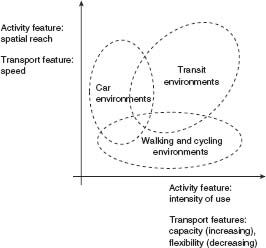
Figure 1 Basic Transport and Land Use Correlations: Transit-Oriented Development Pursues a Combination of Transit and Walking and Cycling Environments
A last but not least factor, and most notably in North America and Australia, is mounting concern about the sustainability of sprawling and car-dependent urbanization patterns. The integrated development of railway networks and land around the nodes of those networks is seen as a way toward a more public transport and nonmotorized modes-oriented, concentrated urbanization pattern. The arguments for this shift are not merely environmental (reduction of pollution, greenhouse emissions, land consumption, etc.); many local governments and citizens also see it as a condition for the development of a much needed mobility alternative for metropolises rapidly approaching total traffic gridlock.
A Spatial Challenge
Basic characteristics of the transport and land use systems determine the competitive position of transit respective to the car, and thus set the backdrop to the spatial challenge of transit-oriented development. There are two basic correlations (Figure 1). The first is between the speed of a transportation system and the scale at which an urban system works (or its reach), for instance, expressed in terms of distances between places of residence and places of work. The second basic correlation is that between the capacity and flexibility of a transportation system and the degree of spatial concentration of activities, as for instance identified by residential and employment densities. The car—a low-capacity (but high-flexibility), high-speed transportation means—is best fit to high-reach, low-density urban environments. Transit matches the speed of the car but has higher capacity (and lower flexibility). Nonmotorized modes combine high capacity and high flexibility but miss speed. To provide a competitive alternative to the car (i.e., both fast and flexible transport), the strengths of transit and slow modes need to be combined. However, this combination can be successful only in the presence of short-distance and/or high-density spatial patterns. This is the central idea of transit-oriented development.
...
- Cities: Historical Overviews
- Allegory of Good Government
- Capitalist City
- Chinatowns
- Colonial City
- Divided Cities
- Global City
- Heritage City
- Historic Cities
- Ideal City
- Informational City
- Islamic City
- Mediterranean City
- Megalopolis
- Multicultural Cities
- Other Global Cities
- Primate City
- Progressive City
- Renaissance City
- Revanchist City
- Situationist City
- World City
- Cities: Specific Cities
- Amsterdam, the Netherlands
- Berlin, Germany
- Bilbao, Spain
- Cairo, Egypt
- Canberra, Australia
- Chicago, Illinois
- Damascus, Syria
- Delhi, India
- Florence, Italy
- Hiroshima, Japan
- Hong Kong, China
- Istanbul, Turkey
- Kolkata (Calcutta), India
- Lagos, Nigeria
- Las Vegas, Nevada
- London, United Kingdom
- Los Angeles, California
- Manchester, United Kingdom
- Manila, Philippines
- Mexico City, Mexico
- Moscow, Russian Federation
- Mumbai (Bombay), India
- New York City, New York
- Paris, France
- Rome, Italy
- São Paulo, Brazil
- Santa Fe, New Mexico
- Santiago de Compostela, Spain
- Savannah, Georgia
- Shanghai, China
- Singapore
- Tokyo, Japan
- Venice, Italy
- Persons
- Alinsky, Saul
- Alonso, William
- Benjamin, Walter
- Berry, Brian J. L.
- Castells, Manuel
- Childe, V. Gordon
- Davis, Mike
- De Certeau, Michel
- Dickens, Charles
- Downs, Anthony
- Du Bois, W. E. B.
- Fujita, Masahisa
- Geddes, Patrick
- Gottdiener, Mark
- Hall, Peter
- Harvey, David
- Haussmann, Baron Georges-Eugène
- Hawley, Amos
- Isard, Walter
- Jackson, Kenneth T.
- Jacobs, Jane
- Kracauer, Siegfried
- Le Corbusier
- Lefebvre, Henri
- LLöschsch, August
- Lynch, Kevin
- Moses, Robert
- Mumford, Lewis
- Riis, Jacob
- Sassen, Saskia
- Sert, Josep Lluís
- Simmel, Goerg
- Soja, Edward W.
- Wren, Sir Christopher
- Places
- Airports
- Béguinage
- Banlieue
- Barrio
- Bazaar
- Caravanserai
- Convention Centers
- Discotheque
- Ethnic Enclave
- Favela
- Forum
- Fourth World
- Gated Community
- Ghetto
- Heterotopia
- Metropolitan
- Necropolis
- Night Spaces
- Piazza
- Placemaking
- Resort
- Shopping Center
- Sports Stadiums
- Suburbanization
- Technoburbs
- Technopoles
- Themed Environments
- Toilets
- Utopia
- World Trade Center (9/11)
- Zoöpolis
- Urban Culture
- Bohemian
- Cinema (Movie House)
- City Club
- City Users
- Creative Class
- Flaâneur
- Graffiti
- Hip Hop
- Intellectuals
- Landscapes of Power
- Loft Living
- Metropolis
- Museums
- Nightlife
- Parks
- Photography and the City
- Placemaking
- Public Art
- Shopping
- Simulacra
- Skateboarding
- Society of the Spectacle
- Stranger
- Urban
- Urban Health
- Urban Life
- Urban Novel
- Urban Economics
- Urban Geography
- Urban History
- Urban Issues
- Urban Planning
- Urban Politics
- Urban Sociology
- Urban Studies—Topical Areas: Architecture
- Urban Studies—Topical Areas: Gender and Sex – Béguinage
- Urban Studies—Topical Areas: Gender and Sex – Social Space
- Urban Studies—Topical Areas: Sustainable Development
- Urban Theory
- Urban Transportation
- Loading...
Get a 30 day FREE TRIAL
-
 Watch videos from a variety of sources bringing classroom topics to life
 -
Read modern, diverse business cases
-
Explore hundreds of books and reference titles

Read next

More like this
Sage Recommends
We found other relevant content for you on other Sage platforms.
Have you created a personal profile? Login or create a profile so that you can save clips, playlists and searches