
Entry
Reader's guide
Entries A-Z
Subject index
Streetcars
From the 1880s to at least the 1930s, streetcars provided the main means of transport in cities across the world. Horse-pulled and later electrically powered railways constituted the means by which many urban centers underwent an unprecedented physical and demographic expansion. Streetcars also redefined urban political culture, as some of the most intense local political struggles revolved around this key public service. Finally, electric streetcars, or “trolleys,” proved important culturally, emerging as a main signifier of urban modernity.
“Elevated car falls to street”—New York City, February 16, 1914
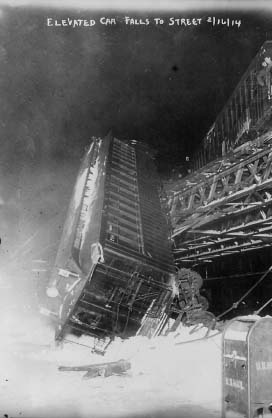
Horse- or mule-cars on rail, appearing by the 1850s, but especially the faster and more reliable trolleys in operation by the 1890s, greatly enlarged the area accessible on a daily basis to city residents, who previously either walked or rode horse carriages. Streetcars thus furthered residential flight toward peripheral areas, either to new suburbs or to old settlements now tied to the city. Also, networks of urban railways (which in some cases also transported freight goods) promoted the specialization of urban spaces according to distinct functions, such that residential, commercial, industrial, and leisure activities moved physically apart. This held true especially for North and South American cities; in contrast, European cities changed less dramatically either in terms of size or functional specialization.
How this major transport innovation shaped any given city had to do with its local politics. Because the streetcar provided a crucial public service to most city residents, the question of government regulation pulled many old and new constituencies, such as business elites, civic reformers, organized labor, and residential and consumer groups, into the political fold and thus invigorated mass-participation in politics. Equivalent to debates over railroads on the national level, streetcar politics revolved around the extent of governmental regulatory powers over private service providers. In the United States these remained fairly limited, whereas European and Latin American cities imposed stringent requirements, such as fare limits and working conditions for streetcar employees, or opted, mainly in the European case, for municipalization altogether.
A visible and omnipresent vehicle in the urban landscape, the streetcar signified the impact of technology on what were then rapidly transforming cities. It figured prominently in newspaper articles and illustrations, as well as in literary accounts. Streetcars became the harbingers of progress, but also became associated with the losses and dangers (such as deadly accidents) associated with modernity. In urban literature and film, such as works by Theodore Dreiser, Henry Roth, and Luis Buñuel, streetcars figured as the means of getting to know, of physically experiencing, urban agglomerations, whose perceived vastness otherwise seemed to escape the capacity of human imagination; passengers inside the trolley, meanwhile, formed an observable microcosm of highly diverse urban societies.
The streetcar era came to an end by the 1930s, as combustion-engine vehicles, both buses and automobiles, emerged as the dominant form of urban transportation. But depending on geography (the area covered by a given city), politics (the extent of public sector intervention in an increasingly unprofitable enterprise), and culture (residents' preferences), streetcars continue, and have recently returned, to shape city life.
...
- Cities: Historical Overviews
- Allegory of Good Government
- Capitalist City
- Chinatowns
- Colonial City
- Divided Cities
- Global City
- Heritage City
- Historic Cities
- Ideal City
- Informational City
- Islamic City
- Mediterranean City
- Megalopolis
- Multicultural Cities
- Other Global Cities
- Primate City
- Progressive City
- Renaissance City
- Revanchist City
- Situationist City
- World City
- Cities: Specific Cities
- Amsterdam, the Netherlands
- Berlin, Germany
- Bilbao, Spain
- Cairo, Egypt
- Canberra, Australia
- Chicago, Illinois
- Damascus, Syria
- Delhi, India
- Florence, Italy
- Hiroshima, Japan
- Hong Kong, China
- Istanbul, Turkey
- Kolkata (Calcutta), India
- Lagos, Nigeria
- Las Vegas, Nevada
- London, United Kingdom
- Los Angeles, California
- Manchester, United Kingdom
- Manila, Philippines
- Mexico City, Mexico
- Moscow, Russian Federation
- Mumbai (Bombay), India
- New York City, New York
- Paris, France
- Rome, Italy
- São Paulo, Brazil
- Santa Fe, New Mexico
- Santiago de Compostela, Spain
- Savannah, Georgia
- Shanghai, China
- Singapore
- Tokyo, Japan
- Venice, Italy
- Persons
- Alinsky, Saul
- Alonso, William
- Benjamin, Walter
- Berry, Brian J. L.
- Castells, Manuel
- Childe, V. Gordon
- Davis, Mike
- De Certeau, Michel
- Dickens, Charles
- Downs, Anthony
- Du Bois, W. E. B.
- Fujita, Masahisa
- Geddes, Patrick
- Gottdiener, Mark
- Hall, Peter
- Harvey, David
- Haussmann, Baron Georges-Eugène
- Hawley, Amos
- Isard, Walter
- Jackson, Kenneth T.
- Jacobs, Jane
- Kracauer, Siegfried
- Le Corbusier
- Lefebvre, Henri
- LLöschsch, August
- Lynch, Kevin
- Moses, Robert
- Mumford, Lewis
- Riis, Jacob
- Sassen, Saskia
- Sert, Josep Lluís
- Simmel, Goerg
- Soja, Edward W.
- Wren, Sir Christopher
- Places
- Airports
- Béguinage
- Banlieue
- Barrio
- Bazaar
- Caravanserai
- Convention Centers
- Discotheque
- Ethnic Enclave
- Favela
- Forum
- Fourth World
- Gated Community
- Ghetto
- Heterotopia
- Metropolitan
- Necropolis
- Night Spaces
- Piazza
- Placemaking
- Resort
- Shopping Center
- Sports Stadiums
- Suburbanization
- Technoburbs
- Technopoles
- Themed Environments
- Toilets
- Utopia
- World Trade Center (9/11)
- Zoöpolis
- Urban Culture
- Bohemian
- Cinema (Movie House)
- City Club
- City Users
- Creative Class
- Flaâneur
- Graffiti
- Hip Hop
- Intellectuals
- Landscapes of Power
- Loft Living
- Metropolis
- Museums
- Nightlife
- Parks
- Photography and the City
- Placemaking
- Public Art
- Shopping
- Simulacra
- Skateboarding
- Society of the Spectacle
- Stranger
- Urban
- Urban Health
- Urban Life
- Urban Novel
- Urban Economics
- Urban Geography
- Urban History
- Urban Issues
- Urban Planning
- Urban Politics
- Urban Sociology
- Urban Studies—Topical Areas: Architecture
- Urban Studies—Topical Areas: Gender and Sex – Béguinage
- Urban Studies—Topical Areas: Gender and Sex – Social Space
- Urban Studies—Topical Areas: Sustainable Development
- Urban Theory
- Urban Transportation
- Loading...
Get a 30 day FREE TRIAL
-
 Watch videos from a variety of sources bringing classroom topics to life
 -
Read modern, diverse business cases
-
Explore hundreds of books and reference titles

Read next

More like this
Sage Recommends
We found other relevant content for you on other Sage platforms.
Have you created a personal profile? Login or create a profile so that you can save clips, playlists and searches