
Entry
Reader's guide
Entries A-Z
Subject index
Shanghai, China
Shanghai is the largest city in China and one of the largest metropolitan areas in the world. Although Shanghai is an atypical Chinese city, its development history crystallizes the trajectory of Chinese urban transformation. It demonstrates the process of the change from a walled city, semicolonial city, socialist city, to a city of transition. Rhoads Murphey suggests that Shanghai is key to modern China, but Shanghai also is key to postreform China.
History
Despite the common wisdom of Shanghai growing from a fishing village to a global city, Shanghai was designated a market city during the Song Dynasty (AD 960–1279) and a county (xian) during the Yuan Dynasty (1271–1638). A city wall extending some nine miles and with six gates was built in 1553 during the Ming Dynasty (1368–1644), and in 1602 the city temple (Cheng Huang Miao) was constructed. In the first century of the Qing Dynasty (1644–1912), the Emperor Yongzheng established a customs office in Shanghai, giving the city exclusive control over customs collections, and by 1735 Shanghai had become the major trade port for the lower Yangzi River region.
Under the Treaty of Nanking in 1842, Shanghai became a major treaty port. Foreign capital sped up Shanghai's early industrialization. Shanghai played a metaphorical role of the “bridgehead”—a channel through which foreign products were distributed to the Yangtze River region and domestic agricultural and mineral products processed and exported. With the unprecedented trade prosperity, Shanghai became truly a cosmopolitan city. It served and controlled its environs. In its great prosperity of the 1930s, Shanghai witnessed a high concentration of banks and foreign trade.
After 1949, Shanghai was transformed from a consumption city to production-oriented city through state-led industrialization. Services such as trade, finance, and distribution dwindled. Nevertheless, Shanghai developed a comprehensive industrial system and became a “locomotive” of industrialization. Shanghai turned over a significant proportion of its revenue to the central government, while the system of planned economy guaranteed the cheap supply of resources from other provinces.
In 1990 Shanghai's Pudong was designated a new development area. In 1992, Shanghai was granted a role of “dragonhead” to drive the development of the Yangtze River delta and the takeoff of the whole region. Shanghai thus entered the fast track of building into a global city and aims to become one of international economic, finance, and trade centers. Foreign capital flowed into Shanghai. But Shanghai's reglobalization is driven by the state's development strategy.
Shanghai has become a cosmopolitan and global city, with other Chinese cities following its lead.
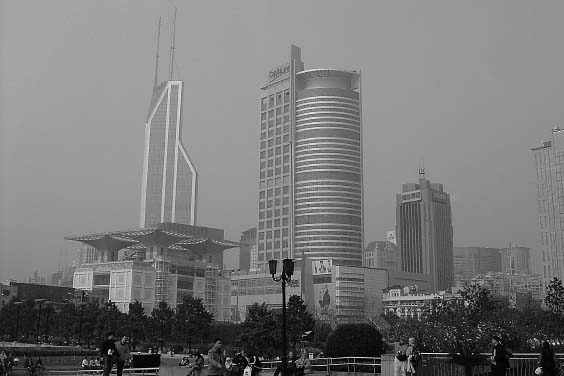
Because Shanghai has a history of entrepôt and immigrants, its culture—Shanghai genre (haipai)—presents the trait of secularism, pragmatism, and cosmopolitism. Urbanism (in the sense of urbanism as a way of modern life) first appeared in Shanghai and then spread over to the rest of China. Leo Ou-fan Lee describes the flowering of a new urban culture in China from 1930 to 1945 in his book Shanghai Modern. On the other hand, because of its significance to the national economy and national industries, the planned system was more developed and codified in everyday Shanghai than in many other Chinese cities. Shanghai developed a more established regulatory control. This is manifested in the management of rural to urban land conversion and regulation over service industries. But from time to time, Shanghai served as an alternative political and cultural base to counterbalance the mainstream trend in China.
...
- Cities: Historical Overviews
- Allegory of Good Government
- Capitalist City
- Chinatowns
- Colonial City
- Divided Cities
- Global City
- Heritage City
- Historic Cities
- Ideal City
- Informational City
- Islamic City
- Mediterranean City
- Megalopolis
- Multicultural Cities
- Other Global Cities
- Primate City
- Progressive City
- Renaissance City
- Revanchist City
- Situationist City
- World City
- Cities: Specific Cities
- Amsterdam, the Netherlands
- Berlin, Germany
- Bilbao, Spain
- Cairo, Egypt
- Canberra, Australia
- Chicago, Illinois
- Damascus, Syria
- Delhi, India
- Florence, Italy
- Hiroshima, Japan
- Hong Kong, China
- Istanbul, Turkey
- Kolkata (Calcutta), India
- Lagos, Nigeria
- Las Vegas, Nevada
- London, United Kingdom
- Los Angeles, California
- Manchester, United Kingdom
- Manila, Philippines
- Mexico City, Mexico
- Moscow, Russian Federation
- Mumbai (Bombay), India
- New York City, New York
- Paris, France
- Rome, Italy
- São Paulo, Brazil
- Santa Fe, New Mexico
- Santiago de Compostela, Spain
- Savannah, Georgia
- Shanghai, China
- Singapore
- Tokyo, Japan
- Venice, Italy
- Persons
- Alinsky, Saul
- Alonso, William
- Benjamin, Walter
- Berry, Brian J. L.
- Castells, Manuel
- Childe, V. Gordon
- Davis, Mike
- De Certeau, Michel
- Dickens, Charles
- Downs, Anthony
- Du Bois, W. E. B.
- Fujita, Masahisa
- Geddes, Patrick
- Gottdiener, Mark
- Hall, Peter
- Harvey, David
- Haussmann, Baron Georges-Eugène
- Hawley, Amos
- Isard, Walter
- Jackson, Kenneth T.
- Jacobs, Jane
- Kracauer, Siegfried
- Le Corbusier
- Lefebvre, Henri
- LLöschsch, August
- Lynch, Kevin
- Moses, Robert
- Mumford, Lewis
- Riis, Jacob
- Sassen, Saskia
- Sert, Josep Lluís
- Simmel, Goerg
- Soja, Edward W.
- Wren, Sir Christopher
- Places
- Airports
- Béguinage
- Banlieue
- Barrio
- Bazaar
- Caravanserai
- Convention Centers
- Discotheque
- Ethnic Enclave
- Favela
- Forum
- Fourth World
- Gated Community
- Ghetto
- Heterotopia
- Metropolitan
- Necropolis
- Night Spaces
- Piazza
- Placemaking
- Resort
- Shopping Center
- Sports Stadiums
- Suburbanization
- Technoburbs
- Technopoles
- Themed Environments
- Toilets
- Utopia
- World Trade Center (9/11)
- Zoöpolis
- Urban Culture
- Bohemian
- Cinema (Movie House)
- City Club
- City Users
- Creative Class
- Flaâneur
- Graffiti
- Hip Hop
- Intellectuals
- Landscapes of Power
- Loft Living
- Metropolis
- Museums
- Nightlife
- Parks
- Photography and the City
- Placemaking
- Public Art
- Shopping
- Simulacra
- Skateboarding
- Society of the Spectacle
- Stranger
- Urban
- Urban Health
- Urban Life
- Urban Novel
- Urban Economics
- Urban Geography
- Urban History
- Urban Issues
- Urban Planning
- Urban Politics
- Urban Sociology
- Urban Studies—Topical Areas: Architecture
- Urban Studies—Topical Areas: Gender and Sex – Béguinage
- Urban Studies—Topical Areas: Gender and Sex – Social Space
- Urban Studies—Topical Areas: Sustainable Development
- Urban Theory
- Urban Transportation
- Loading...
Get a 30 day FREE TRIAL
-
 Watch videos from a variety of sources bringing classroom topics to life
 -
Read modern, diverse business cases
-
Explore hundreds of books and reference titles

Read next

More like this
Sage Recommends
We found other relevant content for you on other Sage platforms.
Have you created a personal profile? Login or create a profile so that you can save clips, playlists and searches