
Entry
Reader's guide
Entries A-Z
Subject index
Resort
A resort is an urban space that provides accommodation, natural and built attractions, and other services and that is used by international and domestic visitors and local residents for the purposes of tourism and leisure. Resorts are complex, multifunctional urban environments that differ greatly in terms of their location, purpose, size, development, morphology, and economic performance.
A resort is perhaps most often associated with the coast, the beach being the main attraction, and within the United Kingdom, this led to the term “bucket and spade” seaside tourism. Initially, such resorts developed during the seventeenth and eighteenth centuries and catered to a wealthy clientele seeking to take advantage of the health benefits of drinking seawater and sea bathing. Early resorts to develop include Exmouth, Torquay, Teignmouth, and Budleigh Salterton (southwest England); Bournemouth and Brighton (southern England); Scarborough (northeast England); and Margate (southeast England). The continued expansion of seaside resorts throughout the late eighteenth and early nineteenth centuries was facilitated by improvements in road and water communications, but it was the advent of the railway during the 1830s and 1840s that provided the direct stimulus to U.K. resorts.
In particular, through increased accessibility and the creation of a new day-visitor market among low-income groups, the railway stimulated the development of resorts adjacent to the industrial cities of Lancashire (northwest England), such as Southport, Blackpool, and Morecambe; near Birmingham, and Bristol, such as Weston-Super-Mare; and within other resorts near London, for example, Folkestone and Hastings. Such a dependency of these often peripheral destinations still exists today, most notably evidenced by the continuation of Wakes Week, a tradition originating from the Industrial Revolution. This involves the closure of factories for one week across Scotland, northern England, and Wales, providing workers with the opportunity for an annual summer break; many of then still opt to spend this time by the seaside.
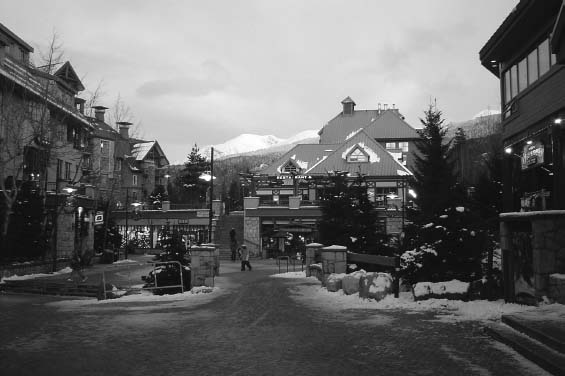
Whistler, British Columbia, is a winter resort town catering to skiers, snowboarders, and cross-country skiers. It is also host to some of the 2010 Winter Olympic events.
The growth of the resort during the Victorian era, however, was not limited to the United Kingdom as a similar pattern of development stimulated by urbanization may be observed also in other countries such as British India. In this instance, during the legacy of the Raj in India, colonial hill stations developed in the lesser Himalayas and elsewhere, near to the large urban centers of administration, and provided an escape for the British from the heat of the plains in May and June as well as a summer seat of government. Such hill stations incorporated many features of seaside resorts including bandstands, the most famous being Simla located close to Kolkata (Calcutta), while others include Poona near to Mumbai and Ootacamundie situated by Chennai (Madras). Although once the preserve of the colonial administrators, these hill stations have become popular resorts for wealthy Indian middle-class families, who migrate to them for the same reason and at the same time of year (May—June) as their predecessors.
More recently, with the internationalization and arguably the globalization of the tourism industry, Agarwal and Shaw note that coastal resorts have become a global product since they have been developed around the world. Examples include Malia (Crete), Torremolinos (Spain), Pattong (Thailand), Sharm-el-Sheik (Egypt), Cancun (Mexico), Cairns (Australia), and Goa (India). Moreover, many other types of resorts have been developed in different geographical environments. Gilbert charts the historical evolution across Europe of one of the oldest types of resort, this being the inland spa town, which, from the early seventeenth century on, attracted visitors wishing to improve their health by drinking or bathing in the mineral waters. Examples include Leamington Spa, Harrogate, and Tunbridge Wells (England); Baden-Baden, Aachen, and Stuttgart (Germany); Aix-les-Bains and Aix-en-Provence (France); Bad Aussee, Bad Kreuzen, and Bad Waltersdof (Austria); and Budapest (Hungary).
...
- Cities: Historical Overviews
- Allegory of Good Government
- Capitalist City
- Chinatowns
- Colonial City
- Divided Cities
- Global City
- Heritage City
- Historic Cities
- Ideal City
- Informational City
- Islamic City
- Mediterranean City
- Megalopolis
- Multicultural Cities
- Other Global Cities
- Primate City
- Progressive City
- Renaissance City
- Revanchist City
- Situationist City
- World City
- Cities: Specific Cities
- Amsterdam, the Netherlands
- Berlin, Germany
- Bilbao, Spain
- Cairo, Egypt
- Canberra, Australia
- Chicago, Illinois
- Damascus, Syria
- Delhi, India
- Florence, Italy
- Hiroshima, Japan
- Hong Kong, China
- Istanbul, Turkey
- Kolkata (Calcutta), India
- Lagos, Nigeria
- Las Vegas, Nevada
- London, United Kingdom
- Los Angeles, California
- Manchester, United Kingdom
- Manila, Philippines
- Mexico City, Mexico
- Moscow, Russian Federation
- Mumbai (Bombay), India
- New York City, New York
- Paris, France
- Rome, Italy
- São Paulo, Brazil
- Santa Fe, New Mexico
- Santiago de Compostela, Spain
- Savannah, Georgia
- Shanghai, China
- Singapore
- Tokyo, Japan
- Venice, Italy
- Persons
- Alinsky, Saul
- Alonso, William
- Benjamin, Walter
- Berry, Brian J. L.
- Castells, Manuel
- Childe, V. Gordon
- Davis, Mike
- De Certeau, Michel
- Dickens, Charles
- Downs, Anthony
- Du Bois, W. E. B.
- Fujita, Masahisa
- Geddes, Patrick
- Gottdiener, Mark
- Hall, Peter
- Harvey, David
- Haussmann, Baron Georges-Eugène
- Hawley, Amos
- Isard, Walter
- Jackson, Kenneth T.
- Jacobs, Jane
- Kracauer, Siegfried
- Le Corbusier
- Lefebvre, Henri
- LLöschsch, August
- Lynch, Kevin
- Moses, Robert
- Mumford, Lewis
- Riis, Jacob
- Sassen, Saskia
- Sert, Josep Lluís
- Simmel, Goerg
- Soja, Edward W.
- Wren, Sir Christopher
- Places
- Airports
- Béguinage
- Banlieue
- Barrio
- Bazaar
- Caravanserai
- Convention Centers
- Discotheque
- Ethnic Enclave
- Favela
- Forum
- Fourth World
- Gated Community
- Ghetto
- Heterotopia
- Metropolitan
- Necropolis
- Night Spaces
- Piazza
- Placemaking
- Resort
- Shopping Center
- Sports Stadiums
- Suburbanization
- Technoburbs
- Technopoles
- Themed Environments
- Toilets
- Utopia
- World Trade Center (9/11)
- Zoöpolis
- Urban Culture
- Bohemian
- Cinema (Movie House)
- City Club
- City Users
- Creative Class
- Flaâneur
- Graffiti
- Hip Hop
- Intellectuals
- Landscapes of Power
- Loft Living
- Metropolis
- Museums
- Nightlife
- Parks
- Photography and the City
- Placemaking
- Public Art
- Shopping
- Simulacra
- Skateboarding
- Society of the Spectacle
- Stranger
- Urban
- Urban Health
- Urban Life
- Urban Novel
- Urban Economics
- Urban Geography
- Urban History
- Urban Issues
- Urban Planning
- Urban Politics
- Urban Sociology
- Urban Studies—Topical Areas: Architecture
- Urban Studies—Topical Areas: Gender and Sex – Béguinage
- Urban Studies—Topical Areas: Gender and Sex – Social Space
- Urban Studies—Topical Areas: Sustainable Development
- Urban Theory
- Urban Transportation
- Loading...
Get a 30 day FREE TRIAL
-
 Watch videos from a variety of sources bringing classroom topics to life
 -
Read modern, diverse business cases
-
Explore hundreds of books and reference titles

Read next

More like this
Sage Recommends
We found other relevant content for you on other Sage platforms.
Have you created a personal profile? Login or create a profile so that you can save clips, playlists and searches