
Entry
Reader's guide
Entries A-Z
Subject index
Photography and the City
Because the technology of photography and the rise of the modern city coincided almost exactly, both temporally and spatially, the emergence of modern visual culture is closely associated with cities and city life, and photographic imagery in all its forms is central to the field of urban studies. From the earliest experiments in the 1830s to the latest developments in digital imaging on websites, the art of photography—whether by professionals or amateurs—has become an important way that people explore, analyze, document, and celebrate the urban environment and one of the key modalities by which the modern city explains itself to itself.
In examining the relationship between photography and the city, it will be useful to keep in mind that photography generally falls into three broad traditions of practice: the aesthetic, the documentary, and the popular.
The aesthetic tradition attempted to mimic or even surpass the preexisting traditions of the visual arts, emphasizing formal composition, evocative patterns of light and shade, and the frequent use of atmospheric blurring and soft focus. The documentary tradition, on the other hand, directly followed the precedents established by the graphic illustration in the popular press from about 1850 to 1900. Some urban documentary photography was commercial in nature, producing postcard, stereoscope, and travelogue images of cities worldwide; other, mostly journalistic documentary photographs assumed a tone of committed social activism and muckraking advocacy. Finally, the popular or snapshot tradition of photography began as early as the 1880s, when the Eastman Kodak Company created an inexpensive system that combined an easy-to-use camera with widely available film and film processing. Today, with the wide availability of digital cameras often built into Internet-connected cell phones, an entirely new phase in the democratization of visual culture has emerged as an integral and ubiquitous feature of global-urban civilization.
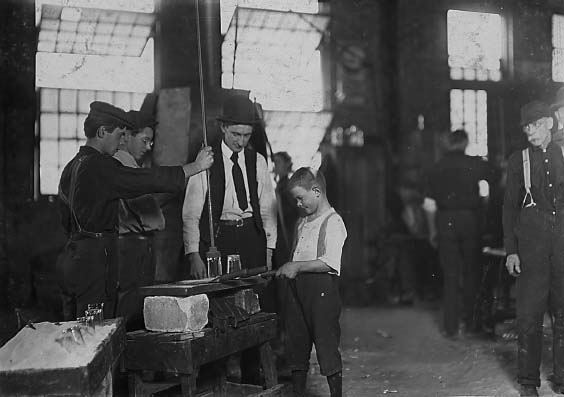
“Teaching the Young Idea,” photograph by Lewis Hine, October 1908, Morgantown, West Virginia
Photography and the Early Modern City
In the early modern period of urban industrialism, photography became instantly popular, and images of urban life—cityscapes, portraits, architectural views, street scenes, and the details of industrial processes—grew in importance as rapid urbanization became a worldwide phenomenon.
Some of the very earliest photographs are urban only because their makers tested their cameras by pointing them out their studio windows. Nicephore Niepce's “View from His Window at Le Gras” of 1827 is a very early example, using the crude heliograph process. In 1838, Louis Jacques Mande Daguerre produced “Two Views of the Boulevards of Paris,” and by 1843, William Henry Fox Talbot had made numerous calotypes of the streets and landmarks of London and Paris. During the rest of the century, photographers throughout the industrial world and beyond began making pictures of the rapidly growing urban centers.
Among the most popular images of cities in the illustrated press and in inexpensive chromolithographs were so-called bird's-eye views, and the early photographers attempted in various ways to achieve a similar effect. Some cities were small enough to be photographed whole in a single image. Charles Fontayne and William Southgate Porter pictured all of Cincinnati in a single shot in 1848, and the great portrait photographer Nadar (Gaspard-Felix Tournachon) took sweeping views of Paris from a balloon in 1868. Another popular technique was to take a series of photographs and string them together in a panoramic montage.
...
- Cities: Historical Overviews
- Allegory of Good Government
- Capitalist City
- Chinatowns
- Colonial City
- Divided Cities
- Global City
- Heritage City
- Historic Cities
- Ideal City
- Informational City
- Islamic City
- Mediterranean City
- Megalopolis
- Multicultural Cities
- Other Global Cities
- Primate City
- Progressive City
- Renaissance City
- Revanchist City
- Situationist City
- World City
- Cities: Specific Cities
- Amsterdam, the Netherlands
- Berlin, Germany
- Bilbao, Spain
- Cairo, Egypt
- Canberra, Australia
- Chicago, Illinois
- Damascus, Syria
- Delhi, India
- Florence, Italy
- Hiroshima, Japan
- Hong Kong, China
- Istanbul, Turkey
- Kolkata (Calcutta), India
- Lagos, Nigeria
- Las Vegas, Nevada
- London, United Kingdom
- Los Angeles, California
- Manchester, United Kingdom
- Manila, Philippines
- Mexico City, Mexico
- Moscow, Russian Federation
- Mumbai (Bombay), India
- New York City, New York
- Paris, France
- Rome, Italy
- São Paulo, Brazil
- Santa Fe, New Mexico
- Santiago de Compostela, Spain
- Savannah, Georgia
- Shanghai, China
- Singapore
- Tokyo, Japan
- Venice, Italy
- Persons
- Alinsky, Saul
- Alonso, William
- Benjamin, Walter
- Berry, Brian J. L.
- Castells, Manuel
- Childe, V. Gordon
- Davis, Mike
- De Certeau, Michel
- Dickens, Charles
- Downs, Anthony
- Du Bois, W. E. B.
- Fujita, Masahisa
- Geddes, Patrick
- Gottdiener, Mark
- Hall, Peter
- Harvey, David
- Haussmann, Baron Georges-Eugène
- Hawley, Amos
- Isard, Walter
- Jackson, Kenneth T.
- Jacobs, Jane
- Kracauer, Siegfried
- Le Corbusier
- Lefebvre, Henri
- LLöschsch, August
- Lynch, Kevin
- Moses, Robert
- Mumford, Lewis
- Riis, Jacob
- Sassen, Saskia
- Sert, Josep Lluís
- Simmel, Goerg
- Soja, Edward W.
- Wren, Sir Christopher
- Places
- Airports
- Béguinage
- Banlieue
- Barrio
- Bazaar
- Caravanserai
- Convention Centers
- Discotheque
- Ethnic Enclave
- Favela
- Forum
- Fourth World
- Gated Community
- Ghetto
- Heterotopia
- Metropolitan
- Necropolis
- Night Spaces
- Piazza
- Placemaking
- Resort
- Shopping Center
- Sports Stadiums
- Suburbanization
- Technoburbs
- Technopoles
- Themed Environments
- Toilets
- Utopia
- World Trade Center (9/11)
- Zoöpolis
- Urban Culture
- Bohemian
- Cinema (Movie House)
- City Club
- City Users
- Creative Class
- Flaâneur
- Graffiti
- Hip Hop
- Intellectuals
- Landscapes of Power
- Loft Living
- Metropolis
- Museums
- Nightlife
- Parks
- Photography and the City
- Placemaking
- Public Art
- Shopping
- Simulacra
- Skateboarding
- Society of the Spectacle
- Stranger
- Urban
- Urban Health
- Urban Life
- Urban Novel
- Urban Economics
- Urban Geography
- Urban History
- Urban Issues
- Urban Planning
- Urban Politics
- Urban Sociology
- Urban Studies—Topical Areas: Architecture
- Urban Studies—Topical Areas: Gender and Sex – Béguinage
- Urban Studies—Topical Areas: Gender and Sex – Social Space
- Urban Studies—Topical Areas: Sustainable Development
- Urban Theory
- Urban Transportation
- Loading...
Get a 30 day FREE TRIAL
-
 Watch videos from a variety of sources bringing classroom topics to life
 -
Read modern, diverse business cases
-
Explore hundreds of books and reference titles

Read next

More like this
Sage Recommends
We found other relevant content for you on other Sage platforms.
Have you created a personal profile? Login or create a profile so that you can save clips, playlists and searches