
Entry
Reader's guide
Entries A-Z
Subject index
Lawn
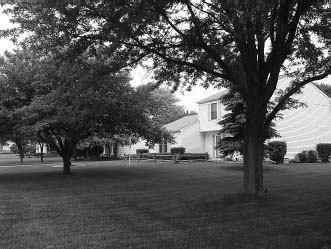
A lawn is defined by four characteristics: It is composed only of grass species; it is subject to weed and pest control; it is subject to practices aimed at maintaining its green color; and it is regularly mowed to ensure an acceptable length. Although many authors include parks, golf courses, and playing fields within the broad rubric of the lawn, the term is most often associated with the green spaces that border private dwellings. Despite its commonplace presence in most North American and some European cities, the lawn generates considerable dialogue concerning its social and cultural symbolism as well as its role in urban ecological processes.
A well-maintained lawn in front of a home in a suburb of Detroit, Michigan.
History
There is some evidence that manicured grassed landscapes made their first appearance in ancient China. A form of lawn is also associated with English and French elites of the sixteenth to eighteenth centuries. However, a more prosaic dating of the urban lawn places it with the growing middle class in the late-nineteenth-century cities. Rapid growth of industrial cities and concern for urban morals fueled the emergence of a pastoral idyll. And, whereas a complete removal from the city was impossible for many families, middle-class rural desires were manifest as a suburban, single detached home surrounded by private green space.
These desires depended on the convergence of a number of factors. First, the emergence of commuter travel and later the automobile allowed urban dwellers the necessary mobility to move to suburban homes. Second, the adoption of the eight-hour workday and the five-day workweek meant that people had adequate time for lawn work. Finally, and contemporaneously, the development of technologies such as lawn mowers, irrigation devices (hoses and sprinklers), pesticides, and herbicides, as well as the identification of appropriate grass plants, offered homeowners the means through which lawns could be created and maintained.
Early-twentieth-century advertisers sought to convince homeowners of the moral, aesthetic, and social virtues of owning a lawn. However, in the 1930s, these same advertisers shifted strategies. That is, instead of persuading homeowners of the lawn's appropriateness, new advertisements offered consumers better means to care for a lawn. The implication is that by this time, most consumers were convinced of the appropriateness of the lawn and now needed to be disciplined to care of it. A post–World War II climate conducive to consumerism and the advent of mass suburban development fixed the lawn in discourses surrounding home and property ownership, public presentation, industri-ousness, gender, the nuclear family, and good citizenship. In North America, in particular, yard after yard of unfenced turf bespoke democracy.
Although it is impossible to fix the degree to which lawn covers the Earth's surface, there are some data that illustrate its extent. For example, 2008 estimates suggest that the lawn is North America's largest agricultural crop and that it covers nearly 2 percent of the continental United States. Furthermore, lawn maintenance has become big business. The production of lawn equipment and lawn products produce commodity chains that touch every continent except Antarctica. Global estimates in the early 2000s for lawn-related expenditure range between $22 billion and $35 billion annually. This amount includes the increasing use of professional lawn care companies that range from small (less than $50,000 in sales per year) to large (more than $1 million in sales per year). Estimates suggest that in 2008, more than 80,000 lawn and landscaping companies operated in the United States alone.
...
- Cities: Historical Overviews
- Allegory of Good Government
- Capitalist City
- Chinatowns
- Colonial City
- Divided Cities
- Global City
- Heritage City
- Historic Cities
- Ideal City
- Informational City
- Islamic City
- Mediterranean City
- Megalopolis
- Multicultural Cities
- Other Global Cities
- Primate City
- Progressive City
- Renaissance City
- Revanchist City
- Situationist City
- World City
- Cities: Specific Cities
- Amsterdam, the Netherlands
- Berlin, Germany
- Bilbao, Spain
- Cairo, Egypt
- Canberra, Australia
- Chicago, Illinois
- Damascus, Syria
- Delhi, India
- Florence, Italy
- Hiroshima, Japan
- Hong Kong, China
- Istanbul, Turkey
- Kolkata (Calcutta), India
- Lagos, Nigeria
- Las Vegas, Nevada
- London, United Kingdom
- Los Angeles, California
- Manchester, United Kingdom
- Manila, Philippines
- Mexico City, Mexico
- Moscow, Russian Federation
- Mumbai (Bombay), India
- New York City, New York
- Paris, France
- Rome, Italy
- São Paulo, Brazil
- Santa Fe, New Mexico
- Santiago de Compostela, Spain
- Savannah, Georgia
- Shanghai, China
- Singapore
- Tokyo, Japan
- Venice, Italy
- Persons
- Alinsky, Saul
- Alonso, William
- Benjamin, Walter
- Berry, Brian J. L.
- Castells, Manuel
- Childe, V. Gordon
- Davis, Mike
- De Certeau, Michel
- Dickens, Charles
- Downs, Anthony
- Du Bois, W. E. B.
- Fujita, Masahisa
- Geddes, Patrick
- Gottdiener, Mark
- Hall, Peter
- Harvey, David
- Haussmann, Baron Georges-Eugène
- Hawley, Amos
- Isard, Walter
- Jackson, Kenneth T.
- Jacobs, Jane
- Kracauer, Siegfried
- Le Corbusier
- Lefebvre, Henri
- LLöschsch, August
- Lynch, Kevin
- Moses, Robert
- Mumford, Lewis
- Riis, Jacob
- Sassen, Saskia
- Sert, Josep Lluís
- Simmel, Goerg
- Soja, Edward W.
- Wren, Sir Christopher
- Places
- Airports
- Béguinage
- Banlieue
- Barrio
- Bazaar
- Caravanserai
- Convention Centers
- Discotheque
- Ethnic Enclave
- Favela
- Forum
- Fourth World
- Gated Community
- Ghetto
- Heterotopia
- Metropolitan
- Necropolis
- Night Spaces
- Piazza
- Placemaking
- Resort
- Shopping Center
- Sports Stadiums
- Suburbanization
- Technoburbs
- Technopoles
- Themed Environments
- Toilets
- Utopia
- World Trade Center (9/11)
- Zoöpolis
- Urban Culture
- Bohemian
- Cinema (Movie House)
- City Club
- City Users
- Creative Class
- Flaâneur
- Graffiti
- Hip Hop
- Intellectuals
- Landscapes of Power
- Loft Living
- Metropolis
- Museums
- Nightlife
- Parks
- Photography and the City
- Placemaking
- Public Art
- Shopping
- Simulacra
- Skateboarding
- Society of the Spectacle
- Stranger
- Urban
- Urban Health
- Urban Life
- Urban Novel
- Urban Economics
- Urban Geography
- Urban History
- Urban Issues
- Urban Planning
- Urban Politics
- Urban Sociology
- Urban Studies—Topical Areas: Architecture
- Urban Studies—Topical Areas: Gender and Sex – Béguinage
- Urban Studies—Topical Areas: Gender and Sex – Social Space
- Urban Studies—Topical Areas: Sustainable Development
- Urban Theory
- Urban Transportation
- Loading...
Get a 30 day FREE TRIAL
-
 Watch videos from a variety of sources bringing classroom topics to life
 -
Read modern, diverse business cases
-
Explore hundreds of books and reference titles

Read next

More like this
Sage Recommends
We found other relevant content for you on other Sage platforms.
Have you created a personal profile? Login or create a profile so that you can save clips, playlists and searches