
Entry
Reader's guide
Entries A-Z
Subject index
Garden City
The Garden City is a planning concept and model developed by Ebenezer Howard, who founded the Garden City Association in 1899. Howard's writing strongly influenced an early generation of urban planners, as well as the City Beautiful movement in the United States. Two garden cities were built in England in the early 1900s, and urban planners and architects in Europe and South America followed with garden cities in their countries. In the United States, garden cities were promoted by the Regional Planning Association, resulting in the construction of three communities in the 1930s. The Garden City has served as a model for urban development and an inspiration for other planning models to the present day.
History
In 1899, Ebenezer Howard founded the Garden City Association, a group formed to promote his ideas for planned communities, which would be include balanced areas of residential, industrial, and commercial spaces, surrounded by greenbelt and agricultural areas, to produce a healthy living environment—smokeless, slumless communities— for the urban dweller. Howard was influenced by his reading of Edward Bellamy's socialist utopian novels, Looking Backward (1888) and Equality (1897), although elements of the Garden City could be found in earlier planning efforts (Benjamin Ward Richardson, for example, published Hygeia: A City of Health, his plan for a model city to alleviate the unhealthy conditions of the industrial city, in 1876). Howard's plan for the Garden City was first published in 1899 as Tomorrow: A Peaceful Path to Real Reform, but the book did not generate much attention; a revised version titled Garden Cities of Tomorrow, published in 1904, became a cornerstone in urban planning.
The Garden City was designed to house some 32,000 people on a site of 6,000 acres. Six radial boulevards 120 feet wide extended from the center, creating a radial pattern, with open spaces and parks separating areas for residential, industrial, institutional, and other uses. The Garden City was intended to be self-sufficient, to include a mix of employment as well as sufficient agricultural land to feed the local population. The Garden City was bordered by a greenbelt to separate it from other cities. In one mapping included in the original publication but not in Garden Cities, a ring of planned communities surrounds a larger, central city; the communities are connected to the central city and to the other suburban centers by rail transport. The Garden City was a blend of the city and nature, but without the problems of pollution and overcrowding found in the large industrial city.
Ebenezer Howard's design for the Garden City
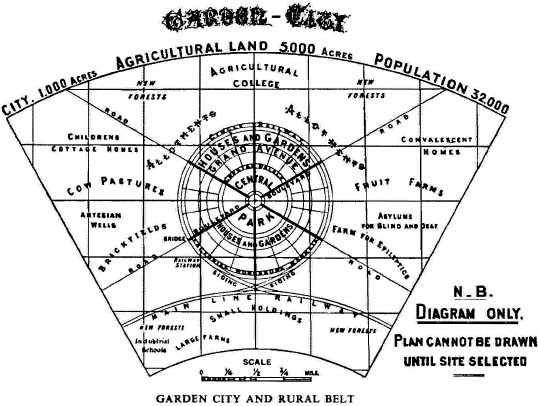
With financial support from William Hesketh Lever, the first Garden City, Letchworth, was built in Hertfordshire, north of London (Lever was in the midst of construction of Port Sunlight, a planned industrial community outside of Liverpool, during this period). Letchworth was viewed as a successful implementation of the Garden City, with new homes and ample open space, a wide range of industries to provide employment for town residents, and an agricultural greenbelt to control further expansion. After World War I, the British government provided support for the second Garden City, in Welwyn, also in Hertfordshire. The Garden City would also serve as a more general model for smaller developments, including the Hampstead garden suburb and Gidea Park in London, and for garden cities in other countries as well, including Hellerau (a suburb of Dresden) in 1909 and Bromma (in Stockholm) beginning in 1910.
...
- Cities: Historical Overviews
- Allegory of Good Government
- Capitalist City
- Chinatowns
- Colonial City
- Divided Cities
- Global City
- Heritage City
- Historic Cities
- Ideal City
- Informational City
- Islamic City
- Mediterranean City
- Megalopolis
- Multicultural Cities
- Other Global Cities
- Primate City
- Progressive City
- Renaissance City
- Revanchist City
- Situationist City
- World City
- Cities: Specific Cities
- Amsterdam, the Netherlands
- Berlin, Germany
- Bilbao, Spain
- Cairo, Egypt
- Canberra, Australia
- Chicago, Illinois
- Damascus, Syria
- Delhi, India
- Florence, Italy
- Hiroshima, Japan
- Hong Kong, China
- Istanbul, Turkey
- Kolkata (Calcutta), India
- Lagos, Nigeria
- Las Vegas, Nevada
- London, United Kingdom
- Los Angeles, California
- Manchester, United Kingdom
- Manila, Philippines
- Mexico City, Mexico
- Moscow, Russian Federation
- Mumbai (Bombay), India
- New York City, New York
- Paris, France
- Rome, Italy
- São Paulo, Brazil
- Santa Fe, New Mexico
- Santiago de Compostela, Spain
- Savannah, Georgia
- Shanghai, China
- Singapore
- Tokyo, Japan
- Venice, Italy
- Persons
- Alinsky, Saul
- Alonso, William
- Benjamin, Walter
- Berry, Brian J. L.
- Castells, Manuel
- Childe, V. Gordon
- Davis, Mike
- De Certeau, Michel
- Dickens, Charles
- Downs, Anthony
- Du Bois, W. E. B.
- Fujita, Masahisa
- Geddes, Patrick
- Gottdiener, Mark
- Hall, Peter
- Harvey, David
- Haussmann, Baron Georges-Eugène
- Hawley, Amos
- Isard, Walter
- Jackson, Kenneth T.
- Jacobs, Jane
- Kracauer, Siegfried
- Le Corbusier
- Lefebvre, Henri
- LLöschsch, August
- Lynch, Kevin
- Moses, Robert
- Mumford, Lewis
- Riis, Jacob
- Sassen, Saskia
- Sert, Josep Lluís
- Simmel, Goerg
- Soja, Edward W.
- Wren, Sir Christopher
- Places
- Airports
- Béguinage
- Banlieue
- Barrio
- Bazaar
- Caravanserai
- Convention Centers
- Discotheque
- Ethnic Enclave
- Favela
- Forum
- Fourth World
- Gated Community
- Ghetto
- Heterotopia
- Metropolitan
- Necropolis
- Night Spaces
- Piazza
- Placemaking
- Resort
- Shopping Center
- Sports Stadiums
- Suburbanization
- Technoburbs
- Technopoles
- Themed Environments
- Toilets
- Utopia
- World Trade Center (9/11)
- Zoöpolis
- Urban Culture
- Bohemian
- Cinema (Movie House)
- City Club
- City Users
- Creative Class
- Flaâneur
- Graffiti
- Hip Hop
- Intellectuals
- Landscapes of Power
- Loft Living
- Metropolis
- Museums
- Nightlife
- Parks
- Photography and the City
- Placemaking
- Public Art
- Shopping
- Simulacra
- Skateboarding
- Society of the Spectacle
- Stranger
- Urban
- Urban Health
- Urban Life
- Urban Novel
- Urban Economics
- Urban Geography
- Urban History
- Urban Issues
- Urban Planning
- Urban Politics
- Urban Sociology
- Urban Studies—Topical Areas: Architecture
- Urban Studies—Topical Areas: Gender and Sex – Béguinage
- Urban Studies—Topical Areas: Gender and Sex – Social Space
- Urban Studies—Topical Areas: Sustainable Development
- Urban Theory
- Urban Transportation
- Loading...
Get a 30 day FREE TRIAL
-
 Watch videos from a variety of sources bringing classroom topics to life
 -
Read modern, diverse business cases
-
Explore hundreds of books and reference titles

Read next

More like this
Sage Recommends
We found other relevant content for you on other Sage platforms.
Have you created a personal profile? Login or create a profile so that you can save clips, playlists and searches