
Entry
Reader's guide
Entries A-Z
Subject index
Capital City
From ancient Athens and Rome to Beijing and Tenochtitlan, the capital city was a national or imperial command center. Face-to-face contacts were essential in consultation and decision making or as sources of history where written texts were nonexistent, as in the realms of the Incas and Aztecs. The capital city also offered an overwhelming demonstration of the superiority of the gods. Athens focused on the Parthenon, Rome on its Forum, and the pre-Columbian capitals boasted enormous temples and pyramids in their city centers. Thus, the capital city provided legitimacy to worldly rulers and their expansionist policies.
It is remarkable to notice that all four capital cities (Athens, Rome, Beijing, and Tenochtitlan) have continued their role until this very day, although the last one is now better known as Mexico City, the world's second largest agglomeration. Obviously they were flexible enough to adapt to the requirements of the modern state.
Premodern Capital Cityscapes
The two functions of the premodern seats of government were revived in Europe's seventeenth century when power was sanctioned by the Christian churches, added to which came the role of the capital as the visible demonstration of national grandeur. Absolutist regimes dominated the continent, with the capital as the visible apex of the urban hierarchy. Both its size and splendor depended on the national tax-extracting capacity. The consuming power of the court, nobility, and clergy entertained a vast army of service providers, from luxury craftsmen to porters and servants. Thus, 8 out of Europe's 10 largest cities were parasitic court capitals. They filled no economic function remotely consistent with their size.
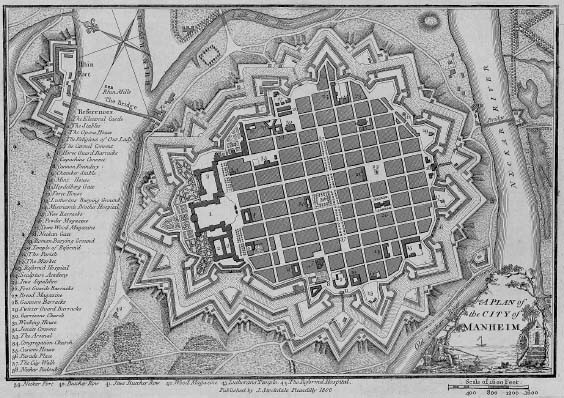
These court capitals were rivals in ostentatious display. Their urban design made abundant use of the discovery of the perspective. Streets were not conceived primarily as traffic arteries but as a scenography offering broad vistas on statues, noble palaces, or impressive art galleries. Their flanks were kept sober and stern so as to not distract the eyes of the visitor from the monument in the distance. Classicist architecture, with its emphasis on symmetry and proportion, was ideally suited for that aim. The resulting cityscape impressed people as truly monumental. The orthogonal layout testified to the ruler's will imposed on what previously was an irregular agrarian parcellation. The land was brought into his hands by expropriation and extortion.
Mannheim around 1800
| Table 1 Europe's 10 Largest Cities in 1750 (population x 1,000) | ||
|---|---|---|
| 1. | London | 676 |
| 2. | Paris | 560 |
| 3. | Naples | 324 |
| 4. | Amsterdam | 219 |
| 5. | Lisbon | 213 |
| 6. | Vienna | 169 |
| 7. | Moscow | 161 |
| 8. | Venice | 158 |
| 9. | Rome | 157 |
| 10. | St. Petersburg | 138 |
Saint Petersburg
No other capital demonstrated its ruler's superiority as newly founded Saint Petersburg in Russia did. But opposite to Versailles or Caserta, the royal alternatives to Paris and Naples that were also created ex nihilo, Czar Peter the Great founded a veritable capital. Although its location was extremely peripheral and its marshy soil and harsh climate were serious disadvantages, all these things were secondary to the czar's wish to open a window to the West, and thus to progress and civilization. Enormous squares and parade grounds in its center testified to his disdain for the costs of urban land reclaimed at great expense. The volume and design of his palaces, built in natural stone that had to be hauled over hundreds of miles, were unmatched elsewhere in Europe. But even miniature capitals like Mannheim or Nancy developed the language of urban display and grandeur that became the almost universal vocabulary of power in following ages.
...
- Cities: Historical Overviews
- Allegory of Good Government
- Capitalist City
- Chinatowns
- Colonial City
- Divided Cities
- Global City
- Heritage City
- Historic Cities
- Ideal City
- Informational City
- Islamic City
- Mediterranean City
- Megalopolis
- Multicultural Cities
- Other Global Cities
- Primate City
- Progressive City
- Renaissance City
- Revanchist City
- Situationist City
- World City
- Cities: Specific Cities
- Amsterdam, the Netherlands
- Berlin, Germany
- Bilbao, Spain
- Cairo, Egypt
- Canberra, Australia
- Chicago, Illinois
- Damascus, Syria
- Delhi, India
- Florence, Italy
- Hiroshima, Japan
- Hong Kong, China
- Istanbul, Turkey
- Kolkata (Calcutta), India
- Lagos, Nigeria
- Las Vegas, Nevada
- London, United Kingdom
- Los Angeles, California
- Manchester, United Kingdom
- Manila, Philippines
- Mexico City, Mexico
- Moscow, Russian Federation
- Mumbai (Bombay), India
- New York City, New York
- Paris, France
- Rome, Italy
- São Paulo, Brazil
- Santa Fe, New Mexico
- Santiago de Compostela, Spain
- Savannah, Georgia
- Shanghai, China
- Singapore
- Tokyo, Japan
- Venice, Italy
- Persons
- Alinsky, Saul
- Alonso, William
- Benjamin, Walter
- Berry, Brian J. L.
- Castells, Manuel
- Childe, V. Gordon
- Davis, Mike
- De Certeau, Michel
- Dickens, Charles
- Downs, Anthony
- Du Bois, W. E. B.
- Fujita, Masahisa
- Geddes, Patrick
- Gottdiener, Mark
- Hall, Peter
- Harvey, David
- Haussmann, Baron Georges-Eugène
- Hawley, Amos
- Isard, Walter
- Jackson, Kenneth T.
- Jacobs, Jane
- Kracauer, Siegfried
- Le Corbusier
- Lefebvre, Henri
- LLöschsch, August
- Lynch, Kevin
- Moses, Robert
- Mumford, Lewis
- Riis, Jacob
- Sassen, Saskia
- Sert, Josep Lluís
- Simmel, Goerg
- Soja, Edward W.
- Wren, Sir Christopher
- Places
- Airports
- Béguinage
- Banlieue
- Barrio
- Bazaar
- Caravanserai
- Convention Centers
- Discotheque
- Ethnic Enclave
- Favela
- Forum
- Fourth World
- Gated Community
- Ghetto
- Heterotopia
- Metropolitan
- Necropolis
- Night Spaces
- Piazza
- Placemaking
- Resort
- Shopping Center
- Sports Stadiums
- Suburbanization
- Technoburbs
- Technopoles
- Themed Environments
- Toilets
- Utopia
- World Trade Center (9/11)
- Zoöpolis
- Urban Culture
- Bohemian
- Cinema (Movie House)
- City Club
- City Users
- Creative Class
- Flaâneur
- Graffiti
- Hip Hop
- Intellectuals
- Landscapes of Power
- Loft Living
- Metropolis
- Museums
- Nightlife
- Parks
- Photography and the City
- Placemaking
- Public Art
- Shopping
- Simulacra
- Skateboarding
- Society of the Spectacle
- Stranger
- Urban
- Urban Health
- Urban Life
- Urban Novel
- Urban Economics
- Urban Geography
- Urban History
- Urban Issues
- Urban Planning
- Urban Politics
- Urban Sociology
- Urban Studies—Topical Areas: Architecture
- Urban Studies—Topical Areas: Gender and Sex – Béguinage
- Urban Studies—Topical Areas: Gender and Sex – Social Space
- Urban Studies—Topical Areas: Sustainable Development
- Urban Theory
- Urban Transportation
- Loading...
Get a 30 day FREE TRIAL
-
 Watch videos from a variety of sources bringing classroom topics to life
 -
Read modern, diverse business cases
-
Explore hundreds of books and reference titles

Read next

More like this
Sage Recommends
We found other relevant content for you on other Sage platforms.
Have you created a personal profile? Login or create a profile so that you can save clips, playlists and searches