
Entry
Reader's guide
Entries A-Z
Subject index
Bazaar
Originally referring to a vaguely defined “oriental” market, the bazaar, as an institution and a space, has for many centuries exercised its attraction upon observers from all over the world. A sensorially and semiotically overloaded space and a point of encounter of various influences, actors, artefacts, and symbols, the bazaar is commonly presented in most travel guides, novels, and reportages (and often in scholarly work too) as the epitome of Middle Eastern (and Asian) societies; as the arena where visitors can capture the most picturesque and “authentic” impressions of the “culture” of such areas. An originally localized space and notion, the bazaar has therefore become a constitutive part of translocal fantasies as well as an example of Western exoticizing and orientalistic representations of the world.
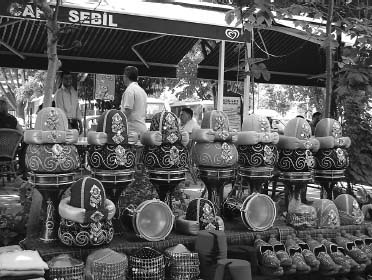
Hats on display at a bazaar outside of Topkapi, Turkey
Among scholars, the bazaar has captured the attention of individuals from different disciplinary environments. In earlier scholarship it was approached primarily in terms of economic behavior, hence becoming a field of encounter primarily between economists, historians, and anthropologists. Later on, however, it was identified as a key arena for understanding societal issues at large. In scholarly work, thus, the bazaar has two main connotations. On the one hand, it signifies a particular space and place of exchange (that some authors have proposed as the ideal precursor of the fairs, the world exhibition, and the contemporary department stores); on the other hand, it refers to an economic system (originally denoting the peasant markets) opposed to the competitive “Western” markets. In the past few decades the bazaar has also become a popular metaphor for addressing various aspects of late modern societies. Carrying along its original orientalistic connotations, the bazaar is today a recurrent term and notion (in scholarly as well as public discourse) for addressing the contemporary hybrid, multifaceted, globally interconnected, and digitalized world.
After a brief introduction presenting the origins of the term, this entry will outline a number of passages and notions that have characterized research on the bazaar. Divided in three sections focusing first on the bazaar as an economic system, second as a space of convergence, and finally as a metaphor, the entry does not, however, aim at offering a thorough chronological account of the history of scientific research in this field. Rather, it suggests some critical insights into the main visions, interpretations, and turns that have characterized its presence within the social and humanistic sciences.
The Term
A term of Persian origins connoting a market or a marketplace, the term bazaar has, across the centuries, spread to different parts of the world. Eastward it has been adopted in south and southeast Asia (in India, in particular, it came to connote also a single shop or stall). Westward, it has reached Arabic, Turkish, and European languages alike. Whereas some of these languages have adopted it literally, in many European countries the term bazaar has become synonymous with the “oriental marketplace” at large and been used to indicate chaotic, disorderly, and irrational places of exchange, where an array of objects and ideas could be found. Generically, however, the bazaar is also often used to address marketplaces (often open aired and indigenous) in most areas of the world.
...
- Cities: Historical Overviews
- Allegory of Good Government
- Capitalist City
- Chinatowns
- Colonial City
- Divided Cities
- Global City
- Heritage City
- Historic Cities
- Ideal City
- Informational City
- Islamic City
- Mediterranean City
- Megalopolis
- Multicultural Cities
- Other Global Cities
- Primate City
- Progressive City
- Renaissance City
- Revanchist City
- Situationist City
- World City
- Cities: Specific Cities
- Amsterdam, the Netherlands
- Berlin, Germany
- Bilbao, Spain
- Cairo, Egypt
- Canberra, Australia
- Chicago, Illinois
- Damascus, Syria
- Delhi, India
- Florence, Italy
- Hiroshima, Japan
- Hong Kong, China
- Istanbul, Turkey
- Kolkata (Calcutta), India
- Lagos, Nigeria
- Las Vegas, Nevada
- London, United Kingdom
- Los Angeles, California
- Manchester, United Kingdom
- Manila, Philippines
- Mexico City, Mexico
- Moscow, Russian Federation
- Mumbai (Bombay), India
- New York City, New York
- Paris, France
- Rome, Italy
- São Paulo, Brazil
- Santa Fe, New Mexico
- Santiago de Compostela, Spain
- Savannah, Georgia
- Shanghai, China
- Singapore
- Tokyo, Japan
- Venice, Italy
- Persons
- Alinsky, Saul
- Alonso, William
- Benjamin, Walter
- Berry, Brian J. L.
- Castells, Manuel
- Childe, V. Gordon
- Davis, Mike
- De Certeau, Michel
- Dickens, Charles
- Downs, Anthony
- Du Bois, W. E. B.
- Fujita, Masahisa
- Geddes, Patrick
- Gottdiener, Mark
- Hall, Peter
- Harvey, David
- Haussmann, Baron Georges-Eugène
- Hawley, Amos
- Isard, Walter
- Jackson, Kenneth T.
- Jacobs, Jane
- Kracauer, Siegfried
- Le Corbusier
- Lefebvre, Henri
- LLöschsch, August
- Lynch, Kevin
- Moses, Robert
- Mumford, Lewis
- Riis, Jacob
- Sassen, Saskia
- Sert, Josep Lluís
- Simmel, Goerg
- Soja, Edward W.
- Wren, Sir Christopher
- Places
- Airports
- Béguinage
- Banlieue
- Barrio
- Bazaar
- Caravanserai
- Convention Centers
- Discotheque
- Ethnic Enclave
- Favela
- Forum
- Fourth World
- Gated Community
- Ghetto
- Heterotopia
- Metropolitan
- Necropolis
- Night Spaces
- Piazza
- Placemaking
- Resort
- Shopping Center
- Sports Stadiums
- Suburbanization
- Technoburbs
- Technopoles
- Themed Environments
- Toilets
- Utopia
- World Trade Center (9/11)
- Zoöpolis
- Urban Culture
- Bohemian
- Cinema (Movie House)
- City Club
- City Users
- Creative Class
- Flaâneur
- Graffiti
- Hip Hop
- Intellectuals
- Landscapes of Power
- Loft Living
- Metropolis
- Museums
- Nightlife
- Parks
- Photography and the City
- Placemaking
- Public Art
- Shopping
- Simulacra
- Skateboarding
- Society of the Spectacle
- Stranger
- Urban
- Urban Health
- Urban Life
- Urban Novel
- Urban Economics
- Urban Geography
- Urban History
- Urban Issues
- Urban Planning
- Urban Politics
- Urban Sociology
- Urban Studies—Topical Areas: Architecture
- Urban Studies—Topical Areas: Gender and Sex – Béguinage
- Urban Studies—Topical Areas: Gender and Sex – Social Space
- Urban Studies—Topical Areas: Sustainable Development
- Urban Theory
- Urban Transportation
- Loading...
Get a 30 day FREE TRIAL
-
 Watch videos from a variety of sources bringing classroom topics to life
 -
Read modern, diverse business cases
-
Explore hundreds of books and reference titles

Read next

More like this
Sage Recommends
We found other relevant content for you on other Sage platforms.
Have you created a personal profile? Login or create a profile so that you can save clips, playlists and searches