
Entry
Reader's guide
Entries A-Z
Subject index
Amsterdam, the Netherlands
Amsterdam is the capital of the Netherlands, and with 750,000 inhabitants it is also its largest city. The city is part of the Randstad metropolitan area, which covers most of the west portion of the country and accommodates roughly half of the country's 16.5 million inhabitants. Randstad also includes the second- and third-largest cities, Rotterdam and The Hague.
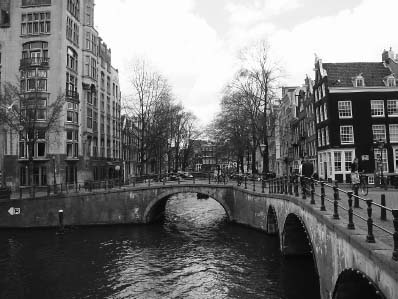
The city of Amsterdam developed on a dam in the Amstel River at the end of the twelfth century. The period 1585 to 1672, the Golden Age, was the heyday of Amsterdam's commercial success. At the time Amsterdam was the staple market of the world. During this period the characteristic Amsterdam cityscape developed; the 1613 and 1663 urban expansions with concentric canals still determine the city's characteristic appearance. The year 1672 brought disaster for the Dutch Republic with the French and English attacking simultaneously: The Golden Age had come to an end. Nevertheless, Amsterdam managed to consolidate its prosperity during the period 1672 to 1795 (the Silver Age) in spite of the predicament the Republic found itself in. The city remained a major staple market and managed to retain its position as the financial center of Europe. The large number of dwellings built in the Golden and Silver Ages reflect the city's prosperity.
Modern Amsterdam demonstrating the merging of canals and traffic thoroughfares
In 1795 the government of the patrician oligarchies was overthrown and the old Republic ceased to exist. Soon the French occupied the country. During the period 1795 to 1813, Amsterdam suffered badly from an economic recession. Many houses were vacant and some even collapsed for lack of maintenance. The period 1813 to 1920 is marked by economic recovery and, from 1870 onward, by expansion. The increasing wealth brought about a rapid population growth. This development was primarily the result of the Industrial Revolution, which triggered a New Golden Age. Large, often poorly built working-class neighborhoods were built. The period 1920 to 1940 was a time of economic recession. Therefore it is all the more remarkable that the so-called Ring 20–40 compares favorably to the nineteenth-century jerry-building. This was also the period of large-scale damage to the historical city center; canals were filled in and new traffic breakthroughs were realized. During the postwar period the population of the city proper grew only modestly, but the metropolitan area increased dramatically. Moreover, Amsterdam acquired an international reputation, both culturally and economically.
Many tourists are attracted by the museums that are now renowned far outside the Netherlands (such as the Van Gogh Museum, Rijksmuseum, and Stedelijk Museum), and because of its canals and architecture the city center is very popular—the historical wealth of this part of the city is still tangible. At least as important is the liberal image of Amsterdam, which, for tourists, is mainly connected to the city's red-light district and its policies on the use of soft drugs. These cultural features make tourism an important source of income. However, the main thrust of the city's income comes from commercial services (banking and insurance companies), trade, and distribution (the national airport Schiphol is located very close to Amsterdam, and the city also has a large seaport). The city has a highly educated workforce, partly due to the presence of two large research universities and various colleges. Amsterdam has never had a uniform industrial profile. To the contrary, the Dutch capital has always been characterized by a relatively strong financial sector, the presence of cultural industries, tourism, and other consumption-related sections of the economy. Amsterdam has a strong postin-dustrial economic and employment structure.
...
- Cities: Historical Overviews
- Allegory of Good Government
- Capitalist City
- Chinatowns
- Colonial City
- Divided Cities
- Global City
- Heritage City
- Historic Cities
- Ideal City
- Informational City
- Islamic City
- Mediterranean City
- Megalopolis
- Multicultural Cities
- Other Global Cities
- Primate City
- Progressive City
- Renaissance City
- Revanchist City
- Situationist City
- World City
- Cities: Specific Cities
- Amsterdam, the Netherlands
- Berlin, Germany
- Bilbao, Spain
- Cairo, Egypt
- Canberra, Australia
- Chicago, Illinois
- Damascus, Syria
- Delhi, India
- Florence, Italy
- Hiroshima, Japan
- Hong Kong, China
- Istanbul, Turkey
- Kolkata (Calcutta), India
- Lagos, Nigeria
- Las Vegas, Nevada
- London, United Kingdom
- Los Angeles, California
- Manchester, United Kingdom
- Manila, Philippines
- Mexico City, Mexico
- Moscow, Russian Federation
- Mumbai (Bombay), India
- New York City, New York
- Paris, France
- Rome, Italy
- São Paulo, Brazil
- Santa Fe, New Mexico
- Santiago de Compostela, Spain
- Savannah, Georgia
- Shanghai, China
- Singapore
- Tokyo, Japan
- Venice, Italy
- Persons
- Alinsky, Saul
- Alonso, William
- Benjamin, Walter
- Berry, Brian J. L.
- Castells, Manuel
- Childe, V. Gordon
- Davis, Mike
- De Certeau, Michel
- Dickens, Charles
- Downs, Anthony
- Du Bois, W. E. B.
- Fujita, Masahisa
- Geddes, Patrick
- Gottdiener, Mark
- Hall, Peter
- Harvey, David
- Haussmann, Baron Georges-Eugène
- Hawley, Amos
- Isard, Walter
- Jackson, Kenneth T.
- Jacobs, Jane
- Kracauer, Siegfried
- Le Corbusier
- Lefebvre, Henri
- LLöschsch, August
- Lynch, Kevin
- Moses, Robert
- Mumford, Lewis
- Riis, Jacob
- Sassen, Saskia
- Sert, Josep Lluís
- Simmel, Goerg
- Soja, Edward W.
- Wren, Sir Christopher
- Places
- Airports
- Béguinage
- Banlieue
- Barrio
- Bazaar
- Caravanserai
- Convention Centers
- Discotheque
- Ethnic Enclave
- Favela
- Forum
- Fourth World
- Gated Community
- Ghetto
- Heterotopia
- Metropolitan
- Necropolis
- Night Spaces
- Piazza
- Placemaking
- Resort
- Shopping Center
- Sports Stadiums
- Suburbanization
- Technoburbs
- Technopoles
- Themed Environments
- Toilets
- Utopia
- World Trade Center (9/11)
- Zoöpolis
- Urban Culture
- Bohemian
- Cinema (Movie House)
- City Club
- City Users
- Creative Class
- Flaâneur
- Graffiti
- Hip Hop
- Intellectuals
- Landscapes of Power
- Loft Living
- Metropolis
- Museums
- Nightlife
- Parks
- Photography and the City
- Placemaking
- Public Art
- Shopping
- Simulacra
- Skateboarding
- Society of the Spectacle
- Stranger
- Urban
- Urban Health
- Urban Life
- Urban Novel
- Urban Economics
- Urban Geography
- Urban History
- Urban Issues
- Urban Planning
- Urban Politics
- Urban Sociology
- Urban Studies—Topical Areas: Architecture
- Urban Studies—Topical Areas: Gender and Sex – Béguinage
- Urban Studies—Topical Areas: Gender and Sex – Social Space
- Urban Studies—Topical Areas: Sustainable Development
- Urban Theory
- Urban Transportation
- Loading...
Get a 30 day FREE TRIAL
-
 Watch videos from a variety of sources bringing classroom topics to life
 -
Read modern, diverse business cases
-
Explore hundreds of books and reference titles

Read next

More like this
Sage Recommends
We found other relevant content for you on other Sage platforms.
Have you created a personal profile? Login or create a profile so that you can save clips, playlists and searches