
Entry
Reader's guide
Entries A-Z
Subject index
Allegory of Good Government
Ambrogio Lorenzetti's frescoes on three walls of the room known as either the Sala della Pace (Hall of Peace, after one of the allegorical figures in the frescoes) or the Sala dei Nove (Hall of the Nine, the elected rulers of the city) in Siena's Palazzo Pubblico are often called the first large-scale secular murals since antiquity. They both project an ideal political landscape and document aspects of contemporary daily life.
Before the Palazzo Pubblico became the home of Siena's elected officials and councils, town meetings had been taking place everywhere from the private palaces of influential citizens to the cathedral. Having a dedicated, imposing public building on a well-organized public space staked out Siena's claim to prominence as a powerful, wealthy commune (i.e., a town ruled by elected officials responsible for the common good).
The council of the Nine ruled Siena from 1287 to 1355. Following a period of government in which the city had won its greatest, and last, victory against the Florentines (at Montasperti, 1260) and completed building its cathedral, the Nine not only built the Palazzo Pubblico and the Piazza del Campo, they also began a vast project to enlarge the duomo in rivalry with that of Florence (aborted with the devastation of the black death in 1348). The Nine were proportionally related to the three districts of the city: The Terzi (“thirds”) of Città, San Martino, and Camollia corresponded to the three legs of the Y, which defined the city's plan, spread across the top of three intersecting ridges. Their intersection in a slightly depressed space would become the bowl-like Piazza del Campo when the decision was made in 1288 (work beginning in 1298) to shape it along with the new town hall; the fan-shaped plan of the piazza was reinforced by the brick paving (divided into nine triangular wedges), which slopes down toward the town hall. At the intersection of the two upper legs of the Y, the Palazzo was a hinge between the city center on the north side and the contado, or countryside, on the south; a top floor loggia on the south side looks out to the landscape below and beyond. The prominent bell tower, which rises vertiginously from the corner of the palazzo, was begun in the same year as Lorenzetti's frescoes. The cathedral, perched nearby on the highest point in town, had been effectively brought to completion 30 years before the piazza project was begun.
Ambrogio Lorenzetti's fourteenth-century fresco, The Allegory of Good Government, at Palazzo Pubblico in Siena, Italy
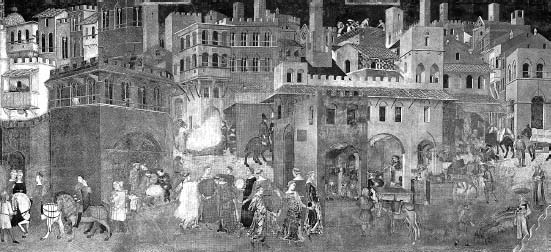
The frescoed allegories of Good and Bad Government were painted in 1338–1339. While the frescoes offer glimpses of what daily life looked like in Siena, they more tellingly convey the Sienese government's sense of itself, its mission, and its effects on town and country. As such they can be read as a visual treatise on the proper relationships of power, people, and environment in fourteenth-century Italy.
Content
The allegories of Good and Bad Government are found on the piano nobile (second floor) of the Palazzo Pubblico. Located on the south side of the building—that is, away from the Piazza del Campo and toward the countryside—the Sala dei Nove is accessed principally from the doorway on its east wall, which gives onto the main gathering space of the Palazzo, the Sala del Mappamondo. So called because of the large globe and circular map of the heavens that were displayed on the west wall, the Sala del Mappamondo was the chamber where the town council met and where its decisions were ratified. On the wall opposite the door to the Sala dei Nove Simone Martini had painted earlier in the century a large fresco of the Maestà, the Madonna and Child enthroned, surrounded by saints and wrapped by an admonitory inscription directing those in the room charged with governing to embrace Wisdom. This image looked toward the room with Lorenzetti's fresco cycle and provided a sacred corollary to his ostensibly secular allegories.
...
- Cities: Historical Overviews
- Allegory of Good Government
- Capitalist City
- Chinatowns
- Colonial City
- Divided Cities
- Global City
- Heritage City
- Historic Cities
- Ideal City
- Informational City
- Islamic City
- Mediterranean City
- Megalopolis
- Multicultural Cities
- Other Global Cities
- Primate City
- Progressive City
- Renaissance City
- Revanchist City
- Situationist City
- World City
- Cities: Specific Cities
- Amsterdam, the Netherlands
- Berlin, Germany
- Bilbao, Spain
- Cairo, Egypt
- Canberra, Australia
- Chicago, Illinois
- Damascus, Syria
- Delhi, India
- Florence, Italy
- Hiroshima, Japan
- Hong Kong, China
- Istanbul, Turkey
- Kolkata (Calcutta), India
- Lagos, Nigeria
- Las Vegas, Nevada
- London, United Kingdom
- Los Angeles, California
- Manchester, United Kingdom
- Manila, Philippines
- Mexico City, Mexico
- Moscow, Russian Federation
- Mumbai (Bombay), India
- New York City, New York
- Paris, France
- Rome, Italy
- São Paulo, Brazil
- Santa Fe, New Mexico
- Santiago de Compostela, Spain
- Savannah, Georgia
- Shanghai, China
- Singapore
- Tokyo, Japan
- Venice, Italy
- Persons
- Alinsky, Saul
- Alonso, William
- Benjamin, Walter
- Berry, Brian J. L.
- Castells, Manuel
- Childe, V. Gordon
- Davis, Mike
- De Certeau, Michel
- Dickens, Charles
- Downs, Anthony
- Du Bois, W. E. B.
- Fujita, Masahisa
- Geddes, Patrick
- Gottdiener, Mark
- Hall, Peter
- Harvey, David
- Haussmann, Baron Georges-Eugène
- Hawley, Amos
- Isard, Walter
- Jackson, Kenneth T.
- Jacobs, Jane
- Kracauer, Siegfried
- Le Corbusier
- Lefebvre, Henri
- LLöschsch, August
- Lynch, Kevin
- Moses, Robert
- Mumford, Lewis
- Riis, Jacob
- Sassen, Saskia
- Sert, Josep Lluís
- Simmel, Goerg
- Soja, Edward W.
- Wren, Sir Christopher
- Places
- Airports
- Béguinage
- Banlieue
- Barrio
- Bazaar
- Caravanserai
- Convention Centers
- Discotheque
- Ethnic Enclave
- Favela
- Forum
- Fourth World
- Gated Community
- Ghetto
- Heterotopia
- Metropolitan
- Necropolis
- Night Spaces
- Piazza
- Placemaking
- Resort
- Shopping Center
- Sports Stadiums
- Suburbanization
- Technoburbs
- Technopoles
- Themed Environments
- Toilets
- Utopia
- World Trade Center (9/11)
- Zoöpolis
- Urban Culture
- Bohemian
- Cinema (Movie House)
- City Club
- City Users
- Creative Class
- Flaâneur
- Graffiti
- Hip Hop
- Intellectuals
- Landscapes of Power
- Loft Living
- Metropolis
- Museums
- Nightlife
- Parks
- Photography and the City
- Placemaking
- Public Art
- Shopping
- Simulacra
- Skateboarding
- Society of the Spectacle
- Stranger
- Urban
- Urban Health
- Urban Life
- Urban Novel
- Urban Economics
- Urban Geography
- Urban History
- Urban Issues
- Urban Planning
- Urban Politics
- Urban Sociology
- Urban Studies—Topical Areas: Architecture
- Urban Studies—Topical Areas: Gender and Sex – Béguinage
- Urban Studies—Topical Areas: Gender and Sex – Social Space
- Urban Studies—Topical Areas: Sustainable Development
- Urban Theory
- Urban Transportation
- Loading...
Get a 30 day FREE TRIAL
-
 Watch videos from a variety of sources bringing classroom topics to life
 -
Read modern, diverse business cases
-
Explore hundreds of books and reference titles

Read next

More like this
Sage Recommends
We found other relevant content for you on other Sage platforms.
Have you created a personal profile? Login or create a profile so that you can save clips, playlists and searches