
Entry
Reader's guide
Entries A-Z
Subject index
Agora
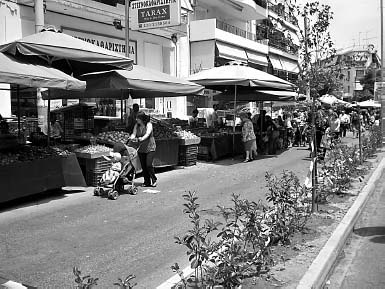
Agora, a Greek word meaning, in early times, “a gathering place” (Homer), later “marketplace,” is used in English particularly to denote the commercial and civic center of an ancient Greek city. The Latin equivalent of agora is forum. The functions of the agora were much more varied than the English translations of the term might suggest. Typically located in the geographical heart of a city, on low-lying ground below the acropolis (“high city”), the agora was a place where people came together for a great range of activities: not only commercial, but also political, religious, and social. The overall layout of an agora followed no specific design. In cities of remote origins and long history, such as Athens, the agora developed gradually over centuries, its buildings and monuments placed according to the needs of a particular time. By the later Hellenistic and Roman periods, such city centers must have seemed like architectural jumbles. In newly founded cities, such as Priene (from the fourth century BC), the agora could be neatly planned, typically a rectangular plaza lined with stoas (porticoed buildings).
The ancient Greeks developed specific building types to house functions routine in the agora, such as the stoa and the bouleuterion (council chamber). One would also see such structures as fountain houses (where people obtained fresh water) and temples. In addition, certain activities might take place in buildings or areas that seem generic; that is, their features do not reveal any specific purpose. Identifying what uses such buildings or spaces were put to thus becomes an archaeological puzzle.
The best known of the ancient Greek agoras is that of Athens. The reasons for this are two. First, the great majority of Greek texts known to us were written by Athenians. Books, essays, speeches, poems, plays (tragedies, comedies), and inscriptions (documents carved on stone, for the attention of the public) contain a wealth of information about the life of Athens, including its agora. Second, the Athenian Agora has been explored continuously since 1931 (except for the years of World War II and immediately after), through archaeological excavations conducted by the American School of Classical Studies at Athens. These excavations have uncovered an enormous richness of buildings, monuments, inscriptions, and objects. In addition, the findings have been well published, both for a scholarly audience and for the interested public. So important is the Athenian Agora for understanding the ancient Greek city center that the rest of this entry is devoted to it.
Agora in Athens
The Athenian Agora
The Agora is located on low ground northwest of the Acropolis, a natural hill used in Greek and Roman times as the main religious center of the city. Agora and Acropolis together formed the central focus of Athens. The territory occupied by the Agora was further defined by a hill on the west (the Kolonos Agoraios) and a small river (the Eridanos) on the north, but was open to the east. Variously used in the Bronze Age and early Iron Age for housing and for burials, the Agora was first laid out as a public center in the early Archaic period, circa 600 BC. By 500 BC, vertical shafts of marble were set up at entrances to the open area to mark the space formally. These boundary stones were inscribed, “I am the boundary of the Agora.” In addition, basins for holy water (perir-rhanteria) were placed at the entrances, recalling the sacred character of certain functions. Indeed, those guilty of certain types of behavior were considered to have violated this sanctity and so could not enter the Agora: traitors, those who avoided military service or deserted, and those who mistreated their parents.
...
- Cities: Historical Overviews
- Allegory of Good Government
- Capitalist City
- Chinatowns
- Colonial City
- Divided Cities
- Global City
- Heritage City
- Historic Cities
- Ideal City
- Informational City
- Islamic City
- Mediterranean City
- Megalopolis
- Multicultural Cities
- Other Global Cities
- Primate City
- Progressive City
- Renaissance City
- Revanchist City
- Situationist City
- World City
- Cities: Specific Cities
- Amsterdam, the Netherlands
- Berlin, Germany
- Bilbao, Spain
- Cairo, Egypt
- Canberra, Australia
- Chicago, Illinois
- Damascus, Syria
- Delhi, India
- Florence, Italy
- Hiroshima, Japan
- Hong Kong, China
- Istanbul, Turkey
- Kolkata (Calcutta), India
- Lagos, Nigeria
- Las Vegas, Nevada
- London, United Kingdom
- Los Angeles, California
- Manchester, United Kingdom
- Manila, Philippines
- Mexico City, Mexico
- Moscow, Russian Federation
- Mumbai (Bombay), India
- New York City, New York
- Paris, France
- Rome, Italy
- São Paulo, Brazil
- Santa Fe, New Mexico
- Santiago de Compostela, Spain
- Savannah, Georgia
- Shanghai, China
- Singapore
- Tokyo, Japan
- Venice, Italy
- Persons
- Alinsky, Saul
- Alonso, William
- Benjamin, Walter
- Berry, Brian J. L.
- Castells, Manuel
- Childe, V. Gordon
- Davis, Mike
- De Certeau, Michel
- Dickens, Charles
- Downs, Anthony
- Du Bois, W. E. B.
- Fujita, Masahisa
- Geddes, Patrick
- Gottdiener, Mark
- Hall, Peter
- Harvey, David
- Haussmann, Baron Georges-Eugène
- Hawley, Amos
- Isard, Walter
- Jackson, Kenneth T.
- Jacobs, Jane
- Kracauer, Siegfried
- Le Corbusier
- Lefebvre, Henri
- LLöschsch, August
- Lynch, Kevin
- Moses, Robert
- Mumford, Lewis
- Riis, Jacob
- Sassen, Saskia
- Sert, Josep Lluís
- Simmel, Goerg
- Soja, Edward W.
- Wren, Sir Christopher
- Places
- Airports
- Béguinage
- Banlieue
- Barrio
- Bazaar
- Caravanserai
- Convention Centers
- Discotheque
- Ethnic Enclave
- Favela
- Forum
- Fourth World
- Gated Community
- Ghetto
- Heterotopia
- Metropolitan
- Necropolis
- Night Spaces
- Piazza
- Placemaking
- Resort
- Shopping Center
- Sports Stadiums
- Suburbanization
- Technoburbs
- Technopoles
- Themed Environments
- Toilets
- Utopia
- World Trade Center (9/11)
- Zoöpolis
- Urban Culture
- Bohemian
- Cinema (Movie House)
- City Club
- City Users
- Creative Class
- Flaâneur
- Graffiti
- Hip Hop
- Intellectuals
- Landscapes of Power
- Loft Living
- Metropolis
- Museums
- Nightlife
- Parks
- Photography and the City
- Placemaking
- Public Art
- Shopping
- Simulacra
- Skateboarding
- Society of the Spectacle
- Stranger
- Urban
- Urban Health
- Urban Life
- Urban Novel
- Urban Economics
- Urban Geography
- Urban History
- Urban Issues
- Urban Planning
- Urban Politics
- Urban Sociology
- Urban Studies—Topical Areas: Architecture
- Urban Studies—Topical Areas: Gender and Sex – Béguinage
- Urban Studies—Topical Areas: Gender and Sex – Social Space
- Urban Studies—Topical Areas: Sustainable Development
- Urban Theory
- Urban Transportation
- Loading...
Get a 30 day FREE TRIAL
-
 Watch videos from a variety of sources bringing classroom topics to life
 -
Read modern, diverse business cases
-
Explore hundreds of books and reference titles

Read next

More like this
Sage Recommends
We found other relevant content for you on other Sage platforms.
Have you created a personal profile? Login or create a profile so that you can save clips, playlists and searches