
Entry
Reader's guide
Entries A-Z
Subject index
Acropolis
The term acropolis (Greek for “high city”) denotes the hilltop the hilltop citadel that dominated the topography of many ancient Greek cities. Thanks to the frequency of rugged landscapes, cities in the ancient Greek world, from Sicily to the Black Sea, often established themselves on high ground, later expanding down the slopes to areas below. However, not all cities were located on varied terrain; those on flat land, along coasts or in plains, could not have an acropolis.
Although an acropolis would be suited first and foremost for defense, fortification was not its sole function. Such a hilltop might have been used for a variety of purposes: as a settlement with houses, even palaces, and as a religious center. Indeed, as cities expanded, adding new fortification walls to enclose larger territory, the importance of the acropolis as a place of protection often declined. The rich history of the Acropolis of Athens from ancient to modern times illustrates different functions these urban hilltops have had over the centuries.
The Athenian Acropolis
In the Late Bronze Age, the Mycenaeans fortified the hilltop. The huge blocks of their defense walls survive in a few places. A royal palace is assumed to have existed, but evidence is scanty. Circa 1200 BC, a cleft in the rock of the north slope, a vertical cavity 30 meters (98 feet) deep, was turned into a protected water supply for those inside the citadel. Steps were installed from the top, and a deep well was dug at the bottom. After only 25 years the lower part of this “fountain house” collapsed; the shaft was then used as a garbage dump.
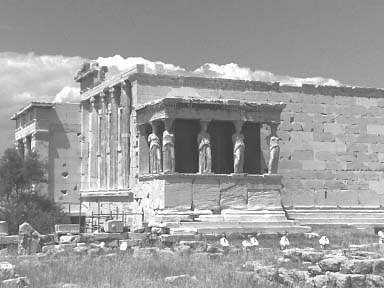
Erechtheum, Acropolis of Athens
Source: Vasilis Gavrilis.
By the Classical period, the Acropolis had become the main religious center of Athens. The buildings of the mid- to late fifth century BC, the high point of Athenian power, are the best known: the Parthenon (the temple of Athena Parthenos), the Erechtheion (a temple-shrine sheltering several cults), the Temple of Athena Nike, and the Propylaia, the ingenious entrance gate. In between these and other buildings, statues and other offerings left by the pious filled the hilltop. The slopes of the Acropolis were utilized for theaters (the Theater of Dionysos and, added in Roman times, the Odeion of Herodes Atticus) and a variety of shrines and monuments.
In medieval and early modern times, as the population of Athens declined, the city retreated to the Acropolis and its north slope. A church was installed inside the Parthenon; in Ottoman times, the church was replaced with a mosque. The hilltop was fortified once again. Franks converted the Propylaia into a castle; Ottomans used the Parthenon for storage of gunpowder (exploded by Venetian artillery in 1687). Modest houses densely filled the spaces between the reused Classical buildings.
In the 1830s, when Athens became the capital of newly independent Greece, the Acropolis was radically altered. The hilltop promptly became an archaeological site. Postclassical constructions were stripped away in order to expose the buildings of the fifth century BC. The Acropolis, now turned into an expression of the glory of ancient Greece, would become a symbol of the new nation. This symbolism continues today. The Athenian Acropolis is Greece's premier tourist destination, and both by day and, floodlit, by night, the Parthenon dominates the skyline of central Athens.
...
- Cities: Historical Overviews
- Allegory of Good Government
- Capitalist City
- Chinatowns
- Colonial City
- Divided Cities
- Global City
- Heritage City
- Historic Cities
- Ideal City
- Informational City
- Islamic City
- Mediterranean City
- Megalopolis
- Multicultural Cities
- Other Global Cities
- Primate City
- Progressive City
- Renaissance City
- Revanchist City
- Situationist City
- World City
- Cities: Specific Cities
- Amsterdam, the Netherlands
- Berlin, Germany
- Bilbao, Spain
- Cairo, Egypt
- Canberra, Australia
- Chicago, Illinois
- Damascus, Syria
- Delhi, India
- Florence, Italy
- Hiroshima, Japan
- Hong Kong, China
- Istanbul, Turkey
- Kolkata (Calcutta), India
- Lagos, Nigeria
- Las Vegas, Nevada
- London, United Kingdom
- Los Angeles, California
- Manchester, United Kingdom
- Manila, Philippines
- Mexico City, Mexico
- Moscow, Russian Federation
- Mumbai (Bombay), India
- New York City, New York
- Paris, France
- Rome, Italy
- São Paulo, Brazil
- Santa Fe, New Mexico
- Santiago de Compostela, Spain
- Savannah, Georgia
- Shanghai, China
- Singapore
- Tokyo, Japan
- Venice, Italy
- Persons
- Alinsky, Saul
- Alonso, William
- Benjamin, Walter
- Berry, Brian J. L.
- Castells, Manuel
- Childe, V. Gordon
- Davis, Mike
- De Certeau, Michel
- Dickens, Charles
- Downs, Anthony
- Du Bois, W. E. B.
- Fujita, Masahisa
- Geddes, Patrick
- Gottdiener, Mark
- Hall, Peter
- Harvey, David
- Haussmann, Baron Georges-Eugène
- Hawley, Amos
- Isard, Walter
- Jackson, Kenneth T.
- Jacobs, Jane
- Kracauer, Siegfried
- Le Corbusier
- Lefebvre, Henri
- LLöschsch, August
- Lynch, Kevin
- Moses, Robert
- Mumford, Lewis
- Riis, Jacob
- Sassen, Saskia
- Sert, Josep Lluís
- Simmel, Goerg
- Soja, Edward W.
- Wren, Sir Christopher
- Places
- Airports
- Béguinage
- Banlieue
- Barrio
- Bazaar
- Caravanserai
- Convention Centers
- Discotheque
- Ethnic Enclave
- Favela
- Forum
- Fourth World
- Gated Community
- Ghetto
- Heterotopia
- Metropolitan
- Necropolis
- Night Spaces
- Piazza
- Placemaking
- Resort
- Shopping Center
- Sports Stadiums
- Suburbanization
- Technoburbs
- Technopoles
- Themed Environments
- Toilets
- Utopia
- World Trade Center (9/11)
- Zoöpolis
- Urban Culture
- Bohemian
- Cinema (Movie House)
- City Club
- City Users
- Creative Class
- Flaâneur
- Graffiti
- Hip Hop
- Intellectuals
- Landscapes of Power
- Loft Living
- Metropolis
- Museums
- Nightlife
- Parks
- Photography and the City
- Placemaking
- Public Art
- Shopping
- Simulacra
- Skateboarding
- Society of the Spectacle
- Stranger
- Urban
- Urban Health
- Urban Life
- Urban Novel
- Urban Economics
- Urban Geography
- Urban History
- Urban Issues
- Urban Planning
- Urban Politics
- Urban Sociology
- Urban Studies—Topical Areas: Architecture
- Urban Studies—Topical Areas: Gender and Sex – Béguinage
- Urban Studies—Topical Areas: Gender and Sex – Social Space
- Urban Studies—Topical Areas: Sustainable Development
- Urban Theory
- Urban Transportation
- Loading...
Get a 30 day FREE TRIAL
-
 Watch videos from a variety of sources bringing classroom topics to life
 -
Read modern, diverse business cases
-
Explore hundreds of books and reference titles

Read next

More like this
Sage Recommends
We found other relevant content for you on other Sage platforms.
Have you created a personal profile? Login or create a profile so that you can save clips, playlists and searches