
Entry
Reader's guide
Entries A-Z
Subject index
Limbic System
In 1878, the French neurologist Paul Broca called attention to a group of distinct subcortical structures surrounding the thalamus in the mammalian brain. He called these interconnected neuronal components the limbic lobe (limbic, from the Latin, limbus, meaning surrounding, as in encircling). This was later called the limbic system by Paul MacLean. The limbic system is a loosely defined anatomical grouping of subcortical and cortical nuclei that, acting together, increase our chances of survival from predators. The limbic system generates both a heightened state of awareness and attention and, when required, activates other brain systems to enable our bodies to run or fight. In addition, it amplifies information processing and memory encoding that relates to a threat so that stimuli that recall the original learning moment are easily retrieved. The system lowers the threshold for salience and increases vigilance when danger is sensed, allowing us to identify a predator so that we can avoid becoming prey. In a moment of danger, the limbic system prunes the number of options under consideration. In short, the limbic system is a coordinator of changing perceptions so that we make the correct response to a perceived threat.
The nuclei that compose the limbic system have been preserved throughout mammalian evolution. In the human, however, the enlarged neocortical structure called the prefrontal cortex specifically expands our emotional range and our cognitive storage space. The anatomical components (not all shown) assigned to the limbic system by Sitoh and Tien (1997) include the following (see Figure 1):
- Amygdala
- Fornix
- Hippocampus
- Thalamus
- Cingulate gyrus
- Hypothalamus
- Parahippocampal gyrus
- Prefrontal cortex
- Olfactory bulb
Figure 1 Anatomy of the Limbic System
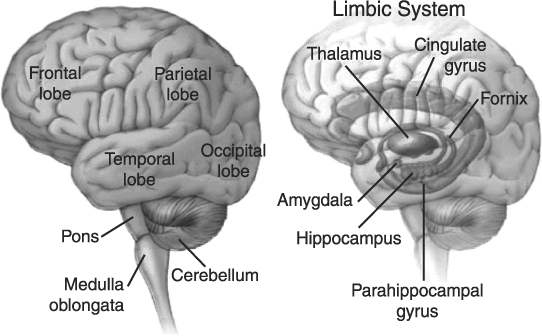
The cingulate gyrus connects to the amygdala and regulates our emotional reaction to pain and aggressive behavior. It is also important for attentiveness. The parahippocampus receives input from the cortex and is important for scene recognition and recall (the context). The olfactory bulb (not shown), unlike other senses, has a direct pathway to the amygdala. This provides for longdistance sensing because early detection increases the number of safe options. The prefrontal cortex, although not belonging to the traditional limbic circuit, has intense bidirectional connections with the other limbic nuclei, most importantly the amygdala and the thalamus. The prefrontal cortex is, in essence, an inhibitor of our limbic system and is involved with the evaluative aspects of a threat.
We now know that fear is generated as a consequence of limbic activation. Aggressive behavior and rage are modulated by the limbic system as well. These two primitive emotional states, fear and rage, are associated with physiological changes that involve the viscera, the soma, and the endocrine system. How does this occur?
Threatening stimuli (unconditional fear stimuli, UFS) enter the thalamus through our senses and activate the amygdala (an exception to this pathway occurs if a predator is sensed by smell, whereby the olfactory neurons directly activate the amygdala; see Figure 2). These UFS are innately hardwired; that is, no learning is required.
The hypothalamus, which connects to the pituitary gland, is simultaneously activated and causes the release of the stress neurochemical cortisol, critical for encoding emotional information.
...
- Anthropology and Archaeology
- Anthropology and Trauma
- Anthropology and War
- Racial and Ethnic Factors
- Racial Variations in the Psychobiology of Trauma
- Resource Loss Among Adults, Groups, and Communities
- Resource Loss Among Children and Families
- Rituals and Ceremonies, Therapeutic Use of
- Role of Trauma in Ethnic and Cultural Identity
- War, Origins in Animals and Early Societies
- Wars for Symbols
- Wars in Civilized Societies
- Arts and Humanities
- Business and Economics
- Children and Families
- Abduction/Kidnapping
- African Women and Girls' Trauma
- Campus Violence
- Childhood and Adolescent Trauma: An Overview
- Childhood and Adolescent Trauma: Assessment and Treatment
- Childhood Trauma and the Juvenile Justice System
- Childhood Traumatic Stress
- Children of War
- Critical Illness in Children
- Dissociative Identity Disorder and Trauma
- Family and Couples Trauma and Treatment
- Family-Based Treatment for Child Traumatic Stress
- Genetic Epidemiology
- Incest
- Marital Rape
- Marriage and the Marital Relationship
- Military Families, Effects of Combat and Deployment on
- Parenting During and After Traumatic Events
- Perinatal Trauma
- Perinatal Trauma, Long-Term Consequences of
- Protective Factors in Childhood Posttraumatic Stress Disorder
- Resilient Posttraumatic Adjustment in Childhood and Beyond
- Resource Loss Among Adults, Groups, and Communities
- Resource Loss Among Children and Families
- School Shootings
- Systemic Trauma Research
- Transgenerational Transmission of Trauma
- Crime and Law
- Abduction/Kidnapping
- Battered Women
- Blaming the Victim
- Campus Violence
- Childhood Trauma and the Juvenile Justice System
- Clergy, Sexual Abuse by
- Community Violence
- Comstock Act
- Correctional Officers and Trauma
- Crime Scene Investigation
- Criminal Behavior Consequent to War
- Date Rape/Acquaintance Rape
- Genocide
- Genocide in Non-Western Nations
- Genocide, Cambodia's Mass Casualty Trauma
- Hate Crimes
- Homicide and Trauma
- Human Trafficking
- Incarceration and Trauma
- Incest
- Law Enforcement Officers
- Lawsuits Against Behavioral Health Professionals
- Lawsuits Against Medical Professionals
- Male Rape
- Marital Rape
- Mass Violence
- Military Sexual Abuse
- Murder
- Perpetrators of Trauma
- Psychological Injury and Law
- Rapist Profiles
- School Shootings
- Secondary Trauma Among First Responders
- Secondary Trauma Among Judges, Jurors, Attorneys, and Courtroom Personnel
- Sexual Assault and Trauma
- Sexual Assault, Drug Facilitated
- Sexual Compulsion and Trauma
- Sexual Harassment of Women
- Sexual Predators
- Sexual Trauma, Causes of
- Slavery and Forced Servitude
- Social Learning Theory and Sexual Aggression
- Survival and Coping After Rape
- Terrorism, History of
- Trauma and Domestic Violence
- Wartime Rape
- Workplace Violence
- Crisis and Disaster
- Community Disasters
- Critical Incident Stress
- Debriefing
- Disaster Medicine
- Disaster Mortuary Services
- Disaster-Related Trauma
- Disasters, History of
- Early Interventions
- Emergency Care and Services
- First Responders and Trauma
- Humanitarian Missions
- Peacekeeping Missions
- Psychobiology of Crisis
- Psychological First Aid
- Psychological First Aid for Older Adults
- Psychospiritual Impact of Disaster
- Resilience and Hurricane Katrina
- Role of Media in Managing Disasters
- Culture and Ethnicity
- African American Culture and Trauma
- African Women and Girls' Trauma
- Cultural Aspects of Trauma
- Cultural Diversity in Trauma Response
- Culture and Cultural Beliefs
- Culture and Trauma
- Ethnicity, Culture, and Disaster Response
- Genocide
- Genocide in Non-Western Nations
- Genocide, Cambodia's Mass Casualty Trauma
- Nongovernmental Organizations, Governments, and Humanitarian Aid
- Race-Based Traumatic Stress
- Racial and Ethnic Factors
- Racial Variations in the Psychobiology of Trauma
- Racism-Induced Trauma
- Refugees
- Rituals and Ceremonies, Therapeutic Use of
- Role of Trauma in Ethnic and Cultural Identity
- Slavery and Forced Servitude
- Traumatization in the Name of Religion
- Death and Dying
- Ethics and Philosophy
- Assisted Suicide
- Boundaries and Boundary Violations
- Boundary Issues for Traumatologists
- Counterbalancing Stress
- Countertransference
- Ethical Dilemmas in Treatment of Trauma
- Ethics
- Humor and Trauma
- Philosophy and Ethics of Trauma Treatments
- Philosophy of Trauma
- Philosophy of Trauma Nursing
- Secondary Trauma Among Behavioral Health Professionals
- Secondary Trauma Among Chaplains
- Secondary Trauma Among First Responders
- Secondary Trauma Among Judges, Jurors, Attorneys, and Courtroom Personnel
- Secondary Trauma Among Medical Professionals
- Secondary Trauma Among Medics and Corpsmen
- Secondary Traumatic Stress
- Shame
- Trauma Caregivers
- Trauma Memories: Research and Ethics
- First Responders
- History
- Humanitarian Aid
- Internet, the Media, and Entertainment
- Medicine
- Abortion
- Alcohol and Trauma
- Assisted Suicide
- Brain and Trauma
- Combat Medics and Corpsmen
- Critical Illness in Children
- Disaster Medicine
- Lawsuits Against Medical Professionals
- Medical Marijuana and Posttraumatic Stress Disorder
- Medical Trauma Research
- Pain
- Perinatal Trauma
- Perinatal Trauma, Long-Term Consequences of
- Pharmacotherapy
- Philosophy of Trauma Nursing
- Primary Care
- Psychopharmacology, Psychiatry, and Trauma
- Public Health
- Retraumatization
- Secondary Trauma Among Medical Professionals
- Sexual Assault, Drug Facilitated
- Somatic Complaints
- Trauma-Related Physical Symptoms and Illnesses
- Traumatized Nurses
- Traumatized Physicians
- Natural Sciences
- Biological Effects of Physical and Psychological Trauma
- Biological Mechanism of Traumatic Stress Response
- Biology and Posttraumatic Stress Disorder
- Brain and Memory
- Brain and Trauma
- Encoding Trauma, Neurobiology of
- Genetic Epidemiology
- Hippocampus
- Limbic System
- Neurobiological Effects of Trauma
- Neurobiology of Posttraumatic Stress Disorder and Suicide
- Psychobiology of Crisis
- Trauma and Metabolic Syndrome
- Trauma Resilience, Ecology of
- Traumatic Inventions and the Ethics of Scientific Discovery
- Traumatized Scientists
- Psychology and Psychiatry
- Acute Stress Disorder
- Biological Mechanism of Traumatic Stress Response
- Brain and Memory
- Burnout
- Clinical Trauma Psychology
- Cognitive Behavioral Therapy
- Cognitive Processing Therapy
- Cognitive Restructuring and Trauma
- Combat Stress Control
- Combat-Related Posttraumatic Stress Disorder
- Compassion Fatigue
- Complex Trauma
- Conservation of Resources Theory
- Counseling and Education About Trauma
- Counterbalancing Stress
- Countertransference
- Dissociation
- Dissociative Identity Disorder and Trauma
- Evidence-Based Practice
- Eye Movement Desensitization and Reprocessing: Theory and Research
- Eye Movement Desensitization and Reprocessing: Treatment
- Family and Couples Trauma and Treatment
- Family-Based Treatment for Child Traumatic Stress
- Fragility, Posttraumatic
- Iatrogenic Effects
- Lawsuits Against Behavioral Health Professionals
- Limbic System
- Marriage and the Marital Relationship
- Meditation
- Memory Work
- Military Psychology and Combat Stress Injuries
- Mowrer's Two-Factor Theory
- Pain
- Personality Disorders
- Pharmacotherapy
- Posttraumatic Stress Disorder
- Posttraumatic Stress Disorder Assessment and Systemic Treatment
- Posttraumatic Stress Disorder, Comorbidity
- Primary Care
- Promoting Resilience in the Traumatized
- Protective Factors in Childhood Posttraumatic Stress Disorder
- Psychological Injury and Law
- Psychological Responses to Trauma
- Psychological Trauma
- Psychological Trauma Research
- Psychoneuroimmunology and Trauma
- Psychopharmacology, Psychiatry, and Trauma
- Psychosensory Therapy
- Rape Counseling
- Rape Crisis Centers
- Rape Trauma Syndrome
- Recovery From Trauma
- Relapse Prevention and Posttraumatic Stress Disorder
- Resilience
- Resilience Bolstering
- Resilience, Growth, and Thriving
- Retraumatization
- Secondary Trauma Among Behavioral Health Professionals
- Secondary Traumatic Stress
- Shame
- Social Learning Theory and Sexual Aggression
- Social Support and Trauma
- Somatic Complaints
- Stigma
- Stress Inoculation Training
- Suicide
- Survival and Coping After Rape
- Systemic Trauma Research
- Theories of Psychological Stress
- Trauma and Selfhood
- Trauma and Sexuality
- Trauma Assessment
- Trauma Education
- Trauma Prevention
- Trauma Psychology Research
- Trauma Triggers
- Trauma-Related Happiness and Pleasure
- Trauma-Related Physical Symptoms and Illnesses
- Trauma, Causes of
- Trauma, Identity, and the Workplace
- Traumatic Stress and Resilience
- Traumatic Stress Responses
- Traumatized Practitioners, Supervisors of
- Victim, Survivor, Thriver
- Virtual Reality Exposure Therapy
- Vulnerability, Posttraumatic
- Public Health
- Religion and Spirituality
- Clergy, Counseling by
- Clergy, Sexual Abuse by
- Combat Chaplains
- Cults and Sects
- Growth, Posttraumatic
- Meditation
- Posttraumatic Growth Among Asylum Seekers and Other Immigrants
- Psychospiritual Impact of Disaster
- Religious and Pastoral Responses to Trauma
- Religious Fundamentalism
- Secondary Trauma Among Chaplains
- Spiritual and Religious Growth
- Spiritual Intelligence and Posttraumatic Growth
- Traumatization in the Name of Religion
- Social Work
- Battered Women
- Bereavement
- Cognitive Behavioral Therapy
- Cognitive Processing Therapy
- Comstock Act
- Ethics
- Evidence-Based Practice
- Military Social Work and Combat Stress Management
- Social Support and Trauma
- Social Work With the Traumatized Homeless
- Theories of Psychological Stress
- Trauma and Domestic Violence
- Trauma and Homelessness
- Trauma and Social Work Practice
- Trauma Research, Social Work Contributions to
- Traumatized Practitioners, Supervisors of
- Sociology
- Traumatology and Trauma Recovery
- Acute Stress Disorder
- Additive Trauma
- Alcohol and Trauma
- Bearing Witness to Trauma
- Biology and Posttraumatic Stress Disorder
- Clergy, Counseling by
- Clinical Trauma Psychology
- Cognitive Restructuring and Trauma
- Compassion Fatigue
- Complex Trauma
- Conspiracy of Silence
- Counseling and Education About Trauma
- Cultural Aspects of Trauma
- Cultural Diversity in Trauma Response
- Culture and Trauma
- Cumulative Trauma
- Dance and Trauma
- Despair, Posttraumatic
- Disaster-Related Trauma
- Early Interventions
- Encoding Trauma, Neurobiology of
- Ethical Dilemmas in Treatment of Trauma
- Eye Movement Desensitization and Reprocessing: Theory and Research
- Eye Movement Desensitization and Reprocessing: Treatment
- Fear, Posttraumatic
- Fragility, Posttraumatic
- Grief and Mourning
- Grief, Complicated
- Growth, Posttraumatic
- Hippocampus
- Homicide and Trauma
- Humor and Trauma
- Hypnosis in the Treatment of Posttraumatic Stress Disorder
- Iatrogenic Effects
- Incarceration and Trauma
- Literary Expressions of Trauma
- Managing Trauma Symptoms
- Medical Marijuana and Posttraumatic Stress Disorder
- Medical Trauma Research
- Military Trauma
- Neurobiological Effects of Trauma
- Neurobiology of Posttraumatic Stress Disorder and Suicide
- Perpetrators of Trauma
- Philosophy and Ethics of Trauma Treatments
- Philosophy of Trauma
- Poetry and Trauma
- Posttraumatic Growth Among Asylum Seekers and Other Immigrants
- Posttraumatic Stress Disorder
- Posttraumatic Stress Disorder Assessment and Systemic Treatment
- Posttraumatic Stress Disorder, Comorbidity
- Posttraumatic Stress Disorder, History of
- Prolonged Exposure
- Promoting Resilience in the Traumatized
- Psychological Responses to Trauma
- Psychological Trauma
- Psychological Trauma Research
- Psychoneuroimmunology and Trauma
- Psychosensory Therapy
- Rape Counseling
- Rape Crisis Centers
- Rape Trauma Syndrome
- Rapist Profiles
- Recovery From Trauma
- Relapse Prevention and Posttraumatic Stress Disorder
- Resilience
- Resilience and Hurricane Katrina
- Resilience Bolstering
- Resilience, Growth, and Thriving
- Sanctuary Model
- Self-Regulation
- Sexual Compulsion and Trauma
- Sexual Harassment of Women
- Sexual Predators
- Sexual Trauma, Causes of
- Shared Trauma
- Silencing Response
- Stigma
- Suicide
- Transgenerational Transmission of Trauma
- Trauma and Autobiography
- Trauma and Homelessness
- Trauma and Metabolic Syndrome
- Trauma and Metaphor
- Trauma and Selfhood
- Trauma and Sexuality
- Trauma and Social Work Practice
- Trauma as Entertainment
- Trauma Assessment
- Trauma Caregivers
- Trauma Education
- Trauma Memories: Research and Ethics
- Trauma Prevention
- Trauma Psychology Research
- Trauma Survival Strategies
- Trauma Triggers
- Trauma-Organized Systems
- Trauma-Related Happiness and Pleasure
- Trauma, Causes of
- Trauma, Definitions of
- Traumatic Bereavement
- Traumatic Stress and Resilience
- Traumatic Stress Responses
- Traumatized Scientists
- Traumatology
- Vicarious Trauma
- Victim, Survivor, Thriver
- Virtual Reality Exposure Therapy
- Vulnerability, Posttraumatic
- War Crimes
- War and Combat
- Anthropology and War
- Children of War
- Combat Chaplains
- Combat Medics and Corpsmen
- Combat Mortuary Services
- Combat Stress Control
- Combat-Related Posttraumatic Stress Disorder
- Combat-Related Stress Injury: Theory, Research, and Management
- Criminal Behavior Consequent to War
- Death Notification in War
- Military Families, Effects of Combat and Deployment on
- Military Psychology and Combat Stress Injuries
- Military Sexual Abuse
- Military Social Work and Combat Stress Management
- Military Trauma
- Secondary Trauma Among Medics and Corpsmen
- War Crimes
- War, Origins in Animals and Early Societies
- Wars for Symbols
- Wars in Civilized Societies
- Wartime Rape
- Loading...
Get a 30 day FREE TRIAL
-
 Watch videos from a variety of sources bringing classroom topics to life
 -
Read modern, diverse business cases
-
Explore hundreds of books and reference titles

Read next

More like this
Sage Recommends
We found other relevant content for you on other Sage platforms.
Have you created a personal profile? Login or create a profile so that you can save clips, playlists and searches