
Entry
Reader's guide
Entries A-Z
Subject index
Twins Paradox
The supposition that time differences between events are not absolute in reality was first expressed by Einstein in his famous work of 1905. He deduced from the equation for the dilation of time that the relation between the time data δτ, δt of clocks situated at the equator and at the pole, respectively, will be the result of the rotation of the earth with the circumferential velocity u ≈ 0.465 km/s (c ≈ 300,000 km/s is the speed of light):

Thus a clock at the equator should be delayed approximately 8/100 microseconds per day with respect to the clock at the pole.
Equation (1) determines the proper time of a moving clock in the inertial system of reference. In the case of time-dependent velocity u(t) it is necessary to take it as a differential equation and integrate it. Equation (1) represents a special case of the conclusion of the relativity theory that the actual time is (apart from the constant multiplying factor) equal to the length of a section of the world line between the events (spacetime points) P and Q:
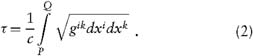
The clock paradox in its broadest sense means the existence of a difference between the actual times measured by the clocks moved in different directions between two meetings. from the geometrical point of view, this means different lengths of appropriate parts of world lines in spacetime. In the case of long and rapid motions, this difference will be reflected also in the biological age of organisms (according to A. Eddington, our faces represent clocks indicating passing years). Thus it is especially impressive when speaking about the twins paradox
The most common and most often discussed form of the paradox is the following: One of two identical twins will remain on the earth while the second makes a cosmic flight proceeding with the constant velocity u close to the speed of light. In the vicinity of a distant star the wandering twin will change the direction of his flight in a very short time interval compared to the total duration of the flight, and he will return to Earth. When the twins meet, the difference in their respective ages, corresponding to equation (1), will be immediately apparent.
The word paradox as used here refers primarily to the strangeness of the conclusion, whose theoretical and experimental legitimacy is beyond doubt. Nevertheless, even now (and sometimes even in physics publications) opinions are offered that the contradiction is real. They are based on the relativity of time. from the point of view of the wandering twin, motionless in his own system ∼, it is the earth-bound twin (at rest in the system S) who recedes and then again approaches with the velocity u. Could not the comparison of times give the opposite result for him?
The standard answer claims that the systems S and σ are not equivalent. Only system S is inertial for the whole time (no regard is taken of negligible effects connected with the motions and gravity of the earth and the sun). In order to return to the earth, the wandering twin changed the direction of his flight and felt great inertial forces in connection with this. His system is not permanently inertial and the use of equation (1) is consequently justified only in system S.
...
- Biography
- Abelard, Peter
- Albertus Magnus
- Alexander the Great
- Alexander, Samuel
- Alighieri, Dante
- Anaximander
- Anaximines
- Anselm of Canterbury
- Apollodorus of Athens
- Aquinas, Saint Thomas
- Aristotle
- Asimov, Isaac
- Attila the Hun
- Augustine of Hippo, Saint
- Avicenna
- Böhm, David
- Baer, Karl Ernst Ritter von
- Bakhtin, Mikhail Mikhailovich
- Barth, Karl
- Baxter, Stephen
- Bede the Venerable, Saint
- Bergson, Henri
- Berkeley, George
- Boethius, Anicius
- Bonaparte, Napoleon
- Boscovich, Roger Joseph
- Boucher de Perthes, Jacques
- Bradbury, Ray
- Bruno, Giordano
- Caesar, Gaius Julius
- Calvin, John
- Campanella, Tommaso
- Carroll, Lewis
- Cartan, Elie Joseph
- Chambers, Robert
- Charlemagne
- Chaucer, Geoffrey
- Clarke, Arthur C.
- Coleridge, Samuel Taylor
- Columbus, Christopher
- Comte, Auguste
- Copernicus, Nicolaus
- Dalí, Salvador
- Darwin, Charles
- Deleuze, Gilles
- Derrida, Jacques
- Descartes, René
- Diderot, Denis
- Dilthey, Wilhelm
- Donne, John
- Dostoevsky, Fyodor M.
- Doyle, Arthur Conan
- Duns Scotus, John
- Durkheim, Emile
- Eckhart, Meister
- Einstein, Albert
- Eliade, Mircea
- Eliot, T. S.
- Empedocles
- Engels, Friedrich
- Eriugena, Johannus Scotus
- Farber, Marvin
- Feuerbach, Ludwig
- Fichte, Johann Gottlieb
- Flaubert, Gustave
- Frege, Gottlob
- Gödel, Kurt
- Galilei, Galileo
- Gamow, George
- Gehlen, Arnold
- Genghis Khan
- Gibran, Kahlil
- Goethe, Johann Wolfgang von
- Gosse, Philip Henry
- Haeckel, Ernst
- Harris, Marvin
- Harrison, John
- Hartshorne, Charles
- Hawking, Stephen
- Hegel, Georg Wilhelm Friedrich
- Heidegger, Martin
- Heraclitus
- Herder, Johann Gottfried von
- Herodotus
- Hesiod
- Hitler, Adolf
- Homer
- Hume, David
- Husserl, Edmund
- Hutton, James
- Huxley, Thomas Henry
- Jaspers, Karl
- Josephus, Flavius
- Joyce, James
- Kafka, Franz
- Kant, Immanuel
- Kierkegaard, S⊘ren Aabye
- Knezevi', Bozidar
- Kropotkin, Peter A.
- Kuhn, Thomas S.
- Lamarck, Jean-Baptiste de
- Laplace, Marquis Pierre-Simon de
- Leibniz, Gottfried Wilhelm von
- Lemaître, Georges Édouard
- Lenin, Vladimir Ilich
- Lucretius
- Luther, Martin
- Lydgate, John
- Lyell, Charles
- Lysenko, Trofim D.
- Mach, Ernst
- Machiavelli, Niccolo
- Malthus, Thomas
- Mann, Thomas
- Maritain, Jacques
- Marx, Karl
- Maximus the Confessor, Saint
- McTaggart, John M. E.
- Mellor, David Hugh
- Merleau-Ponty, Maurice
- Methuselah
- Michelangelo Buonarroti
- Milton, John
- More, Saint Thomas
- Morgan, Lewis Henry
- Nāgārjuna, Acharya
- Nabokov, Vladimir
- Nero, Emperor of Rome
- Nevsky, Saint Alexander
- Newton, Isaac
- Nicholas of Cusa (Cusanus)
- Nietzsche, Friedrich
- Nostradamus
- Oparin, A. I.
- Orwell, George
- Ovid
- Paley, William
- Paracelsus
- Parmenides of Elea
- Petrarch, Francesco
- Philo Judaeus
- Philoponus and Simplicius
- Piaget, Jean
- Plato
- Plotinus
- Plutarch
- Poincaré, Henri
- Polo, Marco
- Popper, Karl R.
- Prigogine, Ilya
- Proust, Marcel
- Pythagoras of Samos
- Rahner, Karl
- Rameses II
- Rawls, John
- Renan, Joseph Ernest
- Ricoeur, Paul
- Rousseau, Jean-Jacques
- Russell, Bertrand
- Sagan, Carl
- Santayana, George
- Scheler, Max
- Schelling, Friedrich W. J. von
- Schopenhauer, Arthur
- Simmel, Georg
- Sloterdijk, Peter
- Smith, William
- Spencer, Herbert
- Spinoza, Baruch de
- Stalin, Joseph
- Steno, Nicolaus
- Sterne, Laurence
- Synge, John Lighton
- Taylor, Frederick W.
- Teilhard de Chardin, Pierre
- Thales
- Thucydides
- Tillich, Paul
- Toffler, Alvin
- Tolkien, J. R. R.
- Tolstoy, Leo Nikolaevich
- Tylor, Edward Burnett
- Unamuno y Jugo, Miguel de
- Verne, Jules
- Wagner, Richard
- Weber, Max
- Wegener, Alfred
- Wells, H. G.
- White, Leslie A.
- Whitehead, Alfred North
- William of Conches
- William of Ockham
- Woolf, Virginia
- Xenophanes
- Yeats, William Butler
- Zara Yacob
- Zeno of Elea
- Zoroaster
- Zurvan
- Biology/Evolution
- Aging
- Anaximander
- Anthropology
- Archaeology
- Archaeopteryx
- Bergson, Henri
- Birth Order
- Birthrates, Human
- Catastrophism
- Chambers, Robert
- Change
- Clocks, Biological
- Coelacanths
- Consciousness
- Creationism
- Cretaceous
- Cryonics
- Cryptozoology
- Cybertaxonomy
- Darwin and Aristotle
- Darwin and Nietzsche
- Darwin, Charles
- Dating Techniques
- Decay, Organic
- Decay, Radioactive
- Design, Intelligent
- Dinosaurs
- Diseases, Degenerative
- DNA
- Duration
- Dying and Death
- Ecology
- Economics
- Empedocles
- Enlightenment, Age of
- Eternal Recurrence
- Evidence of Human Evolution, Interpreting
- Evolution, Chemical
- Evolution, Cosmic
- Evolution, Cultural
- Evolution, Issues in
- Evolution, Organic
- Evolution, Social
- Extinction
- Extinction and Evolution
- Extinctions, Mass
- Fertility Cycle
- Foraminifers
- Fossil Fuels
- Fossil Record
- Fossils and Artifacts
- Fossils, Interpretations of
- Fossils, Living
- Geologic Timescale
- Geological Column
- Geology
- Gerontology
- Gestation Period
- Gingko Trees
- Global Warming
- Haeckel, Ernst
- Harris, Marvin
- Healing
- Heartbeat
- Hibernation
- Hominid-Pongid Split
- Huxley, Thomas Henry
- Incubation
- K-T Boundary
- Knezević, Bozidar
- Kropotkin, Peter A.
- La Brea Tar Pits
- Laetoli Footprints
- Lamarck, Jean-Baptiste de
- Language, Evolution of
- Language, Tree of
- Life Cycle
- Life, Origin of
- Longevity
- Lucretius
- Malthus, Thomas
- Maturation
- Medicine, History of
- Memory
- Metamorphosis, Insect
- Morgan, Lewis Henry
- Neogene
- Nietzsche, Friedrich
- Nuclear Winter
- Oparin, A. I.
- Paleogene
- Paleontology
- Panbiogeography
- Permian Extinction
- Photosynthesis
- Phylogeny
- Piltdown Man Hoax
- Renan, Joseph Ernest
- Saltationism and Gradualism
- Scopes "Monkey Trial" of 1925
- Spencer, Herbert
- Stars, Evolution of
- Stromatolites
- Teilhard de Chardin, Pierre
- Teleology
- Thaies
- Time-Release Medications
- Time, Prehistoric
- Transhumanism
- Trees
- Trilobites
- Tylor, Edward Burnett
- Unamuno y Jugo, Miguel de
- Uniformitarianism
- Universe, Evolving
- White, Leslie A.
- Xenophanes
- Culture/History
- Adam, Creation of
- Alexander the Great
- Altamira Cave
- Anthropology
- Apocalypse
- Archaeology
- Armageddon
- Astrolabes
- Attila the Hun
- Beowulf
- Bible and Time
- Bonaparte, Napoleon
- Boucher de Perthes, Jacques
- Buddhism, Mahayana
- Buddhism, Theravada
- Buddhism, Zen
- Caesar, Gaius Julius
- Calendar, Aztec
- Calendar, Egyptian
- Calendar, Ethiopian
- Calendar, Gregorian
- Calendar, Islamic
- Calendar, Julian
- Calendar, Mayan
- Calendar, Roman
- Calendars, Asian
- Calendars, Megalithic
- Calendars, Tribal
- Catacombs
- Chaco Canyon
- Charlemagne
- Chaucer, Geoffrey
- Chauvet Cave
- Christianity
- Clock, Doomsday
- Clocks, Mechanical
- Coins, Ancient
- Coleridge, Samuel Taylor
- Columbus, Christopher
- Confucianism
- Creation, Myths of
- Creationism
- Creativity
- Cronus (Kronos)
- Dalí, Salvador
- Democracy
- Diaries
- Divination
- Dracula, Legend of
- Dreamtime, Aboriginal
- Ecclesiastes, Book of
- Ecology
- Economics
- Education and Time
- Egypt, Ancient
- Eliot, T. S.
- Elixir of Life
- End-Time, Beliefs in
- Enlightenment, Age of
- Evolution, Cultural
- Evolution, Social
- Fatalism
- Father Time
- Film and Photography
- Flaubert, Gustave
- Fossils and Artifacts
- Frankenstein, Legend of
- Futurology
- Gehlen, George
- Genesis, Book of
- Genghis Khan
- Gibran, Kahlil
- Global Warming
- Globalization
- Goethe, Johann Wolfgang von
- Gospels
- Grim Reaper
- Hammurabi, Codex of
- Harris, Marvin
- Herodotus
- Hesiod
- Hinduism, Mimamsa-Vedanta
- Hinduism, Nyaya-Vaisesika
- Hinduism, Samkhya-Yoga
- Histories, Alternative
- History, End of
- Hitler, Adolf
- Homer
- Hourglass
- Humanism
- Ides of March
- Industrial Revolution
- Information
- Islam
- Jainism
- Janus
- Joyce, James
- Judaism
- Kabbalah
- Language
- Lascaux Cave
- Law
- Libraries
- Longevity
- Luther, Martin
- Magdalenian Bone Calendars
- Magna Carta
- Mann, Thomas
- Marx, Karl
- Materialism
- Media and Time
- Medicine, History of
- Metanarrative
- Michelangelo Buonarroti
- Migrations
- Milton, John
- Morality
- Morgan, Lewis Henry
- Moses
- Mummies
- Museums
- Music
- Mythology
- Navajo
- Nero, Emperor of Rome
- Nietzsche, Friedrich
- Noah
- Nostradamus
- Novels, Historical
- Novels, Time in
- Olduvai Gorge
- Omens
- Ovid
- Peloponnesian War
- Petrarch, Francesco
- Philo Judaeus
- Philosopher's Stone
- Photography, Time-Lapse
- Planetariums
- Plutarch
- Poetry
- Pompeii
- Postmodernism
- Predestination
- Predeterminism
- Presocratic Age
- Progress
- Prophecy
- Proust, Marcel
- Pueblo
- Punctuality
- Qur'an
- Rameses II
- Rapa Nui (Easter Island)
- Redemption
- Reincarnation
- Religions and Time
- Revelation, Book of
- Rip Van Winkle, Tale of
- Rites of Passage
- Rome, Ancient
- Rosetta Stone
- Sandman
- Sandpainting
- Satellites, Artificial and Natural
- Scopes "Monkey Trial" of 1925
- Seven Wonders of the Ancient World
- Shakespeare's Sonnets
- Shangri-La, Myth of
- Shinto
- Simmel, Georg
- Sisyphus, Myth of
- Stalin, Joseph
- Statute of Limitations
- Stonehenge
- Sufism
- Sundials
- Taoism (Daoism)
- Technology Assessment
- Telescopes
- Terrorism
- Time and Computers
- Time Capsules
- Time Machine
- Time Management
- Time Poverty
- Time, Historic
- Time, Measurements of
- Time, Prehistoric
- Time, Sacred
- Time, Teaching
- Timepieces
- Totem Poles
- Transportation
- Tylor, Edward Burnett
- Ur
- Utopia and Dystopia
- Vampires
- Verne, Jules
- Voodoo
- Wagner, Richard
- Wahhābism
- Watches
- Weapons
- Wells, H. G.
- Werewolves
- White, Leslie A.
- Wine
- Witching Hour
- Woolf, Virginia
- Youth, Fountain of
- Zeitgeist
- Geology/Paleontology
- Altamira Cave
- Anthropology
- Archaeology
- Archaeopteryx
- Aristotle
- Boucher de Perthes, Jacques
- Calendars, Megalithic
- Catacombs
- Catastrophism
- Chambers, Robert
- Chauvet Cave
- Chicxulub Crater
- Chronostratigraphy
- Coelacanths
- Creationism
- Cretaceous
- Cryptozoology
- Cybertaxonomy
- Darwin, Charles
- Dating Techniques
- Decay, Radioactive
- Dinosaurs
- Earth, Age of
- Erosion
- Evidence of Human Evolution, Interpreting
- Evolution, Issues in
- Evolution, Organic
- Extinction
- Extinction and Evolution
- Extinctions, Mass
- Foraminifers
- Fossil Fuels
- Fossil Record
- Fossils and Artifacts
- Fossils, Interpretations of
- Fossils, Living
- Geologic Timescale
- Geological Column
- Geology
- Gingko Trees
- Glaciers
- Gosse, Philip Henry
- Grand Canyon
- Haeckel, Ernst
- Hominid-Pongid Split
- Hutton, James
- Huxley, Thomas Henry
- Ice Ages
- K-T Boundary
- La Brea Tar Pits
- Laetoli Footprints
- Lamarck, Jean-Baptiste de
- Lascaux Cave
- Life, Origin of
- Lyell, Charles
- Museums
- Old Faithful
- Olduvai Gorge
- Oparin, A. I.
- Paleogene
- Paleontology
- Paley, William
- Panbiogeography
- Pangea
- Permian Extinction
- Phylogeny
- Piltdown Man Hoax
- Plate Tectonics
- Saltationism and Gradualism
- Scopes "Monkey Trial" of 1925
- Sedimentation
- Smith, William
- Spencer, Herbert
- Steno, Nicolaus
- Stratigraphy
- Stromatolites
- Synchronicity, Geological
- Teilhard de Chardin, Pierre
- Time, Perspectives of
- Time, Planetary
- Time, Prehistoric
- Trilobites
- Uniformitarianism
- Wegener, Alfred
- Xenophanes
- Philosophy
- Abelard, Peter
- Albertus Magnus
- Alexander, Samuel
- Anaximander
- Anaximines
- Anselm of Canterbury
- Anthropic Principle
- Apollodorus of Athens
- Aquinas, Saint Thomas
- Aristotle
- Aristotle and Plato
- Atheism
- Augustine of Hippo, Saint
- Avicenna
- Bakhtin, Mikhail
- Becoming and Being
- Bede the Venerable, Saint
- Bergson, Henri
- Berkeley, George
- Boethius, Anicius
- Bruno and Cusa
- Bruno, Giordano
- Calvin, John
- Campanella, Tommaso
- Comte, Auguste
- Critical Thought and Time
- Cronus (Kronos)
- Darwin and Heraclitus
- Darwin and Nietzsche
- Deleuze, Gilles
- Demiurge
- Democritus
- Derrida, Jacques
- Descartes, René
- Dialectics
- Diderot, Denis
- Dilthey, Wilhelm
- Dogen Zen
- Dostoevsky, Fyodor M.
- Duns Scotus, John
- Eckhart, Meister
- Einstein and Newton
- Einstein, Albert
- Eliade, Mircea
- Empedocles
- End-Time, Beliefs in
- Engels, Friedrich
- Enlightenment, Age of
- Epistemology
- Eriugena, Johannus Scotus
- Eternal Recurrence
- Eternity
- Ethics
- Evil and Time
- Existence
- Existentialism
- Experiments, Thought
- Farber, Marvin
- Fatalism
- Feuerbach, Ludwig
- Fichte, Johann Gottlieb
- Gödel, Kurt
- Gehlen, Arnold
- Gibran, Kahlil
- Goethe, Johann Wolfgang von
- Gosse, Philip Henry
- Haeckel, Ernst
- Hartshorne, Charles
- Hawking, Stephen
- Hegel and Kant
- Hegel, Georg Wilhelm Friedrich
- Heidegger, Martin
- Heraclitus
- Herder, Johann Gottfried von
- Humanism
- Hume, David
- Husserl, Edmund
- Idealism
- Infinity
- Intuition
- Jaspers, Karl
- Kant, Immanuel
- Kierkegaard, S⊘ren Aabye
- Knezevi', Bozidar
- Kropotkin, Peter A.
- Leibniz, Gottfried Wilhelm von
- Lenin, Vladimir Ilich
- Logical Depth
- Lucretius
- Mach, Ernst
- Machiavelli, Niccolo
- Marx, Karl
- Materialism
- Maxwell's Demon
- McTaggart, John M. E.
- Mellor, David Hugh
- Merleau-Ponty, Maurice
- Metaphysics
- Morality
- More, Saint Thomas
- Nabokov, Vladimir
- Newton and Leibniz
- Newton, Isaac
- Nicholas of Cusa (Cusanus)
- Nietzsche and Heraclitus
- Nietzsche, Friedrich
- Nothingness
- Now, Eternal
- Ontology
- Ovid
- Paley, William
- Parmenides of Elea
- Plato
- Plotinus
- Poincaré, Henri
- Postmodernism
- Predestination
- Predeterminism
- Presocratic Age
- Prigogine, Ilya
- Progress
- Rahner, Karl
- Rawls, John
- Regress, Infinite
- Ricoeur, Paul
- Rousseau, Jean-Jacques
- Russell, Bertrand
- Santayana, George
- Scheler, Max
- Schelling, Friedrich W. J. von
- Schopenhauer and Kant
- Schopenhauer, Arthur
- Simmel, Georg
- Sloterdijk, Peter
- Solipsism
- Spencer, Herbert
- Spinoza, Baruch de
- Structuralism
- Teilhard de Chardin, Pierre
- Teleology
- Thaies
- Theodicy
- Tillich, Paul
- Time, Cyclical
- Time, Illusion of
- Time, Imaginary
- Time, Logics of
- Time, Nonexistence of
- Time, Objective Flux of
- Time, Observations of
- Time, Operational Definition of
- Time, Perspectives of
- Time, Phenomenology of
- Time, Problems of
- Time, Real
- Time, Relativity of
- Time, Subjective Flow of
- Unamuno y Jugo, Miguel de
- Values and Time
- Virtual Reality
- Weber, Max
- Whitehead, Alfred North
- William of Conches
- William of Ockham
- Xenophanes
- Zeno of Elea
- Zoroaster
- Zurvan
- Physics/Chemistry
- Astrolabes
- Attosecond and Nanosecond
- Aurora Borealis
- Böhm, David
- Big Bang Theory
- Big Crunch Theory
- Black Holes
- Calendar, Astronomical
- Causality
- Chemical Reactions
- Chemistry
- Chronology
- Chronometry
- Clocks, Atomic
- Clocks, Mechanical
- Comets
- Copernicus, Nicolaus
- Cosmogony
- Cosmological Arguments
- Cosmology, Cyclic
- Cosmology, Inflationary
- Cryonics
- Dating Techniques
- Decay, Organic
- Decay, Radioactive
- Determinism
- DNA
- Dying and Death
- Earth, Age of
- Earth, Revolution of
- Earth, Rotation of
- Eclipses
- Einstein, Albert
- Entropy
- Equinoxes
- Eternity
- Event, First
- Evolution, Chemical
- Evolution, Issues in
- Finitude
- Forces, Four Fundamental
- Fossil Fuels
- Galilei, Galileo
- Gamow, George
- Global Warming
- Hawking, Stephen
- Heat Death, Cosmic
- Histories, Alternative
- Infinity
- Laplace, Marquis Pierre-Simon de
- Latitude
- Leap Years
- Lemaître, Georges Édouard
- Life, Origin of
- Light, Speed of
- Longitude
- Mach, Ernst
- Maxwell's Demon
- Meteors and Meteorites
- Moon, Age of
- Moon, Phases of
- Multiverses
- Nebular Hypothesis
- Newton, Isaac
- Nuclear Winter
- Observatories
- Oparin, A. I.
- Pendulums
- Photography, Time-Lapse
- Photosynthesis
- Planck Time
- Planetariums
- Planets
- Planets, Extrasolar
- Planets, Motion of
- Prime Meridian
- Pulsars and Quasars
- Quantum Mechanics
- Relativity, General Theory of
- Relativity, Special Theory of
- Satellites, Artificial and Natural
- Seasons, Change of
- Singularities
- Solstice
- Space
- Space and Time
- Space Travel
- Space, Absolute
- Spacetime Continuum
- Spacetime Curvature
- Spontaneity
- Stars, Evolution of
- Sun, Age of
- Sunspots, Cycle of
- Teleportation
- Telescopes
- Thanatochemistry
- Tides
- Time and Computers
- Time and Universes
- Time Dilation and Length Contraction
- Time Machine
- Time, Absolute
- Time, Arrow of
- Time, Asymmetry of
- Time, Cosmic
- Time, Emergence of
- Time, End of
- Time, Galactic
- Time, Historic
- Time, Linear
- Time, Measurements of
- Time, Planetary
- Time, Real
- Time, Relativity of
- Time, Reversal of
- Time, Sidereal
- Time, Symmetry of
- Time, Teaching
- Time, Units of
- Time, Universal
- Timelines
- Timescales, Physical
- Timetables
- Twins Paradox
- Universe, Age of
- Universe, Closed or Open
- Universe, Contracting or Expanding
- Universe, End of
- Universe, Evolving
- Universe, Origin of
- Universes, Baby
- White Holes
- Worlds, Possible
- Wormholes
- Psychology/Literature
- Alighieri, Dante
- Amnesia
- Aristotle
- Asimov, Isaac
- Augustine of Hippo, Saint
- Beowulf
- Bergson, Henri
- Berkeley, George
- Bible and Time
- Bradbury, Ray
- Carroll, Lewis
- Chronotopes
- Clarke, Arthur C.
- Cognition
- Coleridge, Samuel
- Consciousness
- Creativity
- Critical Period Hypothesis
- Critical Reflection and Time
- Déjà Vu
- Dalí, Salvador
- Darwin, Charles
- Descartes, René
- Determinism
- Diaries
- Donne, John
- Dostoevsky, Fyodor M.
- Doyle, Arthur Conan
- Dreams
- Dreamtime, Aboriginal
- Duration
- Durkheim, Emile
- Dying and Death
- Education and Time
- Eliade, Mircea
- Eliot, T. S.
- Emotions
- End-Time, Beliefs in
- Epistemology
- Ethics
- Existentialism
- Experiments, Thought
- Fatalism
- Flashbacks
- Flaubert, Gustave
- Gibran, Kahlil
- Goethe, Johann Wolfgang von
- Hegel, Georg Wilhelm Friedrich
- Herodotus
- Hesiod
- Homer
- Humanism
- Hume, David
- Husserl, Edmund
- Ides of March
- Immortality, Personal
- Information
- Intuition
- Jaspers, Karl
- Joyce, James
- Kabbalah
- Kafka, Franz
- Kant, Immanuel
- Kierkegaard, S⊘ren Aabye
- Language
- Leibniz, Gottfried Wilhelm von
- Libraries
- Logical Depth
- Machiavelli, Niccolo
- Mann, Thomas
- Memory
- Merleau-Ponty, Maurice
- More, Saint Thomas
- Music
- Mysticism
- Mythology
- Nietzsche, Friedrich
- Nirvana
- Nostradamus
- Nothingness
- Novels, Historical
- Novels, Time in
- Now, Eternal
- Omens
- Orwell, George
- Ovid
- Perception
- Petrarch, Francesco
- Phi Phenomenon
- Philo Judaeus
- Plato
- Plutarch
- Poetry
- Predestination
- Predeterminism
- Prophecy
- Proust, Marcel
- Psychology and Time
- Punctuality
- Renan, Joseph Ernest
- Rip Van Winkle, Tale of
- Rosetta Stone
- Rousseau, Jean-Jacques
- Schopenhauer, Arthur
- Senescence
- Shakespeare's Sonnets
- Shangri-La, Myth of
- Sisyphus, Myth of
- Sleep
- Solipsism
- Sterne, Laurence
- Tantalus
- Terrorism
- Time, Illusion of
- Time, Imaginary
- Time, Perspectives of
- Time, Phenomenology of
- Time, Subjective Flow of
- Time, Teaching
- Tolstoy, Leo Nikolaevich
- Unamuno y Jugo, Miguel de
- Values and Time
- Verne, Jules
- Virtual Reality
- Voodoo
- Wagner, Richard
- Wells, H. G.
- Woolf, Virginia
- Yeats, William Butler
- Zeitgeist
- Religion/Theology
- Abelard, Peter
- Adam, Creation of
- Afterlife
- Albertus Magnus
- Alexander, Samuel
- Alighieri, Dante
- Angels
- Anselm of Canterbury
- Apocalypse
- Aquinas and Aristotle
- Aquinas and Augustine
- Aquinas, Saint Thomas
- Armageddon
- Augustine of Hippo, Saint
- Barth, Karl
- Becoming and Being
- Bede the Venerable, Saint
- Bible and Time
- Bruno and Cusa
- Bruno, Giordano
- Buddhism, Mahayana
- Buddhism, Theravada
- Buddhism, Zen
- Calvin, John
- Catacombs
- Christianity
- Confucianism
- Creation, Myths of
- Creationism
- Demiurge
- Design, Intelligent
- Destiny
- Devils
- Divination
- Dogen, Zen
- Duns Scotus, John
- Ecclesiastes, Book of
- Eckhart, Meister
- End-Time, Beliefs in
- Eriugena, Johannus Scotus
- Eschatology
- Ethics
- Evil and Time
- Existentialism
- Feuerbach, Ludwig
- Genesis, Book of
- God and Time
- God as Creator
- God, Sensorium of
- Gospels
- Gosse, Philip Henry
- Hartshorne, Charles
- Hegel, Georg Wilhelm Friedrich
- Hinduism, Mimamsa-Vedanta
- Hinduism, Nyaya-Vaisesika
- Hinduism, Samkhya-Yoga
- Humanism
- Hume, David
- Idealism
- Immortality, Personal
- Islam
- Jainism
- Judaism
- Kabbalah
- Kant, Immanuel
- Kierkegaard, S⊘ren Aabye
- Last Judgment
- Luther, Martin
- Maritain, Jacques
- Marx, Karl
- Maximus the Confessor, Saint
- Metaphysics
- More, Saint Thomas
- Moses
- Mysticism
- Mythology
- Nicholas of Cusa (Cusanus)
- Nietzsche, Friedrich
- Nirvana
- Noah
- Ontology
- Paley, William
- Parousia
- Philosophy
- Predestination
- Predeterminism
- Prophecy
- Qur'an
- Rahner, Karl
- Redemption
- Reincarnation
- Religions and Time
- Renan, Joseph Ernest
- Revelation, Book of
- Salvation
- Sankara, Shri Adi
- Satan and Time
- ShintŌ
- Sin, Original
- Spinoza, Baruch de
- Star of Bethlehem
- Sufism
- Taoism (Daoism)
- Teilhard de Chardin, Pierre
- Theodicy
- Theology, Process
- Tillich, Paul
- Time, Sacred
- Unamuno y Jugo, Miguel de
- Voodoo
- Watchmaker, God as
- Whitehead, Alfred North
- Xenophanes
- Zoroaster
- Theories/Concepts
- Anaximander
- Anaximines
- Anthropic Principle
- Apocalypse
- Aquinas and Aristotle
- Aquinas and Augustine
- Aristotle and Plato
- Becoming and Being
- Big Bang Theory
- Big Crunch Theory
- Black Holes
- Bruno and Cusa
- Catastrophism
- Causality
- Change
- Cosmogony
- Cosmological Arguments
- Cosmology, Cyclic
- Cosmology, Inflationary
- Creation, Myths of
- Creationism
- Creativity
- Critical Reflection and Time
- Cronus
- Cryonics
- Darwin and Aristotle
- Darwin and Nietzsche
- Demiurge
- Democracy
- Design, Intelligent
- Destiny
- Determinism
- Dialectics
- Duration
- Einstein and Newton
- Empedocles
- Engels, Friedrich
- Enlightenment, Age of
- Entropy
- Eschatology
- Eternal Recurrence
- Eternity
- Ethics
- Evolution, Issues in
- Evolution, Organic
- Existentialism
- Experiments, Thought
- Extinction
- Extinction and Evolution
- Extinctions, Mass
- Fatalism
- Finitude
- Fossils, Interpretations of
- Futurology
- Globalization
- God and Time
- God as Creator
- God, Sensorium of
- Hawking and Einstein
- Heat Death, Cosmic
- Hegel and Kant
- Histories, Alternative
- History, End of
- Humanism
- Idealism
- Immortality, Personal
- Infinity
- Kropotkin, Peter A.
- Languages, Tree of
- Last Judgment
- Latitude
- Life, Origin of
- Light, Speed of
- Logical Depth
- Longitude
- Maha-Kala (Great Time)
- Marx, Karl
- Materialism
- Media and Time
- Metaphysics
- Morality
- Multiverses
- Mysticism
- Nebular Hypothesis
- Newton and Leibniz
- Nietzsche and Heraclitus
- Nirvana
- Nothingness
- Now, Eternal
- Nuclear Winter
- Ontology
- Paleogene
- Panbiogeography
- Pangea
- Parousia
- Permian Extinction
- Planck Time
- Plate Tectonics
- Postmodernism
- Predestination
- Predeterminism
- Presocratic Age
- Prime Meridian
- Progress
- Punctuality
- Quantum Mechanics
- Redemption
- Regress, Infinite
- Reincarnation
- Relativity, General Theory of
- Relativity, Special Theory of
- Saltationism and Gradualism
- Schopenhauer and Kant
- Singularities
- Sisyphus, Myth of
- Solipsism
- Space, Absolute
- Spacetime Continuum
- Spacetime, Curvature of
- Spencer, Herbert
- Structuralism
- Teleology
- Thales
- Theodicy
- Time and Computers
- Time and Universes
- Time Zones
- Time, Absolute
- Time, Arrow of
- Time, Cyclical
- Time, Emergence of
- Time, End of
- Time, Linear
- Time, Nonexistence of
- Time, Real
- Time, Relativity of
- Time, Reversal of
- Time, Sacred
- Time, Teaching
- Time, Units of
- Timelines
- Timescales, Physical
- Timetables
- Transhumanism
- Uniformitarianism
- Universe, Closed or Open
- Universe, Contracting or Expanding
- Universe, End of
- Universe, Evolving
- Universe, Origin of
- Universes, Baby
- Utopia and Dystopia
- Values and Time
- Virtual Reality
- Watchmaker, God as
- White Holes
- Worlds, Possible
- Wormholes
- Xenophanes
- Youth, Fountain of
- Zeitgeist
- Loading...
Get a 30 day FREE TRIAL
-
 Watch videos from a variety of sources bringing classroom topics to life
 -
Read modern, diverse business cases
-
Explore hundreds of books and reference titles

Read next

More like this
Sage Recommends
We found other relevant content for you on other Sage platforms.
Have you created a personal profile? Login or create a profile so that you can save clips, playlists and searches