
Entry
Reader's guide
Entries A-Z
Subject index
End-Time, Beliefs in
As stories of the beginning are provided by any number of religious or secular belief systems, so too are stories of the end. End-time beliefs broadly understood are those things believed about the eschaton, or the end of things: the end of an individual life, the end of a community, the end of the universe, or the end of time itself. End-time beliefs reflect a cultic system's explanation of how the end of things will come about. These beliefs are based on canonical sources, folk sources in the absence of canonical sources, or creative reinterpretation, willful denial, or simple ignorance of received wisdom whether from folk or canonical sources.
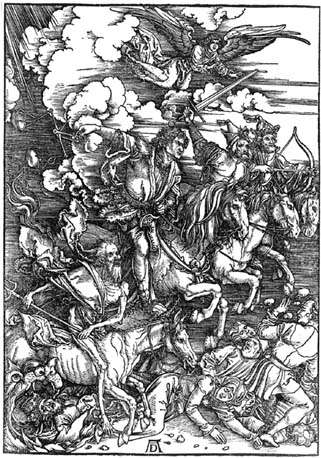
This is the third and most famous woodcut from Dürer's series of illustrations for The Apocalypse, (c. 1497). The Four Horsemen presents a dramatically distilled version of the passage from the Book of Revelation (6:1–8)
Doctrinal beliefs often differ from popular beliefs. For example, often in the popular Christian imagination the death of the saved is directly followed by their heavenly welcome. However, in the canonical Christian account found in the Book of Revelation, the death of the saved is directly followed by their long wait, along with the damned, for the worldwide bodily resurrection, final judgment, and arrival of God's heavenly city into which the saved are only then finally welcomed.
Varieties of End-Time Beliefs
Literature that reflects end-time beliefs that describe a final catastrophe resulting in the general destruction of life on Earth is generically, though somewhat imprecisely referred to as “apocalyptic” literature. However, the word apocalypse is simply an artifact of the Christian influence on world culture. The Book of Revelation (or the Apocalypse of Saint John) in the Christian Bible contains an end-time narrative in the ancient Near East tradition that the writer (or writers) inherited from the Hebrew Bible's Book of Daniel. The word revelation rendered in Greek is άπoκάλνΨιζ, or “apocalypse.” Based on the influence of this book on Christian and therefore Western literature, a text that follows the style or content of the Book of Revelation, whether written before, during, or after the closing of the Jewish and Christian canons, became referred to as “apocalyptic.” The Jewish-Christian form of apocalyptic literature properly includes particular identifying elements such as angelic visitation, numerology, catastrophe, judgment, and final punishments and rewards. Yet narratives that lack one or another apocalyptic element still have been considered apocalypses in the generic sense as long as they include catastrophic events that are to accompany the end-time.
Canonical and noncanonical end-time literature presents a diverse array of end-time beliefs, not all of which contain catastrophe and ultimate destruction. Zoroastrian Persia developed rich and complex end-time scenarios. Here the writers of scripture produced two apocalyptic narratives that provide examples from two decidedly different historical moments. The writers of the more ancient apocalypse recorded in the Greater Bundahisn described a general cataclysm that would result in general happiness. Mountains would empty themselves of molten lava enough to cover everything on a newly flattened Earth. “Followers of truth” would experience the molten rivers as a bath of warm milk. “Followers of evil” would experience them as molten rivers but with miraculous results: First, everyone would survive, and second, the experience would occasion a transformation not only of the entire earth but of all humankind. All would begin to speak the same language. All would become followers of truth. Worldwide apocalypse would be followed by worldwide bliss. This particular narrative developed during a time of relative strength and security in the Persian Empire. After the Roman conquest, however, Zoroastrian end-time narratives themselves became more menacing. Writers of the Oracles of Hystaspes revealed the catastrophe and chaos that would reign as the end-time drew near; but rather than a worldwide transformation resulting in a happy family of an egalitarian humanity, this end-time scenario resulted in a devastated Rome, an ascendant Asia, and rewards and punishments meted out by a just, mighty, and decidedly pro-Zoroastrian God.
...
- Biography
- Abelard, Peter
- Albertus Magnus
- Alexander the Great
- Alexander, Samuel
- Alighieri, Dante
- Anaximander
- Anaximines
- Anselm of Canterbury
- Apollodorus of Athens
- Aquinas, Saint Thomas
- Aristotle
- Asimov, Isaac
- Attila the Hun
- Augustine of Hippo, Saint
- Avicenna
- Böhm, David
- Baer, Karl Ernst Ritter von
- Bakhtin, Mikhail Mikhailovich
- Barth, Karl
- Baxter, Stephen
- Bede the Venerable, Saint
- Bergson, Henri
- Berkeley, George
- Boethius, Anicius
- Bonaparte, Napoleon
- Boscovich, Roger Joseph
- Boucher de Perthes, Jacques
- Bradbury, Ray
- Bruno, Giordano
- Caesar, Gaius Julius
- Calvin, John
- Campanella, Tommaso
- Carroll, Lewis
- Cartan, Elie Joseph
- Chambers, Robert
- Charlemagne
- Chaucer, Geoffrey
- Clarke, Arthur C.
- Coleridge, Samuel Taylor
- Columbus, Christopher
- Comte, Auguste
- Copernicus, Nicolaus
- Dalí, Salvador
- Darwin, Charles
- Deleuze, Gilles
- Derrida, Jacques
- Descartes, René
- Diderot, Denis
- Dilthey, Wilhelm
- Donne, John
- Dostoevsky, Fyodor M.
- Doyle, Arthur Conan
- Duns Scotus, John
- Durkheim, Emile
- Eckhart, Meister
- Einstein, Albert
- Eliade, Mircea
- Eliot, T. S.
- Empedocles
- Engels, Friedrich
- Eriugena, Johannus Scotus
- Farber, Marvin
- Feuerbach, Ludwig
- Fichte, Johann Gottlieb
- Flaubert, Gustave
- Frege, Gottlob
- Gödel, Kurt
- Galilei, Galileo
- Gamow, George
- Gehlen, Arnold
- Genghis Khan
- Gibran, Kahlil
- Goethe, Johann Wolfgang von
- Gosse, Philip Henry
- Haeckel, Ernst
- Harris, Marvin
- Harrison, John
- Hartshorne, Charles
- Hawking, Stephen
- Hegel, Georg Wilhelm Friedrich
- Heidegger, Martin
- Heraclitus
- Herder, Johann Gottfried von
- Herodotus
- Hesiod
- Hitler, Adolf
- Homer
- Hume, David
- Husserl, Edmund
- Hutton, James
- Huxley, Thomas Henry
- Jaspers, Karl
- Josephus, Flavius
- Joyce, James
- Kafka, Franz
- Kant, Immanuel
- Kierkegaard, S⊘ren Aabye
- Knezevi', Bozidar
- Kropotkin, Peter A.
- Kuhn, Thomas S.
- Lamarck, Jean-Baptiste de
- Laplace, Marquis Pierre-Simon de
- Leibniz, Gottfried Wilhelm von
- Lemaître, Georges Édouard
- Lenin, Vladimir Ilich
- Lucretius
- Luther, Martin
- Lydgate, John
- Lyell, Charles
- Lysenko, Trofim D.
- Mach, Ernst
- Machiavelli, Niccolo
- Malthus, Thomas
- Mann, Thomas
- Maritain, Jacques
- Marx, Karl
- Maximus the Confessor, Saint
- McTaggart, John M. E.
- Mellor, David Hugh
- Merleau-Ponty, Maurice
- Methuselah
- Michelangelo Buonarroti
- Milton, John
- More, Saint Thomas
- Morgan, Lewis Henry
- Nāgārjuna, Acharya
- Nabokov, Vladimir
- Nero, Emperor of Rome
- Nevsky, Saint Alexander
- Newton, Isaac
- Nicholas of Cusa (Cusanus)
- Nietzsche, Friedrich
- Nostradamus
- Oparin, A. I.
- Orwell, George
- Ovid
- Paley, William
- Paracelsus
- Parmenides of Elea
- Petrarch, Francesco
- Philo Judaeus
- Philoponus and Simplicius
- Piaget, Jean
- Plato
- Plotinus
- Plutarch
- Poincaré, Henri
- Polo, Marco
- Popper, Karl R.
- Prigogine, Ilya
- Proust, Marcel
- Pythagoras of Samos
- Rahner, Karl
- Rameses II
- Rawls, John
- Renan, Joseph Ernest
- Ricoeur, Paul
- Rousseau, Jean-Jacques
- Russell, Bertrand
- Sagan, Carl
- Santayana, George
- Scheler, Max
- Schelling, Friedrich W. J. von
- Schopenhauer, Arthur
- Simmel, Georg
- Sloterdijk, Peter
- Smith, William
- Spencer, Herbert
- Spinoza, Baruch de
- Stalin, Joseph
- Steno, Nicolaus
- Sterne, Laurence
- Synge, John Lighton
- Taylor, Frederick W.
- Teilhard de Chardin, Pierre
- Thales
- Thucydides
- Tillich, Paul
- Toffler, Alvin
- Tolkien, J. R. R.
- Tolstoy, Leo Nikolaevich
- Tylor, Edward Burnett
- Unamuno y Jugo, Miguel de
- Verne, Jules
- Wagner, Richard
- Weber, Max
- Wegener, Alfred
- Wells, H. G.
- White, Leslie A.
- Whitehead, Alfred North
- William of Conches
- William of Ockham
- Woolf, Virginia
- Xenophanes
- Yeats, William Butler
- Zara Yacob
- Zeno of Elea
- Zoroaster
- Zurvan
- Biology/Evolution
- Aging
- Anaximander
- Anthropology
- Archaeology
- Archaeopteryx
- Bergson, Henri
- Birth Order
- Birthrates, Human
- Catastrophism
- Chambers, Robert
- Change
- Clocks, Biological
- Coelacanths
- Consciousness
- Creationism
- Cretaceous
- Cryonics
- Cryptozoology
- Cybertaxonomy
- Darwin and Aristotle
- Darwin and Nietzsche
- Darwin, Charles
- Dating Techniques
- Decay, Organic
- Decay, Radioactive
- Design, Intelligent
- Dinosaurs
- Diseases, Degenerative
- DNA
- Duration
- Dying and Death
- Ecology
- Economics
- Empedocles
- Enlightenment, Age of
- Eternal Recurrence
- Evidence of Human Evolution, Interpreting
- Evolution, Chemical
- Evolution, Cosmic
- Evolution, Cultural
- Evolution, Issues in
- Evolution, Organic
- Evolution, Social
- Extinction
- Extinction and Evolution
- Extinctions, Mass
- Fertility Cycle
- Foraminifers
- Fossil Fuels
- Fossil Record
- Fossils and Artifacts
- Fossils, Interpretations of
- Fossils, Living
- Geologic Timescale
- Geological Column
- Geology
- Gerontology
- Gestation Period
- Gingko Trees
- Global Warming
- Haeckel, Ernst
- Harris, Marvin
- Healing
- Heartbeat
- Hibernation
- Hominid-Pongid Split
- Huxley, Thomas Henry
- Incubation
- K-T Boundary
- Knezević, Bozidar
- Kropotkin, Peter A.
- La Brea Tar Pits
- Laetoli Footprints
- Lamarck, Jean-Baptiste de
- Language, Evolution of
- Language, Tree of
- Life Cycle
- Life, Origin of
- Longevity
- Lucretius
- Malthus, Thomas
- Maturation
- Medicine, History of
- Memory
- Metamorphosis, Insect
- Morgan, Lewis Henry
- Neogene
- Nietzsche, Friedrich
- Nuclear Winter
- Oparin, A. I.
- Paleogene
- Paleontology
- Panbiogeography
- Permian Extinction
- Photosynthesis
- Phylogeny
- Piltdown Man Hoax
- Renan, Joseph Ernest
- Saltationism and Gradualism
- Scopes "Monkey Trial" of 1925
- Spencer, Herbert
- Stars, Evolution of
- Stromatolites
- Teilhard de Chardin, Pierre
- Teleology
- Thaies
- Time-Release Medications
- Time, Prehistoric
- Transhumanism
- Trees
- Trilobites
- Tylor, Edward Burnett
- Unamuno y Jugo, Miguel de
- Uniformitarianism
- Universe, Evolving
- White, Leslie A.
- Xenophanes
- Culture/History
- Adam, Creation of
- Alexander the Great
- Altamira Cave
- Anthropology
- Apocalypse
- Archaeology
- Armageddon
- Astrolabes
- Attila the Hun
- Beowulf
- Bible and Time
- Bonaparte, Napoleon
- Boucher de Perthes, Jacques
- Buddhism, Mahayana
- Buddhism, Theravada
- Buddhism, Zen
- Caesar, Gaius Julius
- Calendar, Aztec
- Calendar, Egyptian
- Calendar, Ethiopian
- Calendar, Gregorian
- Calendar, Islamic
- Calendar, Julian
- Calendar, Mayan
- Calendar, Roman
- Calendars, Asian
- Calendars, Megalithic
- Calendars, Tribal
- Catacombs
- Chaco Canyon
- Charlemagne
- Chaucer, Geoffrey
- Chauvet Cave
- Christianity
- Clock, Doomsday
- Clocks, Mechanical
- Coins, Ancient
- Coleridge, Samuel Taylor
- Columbus, Christopher
- Confucianism
- Creation, Myths of
- Creationism
- Creativity
- Cronus (Kronos)
- Dalí, Salvador
- Democracy
- Diaries
- Divination
- Dracula, Legend of
- Dreamtime, Aboriginal
- Ecclesiastes, Book of
- Ecology
- Economics
- Education and Time
- Egypt, Ancient
- Eliot, T. S.
- Elixir of Life
- End-Time, Beliefs in
- Enlightenment, Age of
- Evolution, Cultural
- Evolution, Social
- Fatalism
- Father Time
- Film and Photography
- Flaubert, Gustave
- Fossils and Artifacts
- Frankenstein, Legend of
- Futurology
- Gehlen, George
- Genesis, Book of
- Genghis Khan
- Gibran, Kahlil
- Global Warming
- Globalization
- Goethe, Johann Wolfgang von
- Gospels
- Grim Reaper
- Hammurabi, Codex of
- Harris, Marvin
- Herodotus
- Hesiod
- Hinduism, Mimamsa-Vedanta
- Hinduism, Nyaya-Vaisesika
- Hinduism, Samkhya-Yoga
- Histories, Alternative
- History, End of
- Hitler, Adolf
- Homer
- Hourglass
- Humanism
- Ides of March
- Industrial Revolution
- Information
- Islam
- Jainism
- Janus
- Joyce, James
- Judaism
- Kabbalah
- Language
- Lascaux Cave
- Law
- Libraries
- Longevity
- Luther, Martin
- Magdalenian Bone Calendars
- Magna Carta
- Mann, Thomas
- Marx, Karl
- Materialism
- Media and Time
- Medicine, History of
- Metanarrative
- Michelangelo Buonarroti
- Migrations
- Milton, John
- Morality
- Morgan, Lewis Henry
- Moses
- Mummies
- Museums
- Music
- Mythology
- Navajo
- Nero, Emperor of Rome
- Nietzsche, Friedrich
- Noah
- Nostradamus
- Novels, Historical
- Novels, Time in
- Olduvai Gorge
- Omens
- Ovid
- Peloponnesian War
- Petrarch, Francesco
- Philo Judaeus
- Philosopher's Stone
- Photography, Time-Lapse
- Planetariums
- Plutarch
- Poetry
- Pompeii
- Postmodernism
- Predestination
- Predeterminism
- Presocratic Age
- Progress
- Prophecy
- Proust, Marcel
- Pueblo
- Punctuality
- Qur'an
- Rameses II
- Rapa Nui (Easter Island)
- Redemption
- Reincarnation
- Religions and Time
- Revelation, Book of
- Rip Van Winkle, Tale of
- Rites of Passage
- Rome, Ancient
- Rosetta Stone
- Sandman
- Sandpainting
- Satellites, Artificial and Natural
- Scopes "Monkey Trial" of 1925
- Seven Wonders of the Ancient World
- Shakespeare's Sonnets
- Shangri-La, Myth of
- Shinto
- Simmel, Georg
- Sisyphus, Myth of
- Stalin, Joseph
- Statute of Limitations
- Stonehenge
- Sufism
- Sundials
- Taoism (Daoism)
- Technology Assessment
- Telescopes
- Terrorism
- Time and Computers
- Time Capsules
- Time Machine
- Time Management
- Time Poverty
- Time, Historic
- Time, Measurements of
- Time, Prehistoric
- Time, Sacred
- Time, Teaching
- Timepieces
- Totem Poles
- Transportation
- Tylor, Edward Burnett
- Ur
- Utopia and Dystopia
- Vampires
- Verne, Jules
- Voodoo
- Wagner, Richard
- Wahhābism
- Watches
- Weapons
- Wells, H. G.
- Werewolves
- White, Leslie A.
- Wine
- Witching Hour
- Woolf, Virginia
- Youth, Fountain of
- Zeitgeist
- Geology/Paleontology
- Altamira Cave
- Anthropology
- Archaeology
- Archaeopteryx
- Aristotle
- Boucher de Perthes, Jacques
- Calendars, Megalithic
- Catacombs
- Catastrophism
- Chambers, Robert
- Chauvet Cave
- Chicxulub Crater
- Chronostratigraphy
- Coelacanths
- Creationism
- Cretaceous
- Cryptozoology
- Cybertaxonomy
- Darwin, Charles
- Dating Techniques
- Decay, Radioactive
- Dinosaurs
- Earth, Age of
- Erosion
- Evidence of Human Evolution, Interpreting
- Evolution, Issues in
- Evolution, Organic
- Extinction
- Extinction and Evolution
- Extinctions, Mass
- Foraminifers
- Fossil Fuels
- Fossil Record
- Fossils and Artifacts
- Fossils, Interpretations of
- Fossils, Living
- Geologic Timescale
- Geological Column
- Geology
- Gingko Trees
- Glaciers
- Gosse, Philip Henry
- Grand Canyon
- Haeckel, Ernst
- Hominid-Pongid Split
- Hutton, James
- Huxley, Thomas Henry
- Ice Ages
- K-T Boundary
- La Brea Tar Pits
- Laetoli Footprints
- Lamarck, Jean-Baptiste de
- Lascaux Cave
- Life, Origin of
- Lyell, Charles
- Museums
- Old Faithful
- Olduvai Gorge
- Oparin, A. I.
- Paleogene
- Paleontology
- Paley, William
- Panbiogeography
- Pangea
- Permian Extinction
- Phylogeny
- Piltdown Man Hoax
- Plate Tectonics
- Saltationism and Gradualism
- Scopes "Monkey Trial" of 1925
- Sedimentation
- Smith, William
- Spencer, Herbert
- Steno, Nicolaus
- Stratigraphy
- Stromatolites
- Synchronicity, Geological
- Teilhard de Chardin, Pierre
- Time, Perspectives of
- Time, Planetary
- Time, Prehistoric
- Trilobites
- Uniformitarianism
- Wegener, Alfred
- Xenophanes
- Philosophy
- Abelard, Peter
- Albertus Magnus
- Alexander, Samuel
- Anaximander
- Anaximines
- Anselm of Canterbury
- Anthropic Principle
- Apollodorus of Athens
- Aquinas, Saint Thomas
- Aristotle
- Aristotle and Plato
- Atheism
- Augustine of Hippo, Saint
- Avicenna
- Bakhtin, Mikhail
- Becoming and Being
- Bede the Venerable, Saint
- Bergson, Henri
- Berkeley, George
- Boethius, Anicius
- Bruno and Cusa
- Bruno, Giordano
- Calvin, John
- Campanella, Tommaso
- Comte, Auguste
- Critical Thought and Time
- Cronus (Kronos)
- Darwin and Heraclitus
- Darwin and Nietzsche
- Deleuze, Gilles
- Demiurge
- Democritus
- Derrida, Jacques
- Descartes, René
- Dialectics
- Diderot, Denis
- Dilthey, Wilhelm
- Dogen Zen
- Dostoevsky, Fyodor M.
- Duns Scotus, John
- Eckhart, Meister
- Einstein and Newton
- Einstein, Albert
- Eliade, Mircea
- Empedocles
- End-Time, Beliefs in
- Engels, Friedrich
- Enlightenment, Age of
- Epistemology
- Eriugena, Johannus Scotus
- Eternal Recurrence
- Eternity
- Ethics
- Evil and Time
- Existence
- Existentialism
- Experiments, Thought
- Farber, Marvin
- Fatalism
- Feuerbach, Ludwig
- Fichte, Johann Gottlieb
- Gödel, Kurt
- Gehlen, Arnold
- Gibran, Kahlil
- Goethe, Johann Wolfgang von
- Gosse, Philip Henry
- Haeckel, Ernst
- Hartshorne, Charles
- Hawking, Stephen
- Hegel and Kant
- Hegel, Georg Wilhelm Friedrich
- Heidegger, Martin
- Heraclitus
- Herder, Johann Gottfried von
- Humanism
- Hume, David
- Husserl, Edmund
- Idealism
- Infinity
- Intuition
- Jaspers, Karl
- Kant, Immanuel
- Kierkegaard, S⊘ren Aabye
- Knezevi', Bozidar
- Kropotkin, Peter A.
- Leibniz, Gottfried Wilhelm von
- Lenin, Vladimir Ilich
- Logical Depth
- Lucretius
- Mach, Ernst
- Machiavelli, Niccolo
- Marx, Karl
- Materialism
- Maxwell's Demon
- McTaggart, John M. E.
- Mellor, David Hugh
- Merleau-Ponty, Maurice
- Metaphysics
- Morality
- More, Saint Thomas
- Nabokov, Vladimir
- Newton and Leibniz
- Newton, Isaac
- Nicholas of Cusa (Cusanus)
- Nietzsche and Heraclitus
- Nietzsche, Friedrich
- Nothingness
- Now, Eternal
- Ontology
- Ovid
- Paley, William
- Parmenides of Elea
- Plato
- Plotinus
- Poincaré, Henri
- Postmodernism
- Predestination
- Predeterminism
- Presocratic Age
- Prigogine, Ilya
- Progress
- Rahner, Karl
- Rawls, John
- Regress, Infinite
- Ricoeur, Paul
- Rousseau, Jean-Jacques
- Russell, Bertrand
- Santayana, George
- Scheler, Max
- Schelling, Friedrich W. J. von
- Schopenhauer and Kant
- Schopenhauer, Arthur
- Simmel, Georg
- Sloterdijk, Peter
- Solipsism
- Spencer, Herbert
- Spinoza, Baruch de
- Structuralism
- Teilhard de Chardin, Pierre
- Teleology
- Thaies
- Theodicy
- Tillich, Paul
- Time, Cyclical
- Time, Illusion of
- Time, Imaginary
- Time, Logics of
- Time, Nonexistence of
- Time, Objective Flux of
- Time, Observations of
- Time, Operational Definition of
- Time, Perspectives of
- Time, Phenomenology of
- Time, Problems of
- Time, Real
- Time, Relativity of
- Time, Subjective Flow of
- Unamuno y Jugo, Miguel de
- Values and Time
- Virtual Reality
- Weber, Max
- Whitehead, Alfred North
- William of Conches
- William of Ockham
- Xenophanes
- Zeno of Elea
- Zoroaster
- Zurvan
- Physics/Chemistry
- Astrolabes
- Attosecond and Nanosecond
- Aurora Borealis
- Böhm, David
- Big Bang Theory
- Big Crunch Theory
- Black Holes
- Calendar, Astronomical
- Causality
- Chemical Reactions
- Chemistry
- Chronology
- Chronometry
- Clocks, Atomic
- Clocks, Mechanical
- Comets
- Copernicus, Nicolaus
- Cosmogony
- Cosmological Arguments
- Cosmology, Cyclic
- Cosmology, Inflationary
- Cryonics
- Dating Techniques
- Decay, Organic
- Decay, Radioactive
- Determinism
- DNA
- Dying and Death
- Earth, Age of
- Earth, Revolution of
- Earth, Rotation of
- Eclipses
- Einstein, Albert
- Entropy
- Equinoxes
- Eternity
- Event, First
- Evolution, Chemical
- Evolution, Issues in
- Finitude
- Forces, Four Fundamental
- Fossil Fuels
- Galilei, Galileo
- Gamow, George
- Global Warming
- Hawking, Stephen
- Heat Death, Cosmic
- Histories, Alternative
- Infinity
- Laplace, Marquis Pierre-Simon de
- Latitude
- Leap Years
- Lemaître, Georges Édouard
- Life, Origin of
- Light, Speed of
- Longitude
- Mach, Ernst
- Maxwell's Demon
- Meteors and Meteorites
- Moon, Age of
- Moon, Phases of
- Multiverses
- Nebular Hypothesis
- Newton, Isaac
- Nuclear Winter
- Observatories
- Oparin, A. I.
- Pendulums
- Photography, Time-Lapse
- Photosynthesis
- Planck Time
- Planetariums
- Planets
- Planets, Extrasolar
- Planets, Motion of
- Prime Meridian
- Pulsars and Quasars
- Quantum Mechanics
- Relativity, General Theory of
- Relativity, Special Theory of
- Satellites, Artificial and Natural
- Seasons, Change of
- Singularities
- Solstice
- Space
- Space and Time
- Space Travel
- Space, Absolute
- Spacetime Continuum
- Spacetime Curvature
- Spontaneity
- Stars, Evolution of
- Sun, Age of
- Sunspots, Cycle of
- Teleportation
- Telescopes
- Thanatochemistry
- Tides
- Time and Computers
- Time and Universes
- Time Dilation and Length Contraction
- Time Machine
- Time, Absolute
- Time, Arrow of
- Time, Asymmetry of
- Time, Cosmic
- Time, Emergence of
- Time, End of
- Time, Galactic
- Time, Historic
- Time, Linear
- Time, Measurements of
- Time, Planetary
- Time, Real
- Time, Relativity of
- Time, Reversal of
- Time, Sidereal
- Time, Symmetry of
- Time, Teaching
- Time, Units of
- Time, Universal
- Timelines
- Timescales, Physical
- Timetables
- Twins Paradox
- Universe, Age of
- Universe, Closed or Open
- Universe, Contracting or Expanding
- Universe, End of
- Universe, Evolving
- Universe, Origin of
- Universes, Baby
- White Holes
- Worlds, Possible
- Wormholes
- Psychology/Literature
- Alighieri, Dante
- Amnesia
- Aristotle
- Asimov, Isaac
- Augustine of Hippo, Saint
- Beowulf
- Bergson, Henri
- Berkeley, George
- Bible and Time
- Bradbury, Ray
- Carroll, Lewis
- Chronotopes
- Clarke, Arthur C.
- Cognition
- Coleridge, Samuel
- Consciousness
- Creativity
- Critical Period Hypothesis
- Critical Reflection and Time
- Déjà Vu
- Dalí, Salvador
- Darwin, Charles
- Descartes, René
- Determinism
- Diaries
- Donne, John
- Dostoevsky, Fyodor M.
- Doyle, Arthur Conan
- Dreams
- Dreamtime, Aboriginal
- Duration
- Durkheim, Emile
- Dying and Death
- Education and Time
- Eliade, Mircea
- Eliot, T. S.
- Emotions
- End-Time, Beliefs in
- Epistemology
- Ethics
- Existentialism
- Experiments, Thought
- Fatalism
- Flashbacks
- Flaubert, Gustave
- Gibran, Kahlil
- Goethe, Johann Wolfgang von
- Hegel, Georg Wilhelm Friedrich
- Herodotus
- Hesiod
- Homer
- Humanism
- Hume, David
- Husserl, Edmund
- Ides of March
- Immortality, Personal
- Information
- Intuition
- Jaspers, Karl
- Joyce, James
- Kabbalah
- Kafka, Franz
- Kant, Immanuel
- Kierkegaard, S⊘ren Aabye
- Language
- Leibniz, Gottfried Wilhelm von
- Libraries
- Logical Depth
- Machiavelli, Niccolo
- Mann, Thomas
- Memory
- Merleau-Ponty, Maurice
- More, Saint Thomas
- Music
- Mysticism
- Mythology
- Nietzsche, Friedrich
- Nirvana
- Nostradamus
- Nothingness
- Novels, Historical
- Novels, Time in
- Now, Eternal
- Omens
- Orwell, George
- Ovid
- Perception
- Petrarch, Francesco
- Phi Phenomenon
- Philo Judaeus
- Plato
- Plutarch
- Poetry
- Predestination
- Predeterminism
- Prophecy
- Proust, Marcel
- Psychology and Time
- Punctuality
- Renan, Joseph Ernest
- Rip Van Winkle, Tale of
- Rosetta Stone
- Rousseau, Jean-Jacques
- Schopenhauer, Arthur
- Senescence
- Shakespeare's Sonnets
- Shangri-La, Myth of
- Sisyphus, Myth of
- Sleep
- Solipsism
- Sterne, Laurence
- Tantalus
- Terrorism
- Time, Illusion of
- Time, Imaginary
- Time, Perspectives of
- Time, Phenomenology of
- Time, Subjective Flow of
- Time, Teaching
- Tolstoy, Leo Nikolaevich
- Unamuno y Jugo, Miguel de
- Values and Time
- Verne, Jules
- Virtual Reality
- Voodoo
- Wagner, Richard
- Wells, H. G.
- Woolf, Virginia
- Yeats, William Butler
- Zeitgeist
- Religion/Theology
- Abelard, Peter
- Adam, Creation of
- Afterlife
- Albertus Magnus
- Alexander, Samuel
- Alighieri, Dante
- Angels
- Anselm of Canterbury
- Apocalypse
- Aquinas and Aristotle
- Aquinas and Augustine
- Aquinas, Saint Thomas
- Armageddon
- Augustine of Hippo, Saint
- Barth, Karl
- Becoming and Being
- Bede the Venerable, Saint
- Bible and Time
- Bruno and Cusa
- Bruno, Giordano
- Buddhism, Mahayana
- Buddhism, Theravada
- Buddhism, Zen
- Calvin, John
- Catacombs
- Christianity
- Confucianism
- Creation, Myths of
- Creationism
- Demiurge
- Design, Intelligent
- Destiny
- Devils
- Divination
- Dogen, Zen
- Duns Scotus, John
- Ecclesiastes, Book of
- Eckhart, Meister
- End-Time, Beliefs in
- Eriugena, Johannus Scotus
- Eschatology
- Ethics
- Evil and Time
- Existentialism
- Feuerbach, Ludwig
- Genesis, Book of
- God and Time
- God as Creator
- God, Sensorium of
- Gospels
- Gosse, Philip Henry
- Hartshorne, Charles
- Hegel, Georg Wilhelm Friedrich
- Hinduism, Mimamsa-Vedanta
- Hinduism, Nyaya-Vaisesika
- Hinduism, Samkhya-Yoga
- Humanism
- Hume, David
- Idealism
- Immortality, Personal
- Islam
- Jainism
- Judaism
- Kabbalah
- Kant, Immanuel
- Kierkegaard, S⊘ren Aabye
- Last Judgment
- Luther, Martin
- Maritain, Jacques
- Marx, Karl
- Maximus the Confessor, Saint
- Metaphysics
- More, Saint Thomas
- Moses
- Mysticism
- Mythology
- Nicholas of Cusa (Cusanus)
- Nietzsche, Friedrich
- Nirvana
- Noah
- Ontology
- Paley, William
- Parousia
- Philosophy
- Predestination
- Predeterminism
- Prophecy
- Qur'an
- Rahner, Karl
- Redemption
- Reincarnation
- Religions and Time
- Renan, Joseph Ernest
- Revelation, Book of
- Salvation
- Sankara, Shri Adi
- Satan and Time
- ShintŌ
- Sin, Original
- Spinoza, Baruch de
- Star of Bethlehem
- Sufism
- Taoism (Daoism)
- Teilhard de Chardin, Pierre
- Theodicy
- Theology, Process
- Tillich, Paul
- Time, Sacred
- Unamuno y Jugo, Miguel de
- Voodoo
- Watchmaker, God as
- Whitehead, Alfred North
- Xenophanes
- Zoroaster
- Theories/Concepts
- Anaximander
- Anaximines
- Anthropic Principle
- Apocalypse
- Aquinas and Aristotle
- Aquinas and Augustine
- Aristotle and Plato
- Becoming and Being
- Big Bang Theory
- Big Crunch Theory
- Black Holes
- Bruno and Cusa
- Catastrophism
- Causality
- Change
- Cosmogony
- Cosmological Arguments
- Cosmology, Cyclic
- Cosmology, Inflationary
- Creation, Myths of
- Creationism
- Creativity
- Critical Reflection and Time
- Cronus
- Cryonics
- Darwin and Aristotle
- Darwin and Nietzsche
- Demiurge
- Democracy
- Design, Intelligent
- Destiny
- Determinism
- Dialectics
- Duration
- Einstein and Newton
- Empedocles
- Engels, Friedrich
- Enlightenment, Age of
- Entropy
- Eschatology
- Eternal Recurrence
- Eternity
- Ethics
- Evolution, Issues in
- Evolution, Organic
- Existentialism
- Experiments, Thought
- Extinction
- Extinction and Evolution
- Extinctions, Mass
- Fatalism
- Finitude
- Fossils, Interpretations of
- Futurology
- Globalization
- God and Time
- God as Creator
- God, Sensorium of
- Hawking and Einstein
- Heat Death, Cosmic
- Hegel and Kant
- Histories, Alternative
- History, End of
- Humanism
- Idealism
- Immortality, Personal
- Infinity
- Kropotkin, Peter A.
- Languages, Tree of
- Last Judgment
- Latitude
- Life, Origin of
- Light, Speed of
- Logical Depth
- Longitude
- Maha-Kala (Great Time)
- Marx, Karl
- Materialism
- Media and Time
- Metaphysics
- Morality
- Multiverses
- Mysticism
- Nebular Hypothesis
- Newton and Leibniz
- Nietzsche and Heraclitus
- Nirvana
- Nothingness
- Now, Eternal
- Nuclear Winter
- Ontology
- Paleogene
- Panbiogeography
- Pangea
- Parousia
- Permian Extinction
- Planck Time
- Plate Tectonics
- Postmodernism
- Predestination
- Predeterminism
- Presocratic Age
- Prime Meridian
- Progress
- Punctuality
- Quantum Mechanics
- Redemption
- Regress, Infinite
- Reincarnation
- Relativity, General Theory of
- Relativity, Special Theory of
- Saltationism and Gradualism
- Schopenhauer and Kant
- Singularities
- Sisyphus, Myth of
- Solipsism
- Space, Absolute
- Spacetime Continuum
- Spacetime, Curvature of
- Spencer, Herbert
- Structuralism
- Teleology
- Thales
- Theodicy
- Time and Computers
- Time and Universes
- Time Zones
- Time, Absolute
- Time, Arrow of
- Time, Cyclical
- Time, Emergence of
- Time, End of
- Time, Linear
- Time, Nonexistence of
- Time, Real
- Time, Relativity of
- Time, Reversal of
- Time, Sacred
- Time, Teaching
- Time, Units of
- Timelines
- Timescales, Physical
- Timetables
- Transhumanism
- Uniformitarianism
- Universe, Closed or Open
- Universe, Contracting or Expanding
- Universe, End of
- Universe, Evolving
- Universe, Origin of
- Universes, Baby
- Utopia and Dystopia
- Values and Time
- Virtual Reality
- Watchmaker, God as
- White Holes
- Worlds, Possible
- Wormholes
- Xenophanes
- Youth, Fountain of
- Zeitgeist
- Loading...
Get a 30 day FREE TRIAL
-
 Watch videos from a variety of sources bringing classroom topics to life
 -
Read modern, diverse business cases
-
Explore hundreds of books and reference titles

Read next

More like this
Sage Recommends
We found other relevant content for you on other Sage platforms.
Have you created a personal profile? Login or create a profile so that you can save clips, playlists and searches