
Entry
Reader's guide
Entries A-Z
Subject index
Aurora Borealis
The Valkyrior are warlike virgins, mounted upon horses and armed with helmets and spears. When they ride forth on their errand, their armour sheds a strange flickering light, which flashes up over the northern skies, making what men call the aurora borealis, or Northern Lights.
Bulfinch's Mythology, 1855
Throughout time, humans have gazed at the sky to behold the splendor of the universe and contemplate the unknown. Certain times of the year, at the polar zones of Earth, there is a majestic show of lights and colors that occurs in the night sky. The lights that are viewed from the north skies are called aurora borealis, a combination of the name of the Roman goddess of the dawn, Aurora, and the Greek name for north wind, Boreas. The aurora borealis is visible only in the northern skies and is thus also known as the northern lights. This phenomenon also occurs in the southern skies; the counterpart is known as the aurora australis, with the name being derived from the Latin word for “of the South.”
The cause of these great lights starts far away from Earth, at the center of our solar system. The solar corona is the outermost portion of the sun and also the portion that produces temperatures that range in the millions of degrees. This corona, at times, ejects a rarefied flow of hot plasma (a gas consisting of both free and positive electrons) into outer space. This ejection of plasma is known as the solar wind. The solar wind travels through space until it nears Earth.
Earth's magnetosphere consists of the area dominated by its magnetic field. Extending far beyond Earth's atmosphere into outer space, the magneto-sphere blocks much of the solar wind and causes it to disperse. Solar winds contribute energy and material to the magnetosphere, causing the electrons and ions present in the magnetosphere to become energized. Once energized, these particles move along the magnetic field lines toward the polar regions of the atmosphere. The light is emitted shortly after this transfer occurs and is usually dominated by a greenish glow, produced by emissions of atomic energy, and also a dark-red glow, especially at high altitudes and lower energy levels. These two colors represent transitions of electrons and atomic energy, in absence of newer collisions, which continue for extended periods of time and account for the fading and brightening that occur. Other colors, such as purple and blue, can be seen when atomic energy and molecular nitrogen interact, but these displays tend to be of shorter duration.
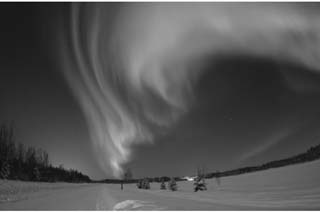
The aurora borealis, or northern lights, shines above Bear Lake, Alaska. The lights are the result of solar particles colliding with gases in Earth's atmosphere. Early Eskimos and Indians believed different legends about the northern lights, such as they were the souls of animals dancing in the sky or the souls of fallen enemies trying to rise again
Source: U.S. Air Force photo by Senior Airman Joshua Strang.
The best place to see the aurora is near Earth's magnetic poles. It can, however, be seen in temperate latitudes during times of heavy magnetic storms. These storms relate directly to the 11-year sunspot cycle and are strongest during the peak. These strong storms can continue to occur for up to 3 years following the peak. In September 1859, one of these strong magnetic storms occurred and produced what is thought to be the most spectacular aurora ever witnessed in recorded history. The aurora was the result of the Carrington-Hodgson white light solar flare, which was emitted on September 1, 1859. This flare was one of the most intense coronal mass ejections in recorded history. The aurora was seen across the United States, Japan, Australia, and Europe. It was this aurora that allowed the link to be seen between auroral activity and electricity. Many of the telegraph lines that were in use across North America and Canada encountered interference during this aurora. Several other telegraph lines had been powered down but, nevertheless, they picked up a geomagnetically induced current through the lines and allowed the telegraph operators to continue communicating. Since then, the phenomenon of the aurora has continued to intrigue many people. In the future, scientific research in outer space may shed more light on the aurora phenomenon.
...
- Biography
- Abelard, Peter
- Albertus Magnus
- Alexander the Great
- Alexander, Samuel
- Alighieri, Dante
- Anaximander
- Anaximines
- Anselm of Canterbury
- Apollodorus of Athens
- Aquinas, Saint Thomas
- Aristotle
- Asimov, Isaac
- Attila the Hun
- Augustine of Hippo, Saint
- Avicenna
- Böhm, David
- Baer, Karl Ernst Ritter von
- Bakhtin, Mikhail Mikhailovich
- Barth, Karl
- Baxter, Stephen
- Bede the Venerable, Saint
- Bergson, Henri
- Berkeley, George
- Boethius, Anicius
- Bonaparte, Napoleon
- Boscovich, Roger Joseph
- Boucher de Perthes, Jacques
- Bradbury, Ray
- Bruno, Giordano
- Caesar, Gaius Julius
- Calvin, John
- Campanella, Tommaso
- Carroll, Lewis
- Cartan, Elie Joseph
- Chambers, Robert
- Charlemagne
- Chaucer, Geoffrey
- Clarke, Arthur C.
- Coleridge, Samuel Taylor
- Columbus, Christopher
- Comte, Auguste
- Copernicus, Nicolaus
- Dalí, Salvador
- Darwin, Charles
- Deleuze, Gilles
- Derrida, Jacques
- Descartes, René
- Diderot, Denis
- Dilthey, Wilhelm
- Donne, John
- Dostoevsky, Fyodor M.
- Doyle, Arthur Conan
- Duns Scotus, John
- Durkheim, Emile
- Eckhart, Meister
- Einstein, Albert
- Eliade, Mircea
- Eliot, T. S.
- Empedocles
- Engels, Friedrich
- Eriugena, Johannus Scotus
- Farber, Marvin
- Feuerbach, Ludwig
- Fichte, Johann Gottlieb
- Flaubert, Gustave
- Frege, Gottlob
- Gödel, Kurt
- Galilei, Galileo
- Gamow, George
- Gehlen, Arnold
- Genghis Khan
- Gibran, Kahlil
- Goethe, Johann Wolfgang von
- Gosse, Philip Henry
- Haeckel, Ernst
- Harris, Marvin
- Harrison, John
- Hartshorne, Charles
- Hawking, Stephen
- Hegel, Georg Wilhelm Friedrich
- Heidegger, Martin
- Heraclitus
- Herder, Johann Gottfried von
- Herodotus
- Hesiod
- Hitler, Adolf
- Homer
- Hume, David
- Husserl, Edmund
- Hutton, James
- Huxley, Thomas Henry
- Jaspers, Karl
- Josephus, Flavius
- Joyce, James
- Kafka, Franz
- Kant, Immanuel
- Kierkegaard, S⊘ren Aabye
- Knezevi', Bozidar
- Kropotkin, Peter A.
- Kuhn, Thomas S.
- Lamarck, Jean-Baptiste de
- Laplace, Marquis Pierre-Simon de
- Leibniz, Gottfried Wilhelm von
- Lemaître, Georges Édouard
- Lenin, Vladimir Ilich
- Lucretius
- Luther, Martin
- Lydgate, John
- Lyell, Charles
- Lysenko, Trofim D.
- Mach, Ernst
- Machiavelli, Niccolo
- Malthus, Thomas
- Mann, Thomas
- Maritain, Jacques
- Marx, Karl
- Maximus the Confessor, Saint
- McTaggart, John M. E.
- Mellor, David Hugh
- Merleau-Ponty, Maurice
- Methuselah
- Michelangelo Buonarroti
- Milton, John
- More, Saint Thomas
- Morgan, Lewis Henry
- Nāgārjuna, Acharya
- Nabokov, Vladimir
- Nero, Emperor of Rome
- Nevsky, Saint Alexander
- Newton, Isaac
- Nicholas of Cusa (Cusanus)
- Nietzsche, Friedrich
- Nostradamus
- Oparin, A. I.
- Orwell, George
- Ovid
- Paley, William
- Paracelsus
- Parmenides of Elea
- Petrarch, Francesco
- Philo Judaeus
- Philoponus and Simplicius
- Piaget, Jean
- Plato
- Plotinus
- Plutarch
- Poincaré, Henri
- Polo, Marco
- Popper, Karl R.
- Prigogine, Ilya
- Proust, Marcel
- Pythagoras of Samos
- Rahner, Karl
- Rameses II
- Rawls, John
- Renan, Joseph Ernest
- Ricoeur, Paul
- Rousseau, Jean-Jacques
- Russell, Bertrand
- Sagan, Carl
- Santayana, George
- Scheler, Max
- Schelling, Friedrich W. J. von
- Schopenhauer, Arthur
- Simmel, Georg
- Sloterdijk, Peter
- Smith, William
- Spencer, Herbert
- Spinoza, Baruch de
- Stalin, Joseph
- Steno, Nicolaus
- Sterne, Laurence
- Synge, John Lighton
- Taylor, Frederick W.
- Teilhard de Chardin, Pierre
- Thales
- Thucydides
- Tillich, Paul
- Toffler, Alvin
- Tolkien, J. R. R.
- Tolstoy, Leo Nikolaevich
- Tylor, Edward Burnett
- Unamuno y Jugo, Miguel de
- Verne, Jules
- Wagner, Richard
- Weber, Max
- Wegener, Alfred
- Wells, H. G.
- White, Leslie A.
- Whitehead, Alfred North
- William of Conches
- William of Ockham
- Woolf, Virginia
- Xenophanes
- Yeats, William Butler
- Zara Yacob
- Zeno of Elea
- Zoroaster
- Zurvan
- Biology/Evolution
- Aging
- Anaximander
- Anthropology
- Archaeology
- Archaeopteryx
- Bergson, Henri
- Birth Order
- Birthrates, Human
- Catastrophism
- Chambers, Robert
- Change
- Clocks, Biological
- Coelacanths
- Consciousness
- Creationism
- Cretaceous
- Cryonics
- Cryptozoology
- Cybertaxonomy
- Darwin and Aristotle
- Darwin and Nietzsche
- Darwin, Charles
- Dating Techniques
- Decay, Organic
- Decay, Radioactive
- Design, Intelligent
- Dinosaurs
- Diseases, Degenerative
- DNA
- Duration
- Dying and Death
- Ecology
- Economics
- Empedocles
- Enlightenment, Age of
- Eternal Recurrence
- Evidence of Human Evolution, Interpreting
- Evolution, Chemical
- Evolution, Cosmic
- Evolution, Cultural
- Evolution, Issues in
- Evolution, Organic
- Evolution, Social
- Extinction
- Extinction and Evolution
- Extinctions, Mass
- Fertility Cycle
- Foraminifers
- Fossil Fuels
- Fossil Record
- Fossils and Artifacts
- Fossils, Interpretations of
- Fossils, Living
- Geologic Timescale
- Geological Column
- Geology
- Gerontology
- Gestation Period
- Gingko Trees
- Global Warming
- Haeckel, Ernst
- Harris, Marvin
- Healing
- Heartbeat
- Hibernation
- Hominid-Pongid Split
- Huxley, Thomas Henry
- Incubation
- K-T Boundary
- Knezević, Bozidar
- Kropotkin, Peter A.
- La Brea Tar Pits
- Laetoli Footprints
- Lamarck, Jean-Baptiste de
- Language, Evolution of
- Language, Tree of
- Life Cycle
- Life, Origin of
- Longevity
- Lucretius
- Malthus, Thomas
- Maturation
- Medicine, History of
- Memory
- Metamorphosis, Insect
- Morgan, Lewis Henry
- Neogene
- Nietzsche, Friedrich
- Nuclear Winter
- Oparin, A. I.
- Paleogene
- Paleontology
- Panbiogeography
- Permian Extinction
- Photosynthesis
- Phylogeny
- Piltdown Man Hoax
- Renan, Joseph Ernest
- Saltationism and Gradualism
- Scopes "Monkey Trial" of 1925
- Spencer, Herbert
- Stars, Evolution of
- Stromatolites
- Teilhard de Chardin, Pierre
- Teleology
- Thaies
- Time-Release Medications
- Time, Prehistoric
- Transhumanism
- Trees
- Trilobites
- Tylor, Edward Burnett
- Unamuno y Jugo, Miguel de
- Uniformitarianism
- Universe, Evolving
- White, Leslie A.
- Xenophanes
- Culture/History
- Adam, Creation of
- Alexander the Great
- Altamira Cave
- Anthropology
- Apocalypse
- Archaeology
- Armageddon
- Astrolabes
- Attila the Hun
- Beowulf
- Bible and Time
- Bonaparte, Napoleon
- Boucher de Perthes, Jacques
- Buddhism, Mahayana
- Buddhism, Theravada
- Buddhism, Zen
- Caesar, Gaius Julius
- Calendar, Aztec
- Calendar, Egyptian
- Calendar, Ethiopian
- Calendar, Gregorian
- Calendar, Islamic
- Calendar, Julian
- Calendar, Mayan
- Calendar, Roman
- Calendars, Asian
- Calendars, Megalithic
- Calendars, Tribal
- Catacombs
- Chaco Canyon
- Charlemagne
- Chaucer, Geoffrey
- Chauvet Cave
- Christianity
- Clock, Doomsday
- Clocks, Mechanical
- Coins, Ancient
- Coleridge, Samuel Taylor
- Columbus, Christopher
- Confucianism
- Creation, Myths of
- Creationism
- Creativity
- Cronus (Kronos)
- Dalí, Salvador
- Democracy
- Diaries
- Divination
- Dracula, Legend of
- Dreamtime, Aboriginal
- Ecclesiastes, Book of
- Ecology
- Economics
- Education and Time
- Egypt, Ancient
- Eliot, T. S.
- Elixir of Life
- End-Time, Beliefs in
- Enlightenment, Age of
- Evolution, Cultural
- Evolution, Social
- Fatalism
- Father Time
- Film and Photography
- Flaubert, Gustave
- Fossils and Artifacts
- Frankenstein, Legend of
- Futurology
- Gehlen, George
- Genesis, Book of
- Genghis Khan
- Gibran, Kahlil
- Global Warming
- Globalization
- Goethe, Johann Wolfgang von
- Gospels
- Grim Reaper
- Hammurabi, Codex of
- Harris, Marvin
- Herodotus
- Hesiod
- Hinduism, Mimamsa-Vedanta
- Hinduism, Nyaya-Vaisesika
- Hinduism, Samkhya-Yoga
- Histories, Alternative
- History, End of
- Hitler, Adolf
- Homer
- Hourglass
- Humanism
- Ides of March
- Industrial Revolution
- Information
- Islam
- Jainism
- Janus
- Joyce, James
- Judaism
- Kabbalah
- Language
- Lascaux Cave
- Law
- Libraries
- Longevity
- Luther, Martin
- Magdalenian Bone Calendars
- Magna Carta
- Mann, Thomas
- Marx, Karl
- Materialism
- Media and Time
- Medicine, History of
- Metanarrative
- Michelangelo Buonarroti
- Migrations
- Milton, John
- Morality
- Morgan, Lewis Henry
- Moses
- Mummies
- Museums
- Music
- Mythology
- Navajo
- Nero, Emperor of Rome
- Nietzsche, Friedrich
- Noah
- Nostradamus
- Novels, Historical
- Novels, Time in
- Olduvai Gorge
- Omens
- Ovid
- Peloponnesian War
- Petrarch, Francesco
- Philo Judaeus
- Philosopher's Stone
- Photography, Time-Lapse
- Planetariums
- Plutarch
- Poetry
- Pompeii
- Postmodernism
- Predestination
- Predeterminism
- Presocratic Age
- Progress
- Prophecy
- Proust, Marcel
- Pueblo
- Punctuality
- Qur'an
- Rameses II
- Rapa Nui (Easter Island)
- Redemption
- Reincarnation
- Religions and Time
- Revelation, Book of
- Rip Van Winkle, Tale of
- Rites of Passage
- Rome, Ancient
- Rosetta Stone
- Sandman
- Sandpainting
- Satellites, Artificial and Natural
- Scopes "Monkey Trial" of 1925
- Seven Wonders of the Ancient World
- Shakespeare's Sonnets
- Shangri-La, Myth of
- Shinto
- Simmel, Georg
- Sisyphus, Myth of
- Stalin, Joseph
- Statute of Limitations
- Stonehenge
- Sufism
- Sundials
- Taoism (Daoism)
- Technology Assessment
- Telescopes
- Terrorism
- Time and Computers
- Time Capsules
- Time Machine
- Time Management
- Time Poverty
- Time, Historic
- Time, Measurements of
- Time, Prehistoric
- Time, Sacred
- Time, Teaching
- Timepieces
- Totem Poles
- Transportation
- Tylor, Edward Burnett
- Ur
- Utopia and Dystopia
- Vampires
- Verne, Jules
- Voodoo
- Wagner, Richard
- Wahhābism
- Watches
- Weapons
- Wells, H. G.
- Werewolves
- White, Leslie A.
- Wine
- Witching Hour
- Woolf, Virginia
- Youth, Fountain of
- Zeitgeist
- Geology/Paleontology
- Altamira Cave
- Anthropology
- Archaeology
- Archaeopteryx
- Aristotle
- Boucher de Perthes, Jacques
- Calendars, Megalithic
- Catacombs
- Catastrophism
- Chambers, Robert
- Chauvet Cave
- Chicxulub Crater
- Chronostratigraphy
- Coelacanths
- Creationism
- Cretaceous
- Cryptozoology
- Cybertaxonomy
- Darwin, Charles
- Dating Techniques
- Decay, Radioactive
- Dinosaurs
- Earth, Age of
- Erosion
- Evidence of Human Evolution, Interpreting
- Evolution, Issues in
- Evolution, Organic
- Extinction
- Extinction and Evolution
- Extinctions, Mass
- Foraminifers
- Fossil Fuels
- Fossil Record
- Fossils and Artifacts
- Fossils, Interpretations of
- Fossils, Living
- Geologic Timescale
- Geological Column
- Geology
- Gingko Trees
- Glaciers
- Gosse, Philip Henry
- Grand Canyon
- Haeckel, Ernst
- Hominid-Pongid Split
- Hutton, James
- Huxley, Thomas Henry
- Ice Ages
- K-T Boundary
- La Brea Tar Pits
- Laetoli Footprints
- Lamarck, Jean-Baptiste de
- Lascaux Cave
- Life, Origin of
- Lyell, Charles
- Museums
- Old Faithful
- Olduvai Gorge
- Oparin, A. I.
- Paleogene
- Paleontology
- Paley, William
- Panbiogeography
- Pangea
- Permian Extinction
- Phylogeny
- Piltdown Man Hoax
- Plate Tectonics
- Saltationism and Gradualism
- Scopes "Monkey Trial" of 1925
- Sedimentation
- Smith, William
- Spencer, Herbert
- Steno, Nicolaus
- Stratigraphy
- Stromatolites
- Synchronicity, Geological
- Teilhard de Chardin, Pierre
- Time, Perspectives of
- Time, Planetary
- Time, Prehistoric
- Trilobites
- Uniformitarianism
- Wegener, Alfred
- Xenophanes
- Philosophy
- Abelard, Peter
- Albertus Magnus
- Alexander, Samuel
- Anaximander
- Anaximines
- Anselm of Canterbury
- Anthropic Principle
- Apollodorus of Athens
- Aquinas, Saint Thomas
- Aristotle
- Aristotle and Plato
- Atheism
- Augustine of Hippo, Saint
- Avicenna
- Bakhtin, Mikhail
- Becoming and Being
- Bede the Venerable, Saint
- Bergson, Henri
- Berkeley, George
- Boethius, Anicius
- Bruno and Cusa
- Bruno, Giordano
- Calvin, John
- Campanella, Tommaso
- Comte, Auguste
- Critical Thought and Time
- Cronus (Kronos)
- Darwin and Heraclitus
- Darwin and Nietzsche
- Deleuze, Gilles
- Demiurge
- Democritus
- Derrida, Jacques
- Descartes, René
- Dialectics
- Diderot, Denis
- Dilthey, Wilhelm
- Dogen Zen
- Dostoevsky, Fyodor M.
- Duns Scotus, John
- Eckhart, Meister
- Einstein and Newton
- Einstein, Albert
- Eliade, Mircea
- Empedocles
- End-Time, Beliefs in
- Engels, Friedrich
- Enlightenment, Age of
- Epistemology
- Eriugena, Johannus Scotus
- Eternal Recurrence
- Eternity
- Ethics
- Evil and Time
- Existence
- Existentialism
- Experiments, Thought
- Farber, Marvin
- Fatalism
- Feuerbach, Ludwig
- Fichte, Johann Gottlieb
- Gödel, Kurt
- Gehlen, Arnold
- Gibran, Kahlil
- Goethe, Johann Wolfgang von
- Gosse, Philip Henry
- Haeckel, Ernst
- Hartshorne, Charles
- Hawking, Stephen
- Hegel and Kant
- Hegel, Georg Wilhelm Friedrich
- Heidegger, Martin
- Heraclitus
- Herder, Johann Gottfried von
- Humanism
- Hume, David
- Husserl, Edmund
- Idealism
- Infinity
- Intuition
- Jaspers, Karl
- Kant, Immanuel
- Kierkegaard, S⊘ren Aabye
- Knezevi', Bozidar
- Kropotkin, Peter A.
- Leibniz, Gottfried Wilhelm von
- Lenin, Vladimir Ilich
- Logical Depth
- Lucretius
- Mach, Ernst
- Machiavelli, Niccolo
- Marx, Karl
- Materialism
- Maxwell's Demon
- McTaggart, John M. E.
- Mellor, David Hugh
- Merleau-Ponty, Maurice
- Metaphysics
- Morality
- More, Saint Thomas
- Nabokov, Vladimir
- Newton and Leibniz
- Newton, Isaac
- Nicholas of Cusa (Cusanus)
- Nietzsche and Heraclitus
- Nietzsche, Friedrich
- Nothingness
- Now, Eternal
- Ontology
- Ovid
- Paley, William
- Parmenides of Elea
- Plato
- Plotinus
- Poincaré, Henri
- Postmodernism
- Predestination
- Predeterminism
- Presocratic Age
- Prigogine, Ilya
- Progress
- Rahner, Karl
- Rawls, John
- Regress, Infinite
- Ricoeur, Paul
- Rousseau, Jean-Jacques
- Russell, Bertrand
- Santayana, George
- Scheler, Max
- Schelling, Friedrich W. J. von
- Schopenhauer and Kant
- Schopenhauer, Arthur
- Simmel, Georg
- Sloterdijk, Peter
- Solipsism
- Spencer, Herbert
- Spinoza, Baruch de
- Structuralism
- Teilhard de Chardin, Pierre
- Teleology
- Thaies
- Theodicy
- Tillich, Paul
- Time, Cyclical
- Time, Illusion of
- Time, Imaginary
- Time, Logics of
- Time, Nonexistence of
- Time, Objective Flux of
- Time, Observations of
- Time, Operational Definition of
- Time, Perspectives of
- Time, Phenomenology of
- Time, Problems of
- Time, Real
- Time, Relativity of
- Time, Subjective Flow of
- Unamuno y Jugo, Miguel de
- Values and Time
- Virtual Reality
- Weber, Max
- Whitehead, Alfred North
- William of Conches
- William of Ockham
- Xenophanes
- Zeno of Elea
- Zoroaster
- Zurvan
- Physics/Chemistry
- Astrolabes
- Attosecond and Nanosecond
- Aurora Borealis
- Böhm, David
- Big Bang Theory
- Big Crunch Theory
- Black Holes
- Calendar, Astronomical
- Causality
- Chemical Reactions
- Chemistry
- Chronology
- Chronometry
- Clocks, Atomic
- Clocks, Mechanical
- Comets
- Copernicus, Nicolaus
- Cosmogony
- Cosmological Arguments
- Cosmology, Cyclic
- Cosmology, Inflationary
- Cryonics
- Dating Techniques
- Decay, Organic
- Decay, Radioactive
- Determinism
- DNA
- Dying and Death
- Earth, Age of
- Earth, Revolution of
- Earth, Rotation of
- Eclipses
- Einstein, Albert
- Entropy
- Equinoxes
- Eternity
- Event, First
- Evolution, Chemical
- Evolution, Issues in
- Finitude
- Forces, Four Fundamental
- Fossil Fuels
- Galilei, Galileo
- Gamow, George
- Global Warming
- Hawking, Stephen
- Heat Death, Cosmic
- Histories, Alternative
- Infinity
- Laplace, Marquis Pierre-Simon de
- Latitude
- Leap Years
- Lemaître, Georges Édouard
- Life, Origin of
- Light, Speed of
- Longitude
- Mach, Ernst
- Maxwell's Demon
- Meteors and Meteorites
- Moon, Age of
- Moon, Phases of
- Multiverses
- Nebular Hypothesis
- Newton, Isaac
- Nuclear Winter
- Observatories
- Oparin, A. I.
- Pendulums
- Photography, Time-Lapse
- Photosynthesis
- Planck Time
- Planetariums
- Planets
- Planets, Extrasolar
- Planets, Motion of
- Prime Meridian
- Pulsars and Quasars
- Quantum Mechanics
- Relativity, General Theory of
- Relativity, Special Theory of
- Satellites, Artificial and Natural
- Seasons, Change of
- Singularities
- Solstice
- Space
- Space and Time
- Space Travel
- Space, Absolute
- Spacetime Continuum
- Spacetime Curvature
- Spontaneity
- Stars, Evolution of
- Sun, Age of
- Sunspots, Cycle of
- Teleportation
- Telescopes
- Thanatochemistry
- Tides
- Time and Computers
- Time and Universes
- Time Dilation and Length Contraction
- Time Machine
- Time, Absolute
- Time, Arrow of
- Time, Asymmetry of
- Time, Cosmic
- Time, Emergence of
- Time, End of
- Time, Galactic
- Time, Historic
- Time, Linear
- Time, Measurements of
- Time, Planetary
- Time, Real
- Time, Relativity of
- Time, Reversal of
- Time, Sidereal
- Time, Symmetry of
- Time, Teaching
- Time, Units of
- Time, Universal
- Timelines
- Timescales, Physical
- Timetables
- Twins Paradox
- Universe, Age of
- Universe, Closed or Open
- Universe, Contracting or Expanding
- Universe, End of
- Universe, Evolving
- Universe, Origin of
- Universes, Baby
- White Holes
- Worlds, Possible
- Wormholes
- Psychology/Literature
- Alighieri, Dante
- Amnesia
- Aristotle
- Asimov, Isaac
- Augustine of Hippo, Saint
- Beowulf
- Bergson, Henri
- Berkeley, George
- Bible and Time
- Bradbury, Ray
- Carroll, Lewis
- Chronotopes
- Clarke, Arthur C.
- Cognition
- Coleridge, Samuel
- Consciousness
- Creativity
- Critical Period Hypothesis
- Critical Reflection and Time
- Déjà Vu
- Dalí, Salvador
- Darwin, Charles
- Descartes, René
- Determinism
- Diaries
- Donne, John
- Dostoevsky, Fyodor M.
- Doyle, Arthur Conan
- Dreams
- Dreamtime, Aboriginal
- Duration
- Durkheim, Emile
- Dying and Death
- Education and Time
- Eliade, Mircea
- Eliot, T. S.
- Emotions
- End-Time, Beliefs in
- Epistemology
- Ethics
- Existentialism
- Experiments, Thought
- Fatalism
- Flashbacks
- Flaubert, Gustave
- Gibran, Kahlil
- Goethe, Johann Wolfgang von
- Hegel, Georg Wilhelm Friedrich
- Herodotus
- Hesiod
- Homer
- Humanism
- Hume, David
- Husserl, Edmund
- Ides of March
- Immortality, Personal
- Information
- Intuition
- Jaspers, Karl
- Joyce, James
- Kabbalah
- Kafka, Franz
- Kant, Immanuel
- Kierkegaard, S⊘ren Aabye
- Language
- Leibniz, Gottfried Wilhelm von
- Libraries
- Logical Depth
- Machiavelli, Niccolo
- Mann, Thomas
- Memory
- Merleau-Ponty, Maurice
- More, Saint Thomas
- Music
- Mysticism
- Mythology
- Nietzsche, Friedrich
- Nirvana
- Nostradamus
- Nothingness
- Novels, Historical
- Novels, Time in
- Now, Eternal
- Omens
- Orwell, George
- Ovid
- Perception
- Petrarch, Francesco
- Phi Phenomenon
- Philo Judaeus
- Plato
- Plutarch
- Poetry
- Predestination
- Predeterminism
- Prophecy
- Proust, Marcel
- Psychology and Time
- Punctuality
- Renan, Joseph Ernest
- Rip Van Winkle, Tale of
- Rosetta Stone
- Rousseau, Jean-Jacques
- Schopenhauer, Arthur
- Senescence
- Shakespeare's Sonnets
- Shangri-La, Myth of
- Sisyphus, Myth of
- Sleep
- Solipsism
- Sterne, Laurence
- Tantalus
- Terrorism
- Time, Illusion of
- Time, Imaginary
- Time, Perspectives of
- Time, Phenomenology of
- Time, Subjective Flow of
- Time, Teaching
- Tolstoy, Leo Nikolaevich
- Unamuno y Jugo, Miguel de
- Values and Time
- Verne, Jules
- Virtual Reality
- Voodoo
- Wagner, Richard
- Wells, H. G.
- Woolf, Virginia
- Yeats, William Butler
- Zeitgeist
- Religion/Theology
- Abelard, Peter
- Adam, Creation of
- Afterlife
- Albertus Magnus
- Alexander, Samuel
- Alighieri, Dante
- Angels
- Anselm of Canterbury
- Apocalypse
- Aquinas and Aristotle
- Aquinas and Augustine
- Aquinas, Saint Thomas
- Armageddon
- Augustine of Hippo, Saint
- Barth, Karl
- Becoming and Being
- Bede the Venerable, Saint
- Bible and Time
- Bruno and Cusa
- Bruno, Giordano
- Buddhism, Mahayana
- Buddhism, Theravada
- Buddhism, Zen
- Calvin, John
- Catacombs
- Christianity
- Confucianism
- Creation, Myths of
- Creationism
- Demiurge
- Design, Intelligent
- Destiny
- Devils
- Divination
- Dogen, Zen
- Duns Scotus, John
- Ecclesiastes, Book of
- Eckhart, Meister
- End-Time, Beliefs in
- Eriugena, Johannus Scotus
- Eschatology
- Ethics
- Evil and Time
- Existentialism
- Feuerbach, Ludwig
- Genesis, Book of
- God and Time
- God as Creator
- God, Sensorium of
- Gospels
- Gosse, Philip Henry
- Hartshorne, Charles
- Hegel, Georg Wilhelm Friedrich
- Hinduism, Mimamsa-Vedanta
- Hinduism, Nyaya-Vaisesika
- Hinduism, Samkhya-Yoga
- Humanism
- Hume, David
- Idealism
- Immortality, Personal
- Islam
- Jainism
- Judaism
- Kabbalah
- Kant, Immanuel
- Kierkegaard, S⊘ren Aabye
- Last Judgment
- Luther, Martin
- Maritain, Jacques
- Marx, Karl
- Maximus the Confessor, Saint
- Metaphysics
- More, Saint Thomas
- Moses
- Mysticism
- Mythology
- Nicholas of Cusa (Cusanus)
- Nietzsche, Friedrich
- Nirvana
- Noah
- Ontology
- Paley, William
- Parousia
- Philosophy
- Predestination
- Predeterminism
- Prophecy
- Qur'an
- Rahner, Karl
- Redemption
- Reincarnation
- Religions and Time
- Renan, Joseph Ernest
- Revelation, Book of
- Salvation
- Sankara, Shri Adi
- Satan and Time
- ShintŌ
- Sin, Original
- Spinoza, Baruch de
- Star of Bethlehem
- Sufism
- Taoism (Daoism)
- Teilhard de Chardin, Pierre
- Theodicy
- Theology, Process
- Tillich, Paul
- Time, Sacred
- Unamuno y Jugo, Miguel de
- Voodoo
- Watchmaker, God as
- Whitehead, Alfred North
- Xenophanes
- Zoroaster
- Theories/Concepts
- Anaximander
- Anaximines
- Anthropic Principle
- Apocalypse
- Aquinas and Aristotle
- Aquinas and Augustine
- Aristotle and Plato
- Becoming and Being
- Big Bang Theory
- Big Crunch Theory
- Black Holes
- Bruno and Cusa
- Catastrophism
- Causality
- Change
- Cosmogony
- Cosmological Arguments
- Cosmology, Cyclic
- Cosmology, Inflationary
- Creation, Myths of
- Creationism
- Creativity
- Critical Reflection and Time
- Cronus
- Cryonics
- Darwin and Aristotle
- Darwin and Nietzsche
- Demiurge
- Democracy
- Design, Intelligent
- Destiny
- Determinism
- Dialectics
- Duration
- Einstein and Newton
- Empedocles
- Engels, Friedrich
- Enlightenment, Age of
- Entropy
- Eschatology
- Eternal Recurrence
- Eternity
- Ethics
- Evolution, Issues in
- Evolution, Organic
- Existentialism
- Experiments, Thought
- Extinction
- Extinction and Evolution
- Extinctions, Mass
- Fatalism
- Finitude
- Fossils, Interpretations of
- Futurology
- Globalization
- God and Time
- God as Creator
- God, Sensorium of
- Hawking and Einstein
- Heat Death, Cosmic
- Hegel and Kant
- Histories, Alternative
- History, End of
- Humanism
- Idealism
- Immortality, Personal
- Infinity
- Kropotkin, Peter A.
- Languages, Tree of
- Last Judgment
- Latitude
- Life, Origin of
- Light, Speed of
- Logical Depth
- Longitude
- Maha-Kala (Great Time)
- Marx, Karl
- Materialism
- Media and Time
- Metaphysics
- Morality
- Multiverses
- Mysticism
- Nebular Hypothesis
- Newton and Leibniz
- Nietzsche and Heraclitus
- Nirvana
- Nothingness
- Now, Eternal
- Nuclear Winter
- Ontology
- Paleogene
- Panbiogeography
- Pangea
- Parousia
- Permian Extinction
- Planck Time
- Plate Tectonics
- Postmodernism
- Predestination
- Predeterminism
- Presocratic Age
- Prime Meridian
- Progress
- Punctuality
- Quantum Mechanics
- Redemption
- Regress, Infinite
- Reincarnation
- Relativity, General Theory of
- Relativity, Special Theory of
- Saltationism and Gradualism
- Schopenhauer and Kant
- Singularities
- Sisyphus, Myth of
- Solipsism
- Space, Absolute
- Spacetime Continuum
- Spacetime, Curvature of
- Spencer, Herbert
- Structuralism
- Teleology
- Thales
- Theodicy
- Time and Computers
- Time and Universes
- Time Zones
- Time, Absolute
- Time, Arrow of
- Time, Cyclical
- Time, Emergence of
- Time, End of
- Time, Linear
- Time, Nonexistence of
- Time, Real
- Time, Relativity of
- Time, Reversal of
- Time, Sacred
- Time, Teaching
- Time, Units of
- Timelines
- Timescales, Physical
- Timetables
- Transhumanism
- Uniformitarianism
- Universe, Closed or Open
- Universe, Contracting or Expanding
- Universe, End of
- Universe, Evolving
- Universe, Origin of
- Universes, Baby
- Utopia and Dystopia
- Values and Time
- Virtual Reality
- Watchmaker, God as
- White Holes
- Worlds, Possible
- Wormholes
- Xenophanes
- Youth, Fountain of
- Zeitgeist
- Loading...
Get a 30 day FREE TRIAL
-
 Watch videos from a variety of sources bringing classroom topics to life
 -
Read modern, diverse business cases
-
Explore hundreds of books and reference titles

Read next

More like this
Sage Recommends
We found other relevant content for you on other Sage platforms.
Have you created a personal profile? Login or create a profile so that you can save clips, playlists and searches