
Entry
Entries A-Z
Washington, George
It is unlikely that anyone was more indispensable to the success of the new United States of America than George Washington (1732–99). A reluctant leader with no particular penchant for politics or political theory, he held the country’s three most important positions in its early history: commander in chief of the colonial revolutionary army, president of the Constitutional Convention of 1787, and first president of the United States under the Constitution drafted in 1787. There is little doubt that Washington’s stature at the time of his first inauguration as president in 1789—he was chosen unanimously by the first Electoral College—could have propelled a man of lesser character to become a dictator.
Washington was born in Westmoreland County, Virginia, on February 22, 1732. After his father’s death, when Washington was eleven years old, he lived alternately with his mother and his half-brother Lawrence in his Mount Vernon home. He attended school irregularly but had a good grasp of functional mathematics, which, combined with his experience surviving in the wild, led to his appointment as official surveyor for Culpeper County in 1749. When Lawrence died of tuberculosis in 1752, Washington inherited Mount Vernon at the age of twenty.
The same year Washington was made a major in the Virginia militia. Although he experienced several defeats during the French and Indian Wars (1754–63), he was made commander of all the Virginia troops—the highest American military rank—at age twenty-three. Resigning his military commission, he married Martha Custis in 1759 and settled down as a gentleman farmer and member of Virginia’s colonial legislature, the House of Burgesses. When the American war for independence began in 1775, he was made commander in chief of the Continental Army, in part to ensure Virginia’s wholehearted support for the Revolution.
After the successful conclusion of the Revolutionary War, Washington was selected as one of five delegates from Virginia to the Constitutional Convention of 1787 to improve the Articles of Confederation (1781), the ineffectual constitution of the thirteen new states. He was unanimously chosen as the convention’s president and, although he seldom spoke in debates, wrote urging that the delegates “probe the defects of the [Articles] to the bottom and provide a radical cure.”
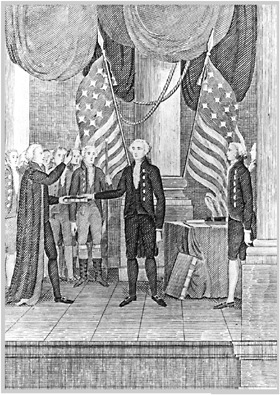
George Washington was inaugurated on April 30,1789, on the balcony of Federal Hall on Wall Streetin New York City. Almost immediately, patriotic re-creations of the event were produced in books formass consumption in the new nation. Library of Congress
Washington presided over the Constitutional Convention in Philadelphia for four months and gave the draft document great weight by approving it. His greatest contributions were the force of his character and his prestige, which focused the delegates on the task at hand and facilitated the compromises necessary to obtain agreement on the final document. Afterward, Washington worked hard for ratification of the Constitution, personally giving out copies of The Federalist—essays written in 1787 and 1788 by James Madison, Alexander Hamilton, and John Jay to favorably influence ratification (see Federalist Papers)—to persuade fellow Virginians to adopt it.
Although not assured of the document’s perfection, Washington nevertheless believed that it was the only possible way to save the Union. After its ratification, he contemplated retiring from active public life to his beloved Mount Vernon farm. But the country called Washington again, and again, reluctantly, he answered its call. He was elected its first president in 1789 and then reelected in 1793. He refused to be considered for a third term, thus setting an unwritten precedent for later presidents until 1940, when Franklin D. Roosevelt (1882–1945) ran for a third term and later for a fourth (see Terms of Office). Washington’s actions in office set further standards for future presidents. Seeing himself as a president of all the people, he eschewed strong partisanship, balancing his first four cabinet appointments with two representatives from each party. Although criticized by the opposition for conducting himself like a king, Washington insisted on solemnity in carrying out his duties, whether in an official capacity or entertaining politicians or dignitaries.
...
Get a 30 day FREE TRIAL
-
 Watch videos from a variety of sources bringing classroom topics to life
 -
Read modern, diverse business cases
-
Explore hundreds of books and reference titles

Read next

More like this
Sage Recommends
We found other relevant content for you on other Sage platforms.
Have you created a personal profile? Login or create a profile so that you can save clips, playlists and searches