
Entry
Entries A-Z
Territory
To justify his annexation and invasion of neighboring territory, the Nazi dictator Adolf Hitler (1889–1945) spoke of Lebensraum—a term originated by the German geographer and ethnographer Friederich Ratzel (1844–1904)—to provide “living space” for the German people. History is replete with accounts of wars fought for territorial acquisition, although aggressors like Hitler often couched their goals in more euphemistic terms, such as calling them wars of liberation or wars to protect some minority population in a coveted territory.
A nation’s territory defines the limits of its jurisdiction under international law. As Chief Justice John Marshall explained in The Schooner Exchange v. McFaddon (1812), “The jurisdiction of the nation within its own territory is necessarily exclusive and absolute. It is susceptible of no limitation not imposed by itself.” Many national constitutions expressly refer to the nation’s territory and its sovereignty over it. For example, the Russian constitution (1993) provides in article 4: “1. The sovereignty of the Russian federation shall extend to its entire territory. 2. The constitution of the Russian federation and federal laws shall have priority throughout the territory of the Russian federation. 3. The Russian federation shall ensure the integrity and inviolability of its territory.”
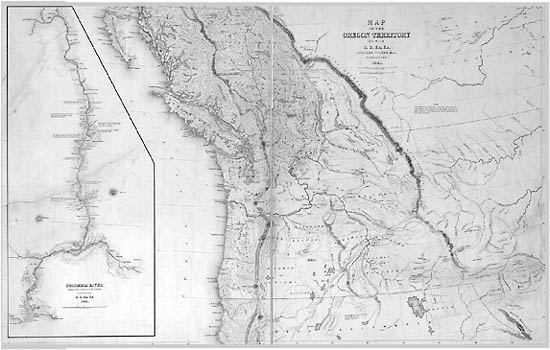
On August 14, 1848, Congress passed a bill creating the Oregon Territory, a tract of land encompassing the present states of Oregon, Idaho, Washington, and western Montana. This map of the region was published around 1879. Library of Congress
The States
The U.S. Constitution sets out two distinct types of territory and methods of governance: states and U.S. territories. The territory of the United States itself was constituted from the thirteen independent states that were first joined under the Articles of Confederation (1781). The states are named in Article I, section 2, which sets out the apportionment of members for the new House of Representatives (see Reapportionment), pending the first official census. Article VII declares that ratification by just nine of the thirteen states would be “sufficient for the Establishment of this Constitution between the States so ratifying the Same.” In the end, by 1790 all thirteen states had ratified the document. Today the territory of the Union comprises the fifty states of the United States, but additional territories that are not a part of any state also come under the nation’s jurisdiction.
At the time the Constitution went into effect, additional territories were claimed by some states, mostly to the north and west of the original thirteen. The process of dealing with these lands had begun in 1780, before the adoption of the Articles of Confederation, when the Continental Congress approved the policy that lands ceded to the confederation would “be settled and formed into distinct republican states, which would become members of the Federal Union.” A Territorial Ordinance was drafted by Thomas Jefferson and adopted in 1784. And then in July 1787, while the Constitutional Convention of 1787 was in progress in Philadelphia, the Congress adopted the Northwest Ordinance. Probably the most important act of the preconstitutional Congress, this law established the basic principles that would be used to convert territories of the United States into states on an equal footing with the other existing states.
...
Get a 30 day FREE TRIAL
-
 Watch videos from a variety of sources bringing classroom topics to life
 -
Read modern, diverse business cases
-
Explore hundreds of books and reference titles

Read next

More like this
Sage Recommends
We found other relevant content for you on other Sage platforms.
Have you created a personal profile? Login or create a profile so that you can save clips, playlists and searches