
Entry
Entries A-Z
Prohibition
Alcoholism is a serious problem in many countries, particularly Iceland and Russia. Although cultures and countries worldwide have tried to ban or prohibit the manufacture, sale, and use of alcohol beverages, few have been successful. Both Finland and the United States tried Prohibition beginning in 1919, and both repealed it—Finland in 1931 and the United States in 1933. The Prohibition movement in America was fueled in the first half of the nineteenth century by a revival of religious fervor that equated the perfection of humankind with the practice of temperance and the abolition of slavery.
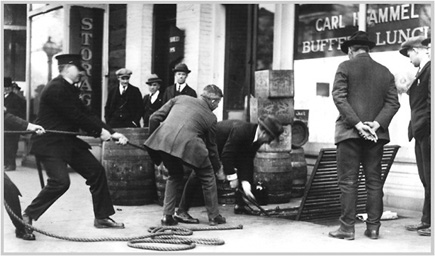
On May 23, 1923, offcers enforcing rohibition stage a lunch-room raid on Pennsylvania Avenue in Washington, D.C., as bystanders watch. Ratified in 1919, the unpopular Eighteenth Amendment banning liquor was repealed fourteen years later. Library of Congress
Factors contributing to the Prohibition movement included population increases in urban centers, where alcohol was most visibly consumed; the relative overrepresentation of rural areas in state legislatures, where proposed constitutional amendments have to be ratified; and the clash of evangelical Protestants, who viewed alcohol as evil, with Roman Catholics, who were not adverse to drink. The National Women’s Christian Temperance League was launched in 1874 and the World’s Women’s Christian Temperance Union in 1883, the latter founded by Frances Willard, who also started the Prohibition Party in 1882. The Anti-Saloon League was established in 1893. In 1917 the matter came to a head: A temporary Wartime Prohibition Act (1917) reserved all grain for food rather than allow any for alcohol production, thirty-three states with more than sixty percent of the nation’s population had adopted Prohibition measures, and then Congress proposed a constitutional amendment banning alcohol nationwide.
The Eighteenth Amendment (1919) consisted of three sections. Section 1, the major section, provided: “After one year from the ratification of this article the manufacture, sale, or transportation of intoxicating liquors within, the importation thereof into, or the exportation thereof from the United States and all territory subject to the jurisdiction thereof for beverage purposes is hereby prohibited.” The amendment gave Congress and the states concurrent power to enforce Prohibition and made ratification dependent on the state legislatures within a seven-year period. It took only thirteen months for thirty-six of the forty-eight states to agree, and the amendment was declared by the secretary of state to be ratified on January 29, 1919. Nine other states subsequently added their approval, but Rhode Island rejected it.
America’s experiment with banning alcohol bolstered the old argument that morality cannot be legislated effectively. Other human vices have been treated differently by Congress and state legislatures. Today, for example, gambling is not merely condoned but officially sponsored by many states through lotteries and is used to pay for state programs, including education. Prostitution, while not widely legalized except in certain Nevada counties, is not strictly enforced in many jurisdictions. Tobacco products are still sold freely, except to minors, despite their proven consequences to health. Drugs, in contrast, constitute a vice that the government still aims to eradicate, although there is some support for legalizing drugs so that the drug trade can be controlled and taxed by the government.
...
Get a 30 day FREE TRIAL
-
 Watch videos from a variety of sources bringing classroom topics to life
 -
Read modern, diverse business cases
-
Explore hundreds of books and reference titles

Read next

More like this
Sage Recommends
We found other relevant content for you on other Sage platforms.
Have you created a personal profile? Login or create a profile so that you can save clips, playlists and searches