
Entry
Entries A-Z
Marshall,Thurgood
In response to a request from Justice Felix Frankfurter (1882–1965) for a definition of equal, Thurgood Marshall, appearing as legal counsel before the Supreme Court, answered succinctly: “Equal means getting the same thing, at the same time and in the same place.” Much of Marshall’s life was devoted to the pursuit of just this kind of equality for all Americans.
Born on July 2, 1908, in Baltimore, Maryland, young Thurgood Marshall was required to read the Constitution as punishment in school. After graduating from Lincoln University in Pennsylvania in 1930, he was barred because of his race from enrolling in the University of Maryland’s law school and instead went to Howard Law School in Washington, D.C., from which he was graduated first in his class in 1933. While practicing law in Baltimore, Marshall worked to develop the local branch of the National Association for the Advancement of Colored People, becoming the director of the NAACP Legal Defense Fund in 1940.

“Equal means getting the same thing, at the same time and in the same place.”
—Justice Thurgood Marshall
After Marshall’s success with the case of Sweatt v. Painter (1950), in which the Supreme Court agreed that Texas’s law school for blacks was not equal to the school established for white law students, he assembled a team of lawyers to attack the constitutionality of the “separate but equal” doctrine approved by the Court in Plessy v. Ferguson (1896). His crowning achievement as a lawyer was his victory in Brown v. Board of Education of Topeka (1954), in which the Supreme Court ended the segregation of black and white students in public schools.
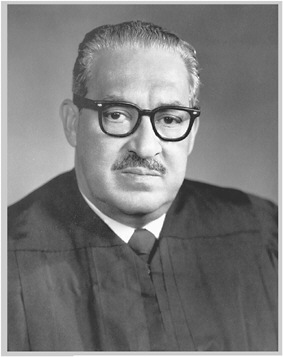
Thurgood Marshall, the first African American justice on the Supreme Court—a steadfast liberal and a champion of equal rights—retired in 1991 from a court increasingly dominated by more conservative members. Library of Congress
Until his 1961 nomination by President John F. Kennedy (1917–63) to be a judge on the Second Circuit Court of Appeals for New York was confirmed, Marshall continued to work to end discrimination against blacks in education, housing, public accommodations, and voting. A group of southern senators delayed his appointment, so he was finally given a recess appointment. None of his 112 opinions on the court was overturned. In 1965 President Lyndon B. Johnson (1908–73) appointed Marshall to be solicitor general of the United States, the number three position in the Department of Justice (see Cabinet). The unexpressed understanding was that he would soon be nominated as the first African American justice on the Supreme Court, which happened in 1967.
The Supreme Court he joined was the Warren Court (1954–69), dominated by relatively liberal justices who felt little compunction in using the power of the Court and the Constitution to support social change and the extension of rights to historically disadvantaged minorities such as blacks and women. Generally siding with the Court majority in the beginning, by the end of his twenty-four-year term he was more often writing dissents from majority opinions as the composition of the Court gradually changed with the addition of more conservative members appointed by Presidents Richard M. Nixon (1913–94) and Ronald Reagan (1911–2004) in the 1970s and 1980s.
...
Get a 30 day FREE TRIAL
-
 Watch videos from a variety of sources bringing classroom topics to life
 -
Read modern, diverse business cases
-
Explore hundreds of books and reference titles

Read next

More like this
Sage Recommends
We found other relevant content for you on other Sage platforms.
Have you created a personal profile? Login or create a profile so that you can save clips, playlists and searches