
Entry
Entries A-Z
Marshall, John
John Marshall’s tenure as chief justice of the United States from 1801 to 1835 came during a period of unsurpassed development in American constitutional law. The author of several key majority opinions on important national issues, Marshall (1755–1835) set the course for the continuing evolution of the Constitution, the federal government, and the United States as a nation.
Marshall was born in a log cabin in Virginia. His father worked for George Washington as a surveyor, and Marshall fought in the Revolutionary War. After studying law at the College of William and Mary, Marshall was admitted to practice in 1780. A member of Virginia’s House of Delegates, he helped persuade the state to ratify the Constitution. Marshall turned down several positions within the federal government, including attorney general, minister to France, and secretary of war. In 1799 he won a seat in the House of Representatives, where he became a leader of the Federalist Party.
In 1800 President John Adams appointed Marshall secretary of state, and when Adams returned to Massachusetts for several months Marshall virtually ran the government. The following year, after Oliver Ellsworth, the nation’s second chief justice, resigned and John Jay, the first chief justice, declined the post, Adams nominated Marshall, who was confirmed on January 27, 1801.
More than a thousand cases came before the Supreme Court during Marshall’s service on it, and he wrote more than five hundred opinions. Perhaps the most well known is his opinion in Marbury v. Madison (1803), which established the Court’s right to review legislative acts and declare them unconstitutional (see Judicial Review). Mcculloch v. Maryland (1819) validated the theory that Congress held implied powers, extending federal power beyond the Constitution’s strict enumeration of powers. And in Gibbons v. Ogden (1824), Marshall wrote an opinion that confirmed Congress’s extensive power vis-á-vis the states under the Constitution’s commerce clause, setting an outer limit that would not be pushed further for more than a hundred years.
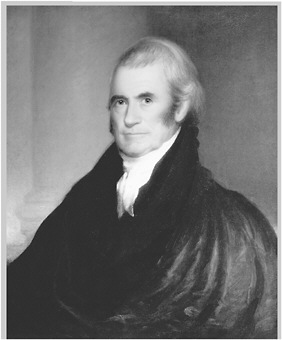
With his landmark decision inMarbury v. Madison(1803), confirming the Supreme Court’s power of judicial review to declare congressional legislation unconstitutional, Chief Justice John Marshall strengthened the federal judiciary. Library of Congress
Marshall helped shape the law of the new nation in many other important cases. The Supreme Court’s decision in United States v. Burr (1807) narrowed the definition of treason as used in the Constitution, making prosecution more difficult. Regarding the Constitution’s prohibition against impairment of contracts, in Fletcher v. Peck (1810) Marshall’s opinion for the Court declared unconstitutional an attempt by a state legislature to rescind contractual rights granted earlier by the same body, and his opinion in Sturges v. Crowninshield (1819) limited the standards for ab-solving a bankrupt of his debts. In Dartmouth College v. Woodward (1819), the Court in an opinion written by Marshall again upheld the sanctity of contractual obligations.
More than merely doing justice within the letter and spirit of a new and untested Constitution in individual cases, Marshall used his position on the Supreme Court to enforce his vision of the federal government it created for the new nation. To him the Constitution was a radical departure from the Articles of Confederation, which had governed the United States of America between 1781 and 1789. The new government possessed both judicial and political powers, but these powers were intended to have their effect directly on the citizens of the United States and not through the states, which had relinquished some of their sovereignty for the sake of a stronger Union.
...
Get a 30 day FREE TRIAL
-
 Watch videos from a variety of sources bringing classroom topics to life
 -
Read modern, diverse business cases
-
Explore hundreds of books and reference titles

Read next

More like this
Sage Recommends
We found other relevant content for you on other Sage platforms.
Have you created a personal profile? Login or create a profile so that you can save clips, playlists and searches