
Entry
Entries A-Z
Madison, James
Perhaps the quintessential American pragmatist, James Madison (1751–1836)—who would become known as the “Father of the Constitution”—contributed mightily to the foundation of the government of the United States, including the drafting of the Constitution itself. Madison was born on March 16, 1751, in Port Conway, Virginia, the son of a landowner with significant holdings near the Blue Ridge Mountains. A frail boy, he entered the College of New Jersey (later Princeton University) in 1769, gaining an education in Enlightenment principles and a degree in just two years. He soon became interested in revolutionary politics.
In 1776 Madison was elected a delegate to the Virginia constitutional convention, which supported independence and wrote a constitution for the commonwealth. He urged a strong religious freedom provision, proclaiming “liberty of conscience for all.” In 1780 he began four years’ service in the Continental Congress, where the studious legislator and orator favored a strong national government, a view that would come to shape the new United States of America.
In 1786 a meeting of representatives from Virginia, Delaware, New York, New Jersey, and Pennsylvania was held in Annapolis, Maryland, to wrestle with interstate commerce problems that had arisen under the Articles of Confederation (1781). Among these problems were retaliatory taxation measures by the states and disagreement over oyster fisheries and transportation of goods through adjacent states. Along with Alexander Hamilton and several other delegates, Madison urged that a constitutional convention be held, ostensibly to revise the woefully inadequate Articles by strengthening the powers of the federal government (see Federalism).
In preparation for the Constitutional Convention of 1787, Madison studied the histories of other nations, in particular the problems of confederations such as those of ancient Greece and Switzerland. He compared their problems to America’s contemporary ills under the Articles in order to give direction to the assemblage of delegates who were to meet in Philadelphia in 1787. Madison corresponded with fellow delegates, including George Washington and Edmund Randolph of Virginia and Rufus King of New York (see Framers of the Constitution). He also wrote to Thomas Jefferson, who was in France and was not a delegate, about the goals of the convention as Madison saw them. For eleven days in May immediately before the convention got under way, Madison brought together his fellow Virginia delegates to set the stage for what he believed was the momentous task that lay ahead.
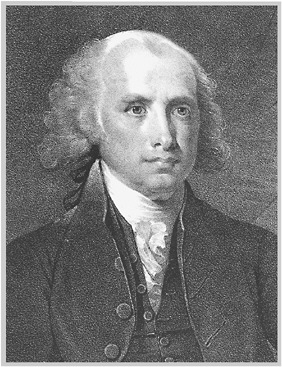
An active proponent of the new Constitution before and during the Constitutional Convention of 1787, James Madison’s contributions earned him the title “Father of the Constitution.” His essays in The Federalist (1787–88) helped secure the document’s ratification, and later, as a representative, he sponsored the Bill of Rights (1791). Library of Congress
“I am afraid you will think this project, if not extravagant, absolutely unattainable and unworthy of being attempted,” he wrote to Randolph on April 8. “I hold it for a fundamental point that an individual independence of the States, is utterly irreconcilable with the idea of an aggregate sovereignty. I think at the same time that a consolidation of the States into one simple republic is not less unattainable than it would be inexpedient. Let it be tried then whether any middle ground can be taken which will at once support a due supremacy of the national authority, and leave in force the local authorities so far as they can be subordinately useful.”
...
Get a 30 day FREE TRIAL
-
 Watch videos from a variety of sources bringing classroom topics to life
 -
Read modern, diverse business cases
-
Explore hundreds of books and reference titles

Read next

More like this
Sage Recommends
We found other relevant content for you on other Sage platforms.
Have you created a personal profile? Login or create a profile so that you can save clips, playlists and searches