
Entry
Entries A-Z
Lincoln, Abraham
In an 1862 letter to Horace Greeley (1811–72), the founder of the New York Tribune who similarly opposed slavery, Abraham Lincoln (1809–65), the sixteenth president of the United States, explained: “As to the policy ‘I seem to be pursuing,’ as you say, I have not meant to leave any one in doubt. I would save the Union. I would save it in the shortest way under the Constitution.”
The country’s leader during the Civil War (1861–65), Lincoln is second only to George Washington in the esteem in which he is held by the American people. Presiding over a nation torn apart by slavery and war, he had one guiding constitutional principle: states once united into a na-tion under the Constitution cannot unilaterally secede.
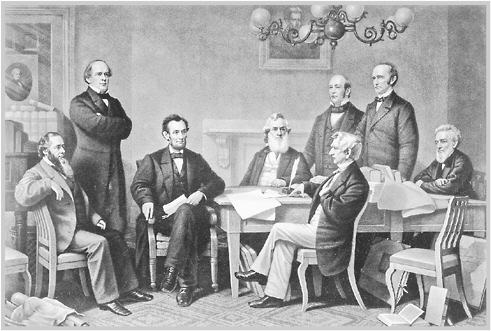
Abraham Lincoln, shown here reading his 1863 Emancipation Proclamation to his cabinet, presided over the nation during the Civil War, which was fought over the question of slavery and the right of states to secede from the Union. Library of Congress
Born in a log cabin in Kentucky on February 12, 1809, Lincoln and his family moved to Illinois after his mother died and his father had remarried. Largely self-taught—his total schooling amounted to about one year—he liked to read. One book he enjoyed was The Life and Memorable Actions of George Washington (ca. 1800) by Mason Locke “Parson” Weems, complete with its story about George and the cherry tree. Six feet four inches tall at twenty-one years of age, Lincoln worked as a storekeeper, postmaster, and surveyor until the Black Hawk War in 1832. Having volunteered to fight, he was elected captain of his unit, but he suffered defeat in his first bid for the Illinois state assembly when he returned. Running as a Whig, he prevailed in 1834 and thereafter was reelected as a state legislator to serve four terms even while studying law.
Lincoln began his legal practice in 1836, moving to the new state capital of Springfield a year later. Continuing his interest in politics, he was elected to Congress in 1846. There he incurred criticism for his opposition to the Mexican War and slavery in the District of Columbia (see Capital, National). After turning down an appointment as governor of the Oregon Territory (see Territory), he returned to the practice of law.
When Stephen A. Douglas (1813–61), a Democrat from Illinois, began campaigning to extend slavery into the nation’s western territories, Lincoln felt it his duty to oppose him. Failing to be nominated by the Whig Party as a candidate for the Senate, he switched to the Republican Party. With what some have called his greatest speech, opposing the further spread of slavery, in 1856 he became the leader of his newly adopted party at its state convention. In 1860 he was named the party’s presidential candidate, and because of the split in the Democratic Party and the formation of a new third party, his election was assured.

“I have never had a feeling, politically, that did not spring from the sentiments embodied in the Declaration of Independence.”
...
Get a 30 day FREE TRIAL
-
 Watch videos from a variety of sources bringing classroom topics to life
 -
Read modern, diverse business cases
-
Explore hundreds of books and reference titles

Read next

More like this
Sage Recommends
We found other relevant content for you on other Sage platforms.
Have you created a personal profile? Login or create a profile so that you can save clips, playlists and searches