
Entry
Entries A-Z
Legislation
Legislation is the primary way in which new laws are made and existing laws are amended or abrogated. In a representative democracy like that of the United States (see Representative Government), elected representatives in Congress and the state legislatures legislate— make statutory law. Such laws must be constitutional under the federal and state constitutions and must be enforced by the executive branch of government and interpreted and applied by the judicial branch.
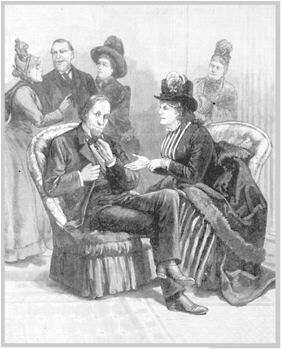
Even in 1888 lobbyists—in this case women meeting with senators in the Capitol’s Marble Room— attempted to sway votes on legislation. Today thousands of paid professionals work on behalf of their clients to influence bills in Congress. Library of Congress
Legislative Power
The power to make laws for the national government is vested by Article I, section 1, of the Constitution “in a Congress of the United States, which shall consist of a Senate and House of Representatives” (see House of representatives; Senate). The legislature’s power to enact laws was a basic assumption of the Framers of the Constitution. Unlike the unique creation of the presidency and the federal judiciary, the starting point for the creation of Congress was the historic role of the British Parliament as a supreme constitutional body. One major difference was that in Britain the electorate who periodically chose the members of the House of Commons, Parliament’s lower house, had only one function: to elect representatives to a legislative body in which all of the nation’s sovereignty resided.
In the United States, in contrast, the framers wanted the nation’s sovereignty to reside in the people, who delegated power first to those who ratified the Constitution and then, on a regular basis through the system created by the Constitution, to some of their fellow citizens to exercise the nation’s sovereignty on behalf of all citizens. The distinction is crucial, because Parliament in Britain is the final arbiter of that country’s unwritten constitution, whereas in the United States the three branches of government are each responsible for complying with the Constitution, with the judicial branch serving as the final interpreter of the document.
Congress’s many legislative powers are itemized in Article I, section 8, followed by the license “To make all Laws which shall be necessary and proper for carrying into Execution the foregoing Powers, and all other Powers vested by this Constitution in the Government of the United States, or in any Department or Officer thereof” (see Necessary and Proper Clause). The list begins with the power to “lay and collect Taxes, Duties, Imposts and Excises, to pay the Debts and provide for the common Defence and general Welfare of the United States” and enumerates other specific subjects for legislation: borrowing and coinage of money (see Currency), counterfeiting, bankruptcy, weights and measures, post offices (see Postal Power), roads, copyright and patents, establishment of federal courts, declaration of war, support of the armed forces, naturalization, and supervision of the seat of government.
The Constitution places some limits on which laws Congress may pass: (1) Because the federal government is based on specific powers authorized by the Constitution and ultimately determined by the Supreme Court, Congress cannot make laws in areas reserved to the states, such as inheritance of estates and distribution of property, or laws infringing states’rights. (2) The Constitution prohibits Congress from passing certain laws such as ex post racto laws and bills of attainder (see Attainder, Bills Of). (3) Congress is also prevented from enacting legislation that infringes on rights guaranteed by the Constitution to the citizens, such as laws abridging freedom of religion, speech, assembly and association, or the press.
...
Get a 30 day FREE TRIAL
-
 Watch videos from a variety of sources bringing classroom topics to life
 -
Read modern, diverse business cases
-
Explore hundreds of books and reference titles

Read next

More like this
Sage Recommends
We found other relevant content for you on other Sage platforms.
Have you created a personal profile? Login or create a profile so that you can save clips, playlists and searches