
Entry
Entries A-Z
Juries
Panels of citizens charged with passing judgment on a fellow citizen accused of breaking the law were used in ancient Greece, the cradle of democracy. The U.S. jury system, however, had its origins in the legal system that evolved in England. Magna Carta (1215), the charter of liberties forced on King John by his barons, provides in chapter 29: “No freeman shall be taken or imprisoned,…nor will we not pass upon him, nor [condemn him] but by lawful judgment of his peers, or by the law of the land.”
As Article III, section 2, of the Constitution requires, “The Trial of all Crimes, except in Cases of Impeachment, shall be by Jury….” The Sixth Amendment (1791) provides that “[i]n all criminal prosecutions, the accused shall enjoy the right to a speedy and public trial, by an impartial jury of the State and district wherein the crime shall have been committed….” In addition, the Seventh Amendment (1791) guarantees: “In Suits at common law, where the value in controversy shall exceed twenty dollars, the right of trial by jury shall be preserved, and no fact tried by a jury, shall be otherwise re-examined in any Court of the United States, than according to the rules of the common law” (see Common Law).
The jury system is an important aspect of guaranteeing the impartiality of trials. An affirmation of the use of juries that became a landmark in England’s legal history was Bushell’s Case (1670). William Penn, a Quaker who later founded the Pennsylvania colony in America, was arrested with an associate for preaching outside the Quaker meetinghouse in London, which had been officially closed. They were tried before a jury on the spurious charge of inciting a riot. Although the judge had threatened the jurors and detained them without food or heat to coerce a guilty verdict, Penn was acquitted by the jury, led by Edward Bushell. The judge fined and imprisoned the jurors for their obstinance. Eventually England’s lord chief justice intervened, saying that a judge “may try to open the eyes of the jurors, but not to lead them by the nose.” The 1735 case of Peter Zenger (see Zenger’s Case) in New York is a similar example of a resolute jury’s refusal to return a guilty verdict despite threats by the judge.
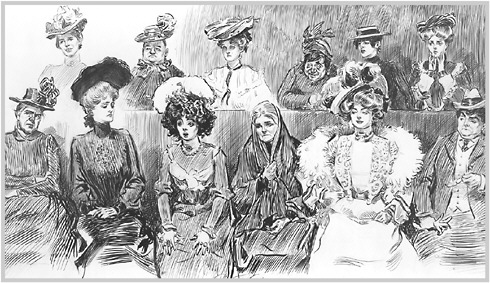
In the nation’s early years, female defendants were denied the constitutional right to a jury of their “peers” because women were barred from jury service. About 1902 Charles Dana Gibson captured the new jury system, complete with “Gibson Girls.” Library of Congress
Jurors
As used in Magna Carta, the term peers originally referred to people of equal social status who knew the accused and his or her character. In today’s more populous and anonymous society, this principle has taken a 180-degree turn: juries are instructed to be as impartial as possible, and anyone who personally knows the defendant is precluded from serving on a jury.
The Supreme Court has held that jurors must represent a cross section of the community and that discrimination is unconstitutional. In an early case, Strauder v. West Virginia (1880), the Court, relying on the equal protection clause of the Fourteenth Amendment (1868), overturned the conviction of an African American because a state law precluded blacks from serving on juries. A century later, in Peters v. Kiff (1972), the Court reversed the conviction of a white person because African Americans had been excluded from the jury, thus denying the defendant an impartial trial by a cross section of the community.
...
Get a 30 day FREE TRIAL
-
 Watch videos from a variety of sources bringing classroom topics to life
 -
Read modern, diverse business cases
-
Explore hundreds of books and reference titles

Read next

More like this
Sage Recommends
We found other relevant content for you on other Sage platforms.
Have you created a personal profile? Login or create a profile so that you can save clips, playlists and searches