
Entry
Entries A-Z
Jefferson,Thomas
At a 1962 White House dinner honoring forty-nine Nobel Prize winners, President John F. Kennedy (1917–63) paid tribute to a person not present: “This is the most extraordinary collection of talent, of human knowledge, that has ever been gathered in the White House—with the possible exception of when Thomas Jefferson dined alone.” The author of the Declaration of Independence (1776), the third president of the United States (1801–9), and the force behind the Louisiana Purchase in 1803, Jefferson (1743–1826) more than anyone else continues to epitomize the quintessential American.
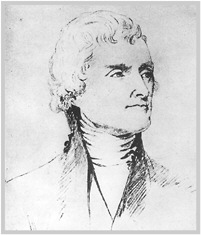
Thomas Jefferson was serving as the U.S. minister to France during the Constitutional Convention, but the views of the author of the Declaration of Independence influenced key delegates such as James Madison and Alexander Hamilton. Library of Congress
Born on April 13, 1743, in Albemarle County, Virginia—his father was one of the early settlers in the area—Thomas Jefferson entered the College of William and Mary at the age of seventeen. Having developed a special interest in the English constitution, he later studied law with George Wythe, who also taught him history, culture, and ethics. Admitted to the bar in 1767, Jefferson became a member of the Virginia legislature two years later. In addition to pursuing a career in politics, Jefferson became an accomplished musician, scientist, agriculturist, amateur architect, and philosopher, having developed for himself a philosophy centered on reason, progress, and improvement that was derived especially from the works of the Englishmen Francis Bacon (1561–1626), Isaac Newton (1642–1727), and John Locke (1632–1704).
Along with Benjamin Franklin (1706–90), Jefferson was among those who spearheaded the Enlightenment movement in America. In his first published work, A Summary View of the Rights of America (1774), he argued against Great Britain’s hegemony over the colonies. The following year he was made a delegate to the Second Continental Congress, where in 1776, as a member of a committee of five, he wrote the first draft of the Declaration of Independence. Jefferson was familiar with the Virginia Declaration of Rights (see pages 000–000), drafted by George Mason and adopted on June 12, 1776. Jefferson later also drafted the Statute of Virginia for Religious Freedom, enacted after much debate in 1786.
Jefferson served as governor of Virginia from 1779 to 1781, thereafter returning to the Congress, where he helped draft the Northwest Ordinance to guarantee political freedoms and eventual statehood for settlers in the country’s Northwest Territory, the sparsely settled upper region between the Ohio and Mississippi Rivers. Serving as the U.S. minister (ambassador) to France during the Constitutional Convention of 1787, he was neither a drafter nor a signer of the Constitution it produced. But his discussions with Alexander Hamilton and his close friendship with James Madison, delegates to the convention from New York and Virginia, respectively, ensured that his ideas influenced the shape of the new government. In a November 13, 1787, letter to the secretary of John Adams, Jefferson responded from France to the news of Shays’s Rebellion, a farmers’ uprising in Massachusetts that illustrated the need for a strong central government. “God forbid,” said the author of the Declaration of Independence, “we should ever be twenty years without rebellion….[T]he tree of Liberty must be refreshed from time to time with the blood of patriots & tyrants.”
...
Get a 30 day FREE TRIAL
-
 Watch videos from a variety of sources bringing classroom topics to life
 -
Read modern, diverse business cases
-
Explore hundreds of books and reference titles

Read next

More like this
Sage Recommends
We found other relevant content for you on other Sage platforms.
Have you created a personal profile? Login or create a profile so that you can save clips, playlists and searches