
Entry
Entries A-Z
House of Representatives
The House of Representatives is the most democratic of all the national government institutions because it is the most accountable—its members are elected directly by the people every two years. While the “principle of state independence prevailed in the shaping of the Senate,” observed the French political scientist Alexis de Tocqueville (1805–59) in Democracy in America (1835), “the dogma of national sovereignty [prevailed] in the composition of the House of Representatives.” The power and superiority of the lower house of Congress were also asserted by James Madison in essay 63 of The Federalist (1787–88) (see Federalist Papers). In the event of any attempted usurpation of power by the upper house, the Senate, said Madison, “[T]he House of Representatives, with the people on their side, will at all times be able to bring back the Constitution to its primitive form and principles.”

The term house to indicate a legislative body in England dates at least from the sixteenth century. Britain’s national legislature, known collectively along with the English monarch as Parliament, consists of an upper chamber, the House of Lords, and a lower chamber, the House of Commons. The House of Representatives is similar to the British House of Commons in that it includes representatives elected from electoral districts. It is dissimilar, however, in that the House of Commons selects the prime minister, who is the British head of government, and the cabinet, which together perform the executive functions for the government of the United Kingdom.
The House and the Senate constitute congress, the coequal legislative branch that works in concert with the executive branch, headed by the president, and the judicial branch, headed by the Supreme Court, to form the federal government (see Separation of Powers). Signifying Con-gress’s importance, the Constitution details the nation’s legislative framework in Article I.
Specialized duties for the House of Representatives are set forth there, most important being the power to initiate revenue bills, to bring charges of impeachment against government officials, and to elect the president when the electoral college fails to confer a majority. Members of the House are also mentioned in Article II with respect to the electors of the president and vice president, whose numbers mirror the total of each state’s representatives plus two senators to which each state is entitled. Like senators, however, representatives are excluded under Article II from being electors of the president and vice president in the electoral college. Several constitutional amendments also address the House of Representatives.
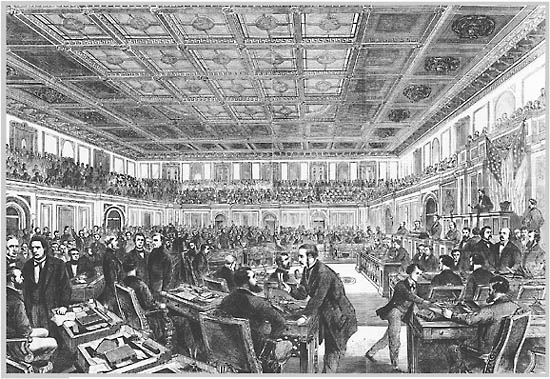
Special constitutional responsibilities of the House of Representatives include initiating revenue bills, bringing impeachment charges against government offcicials, and electing the pesident when the electoral college fails to produce a majority vote. Library of Congress
Structure of the House
“All legislative Powers herein granted,” states Article I, section 1, “shall be vested in a Congress of the United States, which shall consist of a Senate and House of Representatives.” As section 2 provides in the first clause, “The House of Representatives shall be composed of Members chosen every second Year by the People of the several States, and the electors in each State shall have the qualifications requisite for electors of the most numerous Branch of the State Legislature.”
...
Get a 30 day FREE TRIAL
-
 Watch videos from a variety of sources bringing classroom topics to life
 -
Read modern, diverse business cases
-
Explore hundreds of books and reference titles

Read next

More like this
Sage Recommends
We found other relevant content for you on other Sage platforms.
Have you created a personal profile? Login or create a profile so that you can save clips, playlists and searches