
Entry
Entries A-Z
Hamilton, Alexander
After the Constitution was adopted by the Constitutional Convention of 1787, Alexander Hamilton (1755–1804) commented: “The new constitution has in favour of its success these circumstances—a very great weight of influence of the persons who framed it, particularly in the universal popularity of General Washington,— the good will of the commercial interest throughout the states which will give all its efforts to the establishment of a government capable of regulating, protecting and extending the commerce of the Union—the good will of most men of property in the several states who wish a government of the union able to protect them against domestic violence and the depredations which the democratic spirit is apt to make on property….”
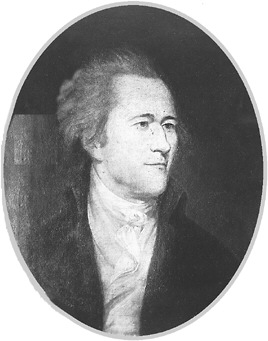
An unapologetic Federalist, Alexander Hamilton was the only member of the New York delegation to sign the Constitution, and afterward he was the major contributor to The Federalist (1787–88), promoting its ratification. Library of Congress
Hamilton, who was the lone New York delegate to the convention to sign the document, would soon join with John Jay and James Madison to write The Federalist (1787–88) (see Federalist Papers), a series of newspaper articles prepared in support of the Constitution’s ratification. Appointed by President George Washington to be the new nation’s first secretary of the Treasury, Hamilton became the leader of the Federalist Party, the country’s first political party (see Political Parties).
The illegitimate son of a Scotsman and a mother whose father was a French Huguenot doctor, Alexander Hamilton was born on the island of Nevis in the British West Indies on January 11, 1755. After working as a clerk in a trading firm between the ages of eleven and thirteen, he immigrated to New York City in 1773 and attended what would become Columbia University. Hamilton was active in supporting the cause of the American Revolution and then joined the Continental Army. An aide-de-camp to General Washington, he became the head of a line regiment at the decisive Battle of Yorktown in 1781.

“Were the people of America, with one voice, to ask, What shall we do to perpetuate our liberties and secure our happiness? The answer would be, ‘govern well.’ ”
—Alexander Hamilton, in Letter from Phocion, January 1–27, 1784
After serving in the Continental Congress, both Hamilton and James Madison urged the delegates to attend a conference in Annapolis, Maryland, in September 1786, on interstate trade problems. He wanted to recommend to the Congress that a national meeting be held to address the inadequacies of the Articles of Confederation (1781). At the Constitutional Convention held beginning in Philadelphia on May 25, 1787, Hamilton’s own proposal based on the British model of government found little support. As soon as the draft document was approved, however, he became an ardent proponent of its ratification by the thirteen states.
As the nation’s first secretary of the Treasury, Hamilton created the First National Bank of the United States to strengthen the country’s credit. Thomas Jefferson questioned the constitutionality of the new bank, and the two men would continue a philosophical rivalry until a duel with another political rival, Aaron Burr, ended Hamilton’s life on July 12, 1804.
...
Get a 30 day FREE TRIAL
-
 Watch videos from a variety of sources bringing classroom topics to life
 -
Read modern, diverse business cases
-
Explore hundreds of books and reference titles

Read next

More like this
Sage Recommends
We found other relevant content for you on other Sage platforms.
Have you created a personal profile? Login or create a profile so that you can save clips, playlists and searches