
Entry
Entries A-Z
Gideon v. Wainwright
If a cat can dare to speak to a king, can a petty thief teach the Supreme Court about the meaning of the Constitution? In 1963 Clarence Earl Gideon, charged with stealing coins from a vending machine along with a bottle of wine, dared to confront the nine berobed Supreme Court justices and challenge them on whether the Constitution guarantees the assistance of counsel to all citizens tried for a felony. “Although he did not know it, Clarence Earl Gideon was calling for one of those great occasions in legal history,” wrote Anthony Lewis in Gideon’s Trumpet. “He was asking the Supreme Court to change its mind.”

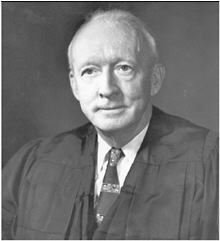
Hugo Black Collection of the Supreme Court of the United States
Hugo Black, who wrote the landmark ruling in Gideon v. Wainwright, was one of the most influential justices of the twentieth century—and also one of the more difficult to typecast. Neither a liberal nor a conservative, his strict reading of the Constitution led him to support civil rights and a strong federal government.
But he parted ways with liberal justices on such issues as privacy. In the 1965 case GrisWold v. Connecticut, Black was one of just two justices who voted to uphold the right of a state government to bar the use of contraceptives.
Black became especially noteworthy for his support of First Amendment rights. He was one of the few justices in the nation’s history who believed that First Amendment freedoms, such as speech and assembly, were so absolute that they could not be curtailed. When the government after World War II began prosecuting members of the Communist Party, Black claimed that the laws were a violation of the right to free speech. In a famous dissent in 1951 (Dennis v. United States), Black wrote:
“Public opinion being what it now is, few will protest the conviction of these Communist petitioners. There is hope, however, that, in calmer times, when present pressures, passions and fears subside, this or some later Court will restore the First Amendment liberties to the high preferred place where they belong in a free society.”
Black was vindicated by the end of the decade, when the justices began reining in government efforts to prosecute leading communists.
“In all criminal prosecutions,” states the Sixth Amendment (1791), “the accused shall enjoy the right…to have the Assistance of Counsel for his defence.” Since ratification of the Fourteenth Amendment (1868), the provisions of the Bill of Rights (1791)—originally applicable only to the national government—have been gradually incorporated by the Supreme Court to apply to the states as well through the amendment’s due process clause (see Incorporation Doctrine). Gideon v. Wainwright (1963) represents the incorporation of the Sixth Amendment’s right of counsel into the Fourteenth Amendment, making it applicable to the states for felonies.
Looking back over the cases that led up to Gideon, it is difficult to understand why the Supreme Court had such a hard time extending the right of counsel to all persons charged with possible loss of their life or liberty. In Powell v. Alabama (1932), the first of the two Scottsboro Cases, the Court held that due process of law required at the least a hearing to provide an opportunity to present both sides of a controversy for an impartial determination on the evidence. In his opinion for the Court in this case, Justice George Sutherland (1862–1942) went so far as to say that the presence of counsel is fundamental to any meaningful hearing (see Fundamental Rights). And in Johnson v. Zerbst (1938), the Court concluded that under the Sixth Amendment indigent felony defendants in federal cases must be provided with counsel. However, the Supreme Court was still reluctant to extend to criminal defendants in the states the Sixth Amendment’s guarantee of assistance of counsel. In Betts v. Brady (1942), the Court defended its action by contending that the states should not be “straitjacketed” and that only where denial of counsel demonstrated a fundamental lack of fairness would the justices overturn a conviction.
...
Get a 30 day FREE TRIAL
-
 Watch videos from a variety of sources bringing classroom topics to life
 -
Read modern, diverse business cases
-
Explore hundreds of books and reference titles

Read next

More like this
Sage Recommends
We found other relevant content for you on other Sage platforms.
Have you created a personal profile? Login or create a profile so that you can save clips, playlists and searches