
Entry
Entries A-Z
Framers of the Constitution
The fifty-five delegates who attended the Constitutional Convention of 1787 at the State House in Philadelphia did not set out to create a utopian state. They simply wanted to provide a means for securing the internal order and defense of the United States, removing trade barriers between the states, and ensuring a fiscally sound national government with limited powers that would not threaten the residual sovereignty of the states and the citizens.
On February 21, 1787, the Continental Congress invited the states to send delegates, who were chosen by various means, to the convention. Well educated for their time, they were knowledgeable about the history of Great Britain and the other major nations of the world. Many of them were financially well off, but some had suffered setbacks from the Revolutionary War (1775–83), postwar speculation, and the new nation’s uncertain economy under the Articles of Confederation (1781), which had been adopted as a basis for running the new confederation of the thirteen former British colonies. Most of the delegates owned considerable property, and thirty-five owned slaves.
Delegations came from twelve of the thirteen states to attend the four-month convention in Philadelphia beginning on May 25, 1787. Only Rhode Island, notorious for having a state government rife with corruption, did not send any delegates because it did not relish having a national government that would force it to put its political house in order. The framers signed the Constitution on September 17, 1787, according to state delegations in the order discussed, except for George Washington of Virginia, who as the president of the convention signed first. Delegates who did not sign the Constitution for political reasons or because they had to leave on personal business are indicated by an asterisk (*) after their name. Six delegates—George Clymer, Benjamin Franklin, Robert Morris, and James Wilson of Pennsylvania; George Read of Delaware; and Roger Sherman of Connecticut—were signers of both the Declaration of Independence (1776) and the Constitution.
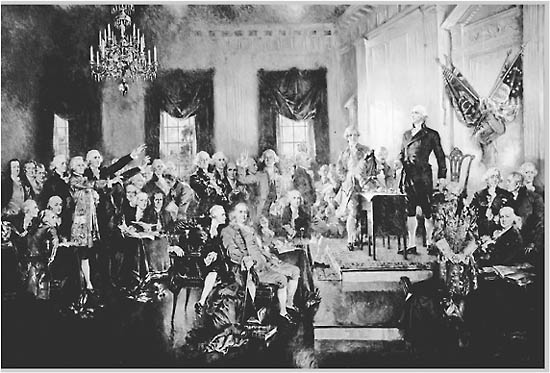
Howard Chandler Christy’s 1940 painting captures the signing of the Constitution on September 17, 1787. In front of George Washington, Benjamin Franklin is flanked by Alexander Hamilton and the “Father of the Constitution,” James Madison. Library of Congress
After thirty-nine of the fifty-five delegates signed the document, Washington sent a resolution transmitting the new document to the Congress, which on September 28 then transmitted it to the state legislatures so that the nation’s new Constitution could be debated and approved by special conventions in each state. Delaware became the first state to ratify the Constitution on December 7, 1787, followed by Pennsylvania on December 12, New Jersey on December 18, Georgia on January 2, 1788, Connecticut on January 9, Massachusetts on February 6, Maryland on April 28, and South Carolina on May 23. When New Hampshire became the ninth state to ratify on June 21, 1788, the document had obtained the sanction of three-fourths of the states as required under Article VII. Four days later Virginia gave its assent, followed by New York on July 26. The next year, North Carolina ratified the Constitution on November 21, 1789, and Rhode Island added its approval on May 29, 1790 (see Ratification).
...
Get a 30 day FREE TRIAL
-
 Watch videos from a variety of sources bringing classroom topics to life
 -
Read modern, diverse business cases
-
Explore hundreds of books and reference titles

Read next

More like this
Sage Recommends
We found other relevant content for you on other Sage platforms.
Have you created a personal profile? Login or create a profile so that you can save clips, playlists and searches