
Entry
Entries A-Z
Declaration of Independence
The American rebellion against British colonial rule that began in 1775 picked up steam as the result of two events in early 1776. The first was the publication of an incendiary pamphlet, Common Sense, written by a recent immigrant from England, Thomas Paine (1737–1809). In it Paine made the logical argument that to change the harsh treatment by the British it was time to move beyond protest and rebellion to revolution and independence. Around the same time, at the beginning of 1776, news reached America about the British Act of December 22, 1775, which prohibited all trade and intercourse with the thirteen colonies.
On January 31, 1776, George Washington, a still-loyal subject of the Crown, wrote: “A few more of such flaming arguments [for example, the burning of Norfolk, Virginia, blamed on the British], added to the sound doctrine and unanswerable reasoning contained in the pamphlet Common Sense, will not leave numbers at a loss to decide upon the propriety of a separation.”
In early May 1776, after hearing that George III was sending twelve thousand German mercenaries to quell the rebellion, a Virginia convention instructed its delegates to the Continental Congress “to declare the United Colonies free and independent states.” And on June 7, 1776, Richard Henry Lee of Virginia introduced in the Continental Congress a resolution declaring that the colonies “are, and of right ought to be, free and independent states, [and that] they are absolved from all allegiance to the British Crown…” (see Liberty).
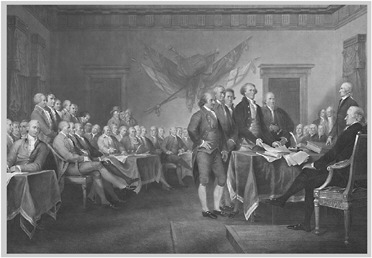
The signers of the Declaration of Independence, as depicted in this early nineteenth-century painting by John Trumbull. The painting features the members of the committee that drafted the document—John Adams, Roger Sherman, Robert Livingston, Thomas Jefferson (presenting the declaration), and Benjamin Franklin—standing in front of John Hancock, who was president of the Continental Congress. Library of Congress
On the basis of Lee’s resolution, seconded by James Madison, also of Virginia, a committee of five members headed by Thomas Jefferson was appointed to craft the sentiments contained in the resolution into a declaration of independence. The other committee members, who reviewed and edited Jefferson’s draft, were John Adams of Massachusetts, Benjamin Franklin of Pennsylvania, Robert R. Livingston of New York, and Roger Sherman of Connecticut. Among the changes to the draft was the deletion of Jefferson’s condemnation of the slave trade, which he called “an abominable commerce” (see Slavery).
The resolution for independence was adopted by the Continental Congress on July 2, 1776, which became the effective date of separation from Great Britain. The vote was twelve for and none against, with only New York abstaining. Two days later the Congress adopted the Declaration of Independence. The document was signed first by John Hancock of Massachusetts, president of the Congress, and Charles Thomson, its secretary. In all, fifty-eight colonists committed treason against the British Crown by signing the Declaration of Independence, which concludes, “we mutually pledge to each other our lives, our Fortunes, and our sacred Honor.” Six signers, including Franklin and Sherman, later signed the Constitution (see Framers of the Constitution).
...
Get a 30 day FREE TRIAL
-
 Watch videos from a variety of sources bringing classroom topics to life
 -
Read modern, diverse business cases
-
Explore hundreds of books and reference titles

Read next

More like this
Sage Recommends
We found other relevant content for you on other Sage platforms.
Have you created a personal profile? Login or create a profile so that you can save clips, playlists and searches