
Entry
Entries A-Z
Debt
On January 1, 1791, according to the U.S. Treasury Department’s Bureau of Public Debt, the national debt was $75,463,476.52; and as of October 15, 2007, it had risen to $9,042,951,429,732.49. Currently, with the U.S. population numbering approximately 303 million persons, each American’s share of the national debt is approximately $30,000. Although the debt, just over nine trillion dollars, is large, its significance to the American economy is not clear. Throughout its history, the United States has generally had an outstanding national debt. Yet such debt has not caused the economy to collapse or hampered long-term progress, at least compared with other countries.
In contrast, until 2001 the national budget had been running a surplus in recent years. The deficit is the difference between the government’s receipts (what it takes in from taxes and other types of revenues) (see Taxation) and its outlays (the amount it spends) in any one fiscal year (from October 1 to September 30). It is computed using on-budget items including tax revenues but excluding surpluses that come into the Treasury from various off-budget funds, such as Social Security trust funds, old-age and survivors insurance and disability insurance, and the Postal Service fund. The national debt is the total accumulated deficits in relation to on-budget items plus the surpluses in the Treasury from off-budget items.
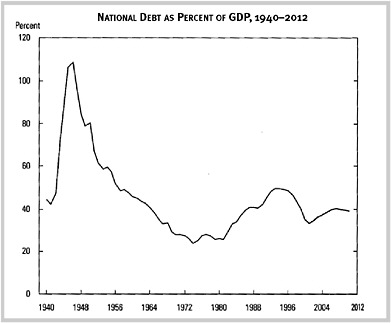
The national debt, which totaled about $43 billion (in current dollars) in 1940, is projected to reach $5.7 trillion in 2012. As a percentage of the nation’s gross national product, however, that portion of the national debt is declining from 44 to 32 percent. U.S. Office of Management and Budget, Budget of the United States Government, Fiscal Year 2008, Historical Tables (Washington, D.C.: Government Printing Office, 2007), 126–127.
Note: Amounts are in current dollars. Figures reflect debt held by the public and do not include debt held by federal government accounts. 2007–2012 percentages are estimates.
All national governments have to finance their activities from their tax revenues, by borrowing (through the sale of bonds, for example), and from other sources, including gifts to the government from citizens and other nations. Switzerland’s constitution (2000) mandates that “[t]he Confederation shall keep its long term expenditure and receipts in balance…[and] shall reduce the federal debt.” Similarly, Columbia’s constitution (1981, as amended) provides: “The domestic and foreign indebtedness of the nation and the territorial entities may not exceed their capacity of repayment. The law will regulate this matter.”
Of the several powers delegated by the U.S. Constitution to the federal government, set forth in Article I, section 8, the first two relate directly to money and debt. Section 8 begins: “The Congress shall have Power To lay and collect Taxes, Duties, Imposts and Excises, to pay the Debts and provide for the common Defence and general Welfare of the United States…[and] To borrow Money on the credit of the United States.” The Constitution places no limit on the amount of indebtedness the United States can incur. The government’s debt is owned by various investors who have lent money to the government through the purchase of U.S. government securities: the general public (through savings bonds, for example), federal reserve banks, foreign investors, and corporations.
...
Get a 30 day FREE TRIAL
-
 Watch videos from a variety of sources bringing classroom topics to life
 -
Read modern, diverse business cases
-
Explore hundreds of books and reference titles

Read next

More like this
Sage Recommends
We found other relevant content for you on other Sage platforms.
Have you created a personal profile? Login or create a profile so that you can save clips, playlists and searches