
Entry
Entries A-Z
Copyright
A creator’s right in a literary work or another original product executed in a tangible medium of expression is recognized and enforceable under the law as a copyright. Copyright law can be traced back to England’s Statute of Anne (1710), which acknowledged the royal prerogative to bestow a monopolistic privilege on the authors of books, thus granting them the sole right to publish their works for a designated period of time. Today most nations, in addition to the United States, have constitutional provisions or other laws regarding copyrights; both Germany’s constitution (1949) and Ethiopia’s (1996), for example, have such provisions. Copyright laws have also been the subject of some regional and international agreements, including the Universal Copyright Convention (1952), which was revised in 1971 and entered into force in 1974.
“The Progress of Science and Useful Arts”
At the time the U.S. Constitution was drafted in 1787, copyright privileges in the United States, as in Great Britain, were rooted in common law. However,the Framers of the Constitution gave to the federal government the power to make consistent and effectual laws regarding copyrights and patents. Article I, section 8, provides that Congress has the power, among other responsibilities, “[t]o promote the Progress of Science and useful Arts, by securing for limited Times to Authors and Inventors the exclusive Right to their respective Writings and Discoveries.” In essay 43 of The Federalist (1787–88) (see Federalist Papers), James Madison defended this change, noting that under the Articles of Confederation (1781–89) individual states were unable to “make effectual provision” for either copyrights or patents. Nearly two centuries later the Supreme Court in Mazer v. Stein (1954) reaffirmed that the purpose of this provision was to encourage “individual effort by personal gain [and] to advance public welfare through the talents of authors.”
The nature of copyright laws under the new Constitution was the subject of a significant early Supreme Court case, Wheaton v. Peters (1834), which involved two reporters of Supreme Court decisions. Wheaton accused Peters of infringing his copyright in twelve volumes of his reports, but Peters argued that Wheaton had not complied with all the federal copyright law requirements to secure his copyright in those volumes. Wheaton’s defense was that common-law copyright still obtained and that any laws passed by Congress only added rights to the commonlaw rights he already possessed. The Court found for Peters on the basis that no federal common law of copyright existed at the time and that whatever rights Wheaton might be entitled to had to be secured according to Article I, section 8, solely under the acts of Congress.
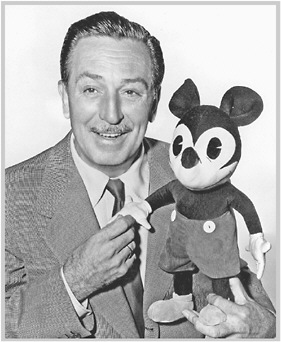
Walt Disney with his creation, Mickey Mouse, in the 1940s. In 1998 Congress added twenty years to the copyright limit, extending protection for any work created in or after 1923, which just happens to be the year of Mickey’s “birth.” Rue des Archives/The Granger Collection, New York
Intellectual Property
Copyright protection in the United States extends to various types of original works, including literary, musical, dramatic, choreographic, pictorial, graphic, architectural, and sculptural creations, as well as recordings and photographs. Despite the language in the Constitution regarding “Discoveries,” some things—ideas, procedures, principles, and even discoveries—may not be copyrighted according to the Copyright Act (1976, revised 1978). This act set the length of a copyright generally at the life of the author plus fifty years. In 1998 Congress added the Sonny Bono Copyright Term Extension Act (CTEA), which extended the copyright period for another twenty years. This extension was challenged in the U.S. Court of Appeals for the District of Columbia on the grounds that it keeps copyrighted materials out of the public domain for too long, but a three-judge panel disagreed. The Supreme Court, in Eldred v. Ashcroft (2003), also found that CTEA did not go beyond the language in the Constitution that provides that copyrights and patents may be granted “for limited Times” and, thus, was not unconstitutional.
...
Get a 30 day FREE TRIAL
-
 Watch videos from a variety of sources bringing classroom topics to life
 -
Read modern, diverse business cases
-
Explore hundreds of books and reference titles

Read next

More like this
Sage Recommends
We found other relevant content for you on other Sage platforms.
Have you created a personal profile? Login or create a profile so that you can save clips, playlists and searches