
Entry
Entries A-Z
Census
For purposes of taxation, both the citizens of ancient Rome and their property were registered in a census, an official enumeration of persons in a nation or another political subdivision. In England, the revenue of the Crown was based on the census regalis (royal census). Today nearly all countries provide for some regular means of counting their population.
The U.S. Constitution specifies in Article I, section 2, that a census “shall be made within three Years after the first Meeting of the Congress of the United States [1789], and within every subsequent Term of ten Years, in such Manner as they shall by Law direct.” The accuracy of the census was originally important for ensuring both fair proportional taxation of the states and fair proportional representation in the House of Representatives (see Reapportionment). Today census data are constitutionally required only for the latter purpose. The U.S. Census Bureau, an agency within the Department of Commerce, bears the primary responsibility for conducting the census at the start of each decade.
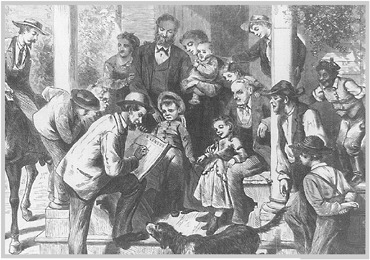
In this 1870 engraving from Harper’s Weekly, a census taker collects information from a diverse group of people, including an African American. Two years earlier, the Fourteenth Amendment allowed former slaves to be counted as individuals for the first time. Library of Congress
At the time the Constitution was written, the purpose and extent of the census were stated in Article I, section 2: “Representatives and direct Taxes shall be apportioned among the several States which may be included within this Union, according to their respective Numbers, which shall be determined by adding to the whole Number of free Persons, including those bound to Service for a Term of Years, and excluding Indians not taxed, three fifths of all other persons [slaves].” This provision was affected by two subsequent constitutional amendments. The Thirteenth Amendment (1865) prohibited slavery, and the Fourteenth Amendment (1868) changed the language of Article I, section 2, so that former slaves were thereafter to be counted as single persons. According to section 2 of the amendment, “Representatives shall be apportioned among the several States according to their respective numbers, counting the whole number of persons in each State, excluding Indians not taxed.”
James Madison, in essay 54 of The Federalist (1787–88) (see Federalist Papers), pointed out one of the clever checks and balances built into the census provisions. “As the accuracy of the census to be obtained by the Congress will necessarily depend, in a considerable degree, on the disposition, if not the co-operation of the States,” he wrote, “it is of great importance that the States should feel as little bias as possible to swell or to reduce the amount of their numbers. Were their share of representatives alone to be governed by this rule, they would have an interest in exaggerating their inhabitants. Were the rule to decide their taxation alone, a contrary temptation would prevail. By extending the rule to both objects, the States have opposite interests which will control and balance each other and produce the requisite impartiality.”
Get a 30 day FREE TRIAL
-
 Watch videos from a variety of sources bringing classroom topics to life
 -
Read modern, diverse business cases
-
Explore hundreds of books and reference titles

Read next

More like this
Sage Recommends
We found other relevant content for you on other Sage platforms.
Have you created a personal profile? Login or create a profile so that you can save clips, playlists and searches