
Entry
Entries A-Z
Assembly and Association
The First Amendment (1791) prohibits Congress from making any law “abridging…the right of the people peaceably to assemble, and to petition the Government for a redress of grievances.” The right of association is not expressly mentioned but has been established as a constitutional right through a series of Supreme Court cases. The right to petition can be traced to the English Bill of Rights (1689), which mandates “the right of the subjects to petition the King….” Today the constitutions of many countries and international human rights documents such as the International Covenant on Civil and Political Rights (1966) explicitly guarantee the right of peaceful assembly and association as both political and civil fundamental rights of the people.
Assembly as a Constitutional Right
The Framers of the Constitution had direct experience with government suppression of peaceful assemblies by citizens protesting government policies and actions. Governments, however, do have legitimate concerns that an assembly that begins peacefully may quickly turn into a violent mob. William Blackstone (1723–80), the commentator on English common law, described an unlawful assembly as three or more persons coming together to do an unlawful act.
However, popular democracy, based on the political sovereignty of citizens, not only must condone peaceful assembly, especially for political purposes, but also must guarantee this right if the people’s voices are to be heard by those elected to govern. In United States v. Cruikshank (1876), the first freedom of assembly case to come before the Supreme Court, the Court stated: “The very idea of a government, republican in form, implies a right on the part of its citizens to meet peaceably for consultation in respect to public affairs and to petition for a redress of grievances.” In De Jonge v. Oregon (1937), the Court declared: “[P]eaceable assembly for lawful discussion cannot be made a crime….”
Even in the United States, government abuses of freedom of assembly have occurred. Before ratification of the Nineteenth Amendment (1920), peaceful supporters of women’s suffrage were often harassed by the police or arrested simply for exercising their well-established constitutional right of assembly (see Women), as were Vietnam War protesters in the 1960s and 1970s. In 2001 a group planning to protest the inauguration of George W. Bush challenged a District of Columbia law barring speech without permission from the police, and a District Court judge prohibited enforcement of the law as unconstitutional.
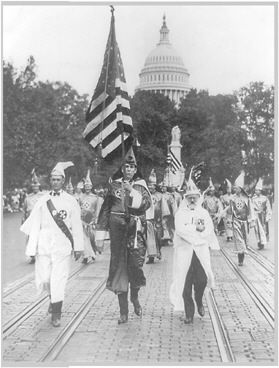
Flags unfurled, the Klu Klux Klan exercises its First Amendment right to peaceably assemble in a 1926 parade in Washington, D.C., one of many the Klan has sponsored. Library of Congress
Association as a Fundamental Right
Freedom of association as a constitutional right is derived from both freedom of assembly and freedom of speech and is recognized in two forms by the courts. Freedom of intimate association refers to relationships such as marriage, while expressive association is generally for the purposes of mutually furthering political, economic, religious, and cultural objectives. “Better use has been made of association and this powerful instrument of action has been applied to more varied aims in America than anywhere else in the world,” observed Alexis de Tocqueville in his famous treatise Democracy in America (1835).
...
Get a 30 day FREE TRIAL
-
 Watch videos from a variety of sources bringing classroom topics to life
 -
Read modern, diverse business cases
-
Explore hundreds of books and reference titles

Read next

More like this
Sage Recommends
We found other relevant content for you on other Sage platforms.
Have you created a personal profile? Login or create a profile so that you can save clips, playlists and searches